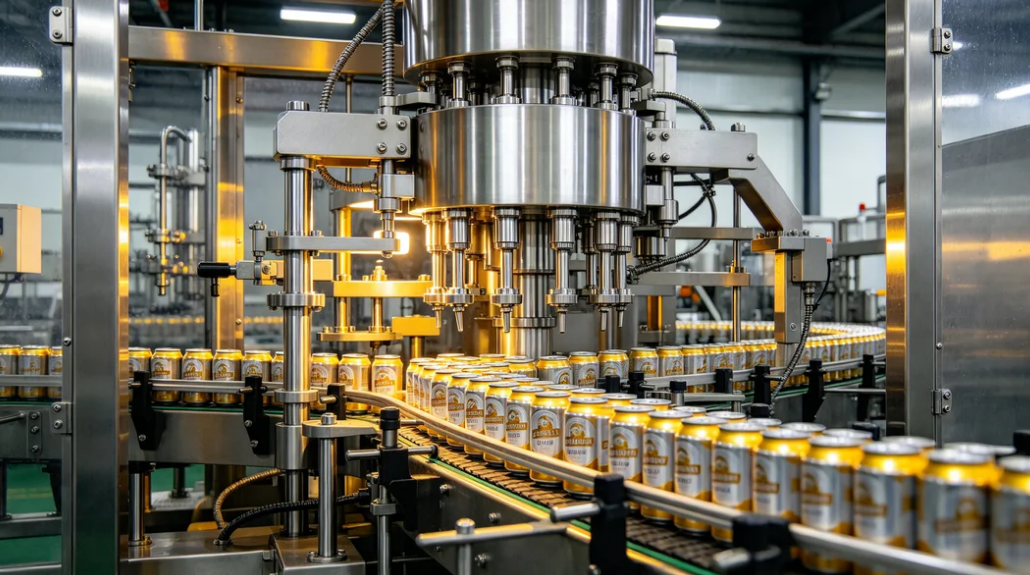
A suitable beer canning machine helps breweries maintain beer quality, reduce packaging labor, and increase production efficiency. Before purchasing, buyers should compare filling capacity, oxygen control, sealing quality, can-size compatibility, and automation level rather than focusing only on the advertised speed. The best choice depends on current production volume, available floor space, packaging requirements, and future expansion plans. By evaluating the complete canning process, breweries can invest in equipment that supports consistent product quality and reliable long-term operation.
What Types of Beer Canning Machines Can Buyers Choose?
The right beer canning machine depends on the brewery’s production scale and packaging workflow. Small breweries may benefit from compact equipment, while growing and industrial breweries often require integrated automatic lines.
Semi-Automatic Beer Canning Machines
Semi-automatic machines suit craft breweries, taprooms, and small beverage producers. Operators may need to position cans, initiate filling, or manage certain packaging steps manually. These machines generally require less initial investment and floor space than fully automatic systems.
However, labor requirements increase as production grows. Buyers should confirm whether the equipment supports their preferred can formats and whether additional rinsing, coding, and labeling equipment is needed.
Fully Automatic Beer Canning Lines
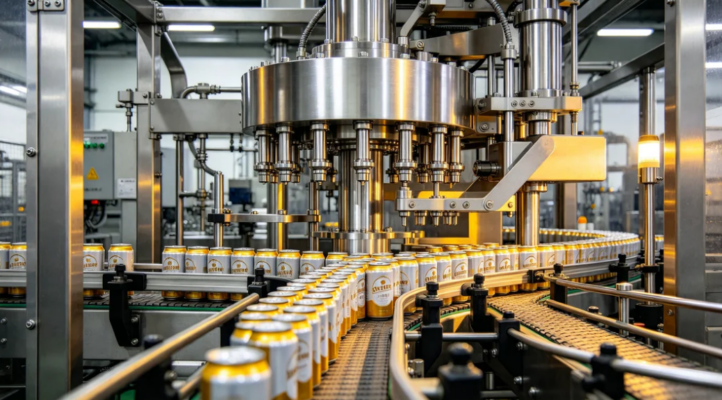
Fully automatic lines integrate filling and seaming with conveyors and, depending on the configuration, rinsing, drying, date coding, and labeling. Automation reduces repetitive handling and helps maintain consistent production when the equipment is correctly configured.
A complete line must be evaluated as a system. Its actual output depends on the performance of each stage, and the slowest machine can limit the entire packaging process.
Which Specifications Matter Most When Buying a Beer Canning Machine?
Buyers should prioritize measurable performance specifications because they directly affect production efficiency, packaging quality, and operating costs.
| Parameter | Semi-Automatic Machine | Fully Automatic Line |
|---|---|---|
| Typical application | Small breweries and pilot production | Growing and high-volume breweries |
| Indicative output | Approximately 300–1,000 cans/hour | Approximately 1,000–several thousand cans/hour, depending on configuration |
| Labor requirement | More manual intervention | Lower routine handling requirements |
| Filling method | Depends on model; counter-pressure is preferred for carbonated beer | Counter-pressure filling is common for commercial beer |
| Can-size compatibility | Often limited by supplied change parts | Depends on filling and seaming specifications |
| Integration | May require separate packaging equipment | Can integrate rinsing, drying, coding, and labeling |
| Initial investment | Generally lower | Generally higher |
| Best purchasing priority | Simplicity and affordability | Consistent output and automation |
These figures are indicative planning ranges, not guaranteed performance specifications. Request a supplier’s rated and demonstrated output for your exact can size and beer type.
Why Is Filling Accuracy Important?
Accurate filling helps reduce product giveaway and maintain consistent package volumes. Buyers should ask about fill-level control, repeatability, and how the machine handles foam during operation.
For carbonated beer, counter-pressure filling is commonly used to help preserve carbonation and control foaming. Actual performance also depends on beer temperature, carbonation level, pressure settings, and operator procedures.
How Does Seaming Quality Affect Beer Shelf Life?
Reliable seaming protects beer against leakage and external contamination. Even a machine with impressive filling speed can create costly problems if its seaming system produces inconsistent closures.
Ask the manufacturer about compatible can ends, seam adjustment procedures, inspection methods, and replacement-part availability. Before accepting the equipment, conduct trial runs and verify seam quality using the appropriate inspection procedures.
How Can Buyers Match Machine Capacity to Brewery Demand?
The best machine capacity should accommodate current sales while leaving reasonable room for growth. Purchasing an oversized system can increase capital and operating costs, while an undersized machine may restrict future expansion.
Estimate weekly packaging demand, operating hours, changeover frequency, and expected seasonal peaks. Then compare these requirements with the machine’s demonstrated output rather than relying exclusively on its maximum rated speed.
Buyers should also consider downtime for cleaning, maintenance, and product changeovers. A machine that runs quickly but takes considerable time to prepare may deliver less finished product per shift than expected.
What Additional Features Should Buyers Check Before Ordering?
The right supporting features can improve hygiene, traceability, and day-to-day usability.
- Sanitation: Check whether product-contact parts are easy to clean and whether the cleaning procedure suits brewery hygiene requirements.
- Can compatibility: Confirm the diameter, height, and format of every planned can, including future packaging sizes.
- Date coding: Verify that the coding system can print production dates, batch numbers, or other required information.
- Electrical requirements: Confirm voltage, phase, total power consumption, compressed-air requirements, and installation conditions.
- Maintenance support: Ask about spare parts, operator training, warranty coverage, and remote or on-site technical support.
A complete quotation should identify which equipment stages are included. This prevents buyers from discovering after installation that conveyors, coding machines, or other essential components must be purchased separately.
How Should Buyers Compare Beer Canning Machine Suppliers?
A reliable supplier should provide clear technical documentation and explain how the proposed configuration meets the brewery’s production targets.
Request a detailed quotation, equipment layout, utility requirements, commissioning plan, and list of included accessories. If possible, arrange a factory acceptance test using the intended can format and verify filling performance, sealing quality, and operating stability.
Buyers importing equipment should also confirm which safety and conformity documents apply in their destination market. Documentation requirements vary by country, so certification claims should be checked against the actual equipment and applicable regulations.
Ultimately, the lowest purchase price does not always represent the best value. Maintenance costs, spare-part availability, labor requirements, and expected downtime should all be included when comparing suppliers.
Frequently Asked Questions
1. What Is the Best Beer Canning Machine for a Small Brewery?
A compact or semi-automatic machine may be suitable for a small brewery with limited packaging demand. Buyers should prioritize dependable filling, consistent seams, straightforward cleaning, and the ability to handle their chosen can sizes.
2. Is Counter-Pressure Filling Necessary for Beer?
Counter-pressure filling is widely used for carbonated beer because it helps maintain pressure and reduce excessive foaming. Buyers should confirm that the selected system suits their beer carbonation level and production requirements.
3. Can One Beer Canning Machine Handle Different Can Sizes?
Some machines support multiple can formats, but additional change parts or adjustments may be required. Confirm compatible can diameters, heights, ends, and changeover procedures before ordering.
4. What Information Is Needed to Request a Beer Canning Machine Quote?
Provide your target output per hour, beer type, carbonation level, can dimensions, available utilities, factory space, and preferred automation level. These details help the manufacturer recommend a suitable configuration and prepare a more accurate quotation.
