
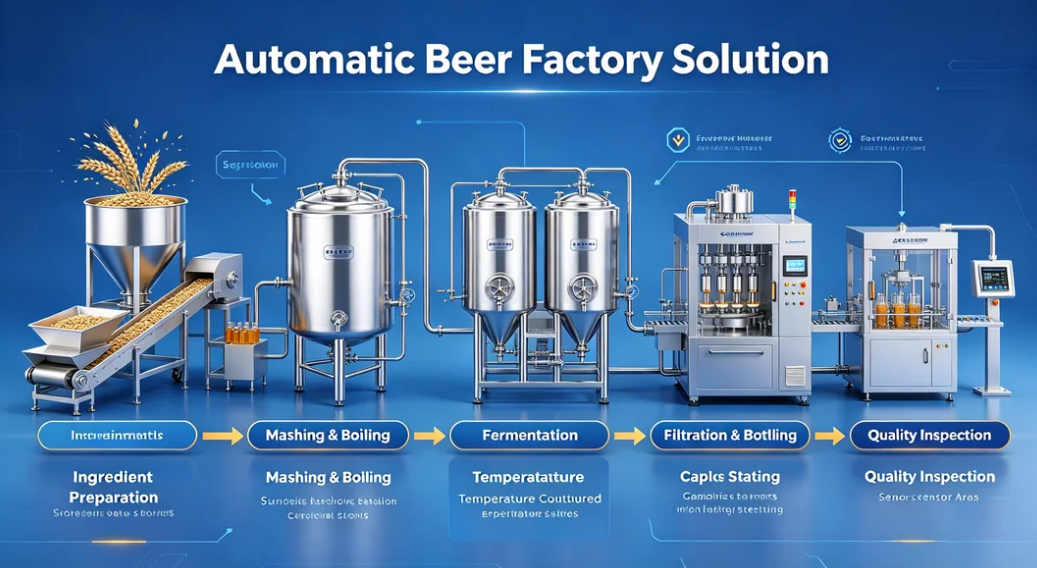
Choosing between a manual brewery and an automatic beer factory solution depends on production volume, labor availability, budget, and long-term business goals. Manual brewing systems offer greater hands-on control and may suit smaller breweries, while automated systems help commercial producers improve process consistency, reduce repetitive work, and coordinate multiple production stages. Before investing, buyers should compare equipment configuration, operating requirements, maintenance costs, and expansion potential. The right solution is not necessarily the most automated one, but the system that matches the brewery’s actual production needs.
What Is the Difference Between a Manual Brewery and an Automatic Beer Factory Solution?
The main difference is how brewing operations are monitored and controlled. A manual brewery relies more heavily on operators to adjust equipment and manage individual production steps. An automatic beer factory solution uses sensors, control panels, and programmable systems to monitor key parameters and coordinate selected processes.
In a manual brewery, experienced brewers can make adjustments directly according to recipes and production conditions. This approach provides flexibility, but results may depend more on operator skills and consistent procedures.
An automated system can manage selected operations through programmed settings, including temperature control, process timing, and equipment coordination. Automation does not eliminate the need for skilled staff, but it can reduce repetitive tasks and help maintain consistent operating conditions.
Which Brewery Equipment Is Required for Each System?
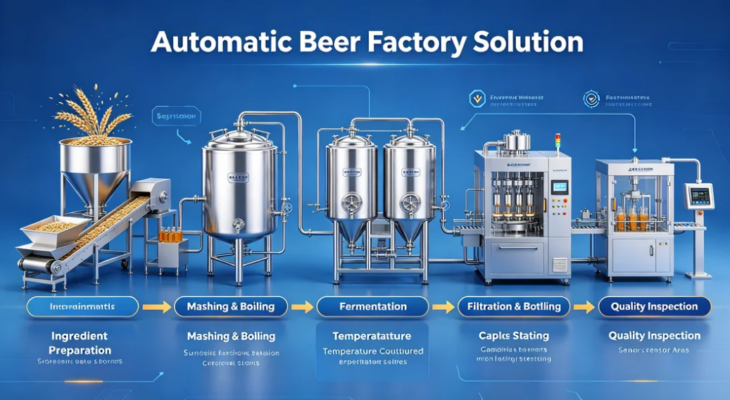
Both manual and automatic breweries require equipment for brewing, fermentation, cooling, cleaning, and packaging. The main difference is the level of automation, control integration, and supporting equipment included in the complete system.
A typical commercial brewery may include:
- Brewhouse equipment: Mash, lauter, boil, and whirlpool vessels for wort production.
- Fermentation tanks: Vessels for fermentation and maturation under controlled conditions.
- Bright beer tanks: Equipment for conditioning, carbonation, and temporary storage before packaging.
- Cooling systems: Glycol chillers and related components for temperature management.
- CIP systems: Cleaning equipment for maintaining appropriate sanitation procedures.
- Control systems: Manual controls or automated panels, sensors, and programmable logic controllers.
- Packaging equipment: Bottling, canning, or kegging equipment suited to the brewery’s distribution needs.
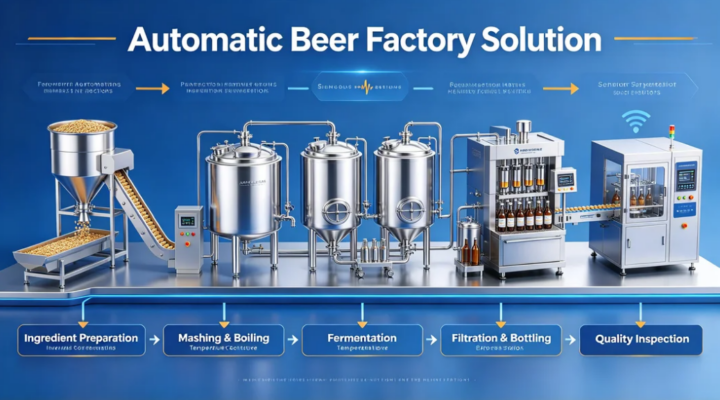
Manual systems may use simpler control arrangements, whereas automatic solutions can integrate multiple equipment sections into a coordinated production workflow. The exact configuration depends on batch size, beer styles, available space, and the desired automation level.
How Do Manual and Automatic Brewery Systems Compare?
The following comparison helps buyers evaluate which system better suits their operating requirements. Actual specifications and costs vary by manufacturer and project configuration.
| Comparison Factor | Manual Brewery | Automatic Beer Factory Solution |
|---|---|---|
| Process control | Primarily operator-managed | Automated control for selected processes |
| Initial investment | Generally lower | Generally higher |
| Labor requirements | More hands-on operation | Less repetitive manual intervention |
| Batch consistency | Depends heavily on operating procedures | Supports repeatable process settings |
| Production monitoring | Manual checks and records may be required | Can provide centralized monitoring and data recording |
| Equipment integration | Often simpler or more independent | Can coordinate multiple production sections |
| Maintenance | May involve simpler controls | May require additional sensor and control-system expertise |
| Expansion potential | Depends on equipment layout and upgrades | Can support integrated expansion when planned properly |
| Suitable application | Smaller operations and flexible production | Growing breweries and more complex commercial operations |
These differences are general guidelines rather than guarantees. A well-managed manual brewery can produce excellent beer, and an automated system still requires proper maintenance, calibration, and quality control.
How Does Automation Improve Brewery Production Efficiency?
Automation can improve efficiency by reducing repetitive adjustments and making important process parameters easier to monitor. For example, automated temperature control can help maintain programmed mashing conditions, while process timing and monitoring functions can help operators follow established recipes more consistently.
Integrated control systems may also improve coordination between brewing, cooling, and fermentation operations. When equipment status and process information are easier to access, operators can identify production delays and respond more quickly.
However, automation alone cannot compensate for poor equipment design or inadequate production planning. Buyers should assess whether the proposed system addresses specific operational challenges rather than paying for functions they do not need.
How Should Buyers Choose the Right Automation Level?
The best automation level should reflect the brewery’s production targets, staffing arrangements, and available investment. Smaller breweries may benefit from a partially automated system that simplifies temperature management while retaining manual control over other tasks.
Growing commercial breweries may need more integrated controls to coordinate larger batches, multiple fermentation tanks, and repeated production schedules. Buyers should consider not only current output but also anticipated demand over the next several years.
Before making a decision, evaluate the following factors:
- Expected daily and annual beer production.
- Number of batches and beer varieties.
- Available operators and their technical experience.
- Factory floor space and utility capacity.
- Budget for equipment, installation, and training.
- Availability of spare parts and technical support.
- Potential upgrades to fermentation, cooling, and packaging capacity.
A modular configuration can be useful when a brewery wants to begin with essential automation and add further functions as production grows.
What Should Buyers Check Before Ordering a Brewery System?
Buyers should request a detailed technical proposal before placing an order. The proposal should specify vessel capacities, materials, control functions, utility requirements, equipment connections, and the scope of installation and commissioning.
It is also important to compare total ownership costs rather than purchase prices alone. Electricity consumption, cleaning requirements, spare parts, maintenance, and operator training can affect the long-term economics of a brewery system.
Ask the manufacturer to explain which operations are automated and which still require manual intervention. If possible, review a control-system demonstration and request references for installations with similar production requirements.
Finally, confirm warranty coverage, documentation, delivery arrangements, and after-sales service. A suitable supplier should be able to explain how the proposed equipment configuration supports your production goals and future expansion plans.
Frequently Asked Questions
1. Is a Manual Brewery Cheaper Than an Automatic Brewery?
A manual brewery generally has a lower initial equipment cost because it may require fewer sensors, control components, and automation functions. However, buyers should also account for labor, operating procedures, and the cost of future upgrades when comparing total ownership costs.
2. Does an Automatic Beer Factory Solution Improve Beer Quality?
Automation can help maintain repeatable temperatures, timings, and other process parameters. These functions support consistency, but beer quality still depends on ingredients, recipes, sanitation, fermentation management, and operator expertise.
3. Can a Manual Brewery Be Upgraded to an Automatic System?
Yes, some manual systems can be upgraded with additional sensors, automated valves, temperature controllers, or integrated control panels. The feasibility and cost depend on the existing equipment design, wiring, and process configuration, so buyers should discuss upgrade options with the manufacturer before purchasing.
4. Which System Is Better for a Growing Commercial Brewery?
An automatic or partially automated system may be more suitable when production volume, labor coordination, and process monitoring become increasingly demanding. The best choice depends on the brewery’s output targets, budget, staffing, and expansion plans rather than automation level alone.
