
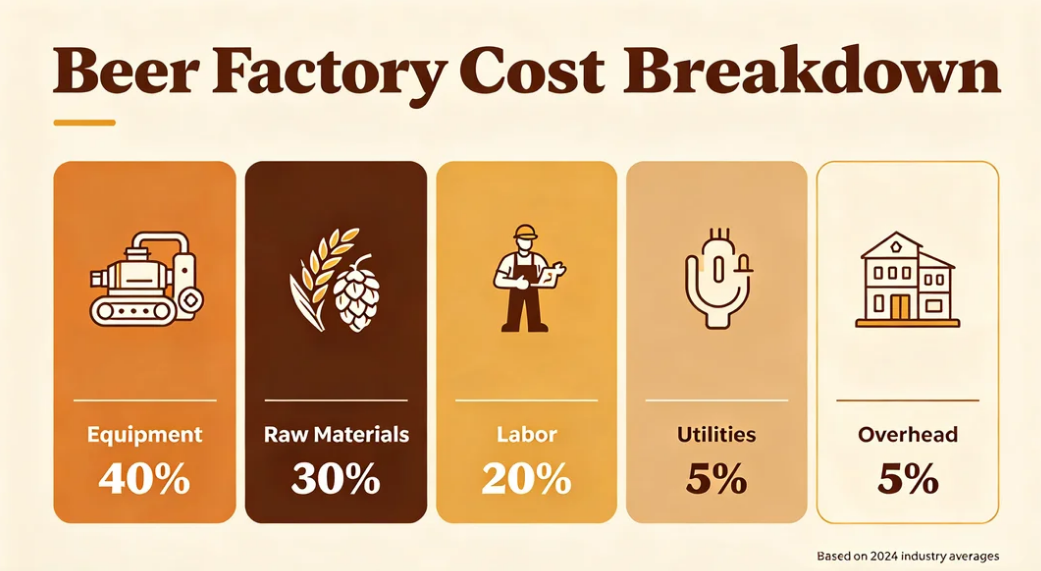
Investing in a commercial brewery requires more than purchasing brewing machines. Beer factory cost depends on production capacity, equipment configuration, automation, installation, utilities, and packaging requirements. Buyers can control their initial investment by defining production targets, comparing complete equipment specifications, and planning for future expansion. A well-designed brewery system should balance equipment quality, operating efficiency, and long-term production needs rather than simply choosing the lowest quotation.
What Does Beer Factory Cost Include?
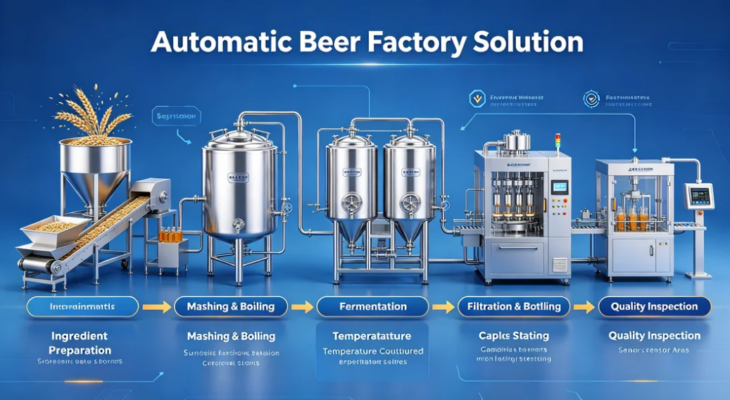
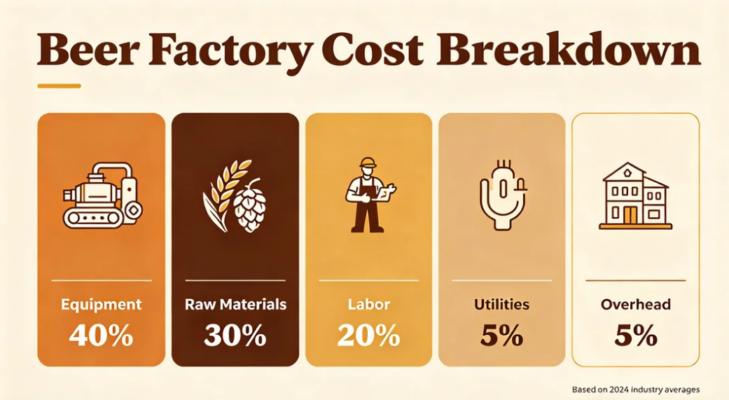
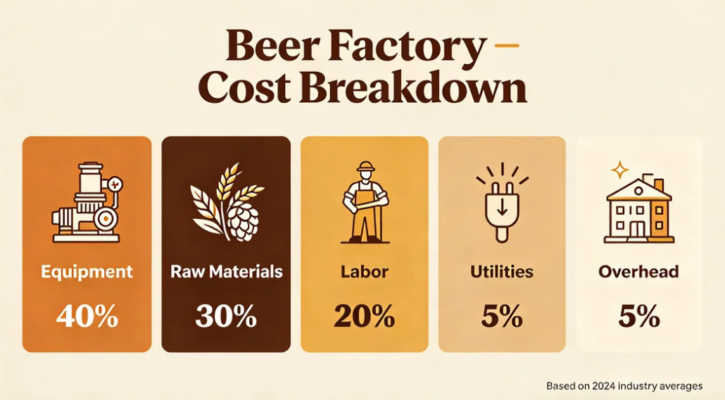
The total beer factory cost includes the equipment needed to produce, ferment, store, and package beer, together with the infrastructure required to operate the brewery. Understanding these cost categories helps buyers prepare a realistic investment budget.
The main expenses generally include:
- Brewing equipment: Mash tuns, lauter tuns, brew kettles, whirlpool vessels, and hot liquor tanks.
- Fermentation equipment: Fermentation tanks, bright beer tanks, and temperature control systems.
- Auxiliary equipment: Pumps, sanitary pipelines, cooling systems, water treatment equipment, and cleaning systems.
- Packaging machinery: Bottling, canning, or keg filling equipment, depending on the distribution model.
- Installation and commissioning: Transportation, equipment assembly, electrical connections, piping, and technical support.
- Facility preparation: Drainage, ventilation, water supply, electrical capacity, and other building modifications.
Buyers should request an itemized quotation covering these categories. Comparing complete project scopes provides a more reliable picture of the actual investment than comparing individual machine prices.
How Does Brewing Capacity Affect Beer Factory Cost?
Production capacity is one of the most important factors determining the initial investment. Larger systems generally require more substantial vessels, greater heating and cooling capacity, and additional fermentation and packaging resources.
However, buyers should distinguish between brewhouse batch volume, daily brewing capacity, and annual finished-beer output. These measurements are not interchangeable because fermentation time, brewing schedules, cleaning cycles, and equipment utilization all influence actual production.
For example, HGMC offers a 500L-per-day microbrewery model, while its available model options range from 600L to 5,000L per day. The appropriate configuration depends on the brewery’s production targets and operating conditions.
Which Brewery Capacity Is Suitable for Your Business?
The following table provides an illustrative comparison of common commercial brewery planning levels. The equipment configurations are planning examples, not fixed manufacturer specifications or price quotations.
| Planning factor | Small commercial brewery | Growing craft brewery | Larger commercial brewery |
|---|---|---|---|
| Illustrative daily capacity | 500–1,000L | 1,000–3,000L | 3,000–5,000L or more |
| Brewhouse configuration | 2-vessel | 2- or 3-vessel | 3- or 4-vessel |
| Fermentation setup | Basic tank group | Multiple fermenters | Expanded fermentation cellar |
| Heating options | Electric, steam, or direct fire | Based on utility availability | Based on energy demand |
| Automation | Manual or semi-automatic | Semi-automatic or automatic | Automation tailored to workflow |
| Packaging | Keg or small filling line | Keg, bottle, or can | Higher-throughput packaging line |
The table illustrates how equipment scope can change as production requirements grow. Buyers should obtain project-specific quotations after confirming their batch volume, brewing frequency, beer styles, and packaging targets.
Which Equipment Specifications Have the Biggest Impact on Cost?
Equipment specifications influence both purchase price and long-term operating performance. Selecting the correct vessel configuration, material grade, and control system can help prevent unnecessary expenditure.
How Does Brewhouse Configuration Affect Investment?
A two-vessel brewhouse is often suitable for smaller operations with relatively straightforward production schedules. A three-vessel system provides additional process flexibility, while a four-vessel arrangement can support more parallel operations when production demand justifies the extra investment.
More vessels do not automatically mean better efficiency. Buyers should evaluate brewing frequency, available floor space, labor requirements, and expected output before selecting a configuration.
Should Buyers Invest in Automatic Brewing Equipment?
Automation can improve process consistency and reduce repetitive manual work, but it also increases the initial equipment and integration requirements.
Manual systems may be appropriate for smaller breweries with experienced operators. Semi-automatic systems offer a balance between investment and operational control, while fully automatic systems can be beneficial for larger operations requiring repeatable processes and coordinated production.
The best option is the automation level that matches the brewery’s staffing, output, and quality requirements.
How Can Buyers Reduce Beer Factory Setup Cost Without Sacrificing Quality?
A detailed production plan is the most effective starting point for controlling project expenditure. Buyers should prioritize essential equipment and avoid purchasing unnecessary capacity before demand has been established.
Consider these practical measures:
- Plan for realistic demand: Base capacity on sales forecasts and production schedules rather than optimistic growth assumptions.
- Match fermentation capacity to brewing output: Insufficient fermentation space can restrict production even when the brewhouse is large enough.
- Select suitable materials: Stainless steel grade, fabrication quality, and sanitary design should match the intended application.
- Coordinate utilities early: Confirm electrical supply, heating requirements, cooling capacity, and drainage before installation.
- Compare complete quotations: Check whether cooling, cleaning, controls, installation, and commissioning are included.
- Allow for future expansion: Choose a layout and system design that can accommodate additional tanks or packaging equipment when needed.
These steps help buyers avoid hidden expenses and reduce the risk of expensive modifications after installation.
What Should Buyers Check Before Choosing a Brewery Equipment Manufacturer?
The right manufacturer should provide more than a competitive price. Buyers need a supplier that understands the entire brewing process and can coordinate equipment specifications, installation requirements, and production objectives.
Before placing an order, request detailed technical drawings, equipment lists, material specifications, control system descriptions, delivery schedules, warranty terms, and after-sales service arrangements.
It is also important to clarify the scope of installation and commissioning. A quotation that excludes essential auxiliary equipment may initially appear attractive but result in a higher final project cost.
HGMC provides commercial brewing equipment and customized brewery solutions based on production capacity, available space, brewing requirements, and automation preferences. Buyers can contact the manufacturer with their target output and project details to obtain a configuration tailored to their business.
Frequently Asked Questions
1. How much does it cost to build a beer factory?
The cost varies according to production capacity, equipment configuration, automation, packaging requirements, facility conditions, and installation scope. Buyers should request a customized quotation rather than rely on a single general price.
2. What equipment is required for a complete beer factory?
A typical commercial brewery requires a brewhouse, fermentation tanks, cooling equipment, pumps and pipelines, cleaning systems, controls, and suitable packaging machinery. Additional equipment depends on the brewing process and production objectives.
3. Is automatic brewing equipment worth the investment?
Automatic systems can improve consistency and reduce repetitive labor, particularly at higher production volumes. Smaller breweries may find manual or semi-automatic equipment more economical, depending on staffing and operating requirements.
4. How can buyers obtain an accurate beer factory cost quotation?
Provide the manufacturer with your target daily output, batch size, preferred heating method, beer styles, packaging format, available facility space, and installation location. Request an itemized quotation that identifies equipment specifications, excluded items, installation costs, and warranty coverage.
Final recommendation: The best beer factory investment is not necessarily the cheapest system. It is the configuration that meets current production requirements, maintains consistent beer quality, and provides a practical path for future growth.
