
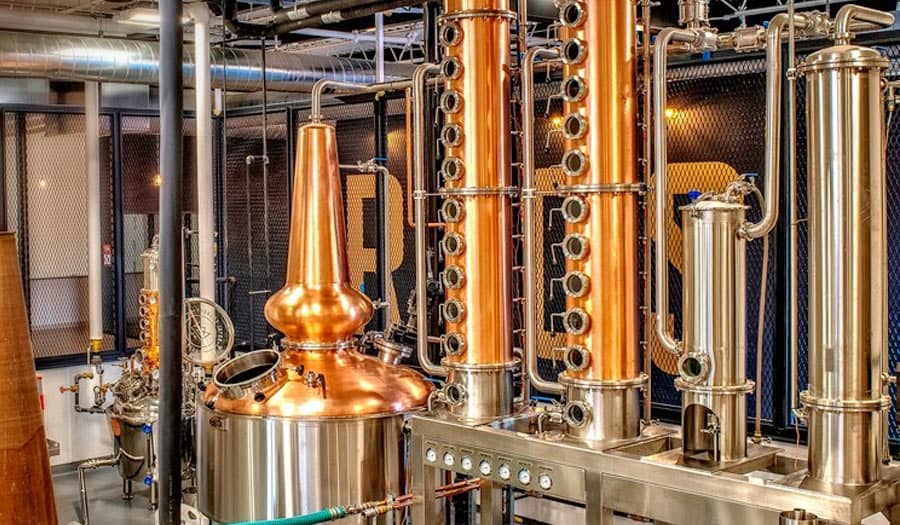
Quick definition: What is an alcohol distiller?
An alcohol distiller (also called a still) is a piece of equipment used to separate and concentrate ethanol and flavor compounds from a fermented liquid (often called a “wash” or “beer”) by controlled heating (evaporation) and cooling (condensation).
Distillation is used to produce spirits such as whiskey, vodka, gin, rum, brandy, and many other categories.
Distilling beverage alcohol is regulated in many countries and may require permits, taxes, and strict safety compliance. This article is for educational and equipment-selection purposes only.
How distillation works (science made practical)
Distillation relies on the fact that ethanol and water have different boiling points under standard pressure. Ethanol boils at about 78°C (173°F), while water boils at 100°C (212°F).[1]
However, real distillation is more than “set a temperature and collect alcohol.” In an actual wash, you have:
- Ethanol + water + hundreds of congeners (aroma compounds)
- Boiling point shifts due to mixture behavior (including azeotropes)
- Heat transfer limits, column efficiency, reflux ratio, and cooling capacity
The four core steps
- Fermentation: Yeast converts sugars to ethanol and CO₂.
- Heating / vaporization: Heat input raises the wash temperature and generates vapor.
- Condensation: Vapor is cooled in a condenser and becomes liquid again.
- Collection / separation: Fractions are collected (for batch systems) or drawn continuously (for continuous systems).
Why “proof” can’t increase forever
Ethanol-water mixtures form an azeotrope near ~95–96% ethanol, meaning simple distillation cannot easily exceed this purity without special methods (e.g., molecular sieves or other dehydration processes).[2]
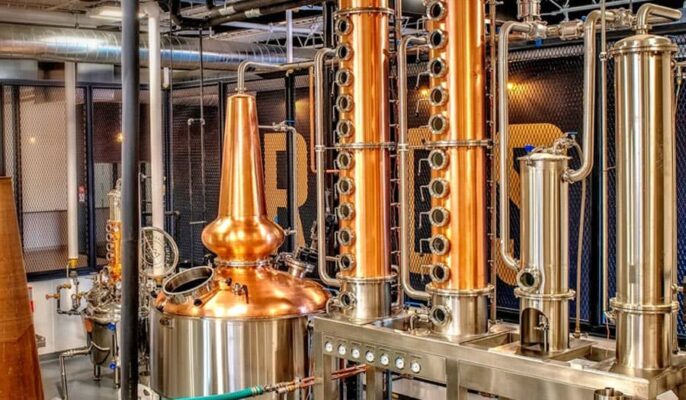
Types of alcohol distillers (stills) and what they’re best for
Choosing the right distillation system depends on your spirit style, desired purity, throughput, utilities, and compliance requirements.
1) Pot still (batch)
Best for: Whiskey, rum, brandy, flavorful spirits
Why it’s chosen:
- Preserves more congeners → richer aroma and mouthfeel
- Straightforward operation and classic style
Trade-offs:
- Lower purity per pass vs. columns
- Batch operation means lower continuous throughput
2) Column still / continuous still
Best for: Vodka, neutral spirits, high-efficiency production
Why it’s chosen:
- Multiple theoretical stages provide stronger separation
- Continuous operation supports higher output
Trade-offs:
- Higher engineering complexity
- Requires accurate control of reflux, cooling, and feed stability
3) Reflux still (batch or hybrid)
Best for: Cleaner spirits, flexible production
Why it’s chosen:
- Reflux increases separation and can raise purity dramatically
- Often used as a “bridge” between pot character and column purity
Trade-offs:
- More sensitive to tuning (reflux ratio, packing/trays, cooling capacity)
Hybrid systems (common in craft distilleries)
Many craft operations use hybrid stills (pot base + rectification sections) to produce:
- A flavorful whiskey base
- Higher-proof neutral for gin or RTD applications
Home vs. commercial distillers (what truly changes)
People often compare home stills by price or capacity alone—but commercial distillation has additional requirements:
- Regulatory compliance (facility classification, permits, recordkeeping)
- Fire and explosion safety (flammable vapor management)
- Material traceability & sanitary design (especially for export)
- Repeatability (instrumentation, automation, standard operating procedures)
Materials: Copper vs. stainless steel (and why many systems use both)
Copper: excellent for sulfur removal and classic character
Copper can help reduce sulfur-related off-notes in certain spirit styles. It’s also traditional and visually distinctive.
Considerations:
- Requires more cleaning and care
- Higher material and fabrication costs
Stainless steel: durable, sanitary, and scalable
Stainless steel is widely used in modern distilleries because it:
- Resists corrosion and lasts longer
- Supports clean-in-place (CIP) designs and sanitary weld standards
- Is easier to maintain for daily production environments
Common best practice: Use stainless for tanks and piping, and copper contact surfaces where beneficial (e.g., in the vapor path), balancing tradition with maintainability.
Data-driven section: What drives distillation performance (and your cost per liter)
If you want consistent quality and a predictable return on equipment investment, focus on the variables that most strongly affect performance.
1) Heat input and energy efficiency
Distillation is inherently energy-intensive because it relies on phase change. On the industrial side, distillation is a major target for efficiency improvement and heat integration concepts (heat pumps, thermal coupling, hybrid designs).[4]
Practical equipment implications:
- Insulation quality on boilers/columns
- Steam system sizing and condensate recovery
- Heat recovery options (e.g., preheating feed with hot streams)
2) Column internals and separation efficiency
For column/reflux systems, separation depends on:
- Packing vs. trays
- Effective height / number of stages
- Reflux ratio and condenser capacity
3) Instrumentation and control (repeatability)
For commercial production, repeatability is achieved by:
- Temperature/pressure sensors at critical points
- Flow control and automated valves
- Recipe-based control logic
4) Cleaning and downtime
A distillery’s output is limited not only by liters per run, but also by:
- How quickly the system can be cleaned
- How easily gaskets, seals, and valves can be inspected
- Whether the design supports CIP and safe access
Safety and compliance: non-negotiables for distilling facilities
Ethanol vapor is flammable, and distillation introduces heat sources, pressure, and flammable liquids—so safety must be designed into equipment and the room around it.
A practical safety reference for craft distilleries highlights measures such as ventilation, grounding/bonding to reduce static ignition risk, and safe operating practices like never leaving a still unattended.[5]
Equipment-level safety checklist
- Pressure relief and safe venting strategy
- Emergency stop and interlocks where appropriate
- Vapor-tight connections and high-quality seals
- Electrical classification aligned with local codes (hazardous locations)
- Grounding and bonding for transfers
Process-level safety checklist
- Adequate ventilation to prevent vapor buildup
- Spill containment and safe receiver setup
- Clear SOPs for startup, shutdown, and cleaning
- Staff training and emergency response planning
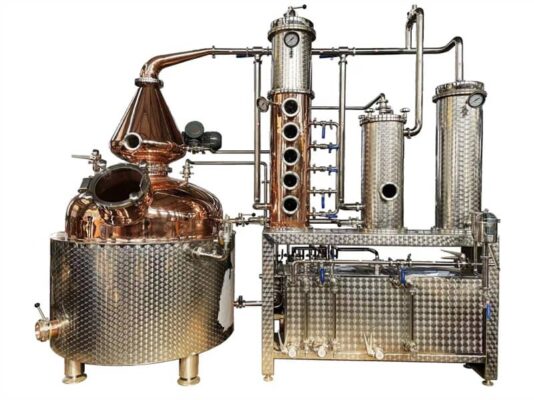
How to choose the right alcohol distiller (buyer’s guide)
Use the following framework to select a still that fits both current production and future scale.
Step 1: Define your spirit portfolio
- Flavor-forward (whiskey/rum/brandy) → pot or hybrid
- Neutral / vodka → columns and higher rectification
- Multiple products → flexible hybrid + modular add-ons
Step 2: Right-size capacity with growth in mind
Ask two capacity questions:
- What is your target liters/day (or month) at bottled proof?
- What is your expected growth in 12–24 months?
A common mistake is buying a system that is “just enough” for today, then facing costly downtime and redesign later.
Step 3: Choose utilities (steam, electric, gas) strategically
- Steam: excellent for control and even heating, common in commercial systems
- Electric: simpler installation in some regions; can be efficient with the right design
- Gas: can be economical but requires robust ventilation and safety practices
Step 4: Specify quality and compliance requirements
If you sell across borders, you may need documentation and fabrication standards aligned with:
- Pressure vessel requirements (where applicable)
- Food-contact material documentation
- Welding and surface finish standards
Step 5: Evaluate serviceability and after-sales support
A distillation system is not only a purchase—it’s a long-term production asset. Ask about:
- Installation commissioning
- Training and SOP support
- Spare parts availability
- Warranty terms and response times
Frequently Asked Questions (FAQ)
1) What is the difference between a distiller and a still?
They’re commonly used interchangeably. “Still” is the traditional term; “distiller” is often used to describe the equipment (and sometimes the operator). In equipment contexts, both usually mean the distillation system.
2) What temperature should an alcohol distiller run at?
There isn’t one “correct” temperature. Ethanol boils around 78°C (173°F) under standard pressure,[1] but real runs depend on mixture composition, pressure, reflux, and desired flavor carryover. Operators typically control the process by stabilizing the system and managing reflux and cooling, not by chasing a single setpoint.
3) Which still is best for whiskey: pot still or column still?
Most whiskey producers prefer pot stills (or hybrids) because they preserve more flavor compounds. Columns are more common for neutral spirits.
4) Is copper required for good spirits?
No. Many modern distilleries produce excellent spirits using mostly stainless systems with targeted copper contact (where desired). The best choice depends on your recipe, style, and maintenance preferences.
5) How do I make distillation safer in a production environment?
Start with facility ventilation, hazardous area electrical design, grounding/bonding, and SOP training. A craft distillery safety fact sheet emphasizes ventilation, ignition source control, and safe operating behaviors such as never leaving a still unattended.[5]
6) Can distillation systems be designed for lower energy use?
Yes. Industrial distillation research and supplier white papers discuss heat integration, including multi-effect designs and heat pumps, to reduce energy demand.[6][4]
Summary: What to prioritize when selecting distillery equipment
- Match still type to spirit style (flavor vs. neutrality)
- Engineer for safety first (vapor management, ignition control, compliance)
- Design for repeatability (instrumentation and control)
- Reduce downtime (CIP-friendly design and maintainability)
- Plan for growth (capacity and modular expansion)
References (authoritative sources)
- Purdue Extension: Alcohol Distillation—basic principles and boiling points.[1]
- U.S. eCFR (Title 27 CFR): Definition of distilled spirits.[3]
- Oregon OSHA: Craft distilleries safety fact sheet (ventilation, grounding/bonding, safe practices).[5]
- ScienceDirect (Current Opinion in Chemical Engineering): Review on energy-efficient distillation methods.[4]
- Sulzer white paper: Heat pumps/MVR and heat integration in distillation for sustainability.[6]
