Buying a brewhouse is one of the biggest capital decisions a brewery will make—because the brewhouse determines capacity, consistency, energy use, staffing needs, and future expansion options. This guide explains how to select the right brewhouse configuration, what to check before you buy, and how to maintain it to protect product quality and extend equipment life.
Key Takeaways (for buyers in a hurry)
- Size the brewhouse for your real peak demand, not just today’s average output.
- Vessel configuration (3/4/5-vessel) impacts throughput, wort quality, and labor more than most buyers expect.
- Automation reduces variability and labor, but it must be designed around your process and utilities.
- Maintenance success is mostly about hygienic design + repeatable CIP + preventive inspection routines.
- Energy and water efficiency are now major ROI drivers, not “nice-to-have” features.
Why Brewhouse Decisions Matter More Than Ever
Breweries worldwide are under pressure to improve efficiency and consistency while meeting increasingly diverse product demand (lagers, IPAs, low/no alcohol, specialty adjunct beers). That’s why investment in brewhouse technology—automation, heat recovery, and hygienic design—is accelerating.
Here are several widely cited market signals:
- Grand View Research estimates the global brewery equipment market at about USD 18.45 billion in 2024, with continued growth driven by new breweries and upgrades (automation, efficiency, monitoring). Source: Grand View Research, “Brewery Equipment Market Size” (industry report page).
- The Brewers Association reported U.S. craft brewers produced 23.1 million barrels in 2024 (with volume share around 13.3%), highlighting a more competitive, mature craft segment where operational excellence matters. Source: Brewers Association, “2024 U.S. Craft Brewing Industry Figures.”
- A U.S. DOE / OSTI-published brewery efficiency report (Ernst Worrell et al.) highlights that energy intensity varies significantly by brewery size, and that efficiency programs and system design can materially reduce energy use. Source: OSTI, “Energy Efficiency Opportunities in the Brewery Industry” (PDF).
These data points matter for buyers because they reinforce a simple truth: the best brewhouse is not only the one that can brew—it’s the one that can brew profitably, repeatedly, and safely for 10–25+ years.
Step 1: Define Your Production Requirements (Sizing That Actually Works)
1) Choose a target annual output and peak-week throughput
A common mistake is sizing only by “barrels per batch” (e.g., 5 BBL, 10 BBL, 20 hL). What really determines profitability is how many turns (batches) you can run per day and how many brew days you need per week.
Ask:
- How many beers do you plan to produce concurrently?
- How many fermenters do you have now, and what’s your 12–24 month expansion plan?
- What is your maximum desired turns per day (1 turn/day vs 2–4 turns/day)?
- Do you need high-gravity brewing capability?
2) Match brewhouse size to cellar capacity (not the other way around)
A brewhouse that’s too big forces overproduction, tank shortages, rushed CIP, and inconsistent fermentation scheduling. Too small forces excessive labor and long brew weeks.
A practical approach:
- Determine total cellar working volume.
- Decide desired tank turns per month.
- Back-calculate required wort volume per brew day and required turns.
3) Utilities and building constraints are “hard limits”
Before locking a brewhouse design, confirm:
- Steam supply or electric service capacity (kW), and gas availability.
- Cooling capacity (glycol system sizing).
- Water flow, drainage, and effluent management.
- Ceiling height, floor loading, and access for rigging.
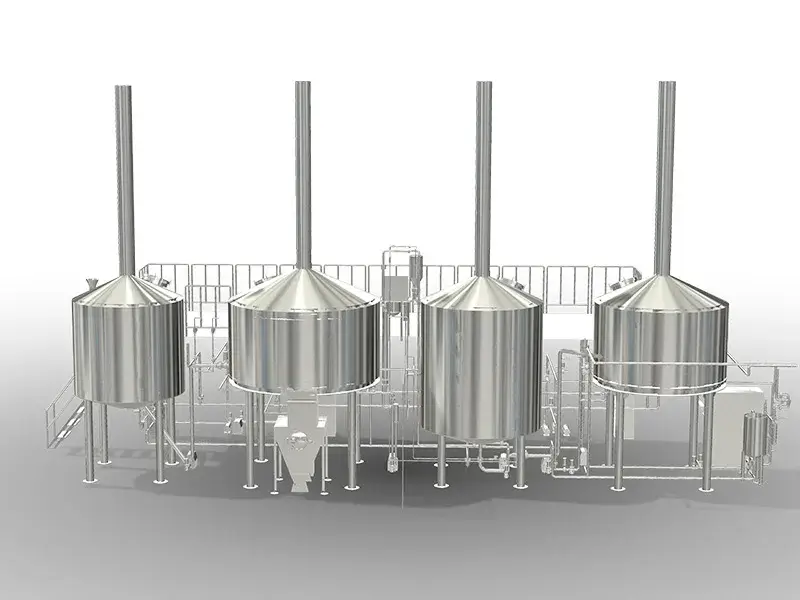
Step 2: Choose the Right Brewhouse Configuration (3-Vessel vs 4/5-Vessel)
3-vessel brewhouse (classic workhorse)
Typical vessels:
- Mash/Lauter (combined or separate)
- Kettle
- Whirlpool (sometimes integrated or separate)
Best for:
- Small-to-mid breweries focused on cost-effective production
- Lower turns per day (or acceptable longer brew days)
Trade-offs:
- Less flexibility for overlapping steps (mashing while boiling)
- Throughput constraints as you scale
4-vessel brewhouse (throughput + flexibility)
Adds a dedicated lauter tun or whirlpool/hot liquor tank depending on design.
Best for:
- Breweries targeting 2–4 turns/day
- Teams wanting better scheduling and less waiting time
Trade-offs:
- Higher CAPEX, more valves/instruments, more maintenance points
5-vessel brewhouse (high efficiency at scale)
Designed for:
- Maximum throughput
- Consistent wort separation
- Process stability for high-volume operations
Trade-offs:
- Most expensive
- Requires stronger utilities, instrumentation discipline, and trained operators
Step 3: Decide on Automation Level (Manual, Semi-Auto, Full Auto)
Automation is not just about convenience. It can directly improve:
- Wort consistency (temperatures, rests, flow rates)
- Repeatability (especially in multi-shift production)
- Labor planning (one operator running multiple tasks)
- Data logging for QA and troubleshooting
What to automate first (highest ROI)
- Temperature control loops (mash, kettle, HLT)
- Flow monitoring for transfers and heat exchanger
- Boil control (steam/electric power regulation)
- CIP sequencing and conductivity monitoring (when applicable)
What buyers should verify
- Sensor quality and placement (RTDs, pressure transmitters, flow meters)
- Control platform (PLC/HMI reliability, spare parts availability)
- Recipe management, batch reports, alarms, and audit logs
- Manual override and safe-state logic (power loss / valve failure behavior)
Step 4: What to Check for Quality (Hygienic Design + Mechanical Details)
A brewhouse is a hygienic processing system. Design choices influence cleanability, beer flavor stability, and contamination risk.
Key build and design checkpoints
- Material: 304/316 stainless where appropriate; weld quality and passivation
- Surface finish on product-contact areas (reduces soil adhesion and biofilm risk)
- Dead-leg minimization: piping routes and valve selection should prevent trapped product
- Gaskets and seals: food-grade, temperature/chemical compatibility, easy replacement
- Instrumentation: sanitary fittings, tri-clamp standards, calibration access
Standards and best-practice references
Many food and beverage hygienic design practices align with sanitary principles promoted by organizations like 3-A Sanitary Standards (commonly referenced in hygienic equipment design). For broader hygienic engineering concepts, ASME’s bioprocessing guidance (ASME-BPE) is widely referenced in hygienic piping discussions (even if breweries do not “certify” to it).
Step 5: Understand Total Cost of Ownership (TCO), Not Just Purchase Price
Two brewhouses with similar “BBL rating” can have very different lifetime cost.
TCO is driven by:
- Energy consumption (steam/electric efficiency, insulation, heat recovery)
- Water use and wastewater charges
- Chemical use (CIP optimization)
- Labor hours per batch
- Downtime risk (maintenance access and spare parts)
Data-backed perspective on energy
Energy use varies widely by brewery size and efficiency measures. The OSTI/DOE report on brewery efficiency notes that primary energy consumption per unit output can differ significantly between small and large breweries, reinforcing the value of efficient system design and energy audits. Source: OSTI, “Energy Efficiency Opportunities in the Brewery Industry” (PDF).
Brewhouse Maintenance: A Practical Program That Extends Equipment Life
1) Cleaning and sanitation: make CIP measurable, not “habit-based”
Cleaning is not only about aesthetics—it’s about preventing off-flavors, microbiological risk, and performance loss (heat exchanger fouling, blocked spray devices, stuck valves).
A good CIP program includes:
- Documented cycles (pre-rinse, caustic wash, rinse, acid wash as needed, sanitize)
- Chemical concentration checks (titration or conductivity-based where applicable)
- Temperature verification (cleaning chemistry is temperature-dependent)
- Time and flow verification (turbulent flow improves cleaning)
Many brewery cleaning guides and chemical suppliers commonly reference caustic soda (NaOH) cleaning ranges in the ~1–4% concentration range depending on soil load, temperature, and chemical formulation. Always follow your chemical supplier’s instructions and your equipment manufacturer’s recommendations.
2) Heat exchanger care (often the #1 hidden risk)
Plate heat exchangers can become a contamination source if not cleaned properly.
Best practices:
- Monitor differential pressure across the exchanger
- Periodically reverse flow during CIP (if recommended)
- Schedule periodic inspection/rebuild of plates and gaskets
- Keep spare gaskets and a rebuild kit on hand
3) Preventive inspections (monthly/quarterly)
Focus on:
- Gaskets and seals (flattening, cracking, chemical swelling)
- Valve seats and actuator function
- Pump seals and bearing noise
- Steam traps (for steam systems)
- Instrument calibration (temperature, pressure, flow)
4) Keep records (this is how you prove ROI)
Track:
- CIP results (time, temp, concentration, conductivity endpoints)
- Parts replacements (which valves fail, how often)
- Downtime causes
- Energy and water per batch (even rough estimates)
Over time, records allow you to optimize cycles, reduce chemical use, and prevent repeat failures.
FAQ: Brewhouse Buying & Maintenance (High-Intent Questions)
Q1: What size brewhouse should I buy for a new craft brewery?
Start from sales demand and cellar capacity, then calculate required turns per day/week. Many small breweries begin with 3–10 BBL (or 5–20 hL), but the “right” size depends on how many brew days you want and how fast you plan to expand.
Q2: Is a 4-vessel brewhouse worth the extra cost?
It can be, especially if you need higher throughput (more turns/day) and smoother scheduling. A 4-vessel design often reduces waiting time between steps and can lower labor pressure on busy production days.
Q3: Should I choose a fully automated brewhouse?
Choose automation when you need:
- Repeatability across shifts
- Reduced labor per batch
- Better QA records and troubleshooting data
But ensure the automation matches your process—poorly designed automation can be harder to operate than a good semi-automatic system.
Q4: How do I extend the life of a brewhouse?
Four pillars:
- Hygienic design (minimal dead legs, good welds, correct slopes and drains)
- Consistent CIP with measured parameters
- Preventive replacement of wear parts (gaskets, valve seats, pump seals)
- Good records + staff training
Q5: What are the most common brewhouse maintenance failures?
Common recurring issues include:
- Valve seat wear and sticking
- Pump seal leaks
- Heat exchanger fouling or gasket failure
- Steam trap failures (steam systems)
- Sensor drift (temperature probes, flow meters)
Q6: How often should instruments be calibrated?
At minimum, verify critical temperature and flow readings on a schedule (often quarterly or semi-annually depending on usage). If you see batch-to-batch variability, calibration should be one of the first checks.
Conclusion: Buy for Your Next Stage, Not Just Today
A brewhouse is the heart of a brewery—but it’s also a long-term operating system. The best results come from aligning brewhouse size, vessel configuration, utilities, and automation with a realistic production plan, then protecting that investment with a measurable CIP program and preventive maintenance discipline.
