
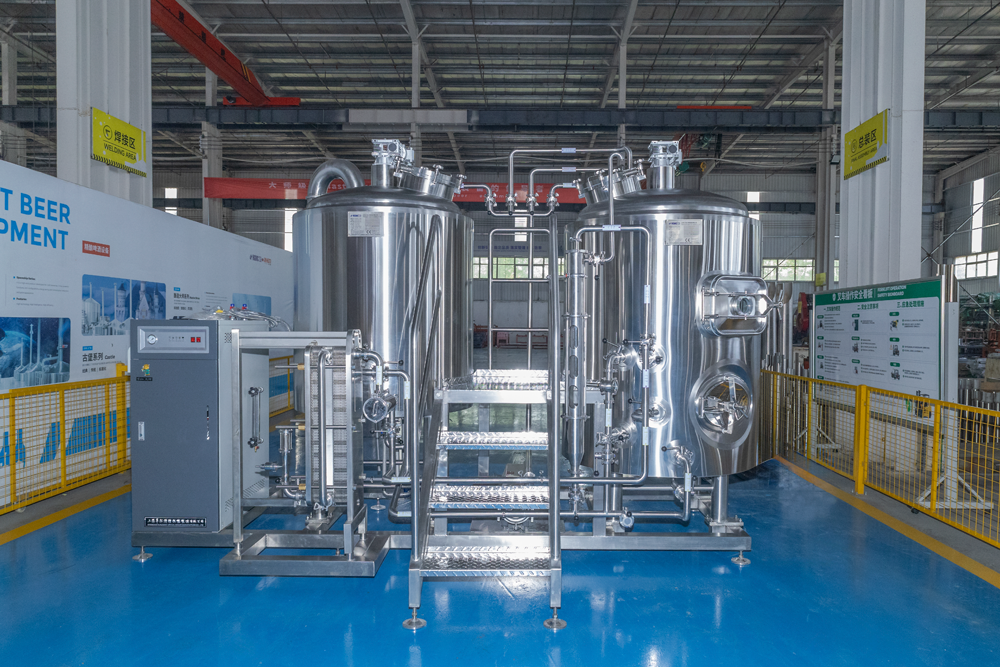
If you’re evaluating a 5 BBL brewing system for a startup brewery, pilot facility, taproom, or contract-production test line, the most common question is simple: “What can a 5bbl system really do—day-to-day—and what equipment do we need around it to run efficiently?”
This article explains the core components of a typical 5bbl brewhouse, how capacity translates into real beer output, what utility requirements usually look like, and what performance indicators to track (with example calculations).
What does “5 BBL” mean in brewing?
In the U.S. beer industry, 1 beer barrel (BBL) is defined as 31 U.S. gallons.[[1]](https://www.convertunits.com/from/gallons/to/barrel+[US,+beer)] That means:
- 5 BBL = 5 × 31 = 155 gallons per batch (theoretical volume)[[1]](https://www.convertunits.com/from/gallons/to/barrel+[US,+beer)]
In practice, “5 BBL brewhouse size” describes the nominal cast-out wort volume (hot-side). Finished beer packaged is usually lower due to losses (trub, yeast, transfers, dry hopping, filtration, etc.). Many breweries plan on packaging roughly 85%–95% of the brewhouse size depending on process and beer style.
If you want a quick planning number:
- 5 BBL wort into fermenter ≈ 155 gal
- Packaged beer often ≈ 4.2–4.8 BBL equivalent (varies)
Why 5bbl brewing systems are popular in today’s craft market
The craft market is competitive and increasingly taproom/hospitality driven. In the U.S. alone, the Brewers Association reported 9,796 operating craft breweries in 2024 (with microbreweries, brewpubs, taprooms, and regional craft breweries across the country).[2] This structure favors:
- Smaller batch sizes for freshness and rotation
- More SKUs and seasonal releases
- Pilot brewing for R&D (recipes, yeast trials, hop products)
- Lower initial CAPEX compared with 10–30 BBL systems
A 5 BBL system hits a sweet spot: big enough to supply a taproom and small distribution, but compact enough for tighter floor plans and budgets.
1) Core components of a 5 BBL brewing system (Brewhouse)
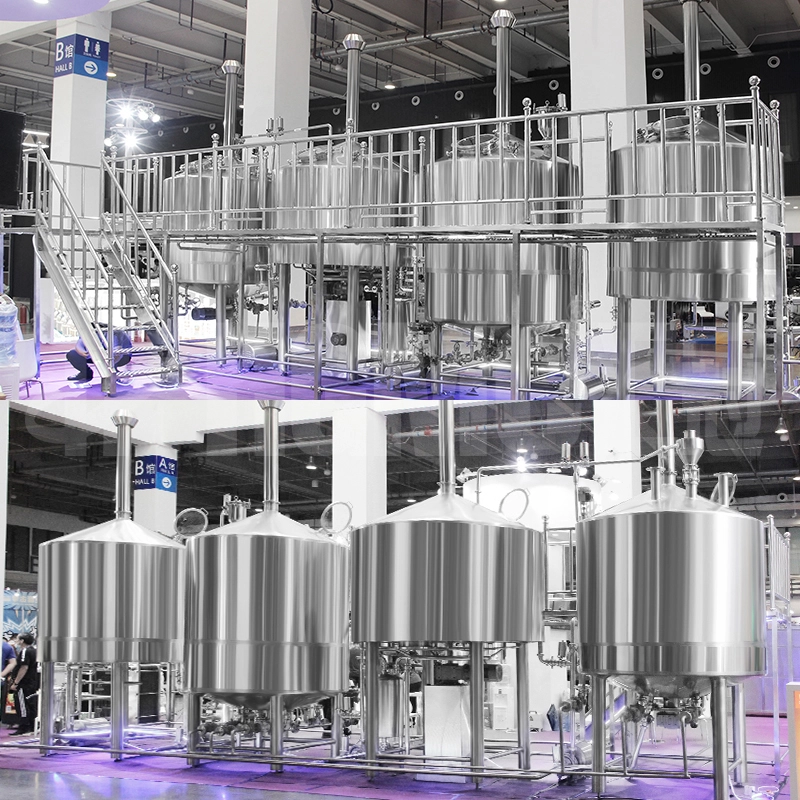
Mash Tun (or Mash/Lauter Tun)
The mash tun is where milled malt and hot liquor (brewing water) are mixed to convert starch into fermentable sugars. For 5bbl systems, common mash/lauter features include:
- Steam jackets or direct fire (less common for commercial)
- False bottom / wedge-wire screens
- Rakes and plow (optional depending on budget)
- Grain-out door and spent grain handling interface
- Dedicated grant (optional) for lauter stability
Key performance metrics to track:
- Mash efficiency (conversion)
- Lauter speed (minutes to runoff)
- Extract efficiency into kettle (overall brewhouse efficiency)
Brew Kettle (Boil Kettle / Whirlpool integration)
The kettle is where wort is boiled for sterilization, hop utilization, volatilization of unwanted compounds, and target gravity. Many 5bbl designs combine whirlpool and kettle functions (kettle/whirlpool combo), while higher-end designs may separate them.
Important kettle considerations:
- Heating method (steam jacket common; electric possible)
- Evaporation rate control
- Whirlpool tangential inlet design
- Trub separation performance
Metrics:
- Boil-off rate (often expressed as %/hour)
- Hop utilization consistency
- Whirlpool trub cone quality
Hot Liquor Tank (HLT) and Cold Liquor Tank (CLT) (often optional but recommended)
While not always listed as “core,” water tanks dramatically improve brewhouse workflow:
- HLT: provides stable hot water for mash-in, sparge, CIP rinse
- CLT: provides cold water for heat exchange and utility needs
In many real breweries, the HLT/CLT sizing determines whether you can brew back-to-back (double-brew days) without waiting.
Heat Exchanger (Wort Cooler)
After the boil and whirlpool, wort must be cooled quickly to yeast-pitch temperature. Plate heat exchangers are most common for 5bbl.
Key design inputs:
- Knockout flow rate (gpm or hl/hr)
- Cooling water temp (seasonal variation matters)
- Ability to use chilled water/glycol loop for warm climates
- Sanitary design and CIP friendliness
Metrics:
- Knockout time
- Cold-side oxygen pickup control
- Final wort temperature stability
Pumps, Valves, and Piping (The “real” productivity engine)
A 5bbl system’s consistency is heavily driven by:
- Sanitary centrifugal pumps sized for hot wort and CIP
- Proper valve count and placement (safety + speed)
- Tri-clamp piping layout that minimizes dead legs
- Instrumentation (thermometers, flow control, pressure gauges)
Control Panel & Automation Level
The control panel is the process “brain,” enabling repeatability. Even semi-automatic systems can maintain high consistency when they include:
- Temperature control loops (HLT, mash steps)
- Pump interlocks and alarms
- Timers for mash rests, boil additions, CIP sequences
- Data logging for brewsheet traceability
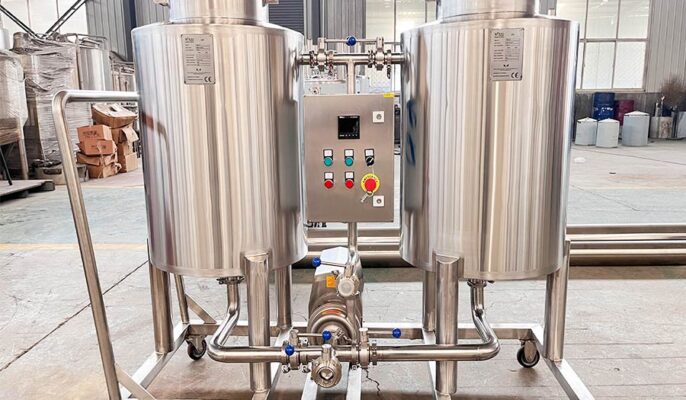
2) Cold-side equipment: fermenters, brite tanks, and glycol
A brewhouse alone does not make a brewery. Cold-side capacity usually determines weekly output.
Fermenters (Unitanks or Fermentation Tanks)
A common setup is:
- 2 to 4 fermenters sized 5–10 BBL each
Why bigger than 5 BBL? Because it allows double-batch brewing into one tank, which improves labor efficiency and increases volume without scaling the brewhouse immediately.
Bright Tank (Brite / Conditioning Tank)
A bright tank holds beer for:
- Clarification / conditioning
- Carbonation
- Packaging buffer (kegging/canning)
For a 5bbl brewery, a 5 BBL brite tank works; many breweries choose 10 BBL to avoid packaging bottlenecks.
Glycol Cooling System (Chiller + reservoir + jackets)
Temperature control is a quality requirement, not a luxury. A glycol system typically controls:
- Fermentation temps
- Cold crash
- Brite tank conditioning
- Serving tank temps (if applicable)
3) Data-driven capacity planning: how much beer can a 5bbl system make?
This is where “analysis data” makes your article more valuable than generic content.
Baseline production math
Using the BA definition 1 BBL = 31 gal,[[1]](https://www.convertunits.com/from/gallons/to/barrel+[US,+beer)] a 5 BBL system yields nominally:
- 155 gallons cast-out (theoretical)
Now convert to finished beer scenarios (example assumptions):
- Packaging yield: 90% (moderate hopping, standard cellar practices)
- Packaged volume per batch: 5 BBL × 0.90 = 4.5 BBL equivalent
Weekly output depends on fermentation time and tank count
Example scenario A (taproom-focused ale program):
- Fermentation + conditioning: 14 days average
- Fermenters: 4 × 5 BBL
- Batches per tank per month ≈ 30 / 14 ≈ 2.14 turns
- Monthly brewhouse volume ≈ 4 tanks × 5 BBL × 2.14 ≈ 42.8 BBL (wort)
- Packaged ≈ 42.8 × 0.90 ≈ 38.5 BBL/month
Example scenario B (same brewhouse, but 2 × 10 BBL fermenters with double-batching):
- Brew 2 batches into one 10 BBL fermenter (2 brewdays close together)
- Better labor efficiency and often better cellar utilization
- Output scales with tank volume and turn time more than brewhouse nameplate
Quick takeaway
A “5 BBL” brewhouse can support a surprisingly wide range of output—if you design the cellar correctly.
4) Utilities & installation considerations (space, plumbing, electrical)
Space and layout requirements
A 5bbl brewhouse footprint is compact compared with larger systems, but you still need working clearance for:
- Safe grain handling
- CIP access
- Pump maintenance and hose routing
- Forklift/pallet movement (if production-focused)
Plumbing
Design for:
- Sufficient water supply flow (mash, sparge, cooling)
- Proper floor drains and slope (cleaning reality)
- Hot water distribution loop (efficiency)
- Wastewater planning (local discharge limits)
Electrical
Electrical needs depend heavily on:
- Steam boiler vs electric heating
- Pump count and VFDs
- Glycol chiller horsepower
- Packaging line (if any)
5) Safety and compliance: credible guidance you can reference
Brewing involves hot liquids, chemicals (CIP caustic/acid/sanitizers), confined spaces (tanks), pressurized vessels, slippery floors, and forklifts.
6) Buyer checklist: what to ask before purchasing a 5bbl brewing system
When you sell 5bbl systems, your prospects often compare quotes that look similar but perform very differently. Consider adding this checklist (it improves conversion and time-on-page):
- What is the true working volume (mash tun and kettle)?
- Is the system 2-vessel, 3-vessel, or kettle/whirlpool combo?
- What is the designed brews-per-day capability (including CIP turnaround)?
- What automation is included (temperature control, alarms, data logging)?
- What is the recommended fermenter strategy (5 BBL vs 10 BBL tanks)?
- What are the utility requirements (steam/electric load, water flow, drainage)?
- What safety features are included (pressure relief, guarding, labeling)?
FAQ: 5 BBL Brewing System Questions (SEO Q&A)
Q1: How many gallons are in a 5 BBL brewing system?
A 5 BBL (beer barrel) system is about 155 U.S. gallons per batch because 1 beer barrel is defined as 31 U.S. gallons.[[1]](https://www.convertunits.com/from/gallons/to/barrel+[US,+beer)]
Q2: Is a 5bbl brewing system big enough to start a craft brewery?
For many taprooms and small local distribution models, yes—especially if you size the cellar correctly (fermenters + brite + glycol). A 5bbl brewhouse is often ideal for SKU variety and freshness.
Q3: How many fermenters do I need for a 5 BBL brewhouse?
A common starting point is 2–4 fermenters. Output depends more on fermentation time and total fermenter volume than on brewhouse size alone. Many breweries choose larger fermenters (e.g., 10 BBL) so they can double-batch.
Q4: What’s the difference between a fermenter and a bright tank?
A fermenter is where yeast converts sugars into alcohol and CO2. A bright tank is mainly for conditioning, clarification, carbonation, and packaging readiness.
Q5: Do I need a glycol chiller for a 5bbl system?
If you want consistent beer quality, you need reliable temperature control. Glycol systems are standard for fermenters and brite tanks. Maintaining correct glycol mixture and routine maintenance reduces failure risk and improves stability.[3]
Q6: What are the main safety risks in a small brewery?
Common risks include hot liquids (burns), chemical exposure (CIP), confined space hazards (tanks), and hazardous energy during maintenance. OSHA guidance for beverage manufacturing highlights hazards like powered industrial trucks, confined spaces, and toxic chemical exposure.[4]
Conclusion: 5 BBL systems are small—but not “limited”
A well-designed 5bbl brewing system can deliver professional, repeatable beer production—provided the brewhouse, cellar, cooling, and utilities are designed as one integrated process. For many modern craft business models (taproom rotation, pilot production, contract test batches, and quality-first local distribution), 5 BBL remains a highly strategic size.
