
Every serious homebrewer eventually hits the same wall. The 50-liter test batches that worked in the garage stop scaling the moment you think about selling beer to the public. The recipes are solid, the palate is trained, but the equipment that got you here simply cannot produce the volume, consistency, or sanitary standards that a commercial operation demands.
This is the exact moment when most aspiring brewery owners start researching commercial microbrewery equipment — and quickly discover that the leap is less about buying a bigger kettle and more about assembling a complete, coherent process chain from raw materials to packaged product.
Commercial brewing is not a single shopping decision. It is a process-chain decision and a staged investment decision rolled into one. The equipment you choose determines whether you end up running a functioning business or an extremely expensive hobby.
A brewery that produces inconsistent batches, fails sanitation inspections, or runs out of fermentation capacity within the first year is almost always a brewery that bought mismatched or undersized equipment at the start. The right approach is to understand what the full process chain requires, then build it in stages that match your actual sales growth.
How much does commercial microbrewery equipment cost?
The honest answer is that microbrewery equipment costs vary enormously, and the variation comes down to four main drivers rather than a single headline number. The first driver is brewhouse size and configuration — typical microbrewery brewhouses range from several hundred litres to a few thousand litres per batch, and that range alone can move the price by an order of magnitude. The second is fermentation and conditioning capacity, which needs to support both your beer portfolio and your expected demand. The third is automation level, spanning manual systems for hands-on brewers through semi-automatic to fully automated controls. The fourth is packaging and cold storage — keg, bottle, or can filling lines plus cold rooms or temperature-controlled tanks.
Fixating on the starting price is the wrong instinct. Two breweries can buy equipment at the same price point and end up with completely different businesses, because what matters is whether the capacity matches the sales plan. A 500-liter brewhouse with six fermenters might be perfect for a brewpub selling draft-only, while the same budget spent on a 2,000-liter brewhouse with two fermenters would create a bottleneck that stops production cold every few weeks.
The more useful way to think about cost is through stages. Stage one typically covers a brewhouse, a set of fermenters, a basic glycol loop, and simple draft distribution — enough to start selling beer. Later stages add more tanks, higher automation, and expanded packaging lines as sales grow. This staged mindset protects cash flow while keeping the process coherent, and it is the single most common trait among microbreweries that survive their third year.
The essential equipment every commercial microbrewery needs
A commercial brewery is a complete process chain, and every link has to function for the beer to come out right. Six critical component categories form a functioning commercial process chain, and skipping any one of them creates problems that show up later — usually during a health inspection or a batch that has to be dumped.
| Component | Primary function | Why it matters |
|---|---|---|
| Brewhouse system | Mash, lauter, kettle, and whirlpool integrated with sanitary pumps and piping | Converts raw grain into wort with consistent extraction and clarity |
| Fermentation tanks | Conical stainless steel vessels sized to batch volume | Controls yeast activity and temperature for predictable fermentation |
| Bright beer tanks / unitanks | Maturation, carbonation, and clarification of finished beer | Produces the stable, clear final product customers actually drink |
| Glycol chilling system | Chilling units and loops that hold fermentation and storage temperatures | Prevents off-flavors and keeps every tank at the right temperature |
| CIP system | Cleaning-in-place equipment for tanks, lines, and valves | Passes sanitation standards and protects product safety batch after batch |
| Control panels | Manual or automated management of temperature, pumps, and valves | Keeps the whole process repeatable and catches errors early |
The brewhouse is where the process starts, combining mash, lauter, kettle, and whirlpool functions into one integrated system. Conical stainless fermenters come next, sized to your batch volume and production cycle. From there, bright beer tanks or unitanks handle maturation, carbonation, and clarification. The glycol chilling system maintains fermentation and storage temperatures across every tank. The CIP system keeps everything hygienic between batches. Control panels tie it all together, managing temperature, pumps, and valves.
What surprises most new brewers is not the brewhouse cost — it is how much of the budget goes into the systems they never thought about. The glycol loop and the CIP system are consistently the most under-budgeted components of a new microbrewery, yet they are exactly the ones that determine whether you can pass sanitation standards and hold consistent product quality. A brewery can get away with an older brewhouse, but it cannot get away with weak chilling or inadequate cleaning.

How to plan microbrewery layout and capacity
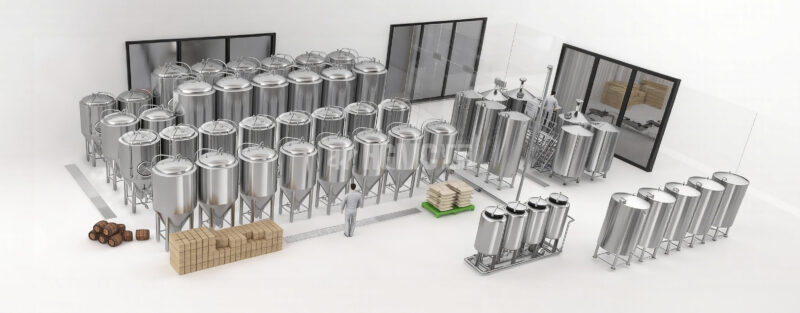
Layout planning comes before purchasing, not after. The first decision is defining annual output — how much beer you actually expect to produce and sell, not how much you hope to sell. From there, map the production flow from raw materials storage through the brewhouse, fermentation, conditioning, and packaging. Every step needs physical space, and the flow between steps needs to make sense for the people working it.
If you operate a taproom, equipment placement has to support safe and engaging visitor routes. A working brewery with customers walking through it is a different design problem than a production-only facility. Cold rooms need to sit where kegs can move in and out without crossing the customer path, and the brewhouse needs enough clearance for cleaning and maintenance without turning into a hazard.
The cheapest expansion a brewery ever makes is reserving floor space and glycol-loop capacity on day one. Retrofitting utilities later costs multiples of the planning time — adding a glycol line to an existing building means tearing up floors or running new pipes around occupied tanks, and adding tank capacity usually means reworking the entire layout. Leaving room for additional tanks is the cheapest insurance a new brewery can buy. This is the tradeoff most new owners miss: layout decisions made once are expensive to reverse, but reserving empty space costs nothing until you actually use it.
Building your brewery in stages instead of all at once
Successful microbrewery planning works in phases, not as a single purchase. Stage one looks the same for most startups: a brewhouse, a set of fermenters, a basic glycol loop, and simple draft distribution. That is enough to start brewing, start selling, and start learning what your actual demand looks like. Packaging expansion comes later, once you know whether your customers want cans, bottles, or kegs — and in what volume.
Later stages add more tanks as fermentation capacity becomes the bottleneck, upgrade automation as the brewhouse crew grows, and expand packaging lines as distribution widens. Plan for the third year, not just the first. A brewery that buys everything at once often ends up with excess capacity it cannot use and debt it cannot service, while a brewery that stages its growth matches equipment investment to actual revenue.
The counterintuitive part is that staged growth is not just cheaper — it produces better beer. A brewer who learns the brewhouse inside out before adding automation makes better decisions about what to automate. A brewery that adds tanks only when fermentation capacity actually limits sales avoids the trap of idle equipment that still needs cleaning and maintenance.
Choosing a commercial microbrewery equipment partner
The supplier matters as much as the equipment, and the criteria go beyond the price tag. Look for a partner focused on professional brewery equipment rather than home-scale kits — the engineering standards, materials, and sanitation requirements are completely different. The supplier should offer custom configurations matched to your brewing concept, capacity goals, and budget, not just a catalog of fixed models.
Turnkey services matter more than most new brewers realize. Project design, manufacturing, installation, commissioning, and training are all part of getting a brewery running, and a partner who handles the whole chain saves months of coordination headaches. After-sales support and parts supply determine whether a minor failure becomes a one-day fix or a two-week shutdown. The right framework for evaluating a partner comes down to four criteria: professional focus, custom configuration capability, turnkey service coverage, and long-term after-sales support.
A supplier who has delivered many brewery projects of different sizes brings practical experience that no spec sheet can convey. Their engineering team should be able to prepare layout plans and capacity recommendations that match your building and market conditions, not just sell you a standard system. The relationship is a process partnership, not a parts transaction — and the difference shows up in the first year of operation, when something breaks and you find out whether support actually responds.
FAQ
How much does a commercial microbrewery setup cost to launch?
A launch setup typically costs anywhere from $100,000 to $500,000 depending on brewhouse size, tank capacity, and automation level. A 500-liter brewhouse with six fermenters and basic glycol runs at the lower end, while a 2,000-liter system with full automation and packaging lines approaches the higher figure. The real question is matching that cost to your sales plan, not the headline number.
What is the minimum equipment needed to brew commercially?
The minimum is a brewhouse system, conical fermentation tanks, bright beer tanks or unitanks, a glycol chilling system, and a CIP system. Control panels round out the set. Without any one of these, you cannot produce consistent, safe beer at commercial scale — the glycol and CIP systems are the ones new brewers most often try to skip and later regret.
Can I start with a smaller brewhouse and expand later?
Yes, and most successful microbreweries do exactly that. Start with a brewhouse sized to your first-year sales, then add fermentation tanks and packaging lines as demand grows. The key is reserving floor space and glycol-loop capacity on day one so expansion does not require expensive retrofits.
What is the difference between bright beer tanks and unitanks?
Bright beer tanks are dedicated vessels for maturation, carbonation, and clarification after fermentation is complete. Unitanks perform fermentation and conditioning in the same vessel, saving floor space and reducing transfer losses. Unitanks suit smaller operations, while bright beer tanks give larger breweries more flexibility in tank scheduling.
Is automation worth the extra cost for a new microbrewery?
Manual controls are fine for a hands-on brewer running small batches, but automation pays off once you scale. Semi-automated systems reduce labor and improve consistency without the full cost of fully automated controls. The right point to upgrade is when your crew size and batch volume start making manual temperature and valve management a bottleneck.
