

Beer filling is where product quality meets commercial reality. A great beer can lose freshness in seconds if oxygen pickup, inconsistent fill levels, or poor sanitation control show up at the packaging stage. Choosing the right beer filling equipment is not only a capacity decision. It is a quality, labor, compliance, and total cost decision that affects shelf life, customer satisfaction, and your ability to scale.
Modern breweries increasingly track packaging metrics like dissolved oxygen (DO) and total packaged oxygen (TPO) because these numbers correlate strongly with flavor stability. Industry packaging guidance emphasizes measuring DO and headspace oxygen as part of TPO management.[1] Leading equipment manufacturers also report that “state-of-the-art” systems can reduce total oxygen pickup dramatically versus older lines (e.g., total oxygen pickup around 20 µg/L is possible with the right technology).[2]
This guide breaks down the main types of beer filling systems, how to match them to your brewing scale, what features matter most, and how to evaluate long-term reliability and supplier support.
1) Understanding Different Types of Beer Filling Equipment Available
“Beer filling equipment” can mean very different machines depending on container type, carbonation level, oxygen targets, and volume. Most systems fall into these categories:
A. Bottle fillers
- Gravity fillers (often used for still or low-carbonation beverages, less ideal for carbonated beer).
- Counter-pressure bottle fillers (common for carbonated beer, better CO₂ retention and lower oxygen pickup).
- Isobaric fillers (a form of counter-pressure filling used on higher-speed lines).
B. Can fillers (canning lines)
Cans have become a mainstream package format for craft beer, and canning lines emphasize:
- Purge quality (CO₂ or N₂)
- Seam quality control
- Low DO/TPO performance
C. Keg fillers
Kegging requires:
- Effective spear/valve handling
- Reliable purge and pressurization
- CIP/SIP alignment with brewery hygiene practices
D. Manual / semi-automatic / automatic systems
- Manual: lowest capex, higher variability, best for pilot batches and taproom-only packaging.
- Semi-automatic: better repeatability, moderate speed, often a strong “first serious packaging” step.
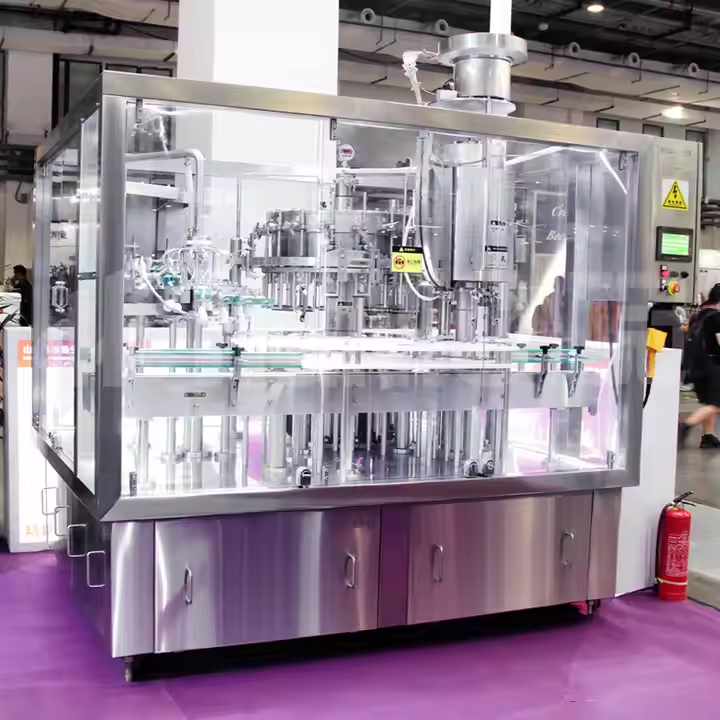
- Fully automatic: designed for consistent quality at higher output, with integrated rinsing, purge, fill, seam/cap/crown, and in-line QC options.
2) Evaluating Your Brewing Scale and Production Requirements
Before you talk to any supplier, define requirements in numbers. A practical capacity worksheet should include:
- Target packaged volume (per day/week/month)
- Peak packaging hours available (e.g., 1–2 days/week vs daily packaging)
- SKU count and changeover frequency (more SKUs = more changeovers = lower real throughput)
- Package mix (cans vs bottles vs kegs)
- Carbonation range (highly carbonated styles demand stronger counter-pressure control)
- Quality targets (DO / TPO, fill height tolerance, seam/cap reject rates)
- Utilities and plant constraints (CO₂ supply, compressed air, water, steam/hot water, floor space, drainage, ventilation)
A frequent mistake is buying a filler based on “max rated speed” rather than effective throughput. Real output depends on:
- Rinsing and purge time
- Foam control and temperature stability
- Changeovers
- Maintenance and sanitation cycles
- Operator skill
Quality and measurement matter. Packaging DO targets vary by brewery sophistication, but multiple technical sources emphasize very low in-package DO as a modern objective (for example, less than 0.025 ppm in package is reported as achievable in many breweries).[3] Packaging-focused training materials also stress that you need proper sampling and measurement to calculate TPO (combining DO and headspace oxygen).[1]
3) Key Features to Look for in Beer Filling Equipment
If you want a buyer-friendly checklist that still sounds technical and authoritative, prioritize these features:
A. Oxygen control (DO/TPO performance)
- Pre-purge quality (CO₂/N₂)
- Low-turbulence filling valves
- Consistent snift / pressure management (counter-pressure systems)
- Designed headspace control (especially for cans and bottles)
TPO is widely defined as the sum of DO in beer plus headspace oxygen.[4] And headspace oxygen can represent a large share of the total oxygen load, so you cannot focus on liquid DO alone.[4]
B. Sanitary design and cleanability
- CIP capability (spray balls, loops, validated coverage)
- Hygienic fittings, minimal dead legs
- Clear procedures for chemical compatibility, temperature limits, and gasket material selection
C. Fill-level accuracy and repeatability
- Flow control and valve response
- Consistent container handling
- Sensors for low-fill/high-fill detection
D. CO₂ management and foam control
- Stable temperature in bright beer tank and line
- Proper pressure balancing (especially in counter-pressure and isobaric fillers)
- Gentle product path design
E. Integrated quality checks (optional but valuable)
- In-line DO measurement strategy (at least defined sampling points)
- Seam inspection system for cans
- Reject systems tied to sensors

4) Assessing the Material and Build Quality for Longevity
Filling equipment lives in a harsh environment: moisture, caustic cleaners, acids, and repetitive thermal cycling. Build quality affects uptime more than most buyers expect.
Look for:
- Food-grade stainless steel in product-contact areas and hygienic weld quality
- Surface finish and cleanability considerations
- Robust frames, guards, and corrosion resistance in non-contact areas
- Quality of valves, seals, and actuators (these determine maintenance frequency)
A good way to communicate longevity in an SEO article is to describe “failure modes” plainly:
- Seal wear causing micro-leaks (air ingress risk)
- Valve sticking leading to fill inconsistency
- Sensor drift impacting rejects and yield
- Inadequate drainage causing microbiological risk
Data visualization suggestion (Figure 4):
A “Total Cost of Ownership (TCO) breakdown” stacked bar: capex, spares, sanitation chemicals, utilities, labor, unplanned downtime cost. Use example numbers or ranges.
5) Comparing Automated vs. Manual Filling Systems
This section usually drives lead conversions because it connects equipment choice to staffing and ROI.
Manual filling (entry-level)
Pros
- Low upfront cost
- Fast to deploy
- Good for low volume and local distribution
Cons
- Higher operator dependency
- More variability in fill levels and oxygen control
- Harder to scale without quality tradeoffs
Semi-automatic systems (growth stage)
Pros
- Better repeatability
- Moderate speed increase
- Often the best “step up” for expanding breweries
Cons
- Still operator-dependent for changeovers and QC discipline
- May require add-ons later (rinser, labeler, packing)
Fully automatic lines (scaled production)
Pros
- High consistency, lower unit labor cost
- Better integration options for QC and rejects
- Designed for long runs and predictable scheduling
Cons
- Higher capex and commissioning complexity
- Requires structured maintenance and trained operators
Authority point: modern filling tech has pushed oxygen pickup down significantly. One manufacturer notes that while older systems achieving around 150 µg/L total oxygen pickup were common, ~20 µg/L can be possible with the right technology.[2]
6) Exploring Budget Considerations and Cost Efficiency
A strong SEO article must address budget transparently without sounding like a sales pitch.
Build a simple ROI model
Include:
- Current packaging labor cost
- Downtime and yield loss (foaming losses, rejects, rework)
- Expected volume growth
- Maintenance and spare parts budget
- Quality cost: shelf-life issues, returns, distributor complaints
You can also support macro trends with market data, but be careful: many market reports are paywalled or marketing-heavy. If you choose to mention market sizing, keep it conservative and cite clearly. (Example: a market research report estimates global beer packaging equipment market value and growth rate.[5])
Hidden costs many breweries miss
- CO₂ usage and purge inefficiency
- Compressed air and water consumption
- Floor drain upgrades and wastewater handling
- Change parts for multiple can/bottle sizes
- Training time and maintenance planning
7) Researching Manufacturer Reputation and Customer Support Services
For industrial equipment, the supplier is part of the product. Your buyer will care about:
- Installation and commissioning scope (what’s included, what’s not)
- Training plan: operators + maintenance + QA sampling
- Spares strategy: recommended spare kits, lead times
- Remote support and troubleshooting
- Documentation quality: wiring diagrams, manuals, CIP procedures
- Warranty terms and response times
A practical evaluation checklist:
- Ask for references from breweries with similar volume and package type
- Request a FAT/SAT plan (factory acceptance test / site acceptance test)
- Ask how the supplier helps you measure packaging DO/TPO correctlyMeasuring packages immediately after filling is emphasized in technical guidance, because oxygen can be consumed during pasteurization and change the reading.[3]
FAQ: Beer Filling Equipment (Common Questions from Brewery Buyers)
Q1: What is the difference between DO and TPO in beer packaging?
DO (Dissolved Oxygen) is oxygen dissolved in the beer. TPO (Total Packaged Oxygen) includes DO plus oxygen in the container headspace.[4] Many packaging quality resources teach that you need proper sampling and measurement to calculate TPO reliably.[1]
Q2: What DO level should a brewery target after packaging?
Targets vary by product, shelf-life goals, and measurement method. Technical guidance notes that many breweries achieve in-package dissolved oxygen levels of < 0.025 ppm.[3] The most important step is to define your internal specification and measure consistently.
Q3: Is manual filling “good enough” for craft beer?
Manual filling can be suitable for very small volumes and fast local consumption. But as distribution distance and shelf-life expectations increase, consistent oxygen control, sanitation, and fill accuracy become harder to maintain without more advanced systems.
Q4: Are cans or bottles better for beer?
It depends on brand positioning, distribution channel, and line capability. From an equipment standpoint, the “better” package is the one your line can fill with stable DO/TPO and tight QC. Poor seam or cap quality will erase any theoretical advantage.
Q5: How do I estimate the right filler capacity?
Start from weekly packaged volume, then work backward using:
- planned packaging days
- planned packaging hours per day
- realistic effective speed (account for changeovers and sanitation)
If you plan aggressive growth, consider buying with headroom to avoid replacing the line too early.
Q6: What support should I expect from a beer filling equipment manufacturer?
At minimum:
- Commissioning and training
- Documented sanitation/CIP procedures
- Spare parts recommendations and availability
- Troubleshooting support
A supplier should also help you establish a repeatable quality measurement routine for packaging oxygen and other key metrics.[1]
Q7: When should I invest in automation?
When labor cost, quality variability, reject rates, or downtime costs become material. Automation often pays back through:
- stable throughput
- fewer packaging defects
- lower oxygen pickup risk
- predictable scheduling
Conclusion: Choose Filling Equipment Around Quality, Throughput, and Total Cost
The best beer filling equipment is not defined by a single number like “cans per minute.” It is defined by how reliably it can protect beer quality (oxygen control), run clean (sanitary design), deliver consistent packages (fill/seam/cap quality), and stay running (serviceability and supplier support).
If you align your system type to your production scale, define measurable quality targets (DO/TPO), and evaluate suppliers based on long-term support—not just price—you will build a packaging operation that scales with your brewery.
