
In today’s competitive craft beer market, breweries are under pressure from every direction: rising raw material costs, increasing quality expectations from consumers, and the need to expand capacity without taking on excessive financial risk. In this context, professional beer brewing equipment is no longer just a collection of stainless-steel tanks. It is a strategic asset that directly determines production efficiency, flavor stability, and long‑term profitability.
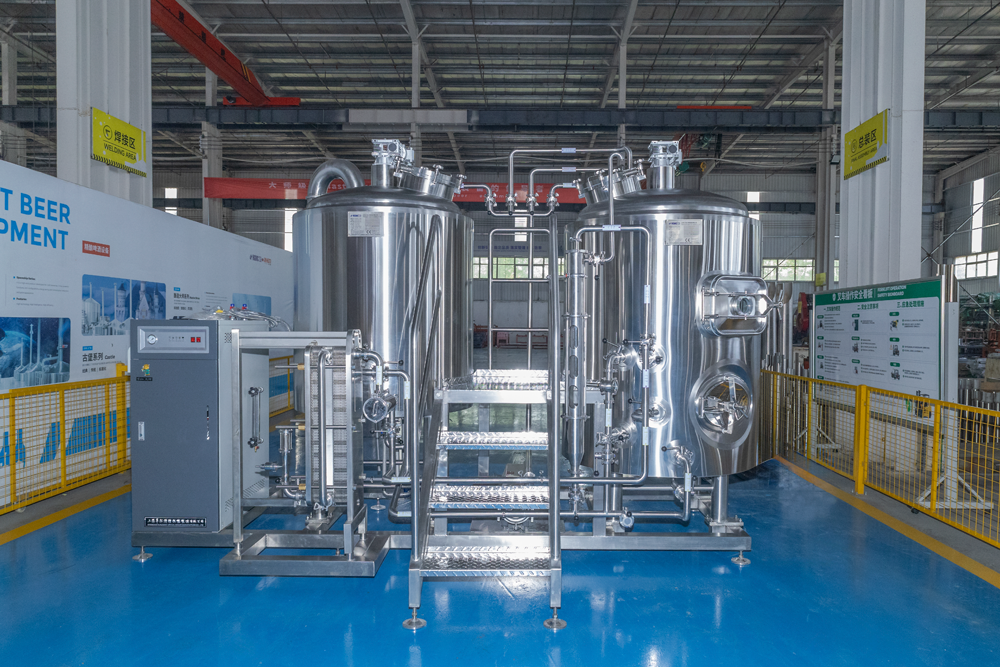
HGMC beer brewing equipment is designed precisely for this new reality. By integrating intelligent control, modular design, and data‑driven process management, HGMC helps breweries of all sizes move from “experienced‑based brewing” to scientifically controlled brewing. This article explains, in practical terms, how HGMC beer brewing equipment solves the core problems that quietly erode a brewery’s profits and reputation.

1. The Hidden Cost in Brewing: Unstable Extract Efficiency
For many breweries, especially craft breweries, the biggest invisible cost is not always labor or rent. It is unstable sugar (extract) efficiency during the brewing process.
When extract efficiency fluctuates, every batch pulls a different amount of fermentable sugars from the same amount of malt. That means:
- You overuse malt to “be safe.”
- Original gravity varies from batch to batch.
- The cost per liter quietly climbs.
- Yield planning becomes unreliable.
Over time, this “invisible drift” in efficiency becomes a serious profit leak.
Intelligent Mashing: Turning Efficiency into a Stable Asset
HGMC beer brewing equipment directly targets this problem with an intelligent mashing system. Instead of relying on manual temperature checks and fixed stirring speeds, HGMC systems perform real‑time regulation of both temperature and stirring rate throughout the mash.
- The wort yield can be stabilized at over 80%.
- The fluctuation range of key parameters is kept within ±1.5%.
By keeping the mashing process under tight control, HGMC equipment turns extract efficiency from an uncertain variable into a predictable and optimizable parameter.
Proven Economic Impact: More Yield, Less Cost
In a comparative study involving 5000 craft breweries that adopted HGMC’s intelligent mashing solution:
- Average raw material cost dropped by 12%.
- The variance of output per batch decreased by 40%.
- Malt budget savings exceeded €15,000 per year on average.
For breweries using HGMC beer brewing equipment, this is not just a technology upgrade. It is a profitability upgrade. More consistent efficiency means less over‑spec malt usage and far better predictability in operating costs.
2. Protecting Brand Reputation: Consistent Flavor, Batch After Batch
In the craft beer world, flavor is the brand. A brewery can build a following with one outstanding IPA or lager, but it can lose that reputation quickly if flavor becomes inconsistent. Customers expect that their favorite beer will taste the same every time they order it.
The greatest risk to brand reputation is therefore not a single failed batch, but small, ongoing flavor deviations that gradually weaken customer trust.
From Art to Replicable Science
HGMC beer brewing equipment is built on a clear philosophy: brewing is both art and science, but high‑level art can only stand on a foundation of replicable science. That is why HGMC places so much emphasis on precise fermentation control.
The core of this system is the temperature control of the fermentation tanks:
- The temperature deviation is kept within ±0.2°C.
- Yeast metabolism is maintained in a stable, optimal range.
- The fluctuation of key yeast metabolites (such as esters and higher alcohols) is narrowed by about 50%.
When fermentation temperature is controlled with this precision, the formation of aroma compounds becomes far more predictable. This results in a tighter distribution of flavor profiles from batch to batch.
Real‑World Results: Fewer Complaints, Stronger Brand
One well‑known brewery that implemented HGMC beer brewing equipment provides a clear example:
- After adopting HGMC’s fermentation solution, the standard deviation of its flagship IPA’s sensory evaluation scores dropped from 2.1 points to 0.8 points.
- The customer complaint rate declined by 70%.
These numbers are not just statistics. They represent a brewery gaining control over its own flavor identity. With HGMC beer brewing equipment, the brand is no longer at the mercy of minor temperature swings or yeast behavior. Flavor stability becomes the norm, not the exception.
3. Solving the Cleaning Headache: Automated CIP for Maximum Uptime
Ask any brewer what they spend a shocking amount of time on, and the answer is almost always the same: cleaning and disinfection.
Poor or inconsistent cleaning creates serious problems:
- Hygiene risks and potential contamination.
- Downtime between batches.
- High consumption of water and cleaning chemicals.
- Physical fatigue and labor costs for the staff.
HGMC addresses this operational pain point with a fully integrated CIP (Clean‑In‑Place) system designed into its beer brewing equipment.
From Manual Cleaning to Intelligent CIP
In traditional setups, cleaning a 4,000‑liter fermentation tank manually can require:
- Around four people.
- Significant physical effort.
- Much longer time and more water.
With the HGMC integrated cleaning system:
- Cleaning time is reduced to about 1.5 hours.
- Water consumption for cleaning is cut by 35%.
- Chemical agent consumption is reduced by 25%.
These numbers are not just about convenience. They translate directly into more effective brewing hours and lower operating costs.
Turning Downtime into Capacity
According to industry data, the average effective production time of brewery equipment (the percentage of time when equipment is actively producing beer, rather than being idle or under cleaning) is around 65%.
With HGMC’s automated CIP system, this can be increased to approximately 85%. For a busy brewery, this improvement is equivalent to:
- Adding around 15 extra brewing batches per year.
- Achieving roughly a 20% increase in potential production capacity.
- Doing so without increasing fixed assets.
In other words, HGMC beer brewing equipment helps breweries “create capacity from time” by reducing cleaning downtime and optimizing resource usage.

4. Breaking Space and Budget Limits: Modular, High‑Density Brewery Design
Many breweries, especially growing craft brands, face the same strategic dilemma:
“We need to increase capacity, but we are limited by space and worried about over‑investing.”
HGMC beer brewing equipment addresses this challenge with a modular, high‑density system design.
More Capacity per Square Meter
Through compact layout and high‑density engineering, HGMC systems can increase production capacity per unit area by about 1.8 times. For example:
- A complete 10‑barrel brewing system can be deployed in a 30‑square‑meter facility.
For breweries in urban environments or with expensive floor space, this density directly reduces rent pressure per unit of production.
Flexible Expansion: Invest with Growth, Not Fear
HGMC beer brewing equipment is built with flexible expansion interfaces, allowing breweries to scale capacity step by step, instead of making one massive, risky investment.
- Breweries can double their production capacity (100% increase) in phases.
- The incremental investment for each expansion can be as low as 30% of the initial system cost.
- This “invest with growth” model lowers the risk of overcapacity from the industry’s typical 60% down to below 20%.
By aligning capacity growth with real market demand, breweries can protect cash flow, reduce financial risk, and still stay ready for rapid expansion when sales rise.
5. From Data Black Hole to Decision‑Making Beacon
For many breweries, production data is either scattered or barely used. Temperatures, pressures, times, and flow rates may be visible on local screens, but they are not integrated into a coherent decision‑making system.
HGMC beer brewing equipment is designed to change that, transforming the brewery from a data black hole into a data‑driven production environment.
IoT‑Enabled Beer Brewing Equipment
HGMC systems are equipped with an Internet of Things (IoT) platform that continuously collects process data:
- Over 200 process data points are captured every second.
- Information includes temperatures, pressures, flow rates, valve positions, fermentation curves, and more.
- Data is uploaded, aggregated, and analyzed in real time.
This is not simply “more data.” It is structured insight that allows breweries to detect patterns, diagnose issues, and optimize processes.
Predictive Warnings: Catch Problems Before They Ruin a Batch
With data streams feeding advanced algorithms, HGMC beer brewing equipment can provide early‑warning signals for abnormal fermentation and other process deviations.
- The system can predict abnormal fermentation with up to 90% probability, 12 hours in advance.
- Brewers receive alerts in time to adjust parameters or intervene before the beer is damaged.
This predictive capability turns quality control from a reactive inspection (after something has gone wrong) into a proactive safeguard.
Case Study: Better Clarity and Longer Shelf Life
A brewery that implemented the HGMC IoT platform achieved several measurable improvements:
- Cold coagulate separation efficiency was optimized by 15%.
- The long‑term turbidity of the beer was reduced by 0.8 EBC.
- Shelf life was extended from 6 months to 9 months.
For breweries targeting wider distribution or export markets, these improvements are critical. Better clarity and longer shelf life directly support higher product value and wider market reach.
6. A Continuous Optimization Roadmap for Brewers
Perhaps the most transformative aspect of HGMC beer brewing equipment is not any single technical feature, but the continuous improvement cycle it enables.
Every brewing process under HGMC’s control becomes an iterative experiment:
- Plan: Define target parameters for mashing, boiling, fermentation, and conditioning.
- Execute: Run the batch using the intelligent, automated control systems.
- Measure: Collect high‑resolution process and quality data via the IoT platform.
- Analyze: Identify where deviations, inefficiencies, or bottlenecks occurred.
- Optimize: Adjust recipes, control curves, or cleaning strategies for the next batch.
Over time, this creates a sustainable optimization roadmap. Instead of repeating the same issues, brewers build an ever‑growing knowledge base of what works best in their unique production environment.
HGMC beer brewing equipment therefore becomes more than hardware. It becomes the central platform for learning, improvement, and innovation.
7. Why HGMC Beer Brewing Equipment Stands Out for Professional Breweries
When comparing brewery equipment manufacturers, it is easy to focus only on basic specs like tank volume, material grade, and visible hardware. While these remain important, modern breweries need to look deeper and ask:
- How stable will my extract efficiency be with this system?
- Can I reliably maintain flavor consistency across hundreds or thousands of batches?
- How much time will my team spend on manual cleaning tasks?
- Can this system support modular expansion without locking me into risky overcapacity?
- Does the equipment give me data I can actually use to improve?
HGMC designs its beer brewing equipment around clear, verifiable answers to these questions.
Key Advantages at a Glance
- Higher EfficiencyIntelligent mashing that keeps wort yield above 80% with minimal fluctuation, and proven raw material cost reductions of around 12%.
- Flavor StabilityFermentation temperature control within ±0.2°C and significant reduction in flavor variability, as demonstrated by lower sensory score deviation and a 70% drop in complaint rates in real cases.
- Operational UptimeAutomated CIP that cuts water and chemical use, reduces manual labor, and increases effective production time from about 65% to around 85%.
- Scalable DesignHigh‑density, modular systems that deliver up to 1.8× capacity per square meter and allow step‑by‑step capacity doubling at approximately 30% of initial investment per expansion.
- Data IntelligenceIoT integration capturing over 200 data points per second, with predictive algorithms that can warn of abnormal fermentation events with up to 90% probability, 12 hours in advance.
- Long‑Term QualityMeasurable improvements such as better cold coagulate separation, lower turbidity, and extended shelf life from 6 to 9 months.
These are not theoretical promises, but metrics derived from real breweries using HGMC beer brewing equipment in daily production.
8. Conclusion: Turning Brewing Challenges into Competitive Advantage
Every brewery, whether a small craft startup or an established regional brand, faces the same fundamental pressures:
- Keep costs under control without sacrificing quality.
- Deliver consistent flavor that builds customer loyalty.
- Use limited space and investment as efficiently as possible.
- Avoid avoidable failures and downtime.
- Build a production system that can grow with the brand.
HGMC beer brewing equipment is engineered to address these pressures head‑on. By combining intelligent control of extract efficiency, precise fermentation management, automated CIP, modular system design, and IoT‑based data analysis, HGMC helps breweries convert operational challenges into clear, measurable competitive advantages.
For breweries that want to move beyond traditional trial‑and‑error brewing, HGMC offers a path where every batch is not just another production run, but a step toward more stable flavor, higher yield, and stronger profitability.
If you are evaluating professional beer brewing equipment or comparing brewery equipment manufacturers, HGMC provides a solution that is not only technically advanced, but also economically rational and strategically future‑proof. By turning brewing into an intelligently managed, data‑driven process, HGMC helps ensure that each tank, each batch, and each investment brings you closer to your ideal beer and your long‑term business goals.
