
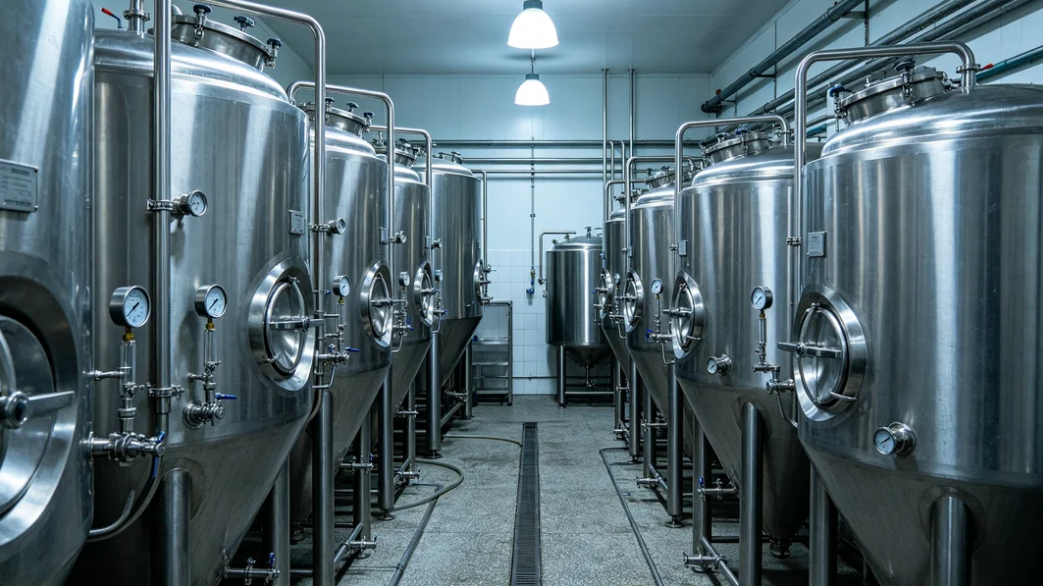
Brewery EquipmentChoosing the right 500L Fermentation Tank can directly affect beer quality, fermentation stability, production efficiency, and future brewery expansion. Buyers should evaluate more than nominal capacity: stainless steel quality, useful and gross volume, cooling area, working pressure, cleaning method, fittings, installation space, and production schedule all matter. A properly configured 500L fermentation tank can provide a practical solution for craft breweries, restaurants, taprooms, pilot production, and growing commercial breweries.
Why Should Buyers Consider a 500L Fermentation Tank?
A 500L Fermentation Tank offers a practical balance between production capacity, flexibility, and equipment footprint. It can be used for craft beer production, brewery expansion, new beer development, and other commercial brewing applications. Multiple 500L tanks can also be combined to increase fermentation capacity without immediately moving to much larger vessels.
The most important point is that buyers should match tank capacity with their actual brewing schedule. A brewery producing several batches per week may require multiple fermentation tanks because the fermentation cycle can extend beyond the time required to brew the next batch.
For example, one 500L fermenter may be sufficient for a small operation with a simple production schedule, while three, four, or more tanks can provide greater flexibility when different beer batches need to ferment simultaneously.
What Is the Useful Capacity of a 500L Fermentation Tank?
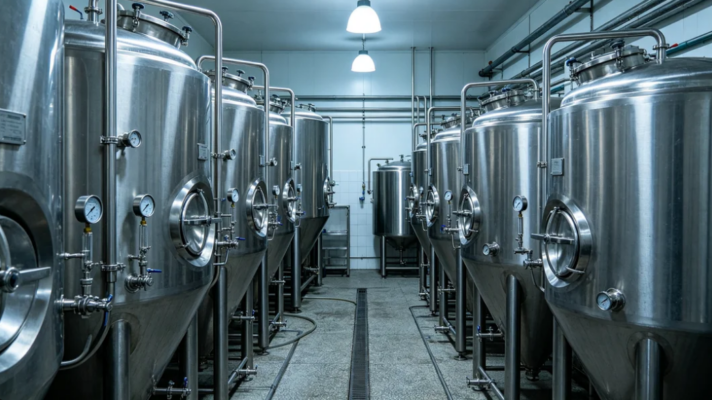
A 500L fermentation tank does not necessarily have a total internal volume of exactly 500L. The HG-FJ-500L model has a 500L useful capacity and 670L gross capacity, providing additional headspace for fermentation and normal operation.
This distinction is important for buyers because yeast activity and carbon dioxide production can create foam and pressure during fermentation. Therefore, the gross capacity needs to be larger than the working volume.
Buyers should always ask the manufacturer to specify both useful capacity and gross capacity rather than comparing tanks based only on the advertised model name.
How Does Stainless Steel Affect 500L Fermentation Tank Performance?
Stainless steel construction is important because fermentation equipment must withstand frequent contact with beer, cleaning chemicals, moisture, and changing operating conditions. The HG 500L fermentation tank uses SUS304 stainless steel, with a listed inner thickness of 3.0 mm and external thickness of 2.5 mm.
SUS304 is widely used for food and beverage equipment because it combines corrosion resistance, durability, cleanability, and suitability for sanitary production environments.
The internal surface finish should also be considered when comparing suppliers. A smoother internal surface can make cleaning easier and reduce areas where beer residues or microorganisms may remain.
Which Technical Parameters Should Buyers Compare?
Buyers should compare the complete technical specification instead of focusing only on tank capacity. The following table summarizes key parameters of the HG-FJ-500L model and several related capacity options.
| Parameter | 500L Fermentation Tank | 1000L Fermentation Tank | 1500L Fermentation Tank | 2000L Fermentation Tank |
|---|---|---|---|---|
| Useful Capacity | 500L | 1000L | 1500L | 2000L |
| Approx. Gross Capacity | 670L | — | — | — |
| Material | SUS304 | SUS304 | SUS304 | SUS304 |
| Heat Exchange Area | 1.8 m² | 2.6 m² | 3.2 m² | 3.6 m² |
| Working Pressure | 0.09 MPa | — | — | — |
| Test Pressure | 0.2 MPa | — | — | — |
| External Size | Ø1060 × 2400 mm | — | — | — |
| Weight | 300 kg | — | — | — |
The 500L model is listed with a 1.8 m² heat exchange area, 0.09 MPa working pressure, 0.2 MPa test pressure, and dimensions of approximately Ø1060 × 2400 mm. The larger capacity models provide additional fermentation volume and may be more appropriate for breweries with higher batch requirements.
Actual specifications for larger tanks should be confirmed with the manufacturer because dimensions, fittings, insulation, cooling configuration, and pressure specifications can vary according to the project.

How Does Temperature Control Affect a 500L Fermentation Tank?
Temperature control is one of the most important functions of a fermentation tank because yeast activity is highly dependent on fermentation temperature. A stable temperature environment helps brewers maintain consistency between batches.
The HG 500L model uses jacket section cooling, with a listed heat exchange area of 1.8 m². The cooling jacket can be connected to a glycol cooling system or another suitable cooling arrangement according to the brewery configuration.
For buyers, the key question is not simply whether a tank has a cooling jacket. Buyers should also evaluate the cooling area, glycol system capacity, temperature sensors, control system, insulation, pipe arrangement, and the number of fermentation tanks connected to the cooling system.
When several 500L fermenters operate simultaneously, the glycol chiller and glycol storage tank should be sized according to the total cooling demand rather than the capacity of a single vessel.
What Configuration Should Buyers Request?
A fermentation tank should be configured according to the brewery’s production process rather than purchased as a basic vessel. The standard 500L design can be equipped with components such as a manhole, butterfly valve, sample valve, safety valve, venting valve, thermometer socket, manometer, and filling-level indicator.
Buyers should pay particular attention to pressure-control components. A pressure gauge and safety valve help operators monitor and manage tank pressure during fermentation and carbonation.
CIP compatibility is another important consideration. A properly configured cleaning system can reduce manual cleaning work and improve sanitation consistency.
Depending on the brewery’s requirements, buyers may also request customized tri-clamp connections, racking arms, hop ports, additional valves, temperature sensors, or other sanitary fittings.
How Many 500L Fermentation Tanks Does a Brewery Need?
The required number of tanks depends on batch size, brewing frequency, fermentation time, beer styles, and expected future production. A single 500L fermenter may work for a small brewery with a limited production schedule, while multiple vessels can support continuous brewing operations.
For example, if a brewery produces 500L of wort per batch but needs several weeks for fermentation and maturation, purchasing only one fermenter could restrict the brewing schedule. Adding multiple tanks allows different batches to occupy separate vessels simultaneously.
Buyers should therefore calculate fermentation capacity using the following factors:
- Batch volume
- Number of brewing days per week
- Average fermentation time
- Maturation or conditioning time
- Number of beer styles
- Expected annual production
- Future expansion plans
This approach can prevent both under-capacity and unnecessary investment.
Is a 500L Fermentation Tank Suitable for Brewery Expansion?
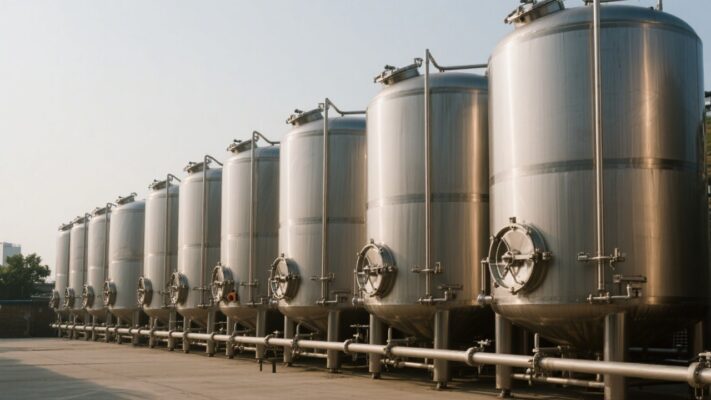
A 500L fermentation tank can be useful when a brewery wants to expand gradually. Instead of replacing the entire fermentation system with large industrial tanks, a brewery can add additional 500L vessels as demand increases.
This modular approach can also make production planning easier. Different tanks can be assigned to different beer styles or production batches, while additional vessels can be introduced as sales volume grows.
For growing breweries, buyers should also check whether the tank manufacturer can supply larger fermentation tanks and compatible brewery equipment in the future. HG’s product range includes fermentation tanks from 300L and 500L through 1000L, 1500L, 2000L and larger capacities.
What Should Buyers Check Before Ordering a 500L Fermentation Tank?
Buyers should confirm the following specifications before placing an order:
- Useful and gross capacity — Confirm the actual working volume and total vessel volume.
- Material — Check whether the tank is manufactured from food-grade stainless steel such as SUS304.
- Cooling system — Confirm jacket type, heat exchange area, glycol connections, and temperature control.
- Working pressure — Make sure the pressure rating matches the intended fermentation and carbonation process.
- Cleaning system — Check whether CIP cleaning is supported.
- Fittings — Confirm valves, manhole, pressure gauge, safety valve, sample valve, and other required connections.
- Dimensions — Verify tank diameter and height against the brewery layout.
- Tank quantity — Calculate the required fermentation capacity according to the production schedule.
- Future expansion — Consider whether additional compatible tanks can be added later.
A complete specification review helps buyers compare suppliers more accurately and reduces the risk of purchasing a tank that does not fit the existing brewing system.
Conclusion: How Should Buyers Choose a 500L Fermentation Tank?
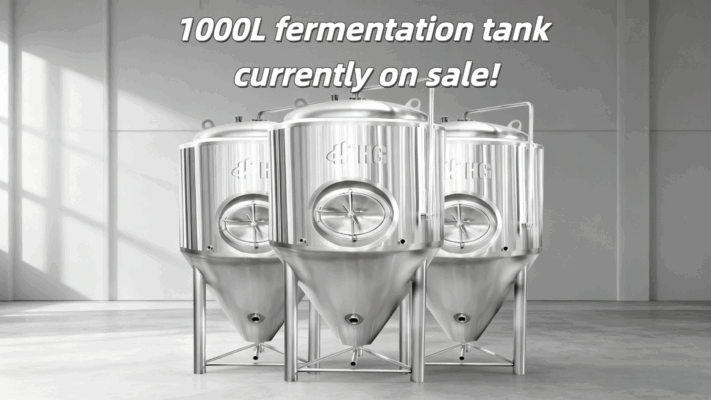
The right 500L Fermentation Tank should be selected according to production requirements rather than capacity alone. Buyers should evaluate useful volume, gross volume, stainless steel construction, cooling performance, pressure control, CIP capability, fittings, dimensions, and future expansion.
For a brewery producing around 500L batches, a properly configured fermentation tank can provide a flexible foundation for stable beer production. When production increases, multiple 500L tanks can be combined or the brewery can transition toward larger fermentation vessels.
For buyers planning a new brewery or upgrading an existing fermentation cellar, the most effective approach is to provide the manufacturer with batch size, brewing frequency, fermentation time, target output, available space, beer styles, and future expansion plans. The manufacturer can then recommend a tank configuration that matches the complete brewing process rather than supplying an isolated vessel.
Frequently Asked Questions About 500L Fermentation Tanks
1. What is the actual capacity of a 500L Fermentation Tank?
A 500L fermentation tank normally refers to its useful working capacity. For example, the HG-FJ-500L model has a 500L useful capacity and 670L gross capacity, allowing additional headspace for fermentation.
2. What material is commonly used for a 500L Fermentation Tank?
SUS304 stainless steel is commonly used for professional beer fermentation tanks because it provides corrosion resistance, durability, and a sanitary surface suitable for food and beverage production. The HG-FJ-500L uses SUS304 stainless steel.
3. How many 500L fermentation tanks does a brewery need?
The required quantity depends on batch size, brewing frequency, fermentation duration, maturation time, beer varieties, and planned production volume. Multiple tanks are useful when breweries need different batches to ferment simultaneously.
4. Can a 500L Fermentation Tank be customized?
Yes. Buyers can request different configurations according to their production process, including cooling systems, pressure-control components, CIP solutions, valves, fittings, sensors, and other accessories. The manufacturer should confirm the final configuration before production.
