
Choosing the right brewery equipment capacity requires more than selecting a 500L or 1,000L brewhouse. Buyers should calculate expected beer sales, brewing frequency, fermentation time, packaging demand, and available space before investing. A well-matched brewery system helps control startup costs, maintain production efficiency, and support future expansion. The best configuration is not necessarily the largest one, but the system that can meet current demand while allowing the business to grow.
Why Should Buyers Calculate Brewery Equipment Capacity Before Purchasing?
Buyers should start with their expected sales volume and work backward to determine the required brewing capacity. A taproom serving local customers may need a different setup from a brewery supplying restaurants, distributors, or supermarkets.
Before requesting a quotation, estimate monthly sales, planned operating weeks, batches per week, and the beer styles you intend to produce. These figures help determine whether a small nano brewery, a microbrewery system, or a larger commercial brewing line is appropriate.
It is also important to distinguish between wort production and finished beer output. Beer losses during fermentation, transfers, conditioning, and packaging mean that the final packaged volume is usually lower than the original wort volume.
What Brewery Equipment Capacity Is Suitable for Different Business Sizes?
The right brewery equipment capacity depends on production targets, available investment, and the expected frequency of brewing. The following table provides illustrative planning ranges rather than fixed industry standards.
| Brewhouse Capacity per Batch | Example Brews per Week | Annual Wort Volume* | Suitable Application |
|---|---|---|---|
| 100L | 3 | 13,500L | Pilot brewing and very small operations |
| 300L | 3 | 40,500L | Nano breweries and small taprooms |
| 500L | 4 | 90,000L | Microbreweries and local distribution |
| 1,000L | 5 | 225,000L | Growing craft breweries |
| 2,000L | 5 | 450,000L | Higher-volume commercial production |
*Illustrative calculation based on 45 operating weeks per year. Annual wort volume equals batch volume multiplied by brews per week and operating weeks. Actual packaged output will be lower and depends on production yield and operating conditions.
Buyers should compare these figures with realistic demand instead of assuming that a larger brewhouse automatically generates higher profits. Underused equipment increases capital costs, while insufficient capacity may restrict sales and delay deliveries.
How Should Buyers Calculate Annual Beer Production?
Annual production can be estimated using a simple formula:
Annual wort volume = Wort volume per batch × Batches per week × Operating weeks per year
For example, a 500L brewing system running four batches per week for 45 weeks produces an estimated 90,000L of wort annually. If the planning yield is 85%, estimated packaged beer output would be approximately 76,500L.
This calculation is only a starting point. Buyers should also allow time for maintenance, cleaning, recipe development, staff training, and seasonal changes in demand. Preparing conservative, expected, and growth scenarios makes it easier to select equipment without overinvesting.
How Many Fermentation Tanks Does a Brewery Need?
Fermentation capacity must match both the brewhouse output and the time beer spends in the cellar. A brewhouse may produce wort quickly, but fermentation and conditioning can occupy tanks for days or weeks before the beer is ready for packaging.
Buyers should consider tank working volume, batch transfer volume, fermentation time, beer styles, cleaning schedules, and temperature-control requirements. Lager production or beers requiring extended conditioning may need more tank capacity than a similar-volume operation focused on faster-turnaround ales.
The number of tanks should therefore be calculated from a production calendar, not simply copied from another brewery. A tank schedule showing filling, fermentation, conditioning, emptying, and cleaning dates can reveal potential bottlenecks before equipment is ordered.
What Other Equipment Must Match the Brewing Capacity?
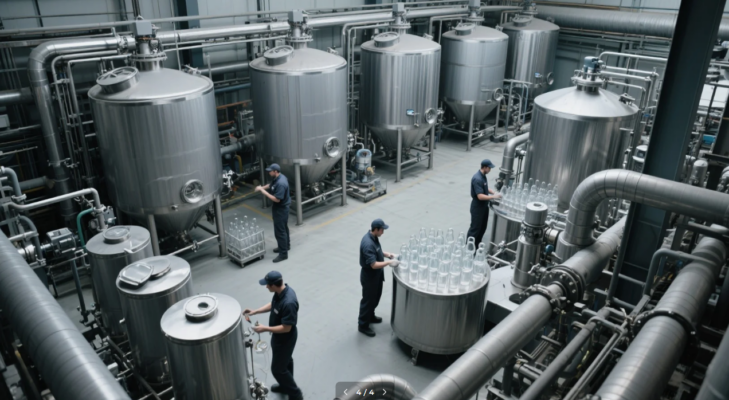
A complete brewery system needs balanced brewhouse, cellar, cooling, cleaning, and packaging capacity. If any major component is undersized, it can limit the output of the entire production line.
Bright beer tanks should support the planned serving or packaging schedule. Cooling equipment must handle wort chilling and fermentation temperature control, while the cleaning-in-place system should support the number of vessels and the required cleaning frequency.
Packaging equipment also deserves careful attention. A filling machine’s advertised maximum speed may not reflect practical output after allowing for container changes, cleaning, foam control, and operator work. Buyers should ask suppliers for expected operating performance using their intended bottle, can, or keg format.
What Should Buyers Check Before Ordering Brewery Equipment?
Buyers should confirm the technical specifications, building conditions, and scope of supply before approving a quotation.
Key checks include:
- Capacity definitions: Confirm nominal volume, working volume, and expected packaged output.
- Building layout: Check floor space, ceiling height, access doors, drainage, and tank installation routes.
- Utilities: Verify electrical supply, water availability, heating requirements, and glycol cooling capacity.
- Automation and staffing: Match the control system to the team’s skills and production schedule.
- Quotation details: Confirm whether tanks, pumps, piping, valves, controls, cooling, cleaning equipment, installation, and training are included.
- Expansion options: Reserve space and utility connections for additional fermentation tanks or packaging upgrades.
A detailed production target helps a brewery equipment manufacturer prepare a more accurate proposal. Buyers should provide planned annual output, batch size, beer styles, packaging format, building dimensions, budget, and future growth expectations.
How Can Buyers Plan for Future Brewery Expansion?
Buyers can reduce future upgrade costs by planning expansion before the first equipment order. It may not be necessary to purchase every tank immediately, especially when demand is still uncertain.
Instead, discuss whether the initial glycol system, utilities, floor layout, piping routes, and control system can accommodate additional vessels later. This approach can help control startup investment while keeping the brewery ready for growth.
The final decision should balance current demand, operating efficiency, available capital, and long-term business goals. A properly sized brewery equipment system should support reliable production today without making future expansion unnecessarily expensive.
Frequently Asked Questions
1. What brewery equipment capacity is best for a new brewery?
It depends on expected sales, brewing frequency, beer styles, budget, and available space. Small taproom-focused operations may begin with a smaller system, while breweries supplying multiple distributors may need greater capacity.
2. Does a 500L brewing system produce 500L of packaged beer per batch?
Not necessarily. The stated capacity may refer to the brewhouse or vessel volume. Fermentation, transfer, conditioning, and packaging losses can reduce the final packaged volume.
3. Should fermentation tanks have the same capacity as the brewhouse?
Their working volume should accommodate the wort transferred from each batch, but total tank volume may be larger to provide operating headspace. Tank quantity should also reflect fermentation time and the brewing schedule.
4. Is it better to buy larger brewery equipment for future growth?
Not always. Oversized equipment can increase initial costs and remain underused. A practical alternative is to purchase equipment that meets realistic current demand while reserving space and utilities for future expansion.
