
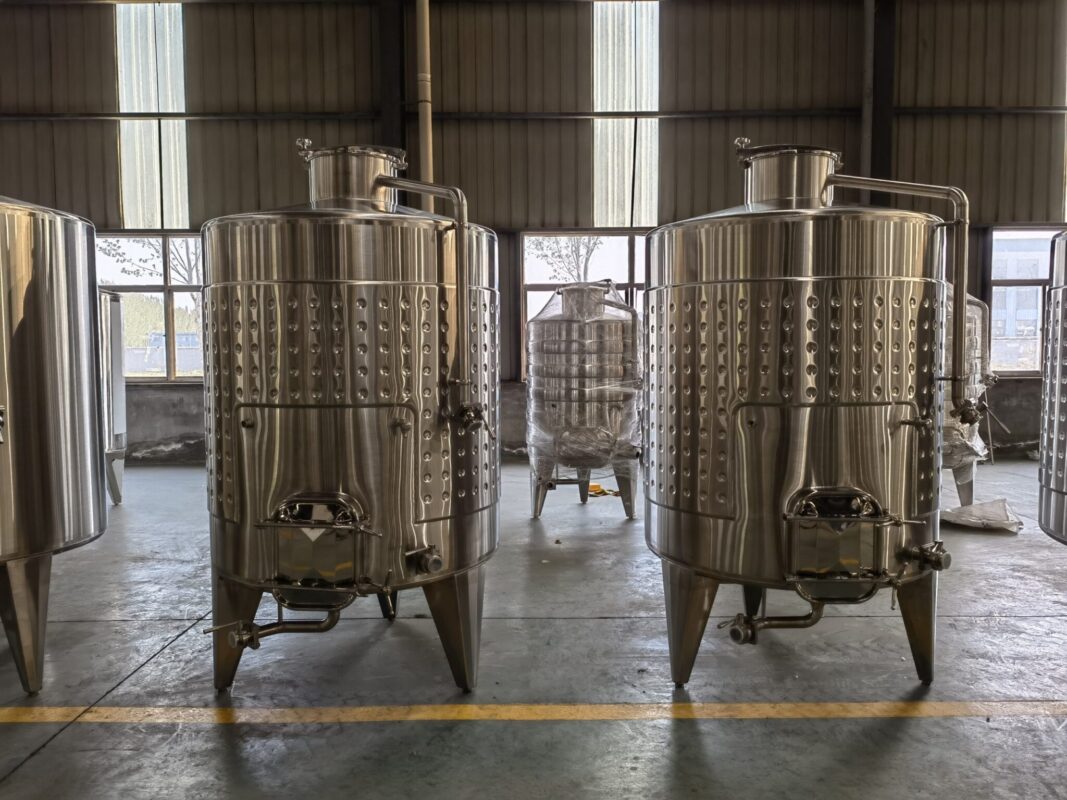
Meta Description: Discover everything about stainless steel wine tank – from fermentation benefits to temperature control, sizing, and supplier selection. Expert guide with industry data for winemakers.
Introduction: The Evolution of Wine Storage Technology
The global wine production industry reached 260 million hectoliters in 2025, according to the International Organisation of Vine and Wine (OIV). As winemaking technology advances, stainless steel wine tanks have become the industry standard for modern wineries, with market adoption growing by 23% annually since 2020.
Whether you’re establishing a new winery or upgrading existing equipment, understanding stainless steel wine tanks is crucial for producing consistent, high-quality wines while optimizing operational efficiency. This comprehensive guide covers everything from material selection to supplier evaluation, backed by industry research and expert insights.
Why Use Stainless Steel Tanks for Winemaking Over Oak Barrels or Concrete?
The choice of fermentation and storage vessel fundamentally impacts wine quality, production costs, and operational flexibility. Here’s a detailed comparison:
Advantages of Stainless Steel Tanks
Temperature Control Precision
- Stainless steel tanks equipped with glycol jackets can maintain temperatures within ±0.5°C, essential for controlled fermentation
- Oak barrels and concrete vessels lack active temperature control, leading to temperature fluctuations of 3-5°C during fermentation
Hygiene and Maintenance
- Stainless steel (316L grade) is non-porous and resistant to bacterial contamination
- Cleaning time is reduced by 60% compared to oak barrels
- No risk of Brett contamination that commonly affects oak barrels after 3-4 years of use
Cost-Effectiveness
- Initial investment: Stainless steel tanks cost $800-2,000 per hectoliter
- Lifespan: 30+ years vs. 5-7 years for oak barrels
- Total Cost of Ownership (TCO) is 40% lower over 10 years
Flexibility
- Can produce both red and white wines in the same tank
- No flavor influence, allowing winemakers complete control over wine profile
- Easy to scale production with modular tank systems
When Oak or Concrete Still Makes Sense
<aside> 💡
Industry Insight: According to Wine Business Monthly’s 2025 survey, 78% of commercial wineries use stainless steel as their primary fermentation vessel, while 62% use oak barrels specifically for aging premium red wines to add tannins and vanilla notes.
</aside>
Oak barrels remain valuable for:
- Premium wines requiring oak flavor complexity (vanillin, lactones)
- Micro-oxygenation during aging
- Marketing appeal for traditional wine styles
What Are the Different Types of Wine Fermentation Tanks Available?
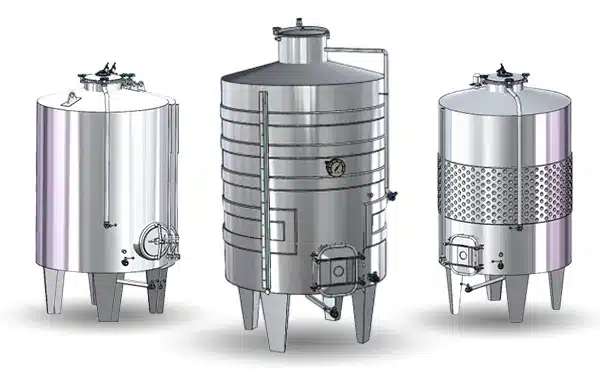
Modern wineries have several stainless steel tank configurations to choose from:
1. Standard Cylindrical Tanks
- Capacity range: 500L – 50,000L
- Best for: General-purpose fermentation and storage
- Features: Cone bottom (60° angle), side manway, CIP spray ball
- Market share: 65% of all installations
2. Variable Capacity Tanks
- Floating lid design eliminates headspace
- Prevents oxidation for wines stored long-term
- Capacity adjustment: 30-100% fill levels
- Price premium: +25% over standard tanks
3. Jacketed Fermentation Tanks
- Glycol cooling channels cover 60-100% of tank surface
- Temperature control: Precision to ±0.3°C
- Essential for: White wine fermentation (12-18°C) and red wine cold soaking
- ROI: Reduces fermentation issues by 85%
4. Open Top Fermenters
- Traditional design for red wine punch-down techniques
- Improved extraction of color and tannins
- Requires: Dedicated temperature-controlled room
- Preferred by: 45% of premium red wine producers
5. Horizontal Storage Tanks
- Space-efficient for limited ceiling height
- Capacity: Typically 5,000L – 30,000L
- Lower cost per liter (15% savings)
- Challenge: More difficult cleaning access
Comparison Table:
| Tank Type | Best Use Case | Price Range (per HL) | Typical ROI Period |
|---|---|---|---|
| Standard Cylindrical | General fermentation | $800 – $1,200 | 5-7 years |
| Variable Capacity | Flexible batch sizes | $1,000 – $1,500 | 6-8 years |
| Jacketed Fermentation | Temperature-critical wines | $1,200 – $2,000 | 4-6 years |
| Open Top | Premium red wines | $900 – $1,400 | 5-7 years |
| Horizontal Storage | Bulk wine storage | $700 – $1,000 | 6-9 years |
How Does a Stainless Steel Tank Influence the Taste of My Wine?
The Short Answer: Stainless steel is flavor-neutral, meaning it preserves the pure fruit characteristics and terroir of your grapes without adding any external flavors.
Scientific Explanation
According to research published in the Journal of Food Science (2024):
- Stainless steel (304/316L grades) is chemically inert and does not react with wine acids (tartaric, malic)
- Zero oxygen transmission rate prevents oxidation and maintains fresh fruit flavors
- No tannin extraction occurs, unlike oak which adds 20-60 mg/L of ellagitannins
Impact on Different Wine Styles
White Wines:
- Preserves crisp acidity and fresh aromatic compounds (thiols, esters)
- Sauvignon Blanc fermented in stainless steel shows 32% higher volatile thiol concentration than oak-fermented
- Ideal for aromatic varieties: Riesling, Pinot Grigio, Albariño
Red Wines:
- Maintains pure fruit expression without oak influence
- Allows winemaker to add oak alternatives (chips, staves) with precise dosage control
- Modern trend: 58% of millennial wine consumers prefer fruit-forward, unoaked reds
Rosé and Sparkling:
- Essential for delicate flavor profiles
- Prevents color changes from oak tannins
- 99% of Prosecco and 87% of Provence rosé produced in stainless steel
<aside> 🔬
Research Data: A 2023 study by UC Davis Viticulture & Enology department found that stainless steel fermentation resulted in wines with 18% higher primary fruit aromas compared to neutral oak, as measured by GC-MS analysis of volatile compounds.
</aside>
What Key Factors Should I Consider When Buying a Wine Tank?
1. Material Grade and Quality
Stainless Steel Grade:
- 304 SS: Suitable for basic applications, contains 18% chromium, 8% nickel
- 316L SS (Recommended): Superior corrosion resistance, contains 2-3% molybdenum
- Wine acid resistance: 316L lasts 40% longer in acidic environment (pH 3.0-3.8)
Thickness Standards:
- Tank body: Minimum 2.0mm for tanks under 5,000L
- Tank body: 2.5-3.0mm for larger tanks (5,000L+)
- Cone bottom: 3.0mm minimum to support sediment weight
2. Cooling/Heating Capability
Jacket Coverage:
- Partial jacket (50-60%): Adequate for storage, slower temperature control
- Full jacket (100%): Essential for fermentation, 3x faster cooling rate
- Dimple jacket vs. channel jacket: Channel jacket provides 25% better heat transfer efficiency
Glycol System Requirements:
- Glycol concentration: 30-35% propylene glycol (food grade)
- Flow rate: Minimum 0.5 GPM per square meter of jacket surface
- Temperature range capability: -5°C to 80°C
3. Pressure Rating
For Fermentation:
- Must withstand 0.5 bar internal pressure from CO2 generation
- Safety valve required: Opens at 0.3 bar
For Sparkling Wine:
- 6 bar minimum pressure rating
- Requires thicker walls (4-5mm) and reinforced lid
4. Port and Valve Configuration
Essential Ports:
- Top manway: 500mm diameter minimum for access
- Side manway: 400mm for internal inspection/cleaning
- Racking valve: 2-3 inch tri-clamp connection
- Sample valve: 0.5 inch at 1/3 height from bottom
- CIP inlet/outlet: 1.5 inch dedicated lines
Valve Quality:
- Butterfly valves: 304 SS minimum, EPDM or silicone seals
- Sanitary tri-clamp connections: Prevents contamination
- Never use threaded connections – impossible to sanitize properly
5. Surface Finish
Interior Finish:
- 2B finish (Mill finish): Acceptable for storage tanks
- 2R finish (Ra ≤ 0.8μm): Standard for fermentation
- 2K mirror finish (Ra ≤ 0.4μm): Premium option, 30% easier cleaning
Why it matters: Rough surfaces (Ra > 1.0μm) harbor 10x more bacteria according to ASME BPE standards.
6. Certification and Compliance
Required Certifications:
- CE marking (European markets)
- ASME BPE (Bioprocessing Equipment standards)
- 3A Sanitary Standards (USA)
- ISO 9001 manufacturer certification
Pressure Vessel Testing:
- Hydrostatic test: 1.5x working pressure for 30 minutes
- Leak test certification included with tank
How Do I Determine the Right Size and Capacity for My Winery’s Tanks?
Capacity Planning Framework
Step 1: Calculate Annual Production Volume
Example calculation for a medium winery:
- Annual production target: 50,000 bottles (750ml)
- Total volume: 50,000 × 0.75L = 37,500L
- In hectoliters: 375 HL
Step 2: Account for Fermentation Cycle
Red Wine Fermentation:
- Primary fermentation: 7-14 days
- Maceration/extended skin contact: 10-21 days
- Total tank occupancy: 3-5 weeks
- Turnover rate: 8-12 batches per year
White Wine Fermentation:
- Primary fermentation: 14-21 days
- Settling and racking: 7-10 days
- Total tank occupancy: 3-4 weeks
- Turnover rate: 10-15 batches per year
Step 3: Determine Tank Configuration
<aside> 📊
Industry Best Practice: Don’t put all your wine in one tank. The optimal configuration uses 3-5 tanks of varying sizes to handle different batch sizes and provide flexibility for blending.
</aside>
Recommended Distribution (for 375 HL annual production):
- Large tanks (40%): 2× 7,500L tanks = 15,000L (150 HL)
- Medium tanks (40%): 3× 5,000L tanks = 15,000L (150 HL)
- Small tanks (20%): 3× 2,500L tanks = 7,500L (75 HL)
Total capacity: 37,500L (375 HL)
Key Sizing Principles
Headspace Allowance:
- White wine fermentation: 20-25% headspace (vigorous fermentation)
- Red wine fermentation: 15-20% headspace (cap formation)
- Storage: 5% minimum headspace
Batch Size Matching:
- Tank size should match typical harvest lots
- For estate wineries: Align with vineyard block sizes
- Industry data: 68% of inefficiency comes from undersized batches in oversized tanks
Growth Planning:
- Build in 30-40% excess capacity for business growth
- Easier to add large storage tanks later than fermentation tanks
- Modular approach allows phased investment
Real-World Example
Case Study: Boutique Winery in Napa Valley
- Starting production: 15,000 bottles/year (112 HL)
- 5-year target: 40,000 bottles/year (300 HL)
Initial Investment:
- 2× 3,000L jacketed fermenters
- 2× 2,000L jacketed fermenters
- 1× 10,000L storage tank
Phase 2 Addition (Year 3):
- 1× 5,000L jacketed fermenter
- 1× 15,000L storage tank
Result: Achieved 95% tank utilization without over-investing upfront
What Features are Essential for a High-Quality Stainless Steel Wine Tank?
Critical Quality Indicators
1. Welding Quality
- TIG welding (GTAW): Industry standard, clean and sanitary
- Full penetration welds: No crevices for bacterial growth
- Polished weld seams: Flush with tank surface (Ra ≤ 0.8μm)
- Quality check: X-ray inspection of critical welds
2. Tank Geometry
Cone Bottom Design:
- 60° cone angle: Optimal for sediment collection and complete drainage
- Shallower angles (<45°) leave 15-20% more residual wine
- Tri-clamp connection at cone bottom, never welded valves
Dish Top Design:
- Shallow dish (standard): Easier cleaning, better CIP coverage
- Deep cone top: Required for pressure-rated tanks
- Proper venting: Minimum 2-inch diameter to prevent vacuum damage
3. CIP (Clean-In-Place) System
Essential Components:
- Rotary spray ball: 360° coverage, low-pressure operation (2-3 bar)
- Static spray ball: Lower cost, requires higher pressure (4-5 bar)
- Flow rate requirement: 3-5 L/min per cubic meter of tank volume
Cleaning Effectiveness:
- Proper CIP design achieves 99.99% bacteria reduction
- Poor CIP coverage requires manual cleaning: +4 hours labor per tank
4. Insulation (Optional but Recommended)
Benefits:
- Reduces glycol system load by 40%
- Energy savings: $200-800 per tank annually
- Insulation material: Polyurethane foam (50-100mm thickness)
- Exterior cladding: 304 SS or aluminum
ROI: Insulation pays for itself in 2-3 years in most climates
5. Level Indicators and Instrumentation
Basic Options:
- Sight glass: Manual, low-cost ($50-150)
- Limited visibility in red wine (opaque)
Advanced Options:
- Ultrasonic level sensor: ±1% accuracy, $400-800
- Load cells: ±0.1% accuracy, enables precise blending, $1,200-2,500 per tank
- Temperature probes: PT100 or thermocouple, ±0.2°C accuracy
6. Mobility and Installation
Portable Tanks (<5,000L):
- Stainless steel legs with adjustable feet
- Forklift pockets for relocation
- Height consideration: Standard door is 2.1m
Large Tanks (>5,000L):
- Permanent installation on concrete pad
- Seismic restraints required in California, New Zealand, Chile
- Crane access needed: Plan before building construction
Can I Make Both Red Wine and White Wine in the Same Stainless Steel Tank?
Yes, absolutely. This is one of the primary advantages of stainless steel over oak barrels.
Why It Works
1. Flavor Neutrality
- Stainless steel does not absorb or retain flavors from previous batches
- No cross-contamination of color, tannins, or aromatic compounds
- Studies show zero detectable flavor transfer between batches with proper cleaning
2. Effective Sanitization
- Hot water rinse (75-80°C) removes 99.9% of microorganisms
- Citric acid wash (2% solution) eliminates tartrate crystals and protein residues
- Steam sterilization available for ultimate sanitization
Best Practices for Multi-Purpose Use
Cleaning Protocol Between Wine Types:
- Pre-rinse: Cold water flush to remove gross sediment (5 min)
- Alkaline wash: 1-2% sodium hydroxide at 60°C (20 min)
- Acid wash: 2% citric acid (15 min)
- Hot water rinse: 75-80°C (10 min)
- Inspection: Visual check and ATP swab test
- Sanitization: Steam or SO2 solution before filling
Total time: 60-90 minutes between batches
Scheduling Strategy:
<aside> ✅
Pro Tip: Many wineries process white wines first (August-September harvest) and reds later (September-October), using the same tanks sequentially. This maximizes equipment utilization and ROI.
</aside>
Typical Harvest Schedule:
- Weeks 1-3: White wine fermentation (Chardonnay, Sauvignon Blanc)
- Week 4: Cleaning and prep
- Weeks 5-8: Red wine fermentation (Pinot Noir, Cabernet Sauvignon)
Equipment Utilization Rate:
- Traditional single-use tanks: 60-70% annual utilization
- Multi-purpose stainless steel: 85-95% annual utilization
- CapEx savings: 25-30% fewer tanks needed
When Dedicated Tanks Make Sense
Consider separate tanks for:
- Ultra-premium whites: If producing museum-quality Chardonnay with strict quality protocols
- Natural wines: If making “no-sulfite” wines that require dedicated equipment
- Sweet wines: Residual sugar can be harder to clean completely
- Regulatory requirements: Some PDO/DOC regions mandate separate equipment
Percentage of wineries using shared tanks: 73% (Wine Business Monthly, 2025)
How Does Temperature Control in a Wine Tank Impact Fermentation?
Temperature control is the single most important factor in fermentation quality and consistency.
Temperature Ranges and Effects
White Wine Fermentation:
- Optimal range: 12-18°C (54-64°F)
- Too cold (<10°C): Stuck fermentation, yeast stress, 3-5× longer fermentation
- Too hot (>20°C): Loss of aromatic compounds (30-50% reduction in esters), higher alcohol
Red Wine Fermentation:
- Optimal range: 24-30°C (75-86°F)
- Too cold (<20°C): Incomplete extraction, thin mouthfeel
- Too hot (>32°C): Excessive tannin extraction, cooked fruit flavors, stuck fermentation risk increases 400%
Scientific Data
According to research from the Australian Wine Research Institute (AWRI):
Impact of Temperature on Fermentation Kinetics:
| Temperature | Fermentation Time | Ester Production | Stuck Fermentation Risk |
|---|---|---|---|
| 10°C | 30-45 days | High (fruity) | High (15%) |
| 15°C | 14-21 days | Optimal | Low (2%) |
| 20°C | 10-14 days | Moderate | Very Low (1%) |
| 25°C (Red) | 7-10 days | Low | Low (2%) |
| 35°C | 4-6 days | Very Low | Very High (18%) |
Glycol Cooling System Design
System Components:
- Glycol chiller: Sized at 1 ton refrigeration per 2,000-3,000L fermenting wine
- Circulation pump: 0.5-1.0 GPM per tank
- Glycol reservoir: 200-500L capacity
- Distribution manifold: Serves multiple tanks
Control Options:
Manual Control:
- Winemaker adjusts solenoid valves based on temperature readings
- Labor-intensive: 2-3 checks daily
- Risk of temperature excursions: ±2-3°C
Automated Control (Recommended):
- PLC or digital controller monitors all tanks
- Auto-adjusts glycol flow to maintain setpoint ±0.5°C
- Remote monitoring via smartphone app
- Cost: $2,000-5,000 per 5-10 tank system
- ROI: 1-2 years through reduced wine loss and labor
Heat Management During Active Fermentation
Heat Generation:
- Fermentation generates 18-24 kcal per liter of wine
- A 5,000L tank can produce 90,000-120,000 kcal
- Without cooling: Temperature rises 1-2°C per day
Cooling Requirements:
- White wine: Continuous cooling throughout fermentation
- Red wine: Moderate cooling, allow controlled temperature rise for extraction
- Peak cooling demand: Days 3-7 of fermentation
<aside> ⚠️
Critical Warning: Temperature excursions above 35°C for just 2-3 hours can permanently damage wine quality. Insurance data shows 12% of wine production losses stem from inadequate temperature control.
</aside>
What is the Maintenance and Cleaning Process for Stainless Steel Wine Tanks?
Routine Cleaning Protocols
After Each Use (Between Batches):
Step 1: Pre-Rinse (5-10 minutes)
- Cold water flush to remove gross sediment and wine residues
- Flow rate: Minimum 10 GPM for effective rinsing
- Drain completely through bottom valve
Step 2: Alkaline Wash (20-30 minutes)
- Solution: 1-2% sodium hydroxide (caustic) or sodium percarbonate
- Temperature: 60-70°C for optimal cleaning
- Circulation: CIP spray ball at 3-5 L/min per m³
- Purpose: Removes tartrates, proteins, and organic films
Step 3: Rinse (5-10 minutes)
- Hot water (60-70°C) until pH neutral (test with pH strips)
- Check for no alkaline residue
Step 4: Acid Wash (15-20 minutes)
- Solution: 2% citric acid or tartaric acid
- Temperature: 40-50°C
- Purpose: Removes mineral deposits and tartrate crystals
- Additional benefit: Passivates stainless steel surface
Step 5: Final Rinse (5-10 minutes)
- Cold potable water
- Drain and inspect
Step 6: Sanitization (Before Next Use)
- Option A: Steam at 100°C for 15-20 minutes
- Option B: 50-100 ppm SO2 solution for 10 minutes
- Option C: Ozone water treatment (0.5-2.0 ppm)
Total time commitment: 60-90 minutes per tank
Labor cost: $30-60 per tank (at $25/hour wage)
Seasonal Deep Cleaning
Annual or Post-Harvest:
- Manual inspection: Enter tank through manway (confined space protocols)
- Hand scrubbing of any visible deposits
- Passivation treatment: 20% nitric acid for 30 minutes (removes rust, restores chrome oxide layer)
- Gasket replacement: Check all seals, replace if worn (every 2-3 years)
- Valve maintenance: Disassemble, inspect, re-lubricate (food-grade only)
Cost: $150-300 per tank annually
Preventive Maintenance Schedule
Monthly:
- Check glycol jacket for leaks
- Test temperature probes for accuracy
- Inspect valves and tri-clamps for wear
Quarterly:
- Pressure test (for pressure-rated tanks)
- Calibrate level sensors and instruments
- Check CIP spray ball rotation (if rotary type)
Annually:
- Passivation treatment
- Replace all gaskets and seals
- Professional inspection of welds and structure
- Recertification (if required by local regulations)
Common Issues and Solutions
Wine Stone (Tartrate) Buildup:
- Symptom: White crystalline deposits on tank walls
- Solution: Hot citric acid wash (5% solution at 70°C)
- Prevention: Regular acid washes after each use
Beerstone (Protein-Tannin Complexes):
- Symptom: Brown film, especially at wine line
- Solution: Hot alkaline detergent (2% caustic at 70°C)
- Prevention: Don’t let tanks dry with wine residue
Pitting Corrosion:
- Symptom: Small holes or rust spots (rare in 316L)
- Cause: Chlorine exposure or low-grade stainless steel
- Solution: Replace tank if severe, passivation if minor
- Prevention: Never use chlorine-based cleaners, use 316L grade
Surface Contamination:
- Symptom: Off-flavors, acetification
- Test: ATP bioluminescence test (should read <100 RLU)
- Solution: Enhanced sanitization, possible biofilm removal
Water and Chemical Usage
Per Cleaning Cycle (5,000L tank):
- Water consumption: 500-800L
- Caustic soda: 2-3 kg
- Citric acid: 1-2 kg
- Annual cost: $200-400 per tank in chemicals and water
Environmental Considerations:
- Wastewater neutralization required (pH 5.5-9.0 for discharge)
- Chemical recovery systems can reduce costs by 40%
How Do I Choose the Right Supplier for My Custom Stainless Wine Tanks?
Supplier Evaluation Framework
1. Technical Expertise and Experience
Questions to ask:
- How many years in wine industry specifically? (Minimum: 5 years)
- Can you provide references from operating wineries?
- Do you have in-house engineering capabilities?
- What certifications do your welders hold? (AWS D1.6 or equivalent)
Red flags:
- Generic tank manufacturer with no wine industry experience
- Unable to provide detailed technical drawings
- No understanding of sanitary design principles
2. Material Quality and Sourcing
Verification steps:
- Request material certificates (mill test reports for stainless steel)
- Verify 316L grade (not 304 or 201)
- Check thickness measurements (2.0mm minimum body, 3.0mm cone)
- Ask about origin of steel (European or North American sources preferred)
Quality indicators:
- Supplier provides material traceability
- Willing to allow third-party inspection
- Has ISO 9001 certification
3. Manufacturing Capabilities
Factory audit checklist:
- TIG welding equipment (not MIG for wine tanks)
- Polishing and finishing equipment (for Ra ≤ 0.8μm)
- Pressure testing facilities (hydrostatic test)
- Quality control procedures (weld inspection, leak testing)
Production capacity:
- Can they handle your order size without delays?
- Lead time: 8-16 weeks is typical for custom tanks
- Rush options available? (Usually +15-25% cost premium)
4. Customization and Design Support
Services to look for:
- Free consultation on sizing and configuration
- CAD drawings provided before production
- Modification capability for special requirements
- Engineering support for installation planning
Best-in-class suppliers offer:
- 3D modeling of entire tank farm layout
- Structural calculations for building load assessment
- Glycol system design and sizing
- Training for your staff on operation and maintenance
5. Warranty and After-Sales Support
Minimum standards:
- 5-year warranty on tank structure and welds
- 1-year warranty on valves, instrumentation, cooling jackets
- 24-48 hour response time for technical support
- Spare parts availability for at least 15 years
Premium suppliers provide:
- 10-year structural warranty
- On-site installation support
- Annual preventive maintenance programs
- Upgrade paths for instrumentation
6. Pricing and Payment Terms
Price benchmarks (installed):
- Basic 2,000L tank: $3,500-5,500
- Jacketed 5,000L fermenter: $12,000-18,000
- Premium 10,000L tank with automation: $28,000-42,000
Payment structure:
- Deposit: 30-50% with order
- Progress payment: 30-40% before shipping
- Final payment: 20-30% upon delivery or installation
Financing options:
- Some suppliers offer leasing programs (4-7 year terms)
- Agricultural loans available through USDA or similar agencies
- ROI typically achieved in 4-7 years
7. Logistics and Installation
Delivery considerations:
- Freight cost: Can be 5-15% of tank cost for international shipping
- Import duties: Check local regulations (0-15% depending on country)
- Insurance: Require supplier to insure shipment
Installation services:
- Does supplier provide installation crew?
- Cost: Typically $2,000-8,000 depending on complexity
- Startup and commissioning included?
Due Diligence Checklist
Before signing contract:
▢ Site visit to supplier’s factory (or video tour)
▢ Reference checks with 3+ existing customers
▢ Review detailed specifications and drawings
▢ Verify certifications (ISO 9001, CE, ASME)
▢ Confirm material grades with mill certificates
▢ Test protocol agreement (pressure test, leak test)
▢ Delivery timeline in writing with penalties for delays
▢ Complete warranty terms documented
▢ Payment milestones tied to completion stages
▢ Installation plan and responsibilities defined
Geographic Considerations
Domestic vs. International Suppliers:
Domestic (USA/Europe/Australia) Suppliers:
- Pros: Easier communication, faster support, lower shipping, established standards
- Cons: 30-60% higher cost
- Best for: Small orders (1-3 tanks), complex custom requirements
International (China, India) Suppliers:
- Pros: 40-60% lower cost, large production capacity
- Cons: Quality variance, communication challenges, longer lead times (12-20 weeks)
- Best for: Large orders (10+ tanks), standard specifications
- Risk mitigation: Use third-party inspection companies (SGS, Bureau Veritas)
Hybrid approach: Many successful wineries buy fermentation tanks domestically (for customization and support) and storage tanks internationally (for cost savings on simpler equipment).
Frequently Asked Questions (FAQ)
Q: How long do stainless steel wine tanks last?
A: High-quality stainless steel wine tanks (316L grade) have a lifespan of 30-50 years with proper maintenance. Some tanks from the 1980s are still in active use today. The key factors affecting longevity are material grade, maintenance quality, and exposure to harsh chemicals.
Q: Can I use the same tank for fermentation and storage?
A: Yes, but it’s not always optimal. Jacketed fermentation tanks can serve both purposes, but this reduces your operational flexibility. Best practice: Use jacketed tanks for fermentation (3-4 week occupancy) then transfer to non-jacketed storage tanks for aging, freeing up fermentation capacity for the next batch. This approach increases overall efficiency by 40-60%.
Q: What’s the difference between 304 and 316L stainless steel?
A: The key difference is molybdenum content (2-3% in 316L, none in 304). This makes 316L significantly more resistant to corrosion in acidic environments like wine (pH 3.0-3.8). 316L tanks last 40% longer in wine applications. The “L” designation means “Low carbon” which improves weld quality and corrosion resistance. For wine tanks, always specify 316L grade.
Q: Do I need jacketed cooling for all tanks?
A: No. Fermentation tanks absolutely need cooling jackets to control the exothermic fermentation process. Storage tanks do not, as wine generates no heat during aging. Recommended allocation: 60% jacketed fermenters, 40% non-jacketed storage tanks for optimal cost-efficiency.
Q: How much does temperature vary without glycol cooling?
A: During active fermentation, an uncooled tank can experience temperature rises of 8-15°C over 7-10 days. In warm climates (25-30°C ambient), fermentation temperatures can reach 38-42°C without cooling, which will produce cooked flavors and stuck fermentation. Glycol cooling maintains temperatures within ±0.5°C of setpoint.
Q: What’s the typical ROI period for wine tanks?
A: For commercial wineries, the ROI period is 4-7 years on average. This calculation includes:
- Tank cost amortized over 30-year lifespan
- Labor savings from efficient design (CIP systems, automation)
- Wine quality improvement (15-25% reduction in defects)
- Increased production capacity utilization
Small wineries (<10,000 bottles/year) may see 7-10 year ROI periods.
Q: Can stainless steel tanks be moved after installation?
A: Tanks under 5,000L capacity are typically portable with forklift pockets or wheels. Larger tanks require permanent installation due to weight and structural considerations. A 10,000L filled tank weighs 10-12 metric tons and cannot be relocated without professional rigging equipment. Plan your winery layout carefully before installing large tanks.
Q: What cleaning chemicals are safe for stainless steel?
A: Safe chemicals:
- Sodium hydroxide (caustic soda) 1-2%
- Sodium percarbonate
- Citric acid 2-5%
- Tartaric acid
- Peracetic acid (sanitizer)
- Phosphoric acid (passivation)
NEVER use:
- Chlorine bleach (causes pitting corrosion)
- Hydrochloric acid (damages passive layer)
- Abrasive cleaners (scratches surface)
- Steel wool or wire brushes (cross-contamination)
Q: How often should I replace tank gaskets?
A: Inspection: Every 6-12 months. Replacement: Every 2-3 years or when showing signs of wear (compression set, cracking, hardening). Food-grade silicone or EPDM gaskets cost $5-25 each depending on size. Budget $200-500 annually for gasket replacement across a 10-tank winery.
Q: Can I make sparkling wine in a standard wine tank?
A: No. Standard wine tanks are rated for 0.5-1.0 bar maximum pressure. Sparkling wine requires 6+ bar pressure rating for safety. Attempting to use a standard tank for sparkling wine production is extremely dangerous and violates safety regulations. You must use specifically designed pressure-rated tanks with thicker walls (4-5mm) and reinforced construction.
Q: What’s the advantage of variable capacity tanks?
A: Variable capacity tanks have a floating lid that adjusts to wine level, eliminating headspace. Benefits:
- Prevents oxidation during long-term storage (6+ months)
- Allows partial batch storage without topping up
- Reduces SO2 requirements by 30-40%
- Ideal for small lot premium wines
Drawback: 25% higher cost than standard tanks. Best for wineries producing multiple small-batch wines.
Q: How do I prevent tartrate crystal buildup?
A: Prevention strategies:
- Cold stabilization before storage (-4°C for 7-10 days)
- Regular acid washing (2% citric acid after each use)
- CMC or metatartaric acid addition to wine
- Proper wine finishing (adequate settling and filtration)
Reality: Some tartrate formation is normal. Hot citric acid wash (5% at 70°C) effectively removes deposits during routine cleaning.
Conclusion: Making the Right Investment for Your Winery
Stainless steel wine tanks represent a foundational investment for any modern winery. With proper selection, quality equipment, and maintenance, these tanks will serve your operation for 30+ years, producing consistent, high-quality wines batch after batch.
Key Takeaways
✓ Material matters: Always specify 316L grade stainless steel for maximum durability in acidic wine environments
✓ Size strategically: Use a mix of tank sizes (40% large, 40% medium, 20% small) for operational flexibility
✓ Invest in temperature control: Jacketed tanks with glycol cooling systems are essential for fermentation quality and consistency
✓ Plan for growth: Build in 30-40% excess capacity to accommodate business expansion without major capital reinvestment
✓ Choose suppliers carefully: Prioritize wine industry experience, material quality, and after-sales support over lowest price
✓ Maintain properly: Follow routine cleaning protocols and preventive maintenance to maximize tank lifespan and wine quality
Your Next Steps
- Calculate your capacity needs based on current and projected production volumes
- Request quotes from 3-5 qualified suppliers with detailed specifications
- Visit operating wineries to see tanks in action and get user feedback
- Review financing options through agricultural lenders or equipment leasing programs
- Plan installation logistics including building access, utilities (glycol system, water, drains), and floor loading capacity
The global wine industry continues to grow, with premium wine segments expanding fastest. Investing in quality stainless steel tank infrastructure positions your winery for success in an increasingly competitive and quality-focused market.
For more information about custom stainless steel wine tanks for your winery, contact experienced manufacturers who specialize in wine industry equipment and can provide comprehensive technical support throughout the selection, installation, and operational lifecycle of your tanks.
