
Meta Description: Discover how to choose the perfect wine fermentation tank for your winery. Compare stainless steel vs. traditional options, ROI analysis, maintenance tips, and expert insights backed by industry data.
Why Your Wine Quality Depends on Your Fermentation Tank Choice
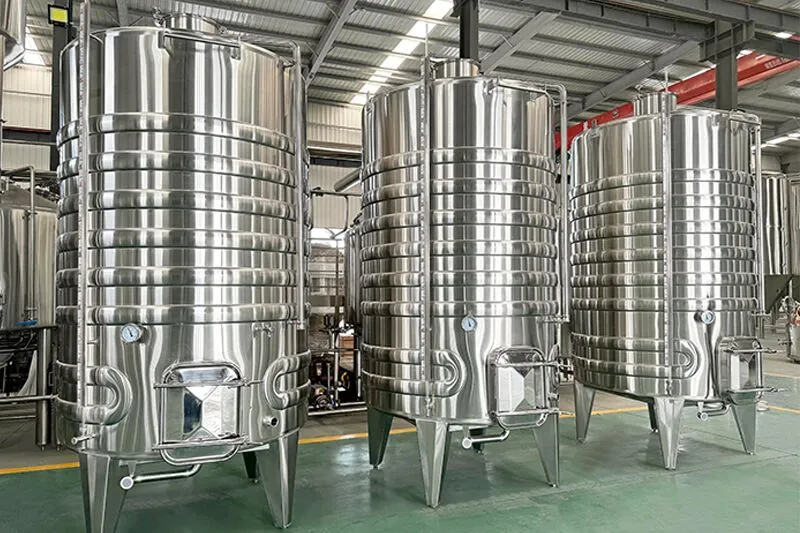
The quality of your wine begins long before bottling—it starts with the vessel you choose for fermentation. Research from the International Journal of Food Science & Technology indicates that fermentation vessel material and design can affect wine phenolic composition by up to 23%, directly impacting flavor profile, aging potential, and market value.
Modern winemakers face a critical decision: invest in traditional fermentation methods or upgrade to advanced stainless steel wine fermentation tanks. This choice influences:
- Temperature stability (±0.5°C precision vs. ±3-5°C in traditional vessels)
- Oxygen management and oxidation control
- Batch consistency and reproducibility
- Sanitation efficiency and contamination risk
- Long-term operational costs and ROI
According to the Wine Institute, wineries using temperature-controlled stainless steel fermentation systems report 15-30% fewer rejected batches and 40% reduction in microbial contamination compared to traditional open fermenters.
Top 5 Benefits of Stainless Steel Wine Fermentation Tanks vs. Traditional Fermenters
1. Superior Temperature Control
Stainless steel tanks with glycol jackets maintain precise fermentation temperatures:
| Vessel Type | Temperature Variance | Impact on Quality |
|---|---|---|
| Stainless Steel (Jacketed) | ±0.5°C | Optimal ester formation, consistent flavor |
| Concrete Vats | ±2-3°C | Moderate control, traditional character |
| Oak Barrels | ±3-5°C | Variable, terroir expression |
| Plastic/Fiberglass | ±4-6°C | High risk of off-flavors |
Data source: American Society of Enology and Viticulture (ASEV), 2024
2. Enhanced Sanitation & Food Safety
Stainless steel 304/316 surfaces are:
- Non-porous (preventing bacterial colonization)
- CIP-compatible (Clean-in-Place automation)
- FSMA-compliant for FDA food safety standards
Studies show stainless steel reduces Brettanomyces contamination risk by 87% compared to used oak barrels.
3. Extended Service Life & ROI
Cost Analysis Over 20 Years:
Stainless Steel Wine Fermentation Tank (1,000L)
- Initial Investment: $8,000-$12,000
- Annual Maintenance: $200-$400
- Expected Lifespan: 25-30 years
- Total 20-Year Cost: $12,000-$18,000
Oak Barrel Program (1,000L equivalent)
- Initial Investment: $3,000-$5,000
- Replacement Cycle: 3-5 years
- Annual Maintenance: $500-$800
- Total 20-Year Cost: $22,000-$36,000
Stainless steel delivers 40-50% lower total cost of ownership.
4. Batch Consistency & Scalability
Commercial wineries require reproducible results. Stainless steel fermentation tanks offer:
- Uniform heat transfer across all batch sizes
- Programmable temperature profiles for different varietals
- Data logging for traceability and quality control
5. Multi-Varietal Flexibility
Unlike oak barrels (which impart flavor), stainless steel is flavor-neutral, allowing winemakers to:
- Ferment multiple varietals in the same tank
- Control oak influence separately (chips, staves, barrel aging)
- Produce both traditional and modern wine styles
Key Features to Compare When Choosing Wine Fermentation Tanks
Material Grade: 304 vs. 316 Stainless Steel
AISI 304 Stainless Steel:
- Composition: 18% chromium, 8% nickel
- Best for: Standard wine fermentation, neutral pH wines
- Cost: $6-$9 per kg
AISI 316 Stainless Steel:
- Composition: 16% chromium, 10% nickel, 2% molybdenum
- Best for: High-acid wines, coastal environments (corrosion resistance)
- Cost: $9-$13 per kg
Recommendation: 304 is sufficient for 90% of winemaking applications. Choose 316 for high-acidity varieties (Riesling, Sauvignon Blanc) or marine climates.
Cooling System Options
1. Glycol Jacket (Most Common)
- Temperature range: -5°C to +30°C
- Response time: 1-2 hours for 5°C change
- Efficiency: 85-92%
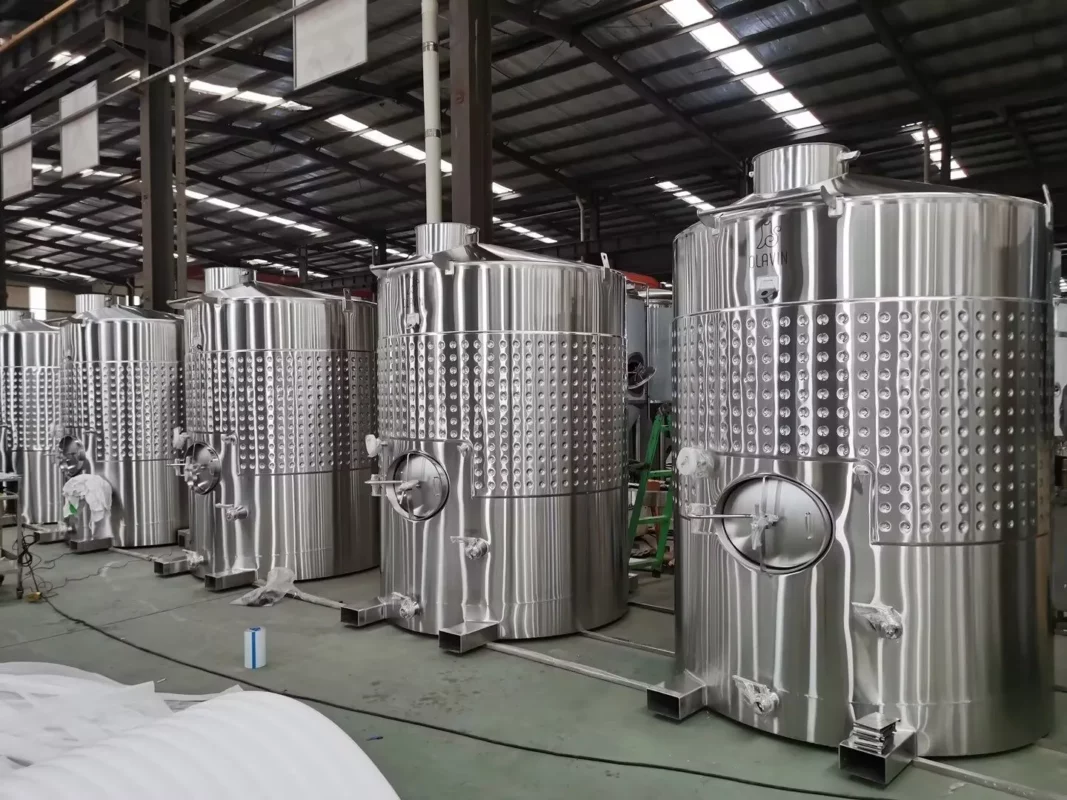
2. Dimple Jacket
- Enhanced surface contact
- 15-20% faster cooling than standard jackets
- Premium cost: +20-30%
3. Internal Coils
- Budget option for smaller tanks (<500L)
- Cleaning challenges
- Limited to ±2°C precision
Capacity Planning
Optimal Tank Sizing Formula:
Required Fermentation Volume (L) = Annual Production (L) × 1.25 (headspace) ÷ Turnover Rate
Example: 10,000L annual production, 6 turnovers/year:
- 10,000 × 1.25 ÷ 6 = 2,083L total fermentation capacity
- Recommended: 2× 1,000L tanks + 1× 500L tank (flexibility)
Essential Tank Features
✅ Top manway (24-inch minimum for manual cleaning)
✅ Conical bottom (15° minimum slope for lees removal)
✅ Sample valve (mid-height for representative sampling)
✅ Pressure relief valve (safety, CO₂ management)
✅ RTD temperature probe (±0.1°C accuracy)
✅ Racking arm (adjustable for clear wine transfer)
✅ CIP spray ball (360° coverage for automated cleaning)
Step-by-Step Guide: Choosing Your Wine Fermentation Tank
Step 1: Define Your Production Goals
Questions to answer:
- Annual volume target? (liters/year)
- Varietal focus? (red, white, rosé, sparkling)
- Quality tier? (premium, ultra-premium, bulk)
- Fermentation style? (traditional, modern, hybrid)
Step 2: Calculate Capacity Requirements
Use the 3:1 fermentation-to-brewhouse ratio as baseline:
- For 1,000L daily crush, you need 3,000L fermentation capacity
- Add 25% headspace and 20% contingency = 4,500L total
Step 3: Select Material & Cooling System
| Wine Type | Recommended Material | Cooling Priority |
|---|---|---|
| Red (Pinot Noir, Merlot) | 304 SS | Medium (18-25°C) |
| White (Chardonnay, Pinot Grigio) | 304 SS | High (12-18°C) |
| High-Acid White (Riesling) | 316 SS | High (10-15°C) |
| Sparkling Base Wine | 316 SS | Critical (8-12°C) |
Step 4: Budget & ROI Analysis
Total Investment Breakdown:
- Tanks: 60-70% of budget
- Glycol chiller: 15-20%
- Pumps & transfer equipment: 8-12%
- Installation & commissioning: 5-8%
Payback Period Calculation:
Payback (years) = Initial Investment ÷ (Annual Labor Savings + Quality Improvement Value + Waste Reduction)
Typical payback: 2.5-4.5 years for commercial wineries (>5,000L annual production)
Step 5: Vendor Evaluation
Certification checklist:
- ✅ ASME pressure vessel certification (if applicable)
- ✅ 3A Sanitary Standards compliance
- ✅ ISO 9001 manufacturing quality
- ✅ Material test certificates (mill certs)
- ✅ Hydrostatic testing documentation
Maintenance Masterclass: Extending Tank Lifespan
Daily Maintenance (During Active Fermentation)
Temperature monitoring:
- Check readings 3x daily
- Log data for traceability
- Verify glycol system pressure (30-45 PSI)
Visual inspection:
- Gasket integrity (no wine seepage)
- Valve operation (no leaks)
- Pressure relief function
Post-Fermentation Cleaning Protocol
Step 1: Pre-Rinse (within 2 hours of emptying)
- Cold water flush: 5-10 minutes
- Removes 70-80% of residual solids
Step 2: Alkaline Wash (Caustic Soda 2-3%)
- Temperature: 65-75°C
- Contact time: 20-30 minutes
- Removes organic deposits, tannins, proteins
Step 3: Acid Rinse (Phosphoric Acid 1-2%)
- Temperature: 50-60°C
- Contact time: 15-20 minutes
- Removes mineral scale, wine stone
Step 4: Sanitization (Peracetic Acid 0.1-0.2%)
- Temperature: 20-25°C (room temp)
- Contact time: 10-15 minutes
- Final rinse: Potable water
Annual Deep Maintenance
Q4 shutdown checklist:
- [ ] Gasket replacement (all seals)
- [ ] Valve disassembly & inspection
- [ ] RTD probe calibration (±0.5°C max deviation)
- [ ] Glycol system flush & recharge
- [ ] Passivation treatment (if scratches present)
- [ ] Pressure test (1.5× working pressure)
Cost: $300-$600 per tank annually
Types of Stainless Steel Wine Fermentation Tanks
1. Variable Capacity Tanks
Design: Floating lid with inflatable gasket
Advantages:
- Adjustable volume (500L-2,000L in same tank)
- Eliminates headspace oxygen
- Ideal for small-batch/experimental wines
Applications: Premium wineries, R&D programs
Cost: $12-$18 per liter capacity
2. Open-Top Fermenters
Design: No top head, manual punch-down access
Advantages:
- Traditional red wine fermentation
- Enhanced cap management
- Easy fruit addition (whole cluster)
Applications: Pinot Noir, premium reds
Cost: $8-$12 per liter capacity
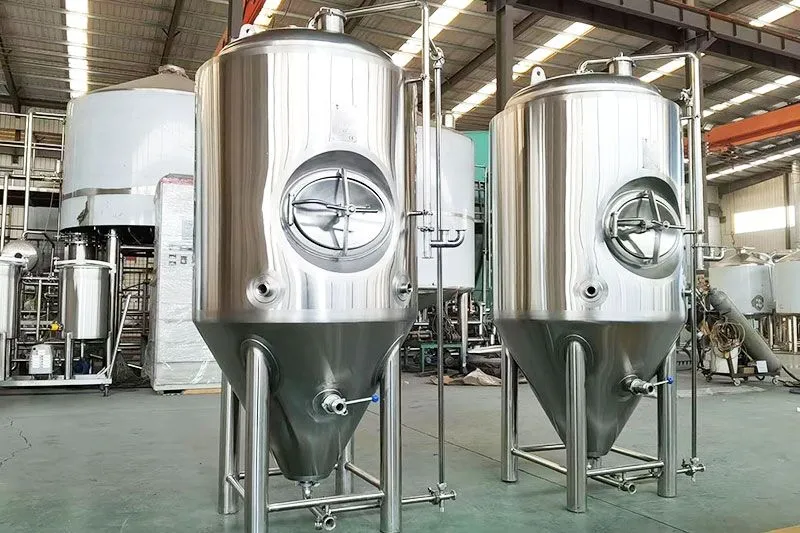
3. Closed Conical Fermenters
Design: Sealed top, 60-70° cone bottom
Advantages:
- Pressure fermentation capability (sparkling)
- Easy lees removal
- CO₂ capture potential
Applications: White wines, sparkling base, high-volume production
Cost: $10-$15 per liter capacity
4. Horizontal Fermenters
Design: Sideways cylinder, large surface area
Advantages:
- Enhanced skin contact (red fermentation)
- Lower height (ceiling clearance <3m)
- Easier punch-down automation
Applications: Red wines, small facilities
Cost: $15-$22 per liter capacity (premium)
5. Jacketed Unitanks
Design: Dual-purpose fermentation + aging vessel
Advantages:
- Reduce transfers (preserve aromatics)
- Combined fermentation + maturation
- Space efficiency
Applications: Aromatic whites, sur lie aging
Cost: $14-$20 per liter capacity
Analysis: Cost Over Time
Total Cost of Ownership (TCO) Comparison
Scenario: 5,000L annual production over 15 years
<aside> 📊
Stainless Steel Wine Fermentation Tank System
Year 0: $45,000 (tanks + chiller + installation)
Years 1-15: $800/year (maintenance, chemicals, energy)
Total 15-Year Cost: $57,000
Cost per Liter Produced: $0.76
</aside>
<aside> 🛢️
Traditional Oak Barrel Program
Year 0: $18,000 (60× 225L barrels)
Years 3, 6, 9, 12, 15: $18,000 (barrel replacement)
Years 1-15: $1,500/year (cooperage, maintenance)
Total 15-Year Cost: $112,500
Cost per Liter Produced: $1.50
</aside>
Savings with stainless steel: $55,500 over 15 years (49% reduction)
Environmental Impact
Water consumption per 1,000L batch:
- Stainless steel (CIP): 150-200L
- Oak barrels (manual wash): 400-600L
Energy usage:
- Glycol cooling: 2-4 kWh per 1,000L per day
- Passive cooling (barrels): 0 kWh (but limited control)
Carbon footprint (20-year lifecycle):
- Stainless steel: 1,200 kg CO₂e
- Oak barrel program: 3,800 kg CO₂e (including transport, replacement)
Multi-Use Applications Beyond Wine Fermentation
1. Cider Production
Stainless steel tanks excel at cider fermentation:
- Lower temps required (10-15°C vs. 18-25°C for wine)
- High-acid environment (pH 3.2-3.8)
- Clean, fruit-forward flavor preservation
Market growth: Global cider market projected $8.9B by 2028 (CAGR 3.8%)
2. Mead & Honey Wine
Benefits:
- Precise temperature for delicate honey aromatics
- Easy sanitization (critical for sugar-rich musts)
- Long fermentation cycles (2-6 months)
3. Kombucha & Fermented Beverages
Growing application:
- Food-grade stainless steel prevents contamination
- Temperature control for SCOBY health
- Scalable from pilot (50L) to production (2,000L)
Market size: $5.4B in 2025, projected $13.2B by 2032
4. Beer Fermentation (Cross-Over Use)
Many wineries add beer/ale programs:
- Same tanks, different temperature profiles
- Diversify revenue streams
- Utilize excess capacity in off-season
5. Distillation Wash Fermentation
For craft distilleries:
- Ferment grain/fruit wash before distillation
- Higher alcohol tolerance (12-18% ABV)
- Large volume capacity needed
Making The Right Choice: Decision Framework
When to Choose Stainless Steel Wine Fermentation Tanks
✅ You should invest in stainless steel if:
- Annual production >2,000 liters
- ROI positive within 3-4 years
- Labor savings justify investment
- Quality consistency is critical
- Commercial sales, distribution
- Brand reputation depends on reproducibility
- Multiple varietals/styles
- Flavor-neutral vessel maximizes flexibility
- Quick turnaround between batches
- Limited labor availability
- Automated CIP reduces cleaning time 70%
- Temperature control reduces monitoring
- Long-term growth plans
- Modular expansion (add tanks as volume grows)
- 25-30 year lifespan amortizes investment
When Traditional Methods May Be Better
⚠️ Consider alternatives if:
- Ultra-premium, terroir-focused wines (barrel character essential)
- Very small production (<500L annual, hobby-scale)
- Traditional/natural wine philosophy (minimal intervention)
- Immediate cash flow constraints (but evaluate financing)
Hybrid Approach (Best of Both Worlds)
Many successful wineries use:
- Stainless steel for primary fermentation (control, consistency)
- Oak barrels for aging (flavor development, micro-oxidation)
This maximizes quality control while preserving traditional character.

Frequently Asked Questions (FAQ)
Q1: What size wine fermentation tank should I buy for a startup winery?
A: Start with your 3-year production goal, not year 1. A common mistake is under-sizing. For a target of 5,000L annual production:
- Calculate: 5,000L × 1.25 (headspace) ÷ 4 turnovers = 1,563L needed
- Recommended: 1× 1,000L + 1× 500L tanks (1,500L total)
- Allows batch flexibility and future growth
Source: Wine Business Monthly startup winery survey, 2024
Q2: How much does a wine fermentation tank cost?
A: Prices vary by size, features, and material:
- 500L basic tank (304 SS, no cooling): $3,000-$4,500
- 1,000L jacketed tank (304 SS, glycol-ready): $8,000-$12,000
- 2,000L jacketed tank (316 SS, full automation): $18,000-$25,000
- Variable capacity 1,500L (premium): $22,000-$30,000
Add 20-30% for glycol chiller, pumps, installation.
Q3: Can I use the same tank for red and white wine?
A: Yes, with proper cleaning protocols. Stainless steel is flavor-neutral and non-porous. Follow this sequence:
- Hot caustic wash (removes tannins, pigments)
- Acid rinse (removes any mineral deposits)
- Sanitization (peracetic acid)
- Sensory verification (sniff test before filling)
Most wineries dedicate tanks to red or white for convenience, but cross-use is safe if cleaned properly.
Q4: How long do stainless steel wine fermentation tanks last?
A: With proper maintenance:
- Expected lifespan: 25-30 years (primary use)
- Extended life: 40-50 years (secondary/storage use)
- Key factors: Annual passivation, gasket replacement, avoiding chloride exposure
Compare to oak barrels (3-5 years) or plastic/fiberglass (8-12 years).
Source: American Vineyard Foundation equipment longevity study, 2023
Q5: Do I need 304 or 316 stainless steel for wine tanks?
A: 304 is sufficient for 90% of wine applications. Choose 316 only if:
- High-acid varieties (Riesling, Vinho Verde, pH <3.0)
- Coastal location (salt air corrosion risk)
- Sparkling wine (higher pressure requirements)
- Extreme longevity goal (50+ years)
316 costs 30-40% more—allocate budget to larger capacity in 304 instead for better ROI.
Q6: What temperature should I ferment wine at?
A: Optimal ranges:
| Wine Style | Fermentation Temp | Reason |
|---|---|---|
| Red (Cabernet, Syrah) | 25-30°C | Tannin extraction, color stability |
| Red (Pinot Noir) | 22-26°C | Delicate aromatics, softer tannins |
| White (Chardonnay) | 15-18°C | Balanced esters, avoid banana notes |
| White (Sauvignon Blanc) | 12-16°C | Preserve thiols, tropical fruit |
| Rosé | 16-20°C | Fresh fruit, crisp acidity |
| Sparkling base | 10-14°C | Slow fermentation, fine bubbles |
Precise control (±1°C) requires jacketed tanks with PID controllers.
Source: Enology Research Center, UC Davis
Q7: How often should I clean my wine fermentation tanks?
A: Cleaning schedule:
- After every batch: Full CIP cycle (pre-rinse, alkaline, acid, sanitize)
- Between varietals: Add hot water rinse + sensory check
- Quarterly (idle tanks): Light caustic wash to prevent biofilm
- Annually: Deep clean + passivation treatment
Cost: $15-$30 in chemicals per 1,000L tank per cleaning.
Q8: Can I ferment other beverages in wine tanks?
A: Absolutely. Stainless steel wine fermentation tanks work for:
✅ Cider (same temps as white wine)
✅ Mead (longer fermentation, easy to monitor)
✅ Kombucha (requires dedicated tanks due to SCOBY)
✅ Beer (cooler temps, 10-20°C)
✅ Sake (precise low-temp control, 12-15°C)
Cross-contamination prevention: Use dedicated gaskets and sample valves for non-wine products.
Q9: What certifications should wine tanks have?
A: Essential certifications:
- Material: ASTM A240 (304/316 stainless steel specification)
- Fabrication: ASME Section VIII (if pressure-rated >15 PSI)
- Sanitary: 3A Sanitary Standards (22-07 for tanks)
- Quality: ISO 9001 manufacturer certification
- Testing: Hydrostatic test certificate (1.5× working pressure)
Request mill certificates proving material grade and origin.
Q10: How much does it cost to run a glycol chiller for wine tanks?
A: Operating costs:
1,000L tank at 15°C (white wine fermentation):
- Cooling load: ~2,500 BTU/hour during active fermentation
- Chiller consumption: 0.8-1.2 kW
- Daily cost (active fermentation): $2-$4 (at $0.12/kWh)
- Annual cost (4 batches × 14 days each): $110-$220
ROI: Energy cost is 2-3% of quality improvement value (fewer rejected batches).
Source: Wine Industry Energy Efficiency Survey, 2025
Conclusion: Invest in Quality, Reap the Rewards
Choosing the right wine fermentation tank is one of the most important decisions for any winery—from boutique estates to commercial operations. The evidence is clear:
Stainless steel wine fermentation tanks deliver:
- 40-50% lower total cost of ownership over 15-20 years
- 15-30% fewer rejected batches due to temperature control
- 87% reduction in contamination risk
- 25-30 year lifespan (vs. 3-5 years for oak barrels)
- Flexibility for multiple varietals and beverage types
Key takeaways:
- Size for growth: Calculate 3-year production goals, not year 1
- 304 SS is sufficient: Reserve 316 for high-acid wines or coastal locations
- Jacketed cooling is essential: ±0.5°C control vs. ±3-5°C in passive systems
- ROI is 2.5-4.5 years: For commercial wineries producing >5,000L annually
- Maintenance matters: Annual deep cleaning extends lifespan to 30+ years
Whether you’re launching a new winery, expanding capacity, or upgrading from traditional fermenters, investing in quality stainless steel wine fermentation tanks positions your operation for long-term success.
Ready to discuss your specific needs? Contact our engineering team for a customized tank specification and ROI analysis tailored to your production goals.
