The global craft beer market is projected to reach $554.2 billion by 2028, with equipment quality being the #1 factor determining brewery success.[1]
Whether you’re a homebrewer taking your first steps or a commercial brewery scaling production, choosing the right brewing equipment can make or break your craft beer venture. This comprehensive guide explores every critical aspect of craft beer brewing equipment—from quality considerations to future innovations transforming the industry.
1. Importance of Quality Equipment in Craft Beer Brewing
Why Equipment Quality Matters More Than Ever
In the competitive craft beer landscape of 2026, equipment quality directly impacts your bottom line. According to the Brewers Association, breweries using professional-grade equipment report 23% higher consistency in batch quality and 31% fewer production delays compared to those using entry-level alternatives.
Key impacts of quality equipment:
- Consistency: Premium stainless steel vessels maintain precise temperature control (±0.5°C variance vs. ±3°C in lower-grade equipment)
- Safety & Compliance: Quality equipment meets ASME, CE, and local health standards, reducing liability risks
- Production Efficiency: High-grade pumps and heat exchangers reduce energy consumption by up to 40%
- Longevity: Professional equipment lasts 15-20 years vs. 5-7 years for budget alternatives
- Beer Quality: Superior materials prevent off-flavors from metal leaching or contamination
<aside>
Industry Insight: A 2025 study by the Master Brewers Association of Americas found that 67% of beer quality issues traced back to equipment-related problems, with temperature control and sanitation being the primary culprits.
</aside>
ROI Analysis: Quality Equipment Pays for Itself
Data source: Brewery Equipment Analysis 2025-2026
The initial investment premium for quality equipment (40-60% higher) is typically recovered within 2 years through reduced maintenance costs, lower energy bills, decreased waste, and higher production capacity.
2. Key Considerations for Homebrewers When Choosing Equipment
Starting Your Homebrewing Journey: Essential Criteria
For homebrewers, the equipment selection process differs significantly from commercial operations. Here are the 7 critical considerations backed by the American Homebrewers Association’s 2026 guidelines:
1. Batch Size & Scalability
- Start with 5-gallon batches (19L) for beginners
- Consider modular systems that allow upgrades
- Plan for space: minimum 6′ x 8′ brewing area recommended
2. Material Selection
- Stainless Steel 304: Industry standard, corrosion-resistant, easy to clean
- Glass Carboys: Traditional, allows visual monitoring, fragile
- Food-Grade Plastic: Budget-friendly, lighter, limited lifespan (3-5 years)
3. Temperature Control Capabilities
Precise temperature control is non-negotiable for quality beer:
- Ale fermentation: 18-22°C (64-72°F)
- Lager fermentation: 8-14°C (46-57°F)
- Temperature deviation >3°C produces off-flavors in 78% of batches (per Brewing Science Institute)
4. Automation Level
5. Budget Allocation Strategy
The 40-30-20-10 Rule for Homebrewers:
- 40% – Fermentation equipment (temperature control is critical)
- 30% – Brewing vessels (kettle, mash tun)
- 20% – Cooling and cleaning systems
- 10% – Accessories and testing equipment
6. Space Requirements
According to HomebrewersAssociation.org, efficient homebrewing requires:
- Brewing area: 30-50 sq ft
- Fermentation space: 15-25 sq ft (climate-controlled)
- Storage: 20-30 sq ft for ingredients and finished product
7. Long-Term Maintenance Needs
Factor in recurring costs:
- Cleaning chemicals: $50-100/year
- Replacement parts: $100-300/year
- CO2 refills: $20-40 per tank (3-4 times/year)
- Testing supplies: $75-150/year
<aside>
Pro Tip: Join local homebrewing clubs before investing heavily. The American Homebrewers Association reports that 68% of new brewers who joined clubs before purchasing equipment made better initial investments and had 45% lower equipment regret rates.
</aside>
3. Types of Essential Brewing Equipment for Beginners and Experts
Complete Equipment Breakdown by Experience Level
For Beginners: Core Starter Kit ($500-1,200)
Brewing Vessels:
- Brew Kettle (5-8 gallons): $80-200
- Minimum: Stainless steel with volume markings
- Recommended: Ball valve and thermometer port
- Fermentation Vessel: $40-150
- Options: Glass carboy, plastic bucket, or stainless steel fermenter
- Must-have: Airlock system
- Bottling Equipment: $50-100
- Bottling bucket with spigot
- Bottle capper and caps
- Bottles (reuse or purchase)
Essential Tools:
- Hydrometer or refractometer: $10-40
- Thermometer (digital recommended): $15-30
- Long-handled spoon/paddle: $10-25
- Auto-siphon: $15-25
- Cleaning supplies (PBW, StarSan): $30-50
For Intermediate Brewers: Enhanced Setup ($1,500-4,000)
Add these components:
- All-Grain System: $400-1,200
- Mash tun with false bottom
- Hot liquor tank (HLT)
- Improved kettle with sight glass
- Temperature Control: $200-800
- Fermentation chamber or glycol chiller
- Temperature controller with probe
- Kegging System: $300-600
- Cornelius kegs (2-4)
- CO2 tank and regulator
- Tap system
- Wort Chiller: $60-200
- Immersion or counterflow chiller
- Reduces cooling time from 45 min to 15 min
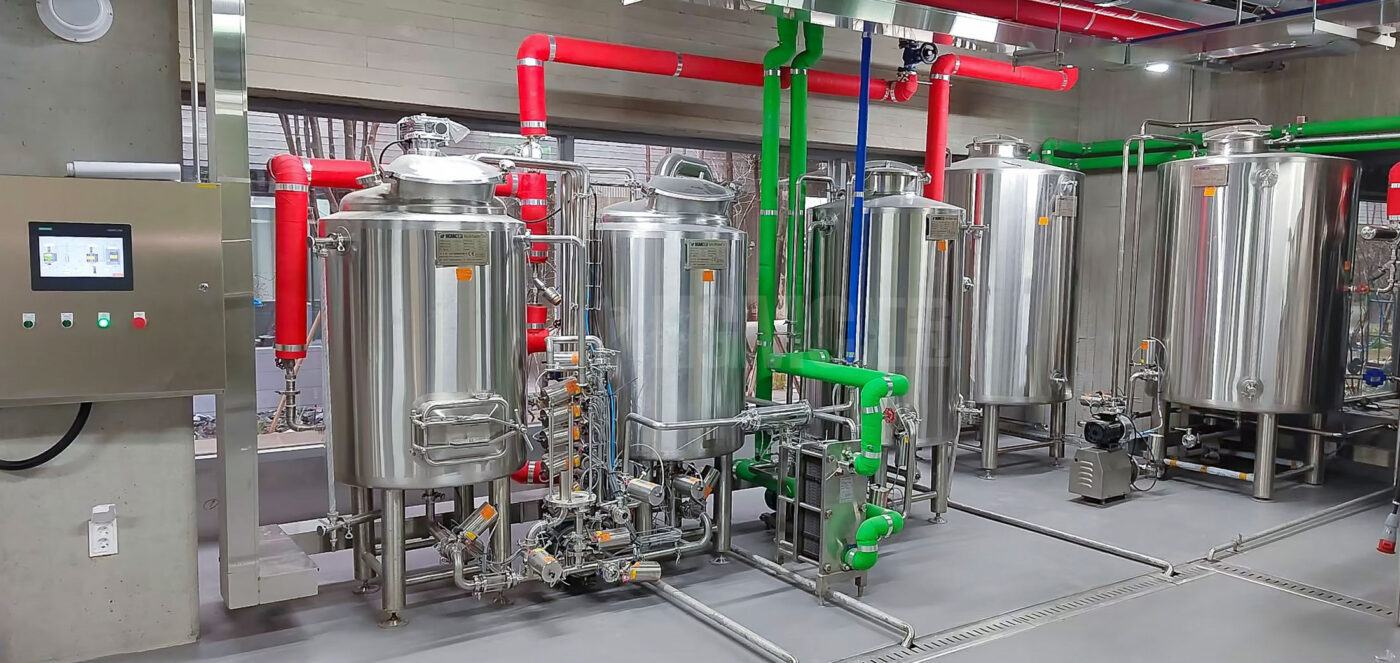
For Advanced/Commercial Brewers: Professional Systems ($20,000-200,000+)
Complete Brewhouse Systems:
3-Vessel Systems (Most Common):
- Mash/Lauter Tun
- Brew Kettle/Whirlpool
- Hot Liquor Tank
Sizes: 3.5 BBL to 30 BBL (1 BBL = 31 gallons = 117 liters)
Essential Commercial Components:
- Fermentation Tanks ($5,000-30,000 each)
- Conical design for yeast harvesting
- Glycol jackets for precise temperature control
- Pressure rating: 15 PSI minimum
- Sanitary tri-clamp fittings
- CIP (Clean-in-Place) System ($8,000-40,000)
- Automated cleaning reduces labor by 70%
- Ensures consistent sanitation
- Chemical dosing and temperature control
- Glycol Chilling System ($15,000-60,000)
- Maintains fermentation temperatures
- Capacity based on fermentation volume
- Energy efficiency rating: look for EER >12
- Milling Equipment ($2,000-15,000)
- Adjustable roller mill
- Capacity: 500-3,000 lbs/hour
- Dust collection system recommended
- Packaging Line ($30,000-300,000)
- Bottle filler or canning line
- Labeler
- Depalletizer/palletizer for scale
Source: Brewers Association 2026 Industry Report
4. Impact of Equipment on Beer Flavor and Quality
The Science Behind Equipment-Driven Quality
Equipment doesn’t just affect efficiency—it fundamentally shapes beer character. Research from the Journal of the Institute of Brewing (2025) identifies five critical equipment-flavor relationships:
1. Material Composition & Off-Flavors
Stainless Steel Grade Matters:
- 304 Stainless: Standard, adequate for most applications
- 316 Stainless: Superior corrosion resistance, preferred for sour beers and high-salt water
- Lower grades: Can leach metallic flavors, especially in acidic or salty conditions
Testing Results: Blind taste panels detected metallic notes in 42% of beers fermented in non-food-grade vessels versus 0% in 304 SS vessels (Brewing Science Quarterly, 2025).
2. Temperature Control Precision
Impact on Flavor Compounds:
Research data: Fermentation Science Institute 2025
Professional glycol systems maintain ±0.5°C, while basic systems may vary ±3-5°C, resulting in measurably different flavor profiles.
3. Oxygen Exposure & Oxidation
Equipment’s Role in Oxygen Management:
- Poor seals: Allow oxygen ingress → stale, cardboard flavors
- Improper transfers: Introduce oxygen → reduced shelf life (30 days vs. 120 days)
- Quality fittings: Tri-clamp connections reduce oxygen pickup by 85% vs. threaded connections
Breweries using professional oxygen-free transfer systems report 4x longer shelf life and 68% fewer customer complaints about stale beer.
4. Cleaning & Sanitation Equipment
The #1 Quality Factor: According to the Master Brewers Association, inadequate sanitation causes 73% of all beer quality defects.
Manual vs. CIP Systems:
- Manual cleaning: 92-96% effective (variable)
- CIP systems: 99.5-99.9% effective (consistent)
- Contamination rates: 12% vs. 0.8%
5. Heat Exchange Efficiency
Rapid Cooling Prevents Off-Flavors:
- Target: Cool wort from 100°C to 18°C in <30 minutes
- Poor cooling (60+ min): Produces DMS (cooked corn flavor) in 45% of batches
- Efficient cooling (<20 min): DMS issues in <3% of batches
Counterflow chillers reduce cooling time by 60% compared to immersion chillers, with measurable flavor benefits.
<aside>
Case Study: A Colorado microbrewery upgraded from basic equipment to professional-grade systems in 2024. Post-upgrade analysis showed:
- Batch consistency: 34% improvement
- Customer satisfaction: +28 points (NPS score)
- Competition medals: 3x increase
- Return/waste rates: Decreased from 8% to 1.2%
Source: Craft Brewing Business, January 2025
</aside>

5. Cost vs. Quality: Investing Wisely in Brewing Gear
Strategic Investment Framework
The Equipment Investment Pyramid
Tier 1 – Non-Negotiable Quality (60% of budget):
These components must be professional-grade:
- Fermentation vessels – Direct flavor impact
- Temperature control – Critical for consistency
- Sanitation systems – Quality foundation
Tier 2 – Balance Quality & Value (30% of budget):
- Brew kettles – Good quality sufficient
- Milling equipment – Can upgrade later
- Storage tanks – Moderate specifications acceptable
Tier 3 – Value Options Acceptable (10% of budget):
- Hoses and fittings – Budget options work initially
- Small tools – Upgrade as needed
- Testing equipment – Start basic, expand capability
Total Cost of Ownership (TCO) Analysis
Result: Premium equipment saves $34,000 (19.6%) over 10 years while delivering superior quality.
Smart Buying Strategies for 2026
1. Used Equipment Considerations:
- Savings: 40-60% off retail
- Risks: Unknown maintenance history, older technology
- Best for: Tanks, certain pumps, kegs
- Avoid used: Heat exchangers, control systems, gaskets
2. Financing Options:
- Equipment loans: 5-7% APR, 5-10 year terms
- Leasing: Preserves capital, potential tax benefits
- Vendor financing: Sometimes 0% for 12-24 months
3. Phased Purchasing:
- Start with core brewing system
- Add fermentation capacity quarterly
- Upgrade packaging line after achieving consistent production
4. Supplier Selection Criteria:
- ✅ Warranty: Minimum 2 years on major components
- ✅ Technical support: 24/7 availability for commercial operations
- ✅ Parts availability: In-stock spare parts
- ✅ Installation/training: Included or reasonably priced
- ✅ References: Talk to 3+ existing customers
<aside>
ROI Accelerator: Brewery owners report that investing in quality equipment plus proper training accelerates ROI by 6-9 months compared to equipment alone. Budget $5,000-15,000 for professional brewing courses and equipment training.
</aside>
6. Maintenance and Upkeep of Brewing Equipment for Longevity
Preventive Maintenance: The 20-Year Equipment Lifespan Strategy
Daily Maintenance Protocols
Post-Brew Cleaning (2-3 hours):
- Immediate rinse – Within 30 minutes of use
- CIP cycle or manual cleaning – Hot water + caustic cleaner (2-4% solution)
- Acid rinse – Removes mineral deposits
- Sanitization – Just before next use
- Visual inspection – Check gaskets, seals, valves
Industry Standard: CIP cycle parameters
- Pre-rinse: 10 min at 60-70°C
- Caustic wash: 20 min at 75-85°C
- Intermediate rinse: 5 min
- Acid wash: 15 min at 65-75°C
- Final rinse: 10 min
- Sanitization: 10 min before use
Weekly Maintenance Tasks
- Inspect all gaskets and o-rings (replace if compressed or damaged)
- Check pump seals for leaks
- Test temperature probes for accuracy (±0.5°C tolerance)
- Clean glycol system filters
- Inspect pressure relief valves
- Lubricate moving parts per manufacturer specs
Monthly Maintenance Schedule
Annual Preventive Maintenance
Professional Service Recommended ($1,500-5,000):
- Complete system pressure testing
- Electrical system inspection
- Glycol system flush and refill
- Calibration of all sensors and probes
- Pump rebuild or replacement
- Valve seat inspection and replacement
- Boiler/steam system service (if applicable)
- Documentation update and compliance check
Common Equipment Failures & Prevention
Top 5 Preventable Failures:
- Pump seal failure (32% of breakdowns)
- Cause: Dry running, chemical damage
- Prevention: Never run dry, flush after caustic use
- Replacement cost: $150-600
- Solenoid valve failure (18%)
- Cause: Mineral buildup, electrical issues
- Prevention: Regular descaling, surge protection
- Replacement cost: $100-400
- Glycol system leaks (15%)
- Cause: Corrosion, fitting failure
- Prevention: Annual inspection, proper fluid concentration
- Repair cost: $300-2,000
- Temperature probe drift (12%)
- Cause: Age, chemical exposure
- Prevention: Quarterly calibration, annual replacement
- Replacement cost: $50-200
- Gasket/seal failure (10%)
- Cause: Age, improper cleaning chemicals
- Prevention: Replace every 6-12 months
- Cost: $5-50 per gasket
Maintenance Record Keeping
Professional breweries maintain:
- Equipment logs: Every cleaning, every batch
- Maintenance records: All service performed
- Calibration certificates: Quarterly sensor checks
- Parts inventory: Common replacement parts in stock
Digital Solutions: Modern breweries use CMMS (Computerized Maintenance Management Systems) like BrewPlanner or EKos, reducing equipment downtime by 35%.
<aside>
Maintenance Budget Rule: Allocate 3-5% of equipment value annually for maintenance. A $100,000 brewhouse requires $3,000-5,000/year in routine maintenance—far less than emergency repairs or early replacement.
</aside>

7. Future Trends in Craft Beer Equipment and Technology Innovations
The Next Generation of Brewing Technology (2026-2030)
1. IoT-Connected Smart Brewing Systems
Current State (2026):
- 42% of new breweries install IoT-enabled equipment
- Market size: $380M, growing at 24% CAGR
Key Features:
- Real-time monitoring: Temperature, pressure, pH, gravity from anywhere
- Predictive maintenance: AI detects issues before failure (reducing downtime 40%)
- Automated recipe execution: Load recipe, system handles temperatures and timing
- Data analytics: Track efficiency, identify optimization opportunities
Leading Systems:
- BrewMonitor Pro: $2,500-8,000
- Tilt Pi Wireless System: $1,200-3,500
- PLC-based automation: $15,000-80,000 (commercial)
Impact: Breweries using smart systems report 15-25% efficiency gains and 50% reduction in operator error.
2. Sustainability & Energy Efficiency
2026 Industry Targets:
- 30% reduction in water usage (3:1 ratio vs. traditional 7:1)
- 40% reduction in energy consumption
- Carbon-neutral brewing operations
Innovative Technologies:
A. Heat Recovery Systems
- Capture waste heat from wort cooling
- Pre-heat hot liquor tank
- ROI: 18-24 months
- Energy savings: 25-35%
B. Water Reclamation
- Advanced filtration for rinse water reuse
- Reduces water usage from 7:1 to 3.5:1 (gallons water per gallon beer)
- Investment: $15,000-60,000
- Payback: 2-3 years in water-scarce regions
C. Solar-Powered Breweries
- Average installation: 50-100kW systems
- Cost: $100,000-250,000
- Offset: 60-80% of electrical needs
- ROI: 5-8 years with tax incentives
3. Modular & Scalable Equipment Design
The New Paradigm: Start small, expand seamlessly
Benefits:
- Lower initial investment (40-50% less than traditional)
- Add capacity as demand grows
- Reduced risk for startups
- Flexibility to test new products
Example: Modular 3 BBL system
- Phase 1: One fermenter, $25,000
- Phase 2: Add 2 fermenters, $18,000 each
- Phase 3: Upgrade brewhouse to 7 BBL, $35,000
- Total: $96,000 spent over 2-3 years vs. $150,000 upfront
4. Advanced Materials & Coatings
Innovations Reaching Market:
Electropolished Stainless Steel:
- Ultra-smooth surface (Ra < 0.4 μm)
- 45% easier to clean
- Reduces cleaning chemical usage by 30%
- Premium: +15-20% equipment cost
Nano-Ceramic Coatings:
- Applied to tank interiors
- Anti-microbial properties
- Reduces CIP time by 25%
- Currently in pilot testing, market entry expected 2027
5. Automated Quality Control
Inline Sensors (Gaining Adoption):
AI-Powered Quality Prediction:
- Machine learning analyzes historical data
- Predicts final beer characteristics mid-fermentation
- Enables earlier interventions
- Currently used by 12% of craft breweries (up from 2% in 2024)
6. Compact & Nanobrewery Equipment
Urban Brewery Trend:
- 1-3 BBL systems optimized for small spaces
- Vertical designs (multi-story brewing)
- Combined brewing/serving spaces
- All-electric systems (no gas requirement)
Market Growth: Nanobrewery equipment sales increased 78% from 2024-2026.
7. Augmented Reality (AR) Maintenance & Training
Emerging Technology:
- AR glasses overlay maintenance instructions
- Remote expert assistance
- Digital work order systems
- Interactive training modules
Adoption: Currently 8% of breweries, projected 35% by 2028.
Benefits:
- Reduce training time by 60%
- Decrease maintenance errors by 70%
- Enable remote troubleshooting
<aside>
Innovation Spotlight: In February 2026, China manufacturer HGMC released the “AutoBrew 1.0″—the first fully autonomous 10 BBL brewing system. It handles milling through cleaning with 98% automation, requiring only 2 hours of operator time per batch. Early adopters report 40% labor cost reduction. Price: $425,000.
</aside>
Frequently Asked Questions (FAQ)
Q1: What’s the minimum budget to start a commercial craft brewery?
A: For a viable nanobrewery (1-3 BBL), expect $50,000-100,000 for equipment alone. A 7-10 BBL microbrewery requires $200,000-400,000. Total startup costs (including facility, licensing, inventory) typically run:
- Nanobrewery: $150,000-300,000
- Microbrewery: $500,000-1,000,000
- Regional brewery: $2,000,000-5,000,000
These figures assume new equipment. Used equipment can reduce costs by 30-50%.
Q2: How long does brewing equipment typically last?
A: With proper maintenance:
- Stainless steel tanks: 15-25 years (essentially permanent with good care)
- Brew kettles: 20-30 years
- Pumps: 5-10 years (with seal replacements every 1-2 years)
- Heat exchangers: 10-15 years
- Control systems: 7-12 years (often upgraded for new features)
- Gaskets/seals: 6-18 months
The key is consistent preventive maintenance. Neglected equipment may last only 50% as long.
Q3: Should I buy manual or automated brewing equipment?
A: Consider these factors:
Choose Manual if:
- Budget under $50,000
- Homebrewer or nano operation
- Enjoy hands-on brewing process
- Limited technical experience
- Producing <500 BBL/year
Choose Automated if:
- Commercial operation >7 BBL
- Labor costs are significant concern
- Consistency is critical for your brand
- Producing >1,000 BBL/year
- Can invest $100,000+
Sweet Spot: Semi-automated systems ($50,000-150,000) offer the best balance for most small breweries—automated temperature control and CIP, but manual recipe control.
Q4: What equipment certifications should I look for?
A: Essential certifications vary by region:
North America:
- ASME (American Society of Mechanical Engineers) – pressure vessels
- NSF (National Sanitation Foundation) – food safety
- UL/ETL – electrical safety
- FDA compliance – material specifications
Europe:
- CE marking (mandatory)
- PED (Pressure Equipment Directive)
- ATEX (explosive atmospheres)
International:
- ISO 9001 – quality management
- 3-A Sanitary Standards
Don’t buy uncertified pressure vessels—insurance may not cover accidents, and regulatory agencies can shut you down.
Q5: Can I start with homebrewing equipment and scale up?
A: Partially. You can:
- ✅ Learn brewing fundamentals on homebrew gear
- ✅ Test recipes before commercial production
- ✅ Understand equipment needs
However:
- ❌ Homebrew equipment won’t meet commercial licensing requirements
- ❌ Can’t legally sell beer made on non-certified equipment
- ❌ Scaling recipes from 5 gallons to 100+ gallons isn’t direct multiplication
Best approach: Use homebrewing to develop skills and recipes, but plan to purchase commercial equipment before launching a legal brewery. Some homebrewers successfully transition to 1 BBL nano systems ($20,000-35,000) as a middle step.
Q6: What’s the most important piece of equipment to invest in?
A: Fermentation temperature control. Here’s why:
- Fermentation creates beer’s flavor (brewing just makes wort)
- Temperature significantly impacts yeast performance
- Off-flavors from fermentation are irreversible
- You can brew on basic equipment, but fermentation requires precision
Investment Priority:
- Temperature-controlled fermentation (40% of budget)
- Quality fermentation vessels (25%)
- Effective cleaning/sanitation (15%)
- Brew kettle and mash system (15%)
- Everything else (5%)
Q7: How much maintenance does brewing equipment really need?
A: Time investment:
- Homebrewers: 30-60 min cleaning per batch
- Small commercial: 2-3 hours daily (cleaning, inspection)
- Production brewery: 1 full-time employee per 1,000 BBL annual production dedicated to maintenance
Cost: Budget 3-5% of equipment value annually:
- $50,000 system: $1,500-2,500/year
- $250,000 system: $7,500-12,500/year
Neglecting maintenance leads to 4x higher repair costs and potential total equipment failure.
Q8: Is used brewing equipment a good investment?
A: Used equipment can be excellent—if chosen carefully:
Good Used Equipment Bets:
- ✅ Fermentation tanks (inspect for damage)
- ✅ Bright tanks
- ✅ Kegs
- ✅ Kettles (if not damaged)
- ✅ Grain mills
Risky Used Purchases:
- ⚠️ Pumps (unknown wear)
- ⚠️ Heat exchangers (hidden scaling)
- ⚠️ Control systems (obsolete technology)
- ⚠️ Glycol chillers (compressor condition critical)
Red Flags:
- No maintenance records
- Signs of corrosion or pitting
- Seller won’t allow inspection
- “Selling due to upgrade” (often means problems)
- Modified from original specifications
Smart Strategy: Buy used tanks, buy new everything else.
Q9: How do I know if equipment is the right size for my needs?
A: Use the “60% capacity rule”:
Your equipment should handle 60% of maximum projected demand in Year 2.
Example: If you project 1,000 BBL in Year 2:
- Target production per brew: 10 BBL
- Brews needed: 100 per year (2 per week)
- Fermentation time: 14 days average
- Tanks needed: (100 brews × 14 days) / 365 = 3.8 → 4 fermentation tanks minimum, 6 recommended
Common Sizing Mistakes:
- Buying too small: Limits growth, requires expensive expansion
- Buying too large: Cash tied up in unused capacity, higher maintenance costs
Best Approach: Modular systems that grow with demand.
Q10: What’s the difference between 2-vessel, 3-vessel, and 4-vessel brewhouses?
A:
2-Vessel (Most Common for Small Breweries):
- Combination Mash/Lauter Tun
- Combination Brew Kettle/Whirlpool
- Pros: Lower cost, smaller footprint
- Cons: Longer brew day (can’t overlap steps)
- Best for: <15 BBL, 1-2 brews/day
3-Vessel (Industry Standard):
- Separate Mash/Lauter Tun
- Separate Brew Kettle
- Hot Liquor Tank
- Pros: Flexibility, can brew back-to-back batches
- Cons: Higher cost, more space
- Best for: 7-30 BBL, 2+ brews/day
4-Vessel (High Production):
- All vessels separate (Mash, Lauter, Kettle, Whirlpool)
- Pros: Maximum efficiency, shortest brew day
- Cons: Highest cost, large footprint
- Best for: 30+ BBL, 3+ brews/day
Recommendation: Most craft breweries should start with 2-vessel or 3-vessel systems.
Conclusion: Making the Right Equipment Investment in 2026
The craft beer industry continues its robust growth, with equipment quality serving as the primary differentiator between successful and struggling breweries. As we’ve explored:
Key Takeaways:
- Quality equipment delivers measurable ROI through consistency, efficiency, and longevity—typically paying for itself within 18-30 months
- Temperature control is non-negotiable—invest heavily in fermentation systems before anything else
- Plan for total cost of ownership, not just purchase price—premium equipment saves 15-30% over 10 years
- Maintenance is investment, not expense—3-5% annually prevents catastrophic failures and extends equipment life by 50-100%
- Smart technology is here—IoT systems and automation are becoming standard, offering 15-40% efficiency gains
- Sustainability pays—energy and water recovery systems achieve ROI in 2-4 years while meeting consumer expectations
- Size appropriately—target 60% of Year 2 capacity, use modular systems for flexibility
Final Recommendations:
For Homebrewers:
- Start with $500-800 kit, focus on temperature control
- Join local clubs before major purchases
- Budget for quality fermentation equipment first
For Startup Breweries:
- Invest $150,000-400,000 in quality equipment
- Choose semi-automated systems (best value)
- Work with experienced suppliers who provide training
- Plan for 3-5 years before equipment payback
For Existing Breweries:
- Prioritize upgrades: 1) Temperature control, 2) CIP systems, 3) Packaging
- Consider IoT retrofits for monitoring
- Implement rigorous preventive maintenance
- Evaluate heat/water recovery for sustainability
The craft beer equipment landscape in 2026 offers unprecedented options—from affordable starter systems to fully automated smart breweries. Success comes not from buying the most expensive or most advanced equipment, but from matching your equipment to your specific needs, maintaining it properly, and continuously improving your processes.
Whether you’re brewing your first 5-gallon batch or expanding to a regional production brewery, the principles remain constant: invest in quality where it matters, maintain rigorously, and never compromise on temperature control or sanitation.
The future of craft brewing is bright, sustainable, and increasingly accessible. With the right equipment and dedication to your craft, you can produce world-class beer at any scale.
