
Craft beer is a mature, competitive category in the US and Europe. That maturity changes what buyers care about: not just shiny stainless steel, but repeatable quality, stable throughput, and predictable operating costs. In the US alone, craft brewers produced 23.1 million barrels in 2024, and craft’s volume share was 13.3%, signaling a large but highly competitive market where consistency and efficiency matter.[1]
If you are planning a new brewery or expanding capacity, a turnkey (EPC) brewery solution can reduce risk by integrating brewhouse, cellar, utilities, automation, and packaging into one validated system. This guide explains the core equipment, how to size it, what EU/US buyers typically require, and how to evaluate turnkey suppliers.
1) Introduction to Beer Production Equipment (Turnkey Perspective)
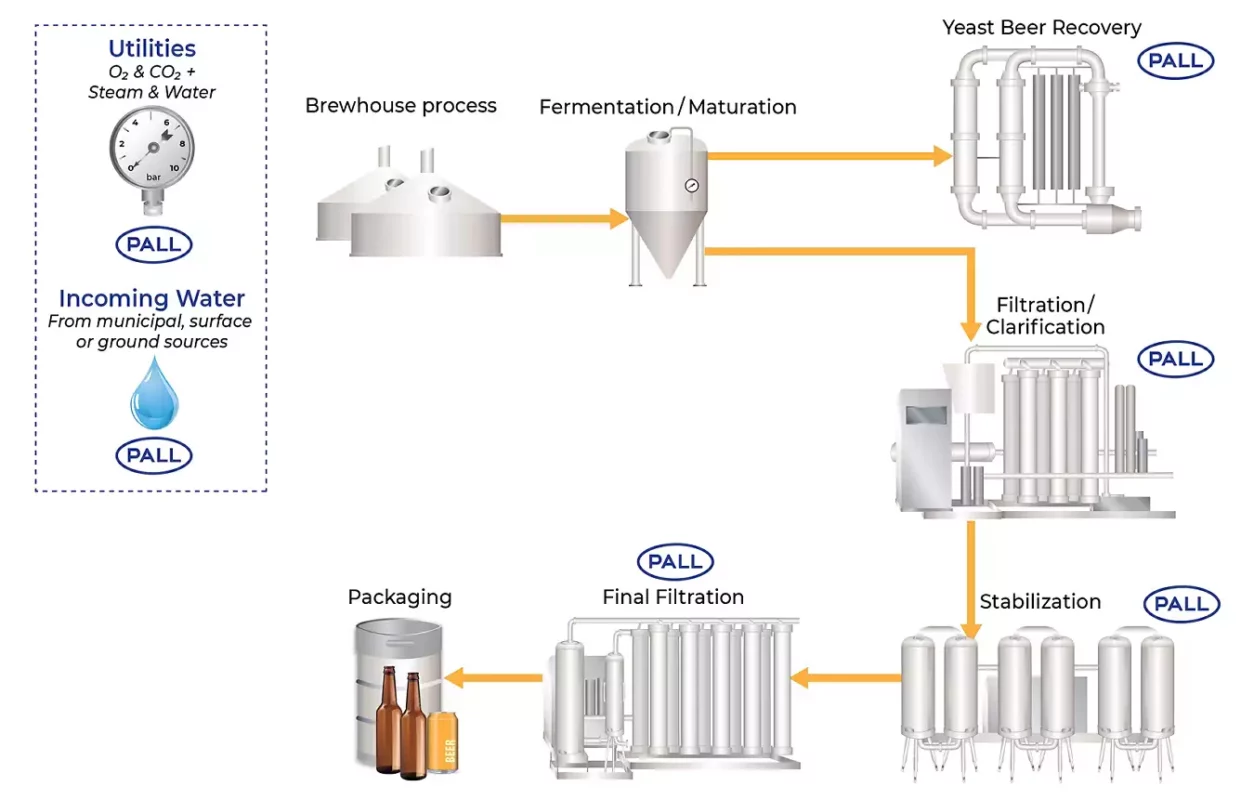
“Beer production equipment” covers four connected systems:
- Brewhouse (hot side): milling, mashing, lautering, boiling, whirlpool
- Cellar (cold side): fermentation, maturation, carbonation, yeast handling
- Packaging: kegging, bottling, canning, labeling, end-of-line
- Utilities + controls: CIP, steam/electric heating, glycol cooling, compressed air, water treatment, automation, safety
A turnkey approach matters because these systems must be designed as one. For example:
- A fast brewhouse is wasted if fermentation capacity is undersized.
- A canning line will not deliver shelf-life if dissolved oxygen control is weak.
- “Easy cleaning” is not optional. CIP design affects downtime and microbial risk.
Market research reflects ongoing global investment in brewery equipment. One widely cited estimate places the global brewery equipment market at USD 18.45 billion in 2024, with continued growth projected through 2030.[2]
2) Key Equipment Needed for Craft Breweries (What a Turnkey Line Should Include)
Below is a practical checklist for a turnkey craft brewery (brewpub to production-scale). Your exact configuration depends on target volume, beer styles, and packaging plan.
2.1 Raw material handling
- Malt mill (2-roller / 4-roller)
- Grist case / auger (optional, for automation)
- Hop dosing tools (hot side and dry hopping)
What buyers often ask in EU/US: dust control, safe guarding, and consistent crush quality.
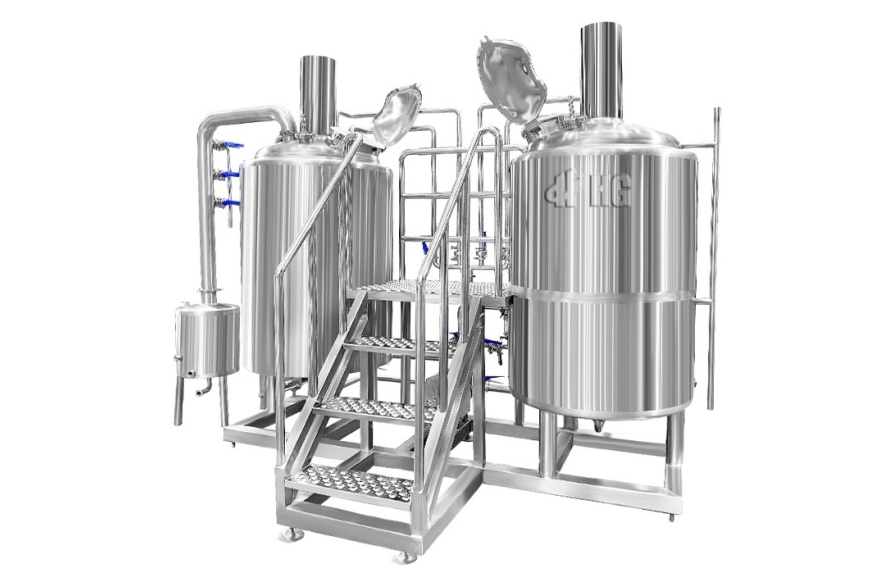
2.2 Brewhouse system (2-vessel / 3-vessel)
Typical turnkey options:
- 2-vessel: Mash/Lauter Tun + Kettle/Whirlpool (efficient footprint)
- 3-vessel: Mash Tun + Lauter Tun + Kettle/Whirlpool (higher flexibility and throughput)
Key specs to compare
- Heating method: steam, electric, or direct fire
- Lauter design: false bottom performance, rake system (if applicable)
- Whirlpool efficiency: trub cone stability, hop load handling
- Instrumentation: flow meters, temperature probes, level sensors
- Automation: manual valves vs semi-automatic vs PLC/SCADA recipe control
2.3 Hot Liquor Tank (HLT) and Cold Liquor Tank (CLT)
These tanks are simple on paper, but they determine whether your brewery runs smoothly:
- HLT sizing affects brew day pace and temperature stability.
- CLT supports rapid knock-out (wort cooling) and reduces batch delays.
Turnkey integration point: tanks, pumps, and piping should be designed to hit your required knock-out time without stressing the heat exchanger.
2.4 Wort cooling and oxygenation
- Plate heat exchanger (PHE) sized for your batch volume and water conditions
- Inline oxygenation (with sterile filtration) for yeast health and repeatability
Buyer focus: easy cleaning, reliable seals, stable outlet temperature, and documented sanitation approach.
3) “Essential Tools” that Make Craft Breweries Successful (Beyond the Main Tanks)
Turnkey buyers in the EU/US often prioritize operational reliability. These items are sometimes overlooked but have outsized ROI.
3.1 CIP (Clean-In-Place) system
A professional CIP loop typically includes:
- Caustic tank
- Acid tank (optional but common)
- Sanitizer loop
- CIP pump, return lines, spray ball coverage design
- Conductivity or concentration measurement (recommended)
Why it matters: Cleaning time is production time. A well-designed CIP system reduces downtime and infection risk.
3.2 Glycol cooling system
- Glycol chiller sized for peak load
- Proper jacket zoning and controls
- Insulated glycol lines and valves
Turnkey integration point: fermentation tank jacket area and glycol sizing must match your expected fermentation heat load and ambient conditions.
3.3 Water treatment
EU/US buyers frequently require:
- Filtration
- Carbon filtration (chlorine/chloramine control)
- Optional RO blending for style flexibility
3.4 Compressed air and CO₂ system
Packaging and automation depend on stable air supply and CO₂ handling:
- Air compressor + dryer + filtration
- CO₂ storage, regulators, safety provisions
4) Sizing a Turnkey Brewery: A Practical Capacity Framework (with Data-Style Analysis)
A common reason projects fail is poor sizing: a brewhouse that looks impressive but cannot meet packaging demand, or a cellar that becomes a bottleneck.
Use this simplified capacity logic:
Monthly Output ≈ (Brew Size) × (Brews per Week) × (Yield Factor) × (Weeks per Month)
Then validate against fermentation capacity:
Required Fermentation Volume ≈ Daily Knock-Out Volume × Average Tank Residence Time (days)
Where “tank residence time” depends on your beer mix:
- fast-turn lager alternatives, blond ales: shorter
- hazy IPAs with heavy dry hop: moderate
- true lagers: longer
5) Fermentation Tanks (Unitanks) for Craft Breweries: Selection and Maintenance
For EU/US craft breweries, fermentation is the center of quality control and scheduling. A turnkey system typically recommends unitanks because they combine fermentation and carbonation in one vessel and simplify transfers.
5.1 What to specify in a professional fermenter/unitank
- Stainless steel grade and sanitary weld quality
- Internal surface finish for cleanability
- Cooling jacket coverage (cone + body)
- Pressure rating suitable for spunding and carbonation
- Adequate ports: sample valve, dry hop, CIP, PRV, carbonation stone option
- Manway design and gasket quality
5.2 Maintenance that protects beer quality (and uptime)
- Scheduled gasket replacement plan
- Verification of spray ball coverage
- Valve teardown schedule for sticky products (high protein, heavy dry hop)
- CIP records and standard operating procedures
6) Bottling, Canning, and Kegging Equipment Overview (EU/US Distribution Reality)
Most craft breweries targeting retail growth in the EU/US consider cans early because cans travel well and protect from light. However, packaging success is not only about speed. It is about oxygen control and repeatability.
6.1 Kegging line (common starter + strong draft channel)
- Keg washer/filler
- CO₂ purge capability
- Sanitary transfer system
Pros: lower CapEx, flexible, strong for taproom/draft distribution.
6.2 Canning line (growth engine for many craft breweries)
Key features buyers look for:
- Rinse and CO₂ purge
- Seam quality and seam inspection routine
- Consistent fill levels
- Integration with inline carbonation and brite tank controls
Turnkey advantage: a canning line must be matched with brite tank sizing, CO₂ system capacity, and compressed air stability. Packaging is where integration mistakes become expensive.
7) Quality Control Instruments (Brewer-Lab Essentials for Consistent Beer)
To build trust in EU/US markets, consistency is the brand. A practical QC kit for a craft brewery includes:
- pH meter (mash and finished beer stability)
- Density measurement (hydrometer, densitometer, or equivalent)
- DO (dissolved oxygen) measurement for packaging QA
- Yeast tools: microscope + cell counting method (or automated counter)
- Basic microbiological checks (method depends on brewery maturity)
Industry credibility note: With a large craft segment but tightening competition, brewers increasingly focus on process control and consistency.[1] On the supplier side, continued equipment market growth suggests breweries keep investing in modernization and efficiency.[2]
FAQ (Q&A) for Turnkey Craft Brewery Projects
Q1: What does a turnkey brewery project usually include?
A turnkey project typically includes brewhouse, cellar tanks, CIP, glycol system, piping/valves, automation scope, installation guidance, commissioning, and operator training. The goal is one coordinated system rather than separate purchases.
Q2: How do I choose between a 2-vessel and 3-vessel brewhouse?
A 2-vessel brewhouse often wins on footprint and cost, and can be ideal for many craft operations. A 3-vessel system typically improves flexibility, lauter performance options, and throughput for larger production plans or complex schedules.
Q3: How many fermentation tanks do I need?
Start with your expected brew frequency and average tank residence time. Many growth constraints come from underbuilding fermentation capacity, not from brewhouse capacity.
Q4: Is a unitank the best choice for craft breweries?
Often yes, because it reduces transfers and simplifies carbonation. The best choice depends on whether you plan filtration, high packaging throughput, or specialized processes that benefit from separate brite tanks.
Q5: What are the biggest technical risks in packaging for EU/US markets?
Oxygen pickup and inconsistent seams (for cans) are common risk areas. Packaging equipment must be matched with CO₂ supply, compressed air quality, brite tank capability, and QA routines.
Q6: What documentation should I ask a turnkey supplier for?
Request a clear scope list, equipment drawings, utilities requirements, piping and instrumentation overview, commissioning plan, spares list, and recommended maintenance schedule.
Conclusion: Why Turnkey Beer Production Equipment Can De-Risk Craft Brewery Growth
For EU and US craft breweries, the best equipment decisions are not only about capacity. They are about:
- integration
- repeatable quality
- cleanability and uptime
- packaging-ready process control
A turnkey brewery approach helps align the entire system from brewhouse to package, reducing schedule risk and preventing expensive “integration surprises” during commissioning. Industry figures show craft remains substantial and competitive,[1] while equipment investment trends remain strong globally.[2]
