
Craft breweries succeed on consistency, flexibility, and cost control. While recipes and ingredients get most of the attention, beer brewing tanks are the physical infrastructure that determines whether a brewery can hit target quality, maintain stable throughput, and scale profitably. From fermentation performance to cleaning time, from carbonation stability to expansion planning, tank decisions affect nearly every KPI in daily operations.
Industry data also shows why breweries continue investing in cold-side capacity even in a competitive market. In the U.S. alone, the Brewers Association reported 9,778 small and independent breweries in operation in 2025, with craft beer supporting 443,000+ jobs and generating $72.5B in economic impact.[1] Even as some markets mature, well-designed production systems remain a core advantage.
This article explains how to choose and optimize beer brewing tanks using practical engineering principles, common sizing ratios, and measurable performance indicators.
1) The Role of Beer Brewing Tanks in Craft Brewery Operations
In a craft brewery, beer brewing tanks are not just storage vessels. They are process tools that determine:
- Fermentation quality and repeatability (temperature stability, pressure control, yeast management)
- Production capacity (how many batches can be fermented, conditioned, and packaged per week)
- Operational efficiency (CIP time, changeover time, transfer loss, oxygen pickup)
- Food safety and compliance (sanitary design, weld quality, surface finish, fittings)
A common mistake is to size the brewhouse first and “add tanks later.” In reality, most breweries become fermentation-limited long before the brewhouse becomes the bottleneck. Many equipment guides and benchmarks recommend a fermenter-to-brewhouse capacity ratio of roughly 3:1 to 4:1 to allow proper fermentation and conditioning time (especially for lagers and dry-hopped styles).[2]
2) Types of Brewing Tanks Used in Craft Brewing Industries
Modern craft breweries typically use a combination of the following beer brewing tanks:
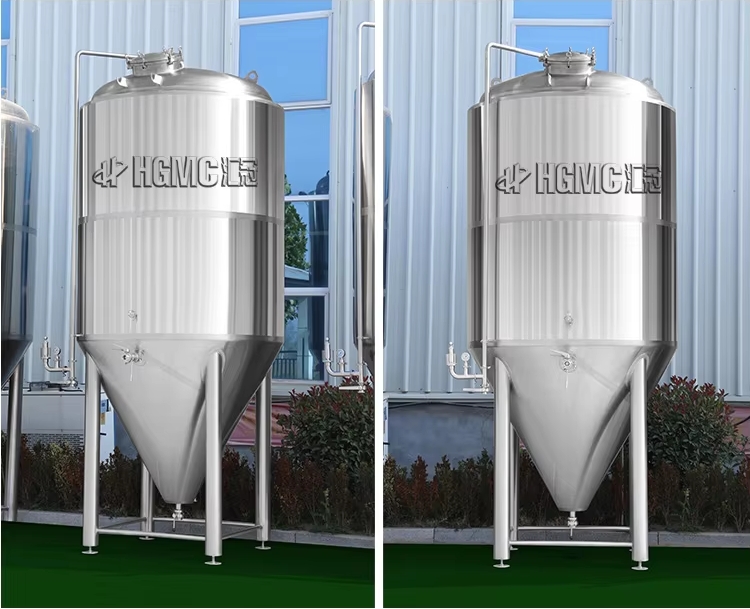
Fermentation Tanks (Cylindroconical Fermenters / Unitanks)
Unitanks can handle fermentation and conditioning in one vessel, improving space efficiency and reducing transfers. Common features include cone angle for yeast collection, glycol jackets, pressure rating for spunding, and CIP spray devices.
Why they matter: Temperature precision and yeast handling strongly influence flavor stability and batch-to-batch consistency.
Bright Beer Tanks (BBTs)
Used for clarification, carbonation, and holding beer before packaging. A properly sized BBT setup improves packaging speed and reduces DO (dissolved oxygen) risk during packaging prep.
Hot Liquor Tank (HLT) and Cold Liquor Tank (CLT)
Not fermentation vessels, but critical utility tanks. HLT sizing is often 1.5–2× brewhouse volume depending on process and heat recovery strategy.[2]
Brew Kettle / Whirlpool (and Mash/Lauter)
These are “hot side” vessels, but still part of the broader “brewing tanks” category in many SEO searches. For smaller breweries, a combined kettle/whirlpool tank is common.
Utility/Process Tanks (as the brewery grows)
- Yeast brink
- CIP tank(s)
- Inline blending or deaerated water tanks (for advanced operations)
3) Capacity Considerations for Craft Brewery Brewing Tanks
Tank capacity decisions should start from a measurable plan:
Step A: Define target annual volume (Year 1, Year 3, Year 5)
Then translate that into:
- Batch size (e.g., 10 bbl / 20 hL)
- Brews per day/week
- Average fermentation/conditioning days by style
- Packaging cadence
Step B: Use fermentation-days math (simple and effective)
A simplified capacity model:
Annual capacity ≈ (Total fermenter working volume × 365 / Average tank residency days) × Yield factor
Where:
- Residency days include fermentation + conditioning + turnaround.
- Yield factor accounts for losses (trub, yeast, transfers), typically 90–96% depending on practices.
Practical sizing reference (common craft setup)
Many breweries plan 3–4× fermenter volume vs. brewhouse size to avoid constant scheduling stress.[2]
Example:
- 10 bbl brewhouse
- Target: 2 brews/day, 4 days/week = 8 brews/week
- Average tank residency: 14–21 days depending on style mix
You will typically need multiple fermenters (often 4–8+) to keep up without sacrificing maturation time.
4) Impact of Tank Materials on Beer Quality and Production
For beer brewing tanks, stainless steel is the industry standard, and for good reason:
Stainless steel grade: 304 vs 316
- 304 stainless is widely used for brewing vessels due to corrosion resistance and cost efficiency.
- 316 stainless offers improved resistance to chlorides and harsh cleaning environments, useful for coastal regions or aggressive CIP regimes.[2]
Surface finish and weld quality affect:
- Biofilm risk (harder-to-clean surfaces raise contamination probability)
- CIP effectiveness (cleaning coverage vs shadow areas)
- Flavor stability (micro-contamination can create recurring off-flavors)
Material choice and real-world production impact
Poor material choices or low-quality fabrication often show up as:
- Rising CIP chemical use
- Longer cleaning cycles
- Higher infection rate
- Lower tank availability (more downtime)
5) Significance of Tank Maintenance for Consistent Brewing
Tank maintenance is not optional if you want stable product quality. Good maintenance reduces unplanned downtime and protects brand consistency.
Core maintenance practices (craft scale)
- Routine CIP verification (spray ball performance, cycle parameters, chemical concentration checks)
- Gasket and seal replacement schedule
- PRV calibration and inspection for pressure vessels
- Jacket and glycol system checks to avoid temperature drift
Why temperature control is a quality multiplier
Many modern breweries adopt automated temperature monitoring to prevent off-flavors and improve consistency. Industry equipment guides emphasize that fermentation temperature control is one of the strongest drivers of repeatable quality.[2]
6) Brewing Tank Design Innovations Enhancing Efficiency in Craft Breweries
Innovation in beer brewing tanks is often about efficiency and repeatability, not “fancy features.”
Key design innovations that matter
- Optimized glycol zoning
- More precise fermentation curves
- Less energy waste
- Improved CIP coverage
- Better spray device placement and flow design
- Shorter cleaning time
- Higher pressure-rated unitanks
- Spunding, natural carbonation
- Fewer transfers, lower oxygen pickup risk
- Smart instrumentation
- Temperature logging, alarms, predictive maintenance
Design = labor cost
Small breweries often underestimate the labor cost of inefficient tanks. If a tank design saves even 15–30 minutes per cleaning cycle, multiplied by weekly cleaning frequency, the annual labor value can be substantial.
7) Economic Implications of Brewing Tank Investment for Small Breweries
Beer brewing tanks are a capital investment that should be evaluated with capacity, uptime, and cost per hectoliter/barrel in mind.
What the market tells us about craft economics
Brewers Association data shows that while overall U.S. beer production and imports were down 1% in 2024, craft retail dollar sales increased 3% to $28.8B, accounting for 24.7% of the U.S. beer market by retail dollars.[3] This suggests a market where value, differentiation, and local brand strength matter, and operational efficiency helps protect margin.
Typical equipment cost ranges (useful buyer context)
A detailed equipment guide estimates rough total equipment ranges such as:
- 3 bbl system: ~$78k–$122k
- 7 bbl system: ~$203k–$335k
- 15 bbl system: ~$580k–$950k
(These ranges vary by automation, tank count, utilities, and packaging scope.)[2]
Practical ROI logic for tanks
For many small breweries, tank ROI comes from:
- Increasing sellable volume without expanding the brewhouse
- Reducing product loss (transfers, DO-related shelf life issues)
- Reducing labor (cleaning time, manual monitoring)
- Improving consistency (fewer dumped batches)
Frequently Asked Questions (FAQ): Beer Brewing Tanks
Q1: What is the best material for beer brewing tanks?
A: For most breweries, 304 stainless steel is the standard choice due to durability, corrosion resistance, and cost efficiency. 316 stainless steel is often chosen when extra corrosion resistance is needed, such as in high-chloride environments or aggressive cleaning conditions.[2]
Q2: How many fermentation tanks does a craft brewery need?
A: A common planning guideline is 3:1 to 4:1 fermentation capacity relative to brewhouse batch size, depending on beer styles and desired maturation time.[2] Lagers, strong ales, and heavily dry-hopped beers typically require more tank time, which increases the number of fermenters needed.
Q3: Should I choose unitanks or separate fermenters and bright tanks?
A: Many craft breweries prefer unitanks for flexibility and fewer transfers, especially at smaller scales. If packaging volume is high and you want steady packaging operations, adding bright beer tanks often improves line efficiency and reduces tank residency pressure.
Q4: What tank pressure rating should I choose?
A: If you want spunding and in-tank carbonation, select fermentation tanks designed for that pressure regime. Pressure-rated tanks also support safer transfers and more stable carbonation practices. Always match the rating to your process and local compliance requirements.
Q5: How do beer brewing tanks affect beer quality?
A: Tanks affect quality through temperature stability, sanitary design, surface finish, and oxygen control during transfers. Better tank design reduces contamination risk and improves repeatability across batches.
Q6: How do I reduce cleaning time without risking sanitation?
A: Focus on sanitary design, correct CIP sizing, verified spray coverage, and consistent cycle parameters. Maintenance of seals, valves, and spray devices is a major factor in both cleaning speed and microbiological safety.
Q7: Are beer brewing tanks a good investment in a competitive craft market?
A: Efficiency and consistency are increasingly important as the market matures. Industry data shows craft remains economically significant (for example, U.S. craft retail dollar sales reached $28.8B in 2024).[3] Tanks that improve uptime, reduce losses, and stabilize quality often provide measurable ROI.
Conclusion: Choosing Beer Brewing Tanks That Improve Quality and Profitability
Beer brewing tanks shape what a craft brewery can produce, how consistently it can brew, and how efficiently it can operate. The best tank plan is not simply “bigger is better,” but a system design that matches style mix, fermentation time, packaging strategy, and growth timeline.
If you treat tanks as a measurable productivity tool, you can:
- increase output without sacrificing maturation,
- reduce labor and downtime,
- protect flavor consistency and brand reputation,
- and make expansion smoother and lower-risk.
