
Introduction: Why “Fermentation Tank + CIP System” Is a Core Brewery Investment
In professional brewing, fermentation is where wort becomes beer—and where the majority of flavor stability, consistency, and product safety are decided. That’s why modern breweries evaluate a fermentation tank not only by volume and appearance, but by how well it controls temperature, pressure, yeast handling, and—most importantly—how reliably it can be cleaned and sanitized.
A CIP system (Clean-In-Place) is the operational partner of the fermentation tank. It enables automated, repeatable cleaning cycles without disassembling the vessel. When properly designed, a fermentation tank with a CIP system reduces contamination risk, lowers labor time, improves cleaning consistency across shifts, and shortens turnaround time between batches.
This guide explains what to look for in a beer fermentation tank and how to size and configure a CIP system for real brewery conditions.
1) What Is a Fermentation Tank in Brewing?
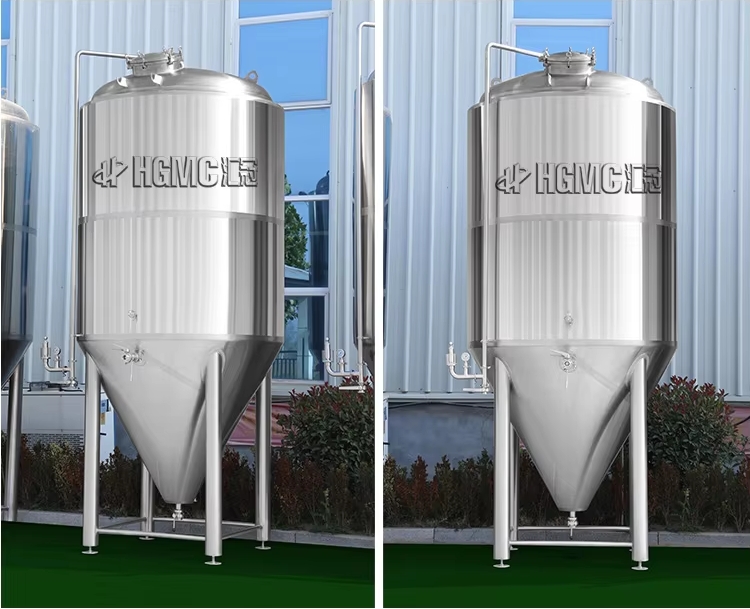
A fermentation tank (often a stainless steel cylindroconical tank, CCV) is a vessel designed to support yeast fermentation under controlled conditions. In most breweries today, fermentation tanks also handle:
- Cooling (via glycol jackets)
- Pressure control (spunding, carbonation, closed transfer)
- Yeast collection/harvesting (from cone)
- Sampling and quality checks
- Cleaning and sanitation (via CIP spray devices)
Common professional fermentation tank types
- Cylindroconical fermenter (CCV / conical fermenter): the mainstream choice for craft and industrial breweries
- Unitank: a pressure-rated conical designed for fermentation + conditioning + carbonation in one tank
- Open fermenter: used for specific traditional styles, requires strong environmental hygiene
- Horizontal tanks: sometimes used for lagering/space optimization depending on cellar layout
2) What Is a CIP System (Clean-In-Place) and Why It Matters?
A CIP system is a cleaning process and equipment set that circulates cleaning solutions through tanks and piping to remove soils (yeast, protein, hop resins, beer stone) and to sanitize surfaces—without opening the vessel or manual scrubbing.
A well-built CIP program delivers:
- Repeatability (same flow, temperature, concentration, time each cycle)
- Reduced contamination events
- Better production efficiency (faster tank turnaround)
- Less operator variability and less chemical “guesswork”
In fermentation, CIP is especially important because the vessel contains warm, nutrient-rich beer/wort conditions that can quickly amplify microbial contamination if sanitation slips.
3) Key Design Features of a Fermentation Tank for CIP Cleaning
When people say “CIP-capable tank,” the details matter. Here are the features that most directly affect cleaning performance:
3.1 Sanitary construction and surface finish
- Internal weld quality: smooth, continuous, well-finished welds reduce harbor points
- Surface roughness/finish: smoother finishes are generally easier to clean and validate
- Drainability: the tank must fully drain; puddles invite microbial growth and dilute chemicals
Practical implication: great CIP chemistry can’t compensate for poor hygienic design.
3.2 Spray device selection (spray ball vs rotary spray head)
A fermenter is typically cleaned using:
- Static spray ball: simple, cost-effective, depends on correct flow and coverage
- Rotary spray head / rotary jet head: higher impact cleaning for tougher soils or larger vessels (usually more demanding on pump and filtration)
Selection depends on tank size, soil load, and required cleaning validation level.
3.3 Correct port placement and “no dead-legs”
CIP failures often come from geometry issues:
- Long, unflushed branches
- Poorly oriented valves
- Trapped pockets around sample valves or sight glasses
A good fermentation tank design minimizes dead legs and ensures cleaning solution reaches all contact surfaces at adequate velocity.
3.4 CIP-ready accessories
Look for sanitary design in:
- Sample valves
- PRV and blow-off piping
- Carb stone ports (if used)
- Racking arms
- Manway gaskets and seats
These are frequent contamination points if not fully cleanable in place.
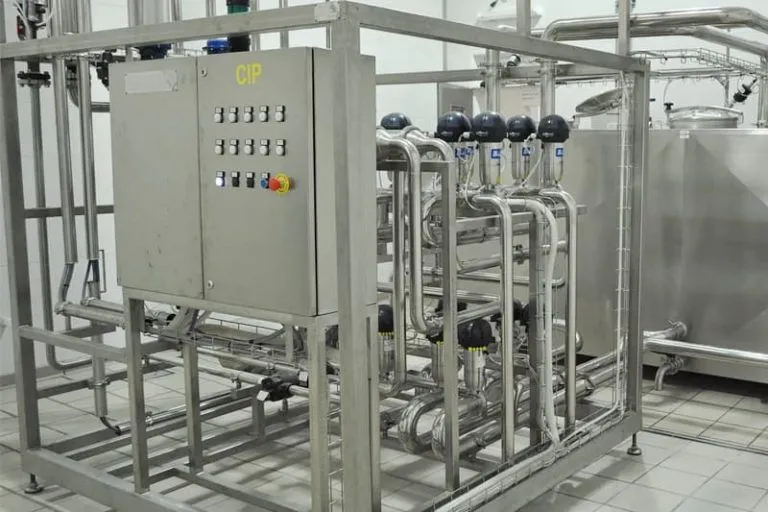
4) Core Components of a Brewery CIP System
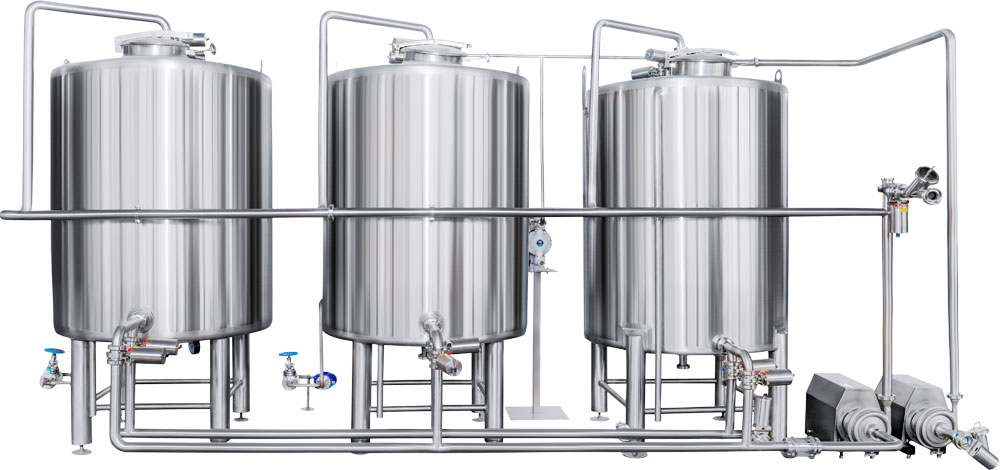
A typical brewery CIP system (for fermentation tanks and cellar piping) includes:
- CIP tanks (solutions):
- Caustic (alkaline wash)
- Acid (for mineral scale / beer stone control)
- Hot water / rinse water
(Some systems use a 2-tank or 3-tank configuration depending on scale.)
- CIP pump
- Provides required flow and pressure to the spray device and pipeline loops
- Heat exchanger or heating method
- Maintains wash temperature for effective cleaning
- Valves + manifolds
- Route CIP to selected tank/loop (manual or automated valve matrix)
- Instrumentation and controls
- Temperature, conductivity (chemical concentration proxy), flow, pressure, timers
- Logging helps standardize cleaning and supports QA documentation
5) A Practical CIP Cycle for Fermentation Tanks (Conceptual SOP)
Every brewery’s chemistry and time/temperature targets differ, but most fermentation tank CIP programs follow this logic:
- Pre-rinse
- Remove gross soils and reduce chemical consumption
- Caustic wash
- Targets organic soils (yeast, proteins, hop resins)
- Intermediate rinse
- Prevent chemical carryover
- Acid wash (periodic or routine)
- Controls mineral deposits and beer stone, improves long-term hygiene
- Final rinse
- Ensures no chemical residue
- Sanitization step (as required)
- Heat or chemical sanitizer depending on brewery SOP
Key principle: CIP is not only “chemicals.” It’s the combined effect of time, temperature, concentration, and mechanical force (flow/impact).
6) Selecting a Fermentation Tank + CIP System: Buyer Checklist
When customers evaluate equipment, these are the questions that prevent expensive mistakes:
Fermentation tank questions
- What is the working volume vs total volume (headspace for krausen)?
- What is the pressure rating (future-proof for unitank operation)?
- How many cooling jacket zones (cylinder + cone)?
- Are all internal surfaces fully drainable?
- Are welds and ports designed for hygienic service (no dead legs)?
CIP system questions
- What is the target flow rate required by the chosen spray device?
- Can the pump maintain flow at real-world pressure losses (height, hoses, valves)?
- How will you manage temperature and chemical concentration consistently?
- Do you need a manual or automated valve matrix?
- Do you need conductivity and flow logging for QA?
8) FAQ (SEO Q&A)
Q1: What does CIP mean in a fermentation tank?
CIP means Clean-In-Place—cleaning the inside of the fermentation tank using circulating solutions and a spray device without disassembling the tank.
Q2: Is a spray ball enough for a brewery fermentation tank?
For many breweries and tank sizes, a properly sized spray ball can work well if flow, temperature, and chemistry are correct. Larger tanks, heavier soils, or stricter validation needs may benefit from rotary spray devices and better instrumentation.
Q3: How often should I run an acid CIP cycle?
Many breweries run acid periodically to control beer stone and mineral scale; frequency depends on water chemistry, beer styles, and SOP. The key is consistency and inspection-driven adjustment.
Q4: What are the most common CIP mistakes?
Common issues include insufficient flow to the spray device, low wash temperature, incorrect chemical concentration, poor drainability, and dead legs in valves/ports that never get fully cleaned.
Q5: Can one CIP system clean multiple fermentation tanks?
Yes. Many breweries use a centralized CIP skid and a valve manifold to clean multiple tanks one at a time. Correct sizing (pump, heating, tank volumes) is critical.
Company Paragraph (HGMC)
HGMC is the world’s leading manufacturer of beer brewing equipment. We produce brewery equipment, beverage equipment, and canning/bottling lines. With more than 30 national authorized patents and more than 20 high-tech achievements, we provide a full range of services—from individual equipment to turnkey projects—exported to more than 120 countries worldwide and recognized by customers for performance and reliability.
