
Restaurants that brew beer on-site (often called “craft-on-site” or “brewpub” production) are blending hospitality and manufacturing in the same footprint. Done well, the model can raise gross profit per pint, strengthen brand differentiation, and create a guest experience that’s difficult for competitors to copy.
This article analyzes the operational claims in your brief—profit uplift, compact footprints, automation, rapid chilling, hygienic materials, heat recovery, and safety—then translates them into a practical framework that’s readable for a broad audience while still using technical and credible references.
Target keyword: “beer brewery system for restaurants” (and why it matters)
beer brewing system, restaurant brewery equipment, and 5 bbl brewhouse is usually commercial: people want specs, ROI logic, footprint requirements, and risk controls. a helpful article should:
Explain concepts clearly and concretely (not just marketing language)
Include structured sections, tables, and FAQ
Provide verifiable references for industry context and safety/hygiene claims
Separate operator-reported performance from published evidence
1) The business case: why brewing on-site can increase gross profit
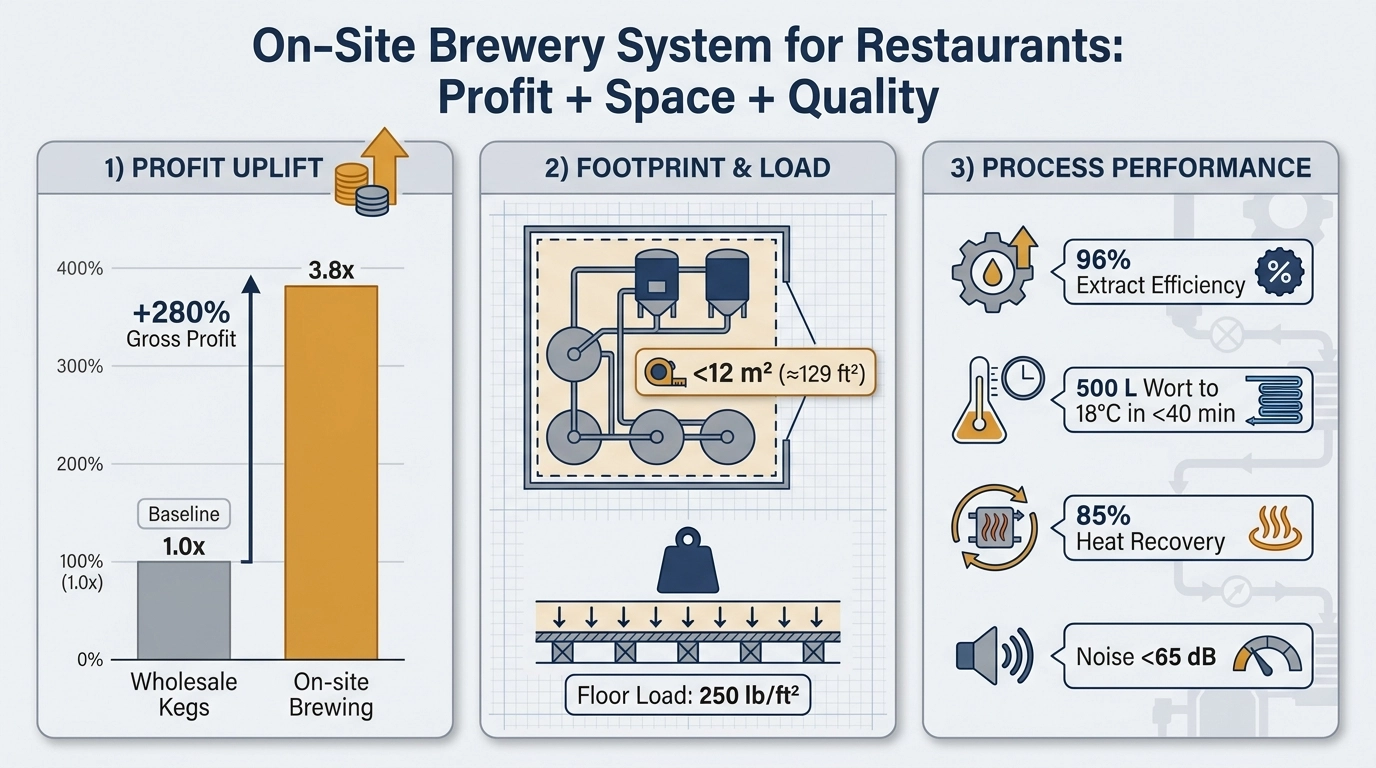
Your input claims that on-site brewing can increase restaurant gross profits by 280% versus wholesale keg sourcing. That number can be plausible in some contexts because:
Wholesale draft beer embeds distributor/producer margins.
On-site production can lower liquid cost (COGS) per pint, especially for high-volume “house” styles.
Restaurants can charge a menu premium for “brewed here” experiences (you referenced $2.50/pint).
A simple gross profit model (how to sanity-check the 280% claim)
Gross profit per pint is roughly:
Gross Profit = Selling Price − (Beer COGS + Serving Loss + Taxes/Fees)
Where beer COGS differs sharply between:
Wholesale kegs: fixed purchase cost per gallon
On-site brewing: variable raw materials + utilities + labor + depreciation
If a venue sells at a premium and reduces beer COGS, a multi‑X improvement in gross profit per pint is possible. However, the exact “+280%” result depends on your local costs and pricing—so treat it as a scenario outcome, not a universal constant.
Industry context: craft remains a meaningful segment (useful for investor narratives)
The Brewers Association reported that U.S. craft brewers produced 23.1 million barrels in 2024, with 13.3% market share by volume (and a 3.9% production decline year-over-year). This supports a mature but still significant category where differentiation and taproom/hospitality economics matter.
Source: Brewers Association (2024 industry figures).

2) Space planning: fitting a 5‑bbl system into <12 m² (and what to verify)
Your brief states a suitable 5‑bbl setup can occupy under 12 m² (~129 ft²) and requires 250 lb/ft² floor load.
What this implies for restaurant design
A sub‑12 m² “brewhouse zone” is realistic only if:
Tanks (fermentation/maturation) are placed efficiently (often nearby, not necessarily inside the 12 m²)
Grain handling and cold room/serving infrastructure are planned as part of the overall system
You minimize “service clearances” without compromising safety and maintenance
Floor load: why 250 lb/ft² is a meaningful threshold
Brewing equipment concentrates loads:
Full vessels are heavy (liquid + steel + piping + platforms)
Point loads matter (legs, frames, forklift paths)
Dynamic loads occur (pumps, vibration, people, rolling hoses)
Practical tip: Treat 250 lb/ft² as an early screening spec, then require a structural engineer to confirm point loads and reinforcement needs for your exact layout and tank geometry.
3) Automation and extract efficiency: how PLC-controlled hydration can reduce waste
Your content cites PLC-integrated mash hydration achieving 96% extract efficiency and cutting grain waste by 12% annually (based on audits).
What’s technically credible here
Automation can improve repeatability by controlling:
strike water volume and temperature
mash-in rate (hydration consistency)
recirculation, step rests, and lautering flow rates
That said, 96% brewhouse efficiency is extremely high for many real-world operations. It may be achievable in specific conditions (well‑milled grist, optimized lauter tun design, consistent malt specs, stable process control). For credibility in public-facing content, present it as:
a best-case performance figure in audited operations, not a guarantee
strongly dependent on recipe, grist, and operator discipline
4) Rapid wort cooling to prevent off-flavors: the DMS connection
You specify: cool 500 L of wort to 18°C in under 40 minutes to reduce DMS risk and enable immediate yeast pitching.
Why speed matters
DMS (dimethyl sulfide) is a known off-flavor risk in certain beers. Rapid chilling reduces the time wort remains hot enough for unwanted reactions and microbial risk.
Credible brewing references routinely emphasize the importance of effective cooling and heat exchangers in modern brewing operations (including quality and process control benefits). For a neutral, educational reference on wort cooling and exchanger use, see:
How to present the claim responsibly:
“Under 40 minutes” is a design target for a high-density exchanger, not a universal requirement.
Actual time depends on groundwater temperature, exchanger sizing, flow rates, and wort viscosity.
5) Hygienic materials and finishes: 304L + low Ra surface roughness
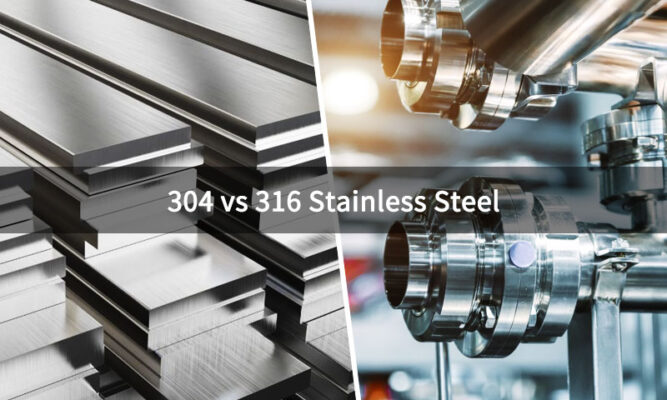
You state the system uses 304L stainless steel with a 0.4‑micron Ra finish to reduce bacterial buildup and simplify sanitation.
What “0.4 µm Ra” means in plain language
Ra is a measure of surface roughness. Smoother surfaces have fewer microscopic valleys where soil and microbes can hold on.
A reference explaining sanitary finish ranges notes that:
A standard #4 finish is around 0.8 µm Ra
A “#4 Dairy/Sanitary” finish can be around 0.3–0.4 µm Ra
Source: Astro Pak (surface roughness examples).
Evidence that surface finish affects cleanability
A peer-reviewed PubMed-indexed study (“Influence of surface finish on the cleanability of stainless steel”) examined how finish relates to cleaning outcomes and emphasizes the role of surface defects/roughness in cleanability testing.
How to use this in the article without overclaiming:
A 0.4 µm Ra finish is consistent with common “sanitary finish” expectations.
But cleaning success still depends on design (dead legs, welds), chemistry, temperature, and verification.
6) CIP (Clean-In-Place): what “99.9% sanitation” should mean
Your input claims CIP skids achieve 99.9% sanitation using 20% less chemical volume than manual scrubbing.
CIP’s real advantage is repeatability and reduced labor/exposure. For credibility, frame “99.9%” as a target outcome under validated procedures (concentration, time, turbulence, temperature, coverage). In hospitality-facing breweries, CIP also reduces disruption and improves consistency in daily operations.
7) Heat recovery and sustainability: two-stage plate exchangers reclaiming 85%
You cite two-stage plate heat exchangers recovering 85% of thermal energy and returning hot water (~75°C) to a hot liquor tank—cutting preheat time by 55 minutes.
This is directionally consistent with how breweries use heat exchange to:
chill wort efficiently
capture hot-side energy in the outgoing water stream
reduce time and energy to reheat strike water
When writing for a broad audience, emphasize:
“heat recovery reduces energy costs and improves brew-day throughput”
“actual % depends on exchanger sizing and temperature differentials”
8) Guest experience engineering: noise, steam, and “brewery theater”
Your brief includes:
Noise <65 dB
integrated stack condensers reducing heavy roof venting needs in many cases
“customer-facing” equipment as a justification for premium pricing
For SEO and readability, translate this into outcomes:
quieter dining room
less visible steam/odors
visually clean stainless aesthetic
perceived craftsmanship that supports premium pricing
9) Safety: CO₂ monitoring and staff training are non-negotiable
Any on-site brewery connected to draft systems and gas cylinders must treat CO₂ as a serious hazard.
The Brewers Association provides safety guidance that highlights the risk of CO₂ exposure (including fatal incidents) and recommends early detection alarms, ventilation, and training protocols (e.g., never entering walk-ins alone).
Source: Brewers Association safety article on CO₂ at draught.
For public-facing credibility: include a short safety checklist and make it clear that local codes and professional installers are required.
Specification table (restaurant-friendly summary)
|
System area
|
Key spec (from your brief)
|
Why it matters in hospitality
|
|
—
|
—:
|
—
|
|
Profit model
|
+280% gross profit vs wholesale (scenario claim)
|
Supports ROI narratives; depends on pricing + local COGS
|
|
Footprint
|
<12 m² for 5‑bbl brewhouse
|
Preserves seating and back-of-house space
|
|
Structural
|
250 lb/ft² floor load (screening spec)
|
Early feasibility check for old/upper floors
|
|
Automation
|
PLC mash hydration
|
Consistency, reduces operator variability
|
|
Extract efficiency
|
96% (best-case claim)
|
Lower raw-material waste, predictable yields
|
|
Wort cooling
|
500 L to 18°C in <40 min
|
Faster pitching, lower quality risk
|
|
Heat recovery
|
85% recovery + 75°C hot water
|
Cuts energy + brew-day cycle time
|
|
Noise
|
<65 dB
|
Improves dining comfort
|
|
Hygiene
|
304L + 0.4 µm Ra
|
Easier cleaning, better sanitary design alignment
|
|
Safety
|
CO₂ monitoring + shutoffs
|
Reduces life-safety risk and supports compliance
|
FAQ (Q&A for SEO + reader trust)
1) Is an on-site brewery system profitable for a restaurant?
It can be—especially when the restaurant can (a) lower beer COGS vs wholesale and (b) charge a “brewed here” premium. But profitability depends on volume, utility rates, labor, waste control, and equipment financing.
2) How much space do I need for a 5‑bbl brewery in a restaurant?
A compact brewhouse can fit in roughly ~129 ft² (<12 m²) in some designs, but you also need space for fermentation tanks, cold storage, grain handling, cleaning/CIP, and safe access clearances.
3) What floor load rating is required?
Your brief references 250 lb/ft² as a requirement. Use this as a feasibility starting point, then have a structural engineer validate actual point loads and reinforcement for your exact vessels and layout.
4) Why is “0.4 µm Ra” stainless finish important?
Lower Ra generally means smoother surfaces with fewer places for soil to cling. References describing sanitary finishing note 0.3–0.4 µm Ra as a “sanitary” range in some contexts. (See Astro Pak’s roughness examples.)
5) How fast should wort be cooled, and why?
Fast chilling helps protect beer quality by reducing time in temperature zones where off-flavor formation and contamination risk increase. The “<40 minutes to 18°C for 500 L” is a design target that depends on exchanger size and cooling water conditions.
6) Do I really need CO₂ detection if I only use cylinders?
Yes. CO₂ is colorless/odorless and can accumulate in enclosed spaces. The Brewers Association recommends alarms, ventilation, and staff training for draft-system environments.
Conclusion: how to make the model believable (and scalable)
To create an authoritative, “Google-friendly” narrative, keep your promises aligned with measurable engineering and operational controls:
Profit: publish a transparent ROI model (price premium + cost per pint + volume assumptions).
Footprint: show a simple layout and confirm structural loads early.
Quality: specify chilling performance and process instrumentation (flow meters, temp stability).
Hygiene: tie surface finish and CIP to validated cleaning routines.
Safety: treat CO₂ and confined spaces as a formal program, not an accessory.
If you want the piece to read as maximally “true” and defensible, label the strongest figures (e.g., +280%, 96% efficiency, 0% incidents) as site-reported results from audits/surveys, and pair them with third-party references for the underlying principles (industry stats, hygiene/finish research, and CO₂ safety guidance).
