
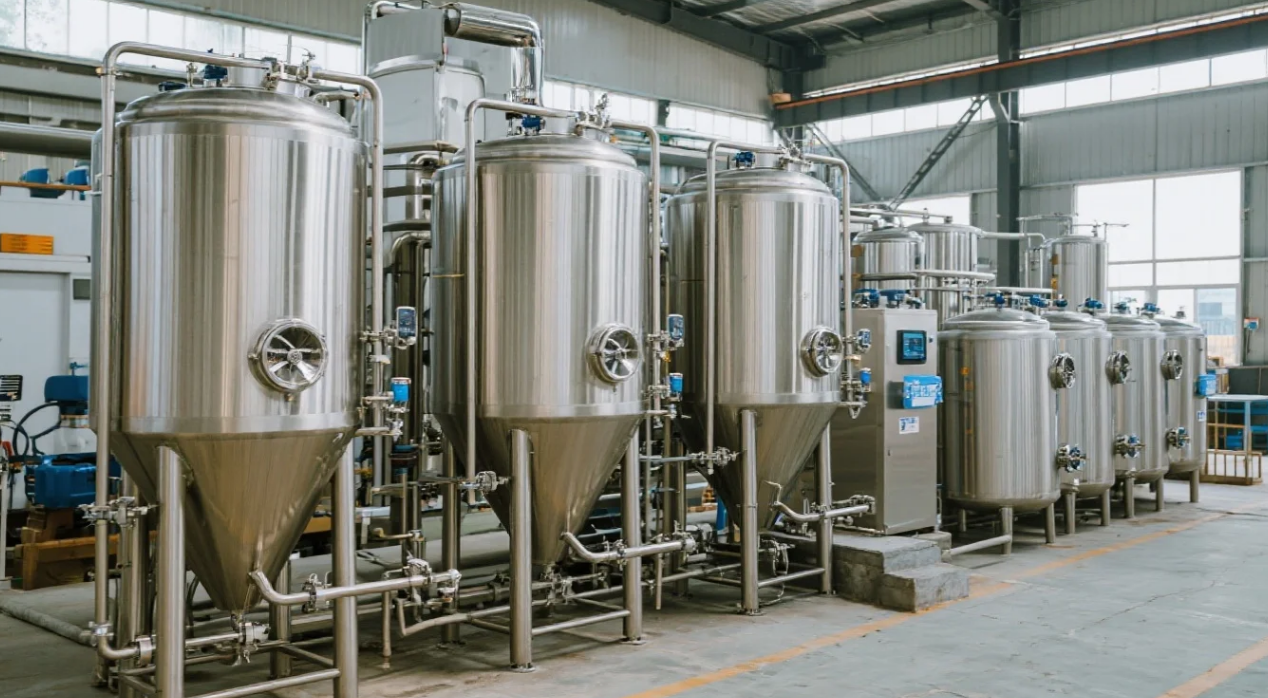
Searching “brewery system China” returns dozens of supplier websites, most with polished product galleries and similar-looking stainless steel vessels. Comparing them feels straightforward until you realize the quotes you collect are rarely built on the same assumptions. One supplier prices a 2,000 L brewhouse with manual controls; another quotes the same nominal capacity with full PLC automation, glycol chilling, and CIP integrated. The numbers look comparable. The projects are not.
The real workload in cross-border equipment buying is separating engineering partners from tank resellers while sitting 6,000 miles away. Price comparison is the easy part. Evaluating specialization, engineering depth, and post-sale support is where most buyers either save themselves years of operational headaches or commit to a system that needs rework before it ever produces a batch.
What to Look for When Vetting Brewery Equipment Suppliers in China
Start with product specialization. A supplier who dedicates manufacturing capacity to beer systems specifically will have different design tolerances than one who builds general stainless steel vessels for multiple industries. Check whether the supplier’s catalog is dominated by brewing equipment or padded with unrelated tanks. Ask for case studies close to your scale — a company that has delivered 2,000 L craft systems to independent breweries understands different constraints than one whose portfolio centers on 30,000 L (30 T) industrial fermentation tanks.
Engineering and customization capability comes next. A genuine brewery equipment manufacturer should be able to discuss process design, not just vessel dimensions. They should ask about your annual output, beer styles, and building constraints before quoting. If a supplier sends a price without asking a single question about your operation, treat that as a signal.
Quality control documentation matters more than marketing claims. Look for documented standards covering stainless steel grade selection, welding procedures, pressure testing, and final inspection. A supplier who can share these processes is different from one who just asserts quality.
Project experience is the final filter. References for breweries similar to yours — in size, concept, and export destination — tell you more than total years in business. HG Beer Equipment is one example of a Chinese supplier that combines manufacturing capability with engineering services, publishing case studies and process documentation rather than just product photos. That combination is what separates a partner from a middleman.
How Much Does a Brewery System from China Actually Cost?
There is no honest generic price for a brewery system from China. Anyone offering a range table without project details is guessing. Cost is driven by variables that only exist in your specific situation.
| Cost component | What it covers | How it scales with project size |
|---|---|---|
| Brewhouse and vessel configuration | Mash/lauter tun, kettle/whirlpool, piping, platforms | Scales with batch size and vessel count |
| Fermentation and bright tank capacity | Conical fermenters, unitanks, bright beer tanks | Scales with annual output in litres or BBLs |
| Automation level | Manual control panels to fully automated PLC systems | Scales steeply with control complexity |
| Optional packaging and processing equipment | Kegging, bottling, canning, pasteurization, filtration | Scales with distribution model, not brewery size |
The mistake buyers make is comparing raw quotes without tying them to project scope. I have watched breweries collect three quotes for “a 10 BBL system” and discover the variance had nothing to do with markup — one included glycol chilling and CIP, another assumed the brewery already had those utilities, and a third omitted packaging entirely. The cheapest quote was not cheap; it was incomplete.
Real pricing only emerges after detailed discussion. Capacity is typically measured in litres or BBLs, and cost scales with vessel configuration from small craft systems to industrial lines. Before any quote is meaningful, you need to define annual output, product mix, and building layout. Those three inputs determine vessel sizing, tank count, and automation requirements — which is where 80 percent of the cost actually lives.
Budget for the full integrated system, not just the brewhouse. Fermentation capacity, cooling, CIP, and packaging together typically exceed the brewhouse cost. Buyers who only price the shiny copper kettle end up with a brewhouse they cannot ferment out of.
What a Complete Brewery System from China Includes
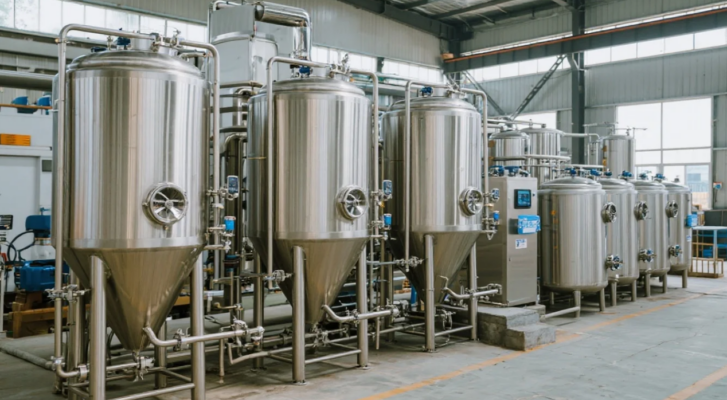
A complete system covers the end-to-end process from brewhouse through fermentation, conditioning, and packaging. Understanding the standard building blocks helps you evaluate whether a proposal is genuinely integrated or just a collection of compatible tanks.
The brewhouse is the first block. It typically includes a mash/lauter tun for mashing and wort separation, a kettle/whirlpool for boiling and trub separation, sanitary pumps, platforms, and piping. These components are designed as a sequence, not individual purchases. The piping and pump sizing between vessels matters as much as the vessels themselves.
Fermentation and conditioning form the second block. Conical fermenters handle primary fermentation, while bright beer tanks or unitanks manage conditioning and carbonation. Selection depends on your production plan — how many batches you run simultaneously, what styles you produce, and how much tank turnover you need.
The cooling system is the third block. Glycol chillers and insulated piping maintain temperature control during fermentation and cold storage. Undersized chilling is a common failure point in budget systems, and it is expensive to retrofit.
CIP equipment is the fourth block. Cleaning-in-place systems are designed for consistent, thorough cleaning cycles between batches. Manual cleaning is possible on small systems but becomes impractical beyond a certain volume.
Optional packaging is the fifth block. Kegging, bottling, and canning lines depend on your distribution model and local market needs. A brewery selling primarily to local taps needs a keg line; one distributing retail needs bottling or canning.
These blocks combine into one integrated line. When evaluating a proposal, check that every stage is addressed — a gap in cooling or CIP will surface as downtime or quality issues within the first months of operation.

How Suppliers Support Brewery Projects from a Distance
Cross-border brewery projects succeed or fail on documentation quality. Process diagrams and layout drawings determine whether your local contractors can install the system correctly. Power supply compatibility, building standards, and regional regulations vary across export markets, and a supplier who has shipped to your region will have already solved these problems.
Technical documentation is the foundation. A complete package includes process and instrumentation diagrams, layout drawings with dimensions, and installation manuals. If a supplier hesitates to share these before purchase, that is a warning sign.
Installation support comes in two forms. On-site commissioning involves sending a technician to your brewery for a defined period. Remote guidance uses video calls and detailed documentation to walk your team through installation. For smaller craft systems, remote guidance often works well and costs less. For larger industrial lines, on-site commissioning is usually worth the expense.
Spare parts access matters after commissioning. Ask about lead times for common consumables and critical components. A supplier with local distribution or fast international shipping is easier to work with than one whose parts take months to arrive.
The practical takeaway: a supplier’s engineering support should feel comparable to what a local provider would offer. HGMC Beer Equipment illustrates this approach — supporting global projects with technical documentation, standards compatibility work, and both on-site and remote commissioning options. Transparent documentation is the foundation of that trust, because it determines whether installation and compliance go smoothly. When documentation is clear, distance becomes a minor logistical detail rather than a project risk.
FAQ
How do I verify that a Chinese brewery equipment supplier actually specializes in brewing systems?
Check their product catalog and case studies. A specialist will have most of their portfolio dedicated to brewing equipment and can share references for breweries similar to your scale. Ask for process design documents, not just product photos — a specialist can discuss your specific brewing workflow.
What drives the price difference between brewery systems from China?
Project scope drives price. Vessel configuration, fermentation capacity in litres or BBLs, automation level, and packaging equipment all affect cost. Two quotes for the same nominal capacity can differ by 40 percent or more if one includes cooling, CIP, and automation while the other does not.
Can a Chinese supplier help with installation and commissioning in my country?
Yes, through on-site commissioning or remote guidance. On-site visits work well for larger systems; remote guidance with video calls and detailed documentation suits smaller craft breweries. Confirm which option is included in your quote before signing.
How do I know if a complete brewery system includes everything I need?
Review the proposal against the full process chain: brewhouse, fermentation and conditioning tanks, cooling, CIP, and packaging. If any stage is missing, ask specifically. A complete system addresses every step from grain to finished beer.
Are Chinese brewery systems compatible with local power and building standards?
Reputable suppliers design for export and can adjust power supply configurations, safety standards, and building code compliance for your region. Ask for documentation on standards compatibility before purchase — this is where cross-border projects typically encounter delays.
