Meta Description: Comprehensive guide to brewing equipment selection for commercial breweries. Learn about brewhouse sizing, fermentation control, CIP systems, automation, and how to choose the right equipment manufacturer for your brewery operation.
Introduction
Selecting the right brewing equipment is one of the most critical decisions facing brewery owners and operators today. Whether you’re launching a new microbrewery or scaling an existing craft brewery, your equipment choices will directly impact product quality, operational efficiency, and long-term profitability.
According to the Brewers Association, the United States had over 9,700 craft breweries operating in 2025, representing a highly competitive market where equipment efficiency and beer quality differentiation are paramount. The global brewery equipment market, valued at $18.7 billion in 2025, is projected to reach $24.3 billion by 2030 (Grand View Research, 2025), driven by craft beer expansion and brewery automation trends.
This guide provides brewery owners, brewmasters, and facility planners with actionable insights into commercial brewing equipment selection, system sizing, process optimization, and supplier evaluation—backed by industry data and engineering best practices.
How Do You Choose the Right Equipment for Your Brewery?
Choosing brewery equipment requires balancing production capacity, beer quality, operational flexibility, and capital investment. The decision framework should consider:
1. Production Volume & Growth Planning
Start by defining your annual production target in barrels (BBL). Industry best practice suggests planning for 30–40% capacity expansion headroom in your facility layout.
Capacity Planning Benchmarks:
- Nanobrewery: <1,000 BBL/year (typically 1–3 BBL systems)
- Microbrewery: 1,000–15,000 BBL/year (7–15 BBL systems)
- Regional craft brewery: 15,000–200,000 BBL/year (20–60 BBL systems)
- Large-scale commercial: >200,000 BBL/year (80+ BBL systems)
2. Fermentation Capacity Ratio
The fermentation vessel (FV) to brewhouse ratio is critical. MBAA (Master Brewers Association of the Americas) guidelines recommend a 3:1 to 4:1 FV-to-brewhouse ratio for most production schedules.
Example: A 20 BBL brewhouse should have 60–80 BBL of total fermentation capacity to maintain consistent production without bottlenecks.
3. Beer Style Portfolio
Different beer styles require different equipment features:
- Lagers require precise glycol cooling and longer fermentation tanks
- IPAs and ales benefit from dry-hopping capabilities and faster turnover
- Sours and wild ales need dedicated vessels to prevent cross-contamination
4. Budget & ROI Expectations
Capital equipment costs typically represent 40–60% of total brewery startup costs. According to industry surveys:
- Small brewhouse (7 BBL): $100,000–$200,000
- Mid-size system (20 BBL): $350,000–$600,000
- Large commercial (60 BBL): $1.2M–$2.5M+
Payback periods for well-planned breweries typically range from 3–5 years, depending on production volume, distribution strategy, and market positioning.
Types of Commercial Brewing: Which Brewing System Fits Small Breweries and Microbrewery Teams?
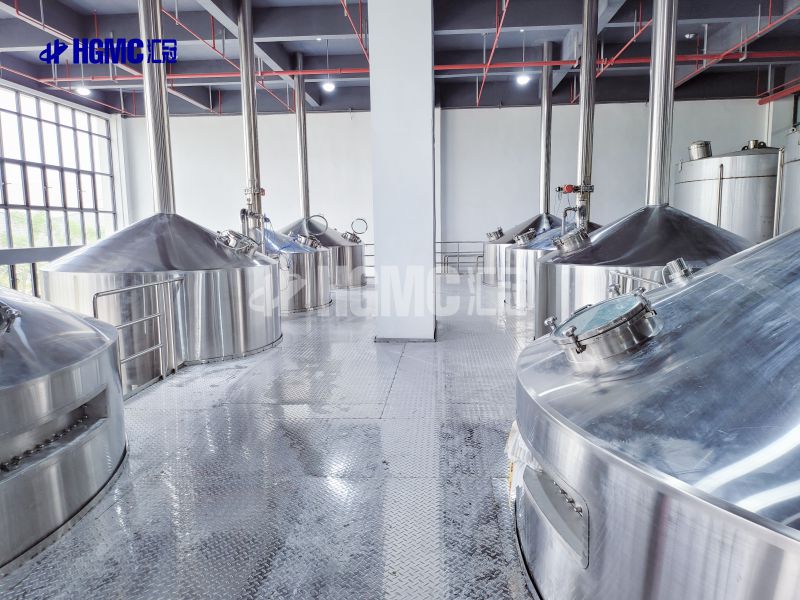
Commercial brewing systems come in several configurations, each suited to different operational models:
1. Two-Vessel Brewhouse Systems
Configuration: Mash/Lauter Tun + Kettle/Whirlpool
Best for: Small breweries and taprooms (3–10 BBL)
Advantages:
- Lower initial capital cost ($75,000–$150,000)
- Smaller footprint (600–1,000 sq ft)
- Simpler operation, ideal for small teams
Limitations:
- Longer brew days (6–8 hours per batch)
- Limited production capacity
2. Three-Vessel Brewhouse Systems
Configuration: Mash Tun + Lauter Tun + Kettle/Whirlpool
Best for: Growing microbreweries (10–30 BBL)
Advantages:
- Better efficiency and flexibility
- Ability to double-batch (start next mash while previous wort is boiling)
- Industry standard for mid-size craft breweries
Typical Investment: $200,000–$500,000
3. Four-Vessel Brewhouse Systems
Configuration: Mash Tun + Lauter Tun + Kettle + Whirlpool
Best for: High-volume production breweries (30+ BBL)
Advantages:
- Maximum throughput (2–3 brews per day)
- Superior wort clarity
- Optimal for consistent large-batch production
Investment Range: $500,000–$1.5M+
4. Brewhouse System Selection Matrix
What Commercial Brewing Equipment Refers To
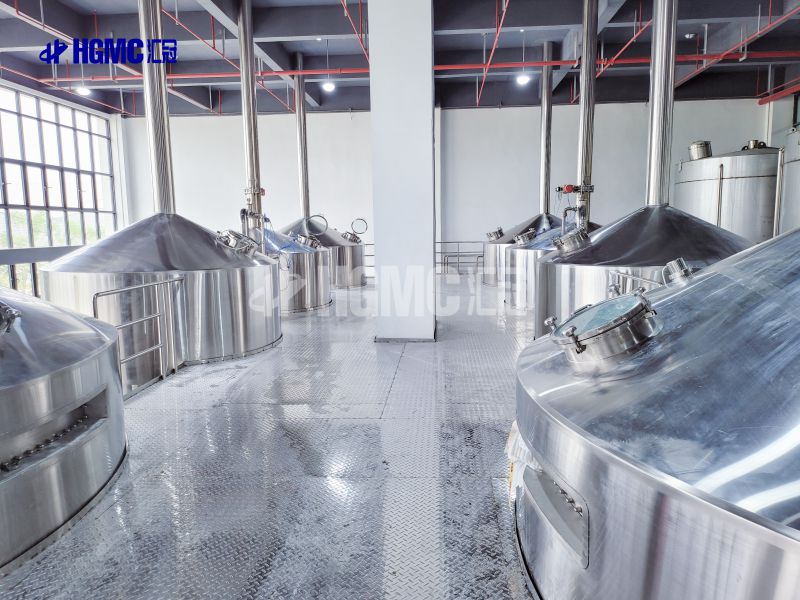
Commercial brewing equipment encompasses the complete system required for beer production at scale. Key components include:
Core Brewhouse Equipment
- Mash/Lauter Tun: Converts grain starches to fermentable sugars and separates wort from spent grain
- Brew Kettle: Boils wort with hops, sterilizes, and concentrates
- Whirlpool: Separates hop material and trub from clear wort
- Hot Liquor Tank (HLT): Stores heated brewing water
Fermentation & Conditioning
- Fermentation Vessels (FVs): Where yeast converts sugar to alcohol (typically 5–21 days)
- Bright Beer Tanks (BBTs): For conditioning, carbonation, and serving
- Glycol Chilling System: Maintains precise fermentation temperatures
Temperature Control Standards:
- Ales: 60–72°F (15.5–22°C)
- Lagers: 45–55°F (7–13°C)
- Cold Conditioning: 32–38°F (0–3°C)
Quality & Sanitation Systems
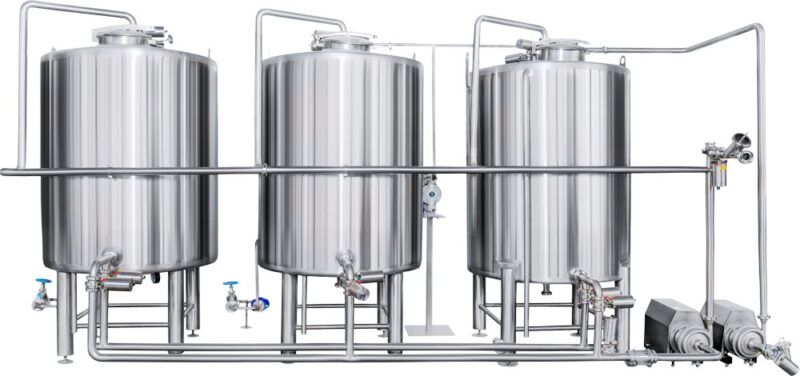
- CIP (Clean-in-Place) System: Automated cleaning without disassembly
- Heat Exchanger: Rapidly cools wort to fermentation temperature
- Filtration (optional): Removes yeast and particulates
Packaging Equipment
- Kegging line: For draft distribution
- Canning/Bottling line: For retail packaging
- Labeling and packaging automation
Support Systems
- Steam boiler or direct-fire system
- Compressed air system
- CO₂ recovery and storage
- Water treatment (RO or filtration)
Sizing Brewhouses: Should You Start Small or Go Right Commercial?
This is one of the most debated questions in brewery planning. The answer depends on your business model, capital availability, and market strategy.
Starting Small (3–7 BBL)
Pros:
- Lower capital requirement ($100,000–$250,000)
- Test recipes and market demand
- Learn brewing operations with lower risk
- Flexibility for frequent recipe changes
Cons:
- Limited production capacity
- Higher per-barrel production costs
- Difficult to scale to distribution
- Labor-intensive operation
Best for: Taproom-focused breweries, experimental brewers, or limited initial capital
Starting Commercial-Scale (15–30 BBL)
Pros:
- Distribution-ready production volume
- Better per-barrel economics
- Professional-grade equipment
- Scalable to regional market
Cons:
- Higher capital investment ($500,000–$1M+)
- Greater financial risk
- Larger facility requirements
- More complex operations
Best for: Well-capitalized startups, experienced brewers, or breweries targeting immediate distribution
The Hybrid Approach
Many successful breweries start with a pilot system (3 BBL) for recipe development alongside a production system (15–20 BBL) for volume. This provides innovation capacity while maintaining production efficiency.
Rule of Thumb: If your business plan projects >5,000 BBL annual production within 3 years, start with at least a 15 BBL system to avoid costly early upgrades.
The Brewing Process: Brew Flow from Mash to Wort to Fermentation
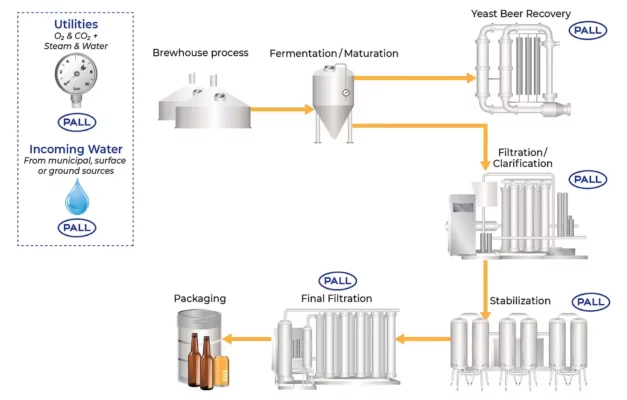
Understanding the complete brewing process is essential for equipment selection and layout optimization.
Step 1: Milling
Crush malted barley to expose starches. Grain mills should be sized for 1–2 BBL per minute throughput.
Step 2: Mashing (60–90 minutes)
Mix crushed grain with hot water in the mash tun at 148–158°F (64–70°C). Enzymes convert starches to fermentable sugars.
Key Equipment Spec: Insulated mash tun with RIMS (Recirculating Infusion Mash System) or HERMS (Heat Exchange Recirculating Mash System) for temperature control.
Step 3: Lautering (60–120 minutes)
Separate sweet wort from spent grain. Modern lauter tuns feature:
- False bottom with 0.7–1.0mm slotted screens
- Automated rake arms
- Variable-speed drive for gentle grain bed management
Step 4: Boiling (60–90 minutes)
Boil wort to sterilize, concentrate, and isomerize hop alpha acids. Energy efficiency is critical:
- Steam heating: 85–90% efficient
- Direct fire: 75–80% efficient
- Electric: 95–98% efficient (best for small systems)
Step 5: Whirlpool & Cooling (30–60 minutes)
Separate trub and rapidly cool wort to fermentation temperature using a plate or tube heat exchanger.
Target: Cool from 210°F to 65°F in 30–45 minutes to minimize infection risk.
Step 6: Fermentation (5–21 days)
Pitch yeast and monitor fermentation. Modern FVs include:
- Glycol-jacketed cooling zones
- Pressure rating (15 PSI for standard, 30 PSI for high-gravity beers)
- Top and bottom sampling ports
- Carbonation stones
Step 7: Conditioning & Packaging
Transfer to BBTs for maturation, carbonate to 2.2–2.7 volumes CO₂, and package.
Process Timeline Summary:
- Brew day: 6–8 hours
- Fermentation: 7–14 days (ales), 14–28 days (lagers)
- Conditioning: 3–7 days
- Total grain-to-glass: 2–6 weeks
Fermentation Temperature and Temperature Control: How to Keep Your Beer Consistent
Temperature control is the single most important factor for beer consistency and quality. According to ASBC (American Society of Brewing Chemists), temperature variations of just ±2°F can create detectable flavor differences.
Glycol Chilling System Design
Modern breweries use propylene glycol systems cooled to 28–32°F (-2 to 0°C) circulating through jacketed fermentation vessels.
Sizing Calculations:
- 1 BBL fermentation capacity requires ~0.15–0.25 tons of refrigeration
- A 20 BBL system with 80 BBL fermentation capacity needs 12–20 tons of chilling
System Components:
- Glycol chiller (scroll or screw compressor)
- Insulated glycol reservoir (20–30% of fermentation volume)
- Circulation pumps (redundant for reliability)
- PLC-controlled solenoid valves per tank
Temperature Control Strategies
Manual Control: Set point adjustment, operator monitoring
- Suitable for: <5 tanks, experienced brewers
- Cost: Lowest
- Risk: Human error, inconsistency
Semi-Automated: Programmable temperature profiles, alarms
- Suitable for: 5–15 tanks, growing breweries
- Investment: $15,000–$40,000
- Benefit: Reproducibility improves 40–60%
Full SCADA Automation: Real-time monitoring, automatic adjustments, data logging
- Suitable for: 15+ tanks, production breweries
- Investment: $50,000–$150,000
- Benefit: Labor reduction 30–50%, consistency >95%
Fermentation Temperature Profiles
Ale Fermentation:
- Day 1–2: 65–68°F (active fermentation starts)
- Day 3–5: 68–70°F (peak fermentation)
- Day 6–7: 72°F (diacetyl rest)
- Day 8+: Crash cool to 38°F
Lager Fermentation:
- Day 1–7: 50–55°F (slow, clean fermentation)
- Day 8–14: 50°F (primary complete)
- Day 15–28: 32–38°F (lagering period)
CIP and Stainless Steel Design: A Cleanability Checklist That Protects Beer Quality
Sanitation is non-negotiable in brewing. The industry standard is “brewery-grade” 304 stainless steel with specific surface finish and weld requirements.
Stainless Steel Specifications
Material Standards:
- 304 SS: Industry standard, good corrosion resistance
- 316 SS: Superior corrosion resistance, used in coastal/high-chloride environments
Surface Finish Requirements:
- Interior contact surfaces: 2B or better (150 grit minimum)
- Electropolished (optional): Ra <0.4 μm for premium sanitation
Weld Quality:
- TIG welds: Full penetration, no crevices
- Smooth internal welds: <3mm radius, no sharp corners
- 3-A Sanitary Standards compliance (if pursuing dairy-grade certification)
CIP System Design
Clean-in-Place systems automate vessel cleaning without disassembly, critical for efficiency and consistency.
CIP Cycle Stages:
- Pre-rinse: 5–10 minutes, cold water
- Caustic wash: 20–30 minutes, 2–3% NaOH at 160–180°F
- Intermediate rinse: 5–10 minutes
- Acid wash: 15–20 minutes, 2% phosphoric or nitric acid
- Final rinse: 10–15 minutes
- Sanitizer: 10 minutes, PAA or iodophor
Total CIP time: 90–120 minutes per tank
CIP System Sizing
For a 20 BBL brewhouse:
- CIP tank capacity: 80–100 gallons
- Pump capacity: 100–150 GPM at 25–35 PSI
- Heat exchanger: Maintain 160–180°F
Investment: $25,000–$75,000 for automated single-tank CIP
Cleanability Checklist
✓ All product contact surfaces are 304+ stainless steel
✓ Internal welds are smooth with <3mm radius
✓ No dead legs in piping (>2.5× pipe diameter is a dead leg)
✓ Spray ball coverage ensures all surfaces contacted
✓ Proper drainage slope (1–2% minimum)
✓ Tri-clamp fittings for easy disassembly
✓ CIP flow rate achieves turbulent flow (Reynolds number >4,000)
✓ Temperature monitoring at return to confirm effectiveness
Automation and Modern Brewing: When to Automate Brewing Operations and When Not To
Brewery automation is a spectrum, not a binary choice. The key is automating the right processes at the right time.
Automation Levels
Level 1: Manual Brewing
- Operator controls all valves, monitors temperatures manually
- Labor: 2–3 FTE per brew
- Suitable for: Nanobreweries, pilot systems
- Capital: Lowest
Level 2: Semi-Automated
- PLC controls temperatures, automated CIP, digital monitoring
- Labor: 1–2 FTE per brew
- Suitable for: 7–20 BBL systems
- Capital: +$30,000–$75,000 over manual
Level 3: Fully Automated Brewhouse
- Recipe-driven automated sequences, valve automation, SCADA monitoring
- Labor: 1 FTE supervision per brew
- Suitable for: 20+ BBL systems, multi-shift operations
- Capital: +$100,000–$250,000 over manual
Level 4: Integrated Brewery Automation
- Full SCADA, automated packaging, inventory integration, predictive maintenance
- Labor reduction: 40–60% vs. manual
- Suitable for: Production breweries >50,000 BBL/year
- Capital: $250,000–$750,000+
When to Automate
Automate when:
- ✓ Production volume exceeds 5,000 BBL/year
- ✓ Labor costs represent >40% of COGS
- ✓ Consistency issues impact quality
- ✓ Running multiple shifts
- ✓ ROI payback <24 months
According to MBAA research, brewery automation typically delivers:
- Labor reduction: 30–50%
- Energy efficiency improvement: 15–25%
- Batch consistency: >95% reproducibility
- Payback period: 18–36 months
When NOT to Automate
Delay automation when:
- ✗ Production <2,000 BBL/year (insufficient volume)
- ✗ Frequent recipe experimentation (flexibility more valuable)
- ✗ Experienced brewers prefer manual control
- ✗ Capital constrained (invest in capacity first)
Smart Automation Strategy
Phase 1 (Years 1–2): Automate temperature control and CIP
Phase 2 (Years 3–4): Add brewhouse automation and data logging
Phase 3 (Years 5+): Implement full SCADA, predictive maintenance, ERP integration
This staged approach spreads capital investment and allows learning time.
Utilities, Cooling Systems, and Heat Recovery: The Hidden Costs of Beer Making Equipment
Operating costs often surprise new brewery owners. Understanding utility requirements is critical for site selection and profitability.
Utility Requirements
Water Consumption
- Industry average: 4–7 gallons of water per gallon of beer produced
- Best-in-class breweries: 2.7–3.5:1 water-to-beer ratio
For a 20 BBL batch (620 gallons of beer):
- Water needed: 1,700–4,300 gallons
- Uses: Brewing (25%), cooling (30%), CIP (35%), packaging (10%)
Electrical Requirements
- Small brewery (10 BBL): 200–400 amp, 3-phase service
- Medium brewery (20–30 BBL): 600–1,000 amp, 3-phase
- Large brewery (60+ BBL): 1,200+ amp, 3-phase
Natural Gas/Steam
- Heating requirement: ~300,000–500,000 BTU per BBL brewed
- 20 BBL brew: 6–10 million BTU (60–100 therms)
Energy Costs Per Barrel
Typical Cost Breakdown (per BBL produced):
- Electricity: $8–$15
- Gas/steam: $6–$12
- Water/sewer: $4–$8
- Total utilities: $18–$35 per BBL
At 10,000 BBL/year production, annual utility costs: $180,000–$350,000
Heat Recovery Systems
Heat recovery can reduce energy costs by 20–35%.
Technologies:
- Wort-to-Water Heat Exchanger
- Captures heat from hot wort to preheat brewing water
- Recovery efficiency: 60–75%
- Payback: 2–4 years
- Investment: $15,000–$40,000
- Stack Heat Recovery
- Captures boiler exhaust heat
- Efficiency gain: 10–15%
- Investment: $25,000–$60,000
- Refrigeration Heat Recovery
- Uses waste heat from glycol chiller condenser
- Can provide hot water for CIP
- Efficiency: 20–30% energy savings
- Investment: $20,000–$50,000
Combined heat recovery systems can reduce utility costs by $4–$10 per BBL, delivering ROI in 3–5 years for breweries producing >5,000 BBL annually.
Cooling System Efficiency
Glycol System Best Practices:
- Variable-frequency drives (VFDs) on pumps save 20–30% energy
- Proper insulation (R-value 4–6 minimum) on glycol lines
- Night setback for conditioning tanks (save 10–15%)
Chiller Efficiency Metrics:
- COP (Coefficient of Performance): Target >3.0
- Energy Star certified chillers save 15–25% vs. standard
Supplier Scorecard: How to Buy Brewing Equipment for Sale from the Right Equipment Manufacturer
Selecting the right equipment manufacturer is as important as selecting the equipment itself. Due diligence prevents costly mistakes.
Supplier Evaluation Framework
1. Manufacturing Quality & Certifications
Essential certifications:
- ✓ ASME U-stamp (pressure vessel certification)
- ✓ CE marking (for European sales)
- ✓ ISO 9001 (quality management)
- ✓ 3-A Sanitary Standards (if applicable)
Quality indicators:
- In-house fabrication vs. outsourcing
- Welding certifications (AWS, ASME)
- Material certifications (mill test reports)
- Quality control processes
2. Technical Capability
Evaluate:
- Engineering team experience (ask for resumes)
- Custom design capability vs. catalog-only
- Brewhouse efficiency guarantees (should be 80–85%+)
- Automation and controls expertise (in-house or partnered?)
- Heat recovery and sustainability features
Red flags:
- Vague technical specifications
- No performance guarantees
- Unwillingness to provide engineering drawings
3. Track Record & References
Required due diligence:
- Request 5–10 customer references at similar scale
- Visit operating breweries with their equipment
- Ask about post-installation support quality
- Check industry forums and reviews
Key questions for references:
- “What was your actual brewhouse efficiency?”
- “How long did commissioning take?”
- “Were there any hidden costs or change orders?”
- “How responsive is their service team?”
- “Would you buy from them again?”
4. Service & Support
Critical factors:
- Technical support availability (24/7 or business hours?)
- Response time guarantees
- Parts availability (stock common wear items?)
- Service technician locations
- Warranty terms (standard: 1 year parts, some offer extended)
- Training provided (minimum 3–5 days onsite)
Best practices:
- Negotiate spare parts package at purchase
- Require operations manual and P&ID drawings
- Include commissioning and startup in contract
5. Total Cost of Ownership
Don’t select on capital cost alone. Evaluate:
Capital cost: Initial equipment purchase
Installation: 15–25% of equipment cost
Commissioning: 5–10% of equipment cost
Training: Included or $5,000–$15,000
Spare parts: 3–5% of equipment cost annually
Maintenance: 2–4% of equipment cost annually
Energy efficiency: Impacts operating costs for 20+ years
A 10% cheaper system with 15% worse energy efficiency will cost more over 10 years.
6. Lead Time & Project Management
Typical lead times:
- Standard systems: 12–20 weeks
- Custom engineered: 20–32 weeks
- Complex automation: 28–40 weeks
Project management essentials:
- Detailed project timeline with milestones
- Regular progress updates (weekly recommended)
- Clear change order process
- Penalty clauses for delays
- Defined acceptance criteria
Supplier Scorecard Template
| Criteria | Weight | Vendor A | Vendor B | Vendor C |
|---|---|---|---|---|
| Quality & Certifications | 20% | |||
| Technical Capability | 20% | |||
| References & Track Record | 15% | |||
| Service & Support | 15% | |||
| Total Cost of Ownership | 20% | |||
| Lead Time & PM | 10% | |||
| Total Score | 100% |
Scoring: Rate each criterion 1–10, multiply by weight, sum for total score.
Frequently Asked Questions (FAQ)
Q1: What is the typical lifespan of commercial brewing equipment?
A: Well-maintained stainless steel brewhouses can last 20–30+ years. Fermentation tanks similarly last 20+ years. Mechanical components (pumps, valves, heat exchangers) typically need replacement every 7–15 years. Automation and controls may need upgrading every 10–15 years as technology advances. With proper CIP procedures and preventive maintenance, equipment longevity is excellent.
Q2: Should I buy new or used brewing equipment?
A: New equipment offers warranties, customization, latest technology, and full service support but costs 100% of market value. Used equipment can save 40–60% on capital but risks include: unknown maintenance history, no warranty, outdated technology, potential hidden damage, and limited manufacturer support. Used equipment makes sense for tight budgets or pilot systems, but production breweries benefit from new equipment reliability and efficiency.
Q3: What’s the difference between electric, steam, and direct-fire heating?
A:
- Electric heating: 95–98% efficient, precise control, no combustion byproducts, but high operating costs in areas with expensive electricity. Best for <10 BBL systems.
- Steam heating: 85–90% efficient, industry standard for 15+ BBL systems, requires boiler investment ($30,000–$100,000+), excellent temperature control.
- Direct-fire: 75–80% efficient, lower capital cost, but risk of scorching wort and less precise control. Common in traditional European breweries.
Q4: How much space do I need for a commercial brewery?
A: Space requirements vary by production scale:
- 7 BBL brewhouse: 2,500–3,500 sq ft minimum (includes taproom)
- 15 BBL brewhouse: 4,000–6,000 sq ft production only
- 20–30 BBL brewhouse: 8,000–12,000 sq ft
- 60+ BBL brewhouse: 20,000+ sq ft
Also plan for: ceiling height 18–26+ feet (vessel-dependent), floor loads 250–750 lbs/sq ft, and 30–40% expansion space.
Q5: What are the most common mistakes when buying brewing equipment?
A:
- Under-sizing fermentation capacity (most common—plan 3:1 to 4:1 FV ratio)
- Inadequate glycol chilling (size for peak summer loads, not annual average)
- Insufficient electrical service (retrofitting 3-phase power is expensive)
- Poor facility layout (equipment arrives before layout finalized)
- Choosing suppliers on price alone (service quality matters enormously)
- Skipping heat recovery (payback is typically 2–4 years)
- Under-estimating installation costs (add 20–30% of equipment cost)
Q6: Can I expand my brewery equipment capacity later?
A: Yes, but plan for it from day one. Design considerations:
- Install oversized utilities (electrical, water, glycol)
- Layout with expansion zones marked
- Purchase modular equipment that accepts add-ons
- Oversize CIP system for future tanks
- Include automation provisions for additional tanks
Adding fermentation capacity later (buying additional tanks) is straightforward. Upgrading brewhouse size typically means purchasing a complete new system.
Q7: What warranties should I expect on brewing equipment?
A: Standard warranties:
- Pressure vessels (tanks): 1 year parts, 5–10 years on catastrophic failure
- Mechanical equipment: 1 year parts and labor
- Automation/controls: 1 year, sometimes extended service contracts available
- Craftsmanship: 1 year on welds and fabrication
Negotiate: Extended warranties on chillers, premium support packages, and spare parts kits.
Q8: Do I need a professional engineer to approve my brewery equipment?
A: In most jurisdictions, yes. Requirements include:
- Pressure vessels: ASME U-stamp and local boiler inspection
- Electrical: Licensed electrician and permit approval
- Plumbing: Licensed plumber and health department approval
- Building: Structural engineer stamp for floor loads and mezzanines
- Fire suppression: Fire marshal approval
Work with an experienced brewery consultant or engineer familiar with local codes.
Conclusion: Making the Right Brewing Equipment Investment
Selecting commercial brewing equipment is a complex decision with long-term implications for quality, efficiency, and profitability. Success requires balancing production goals, capital constraints, quality expectations, and growth plans.
Key Takeaways:
- Size for growth: Plan 30–40% expansion capacity, maintain 3:1 to 4:1 FV-to-brewhouse ratios
- Prioritize quality: Brewery-grade 304 SS, proper CIP design, and certified pressure vessels are non-negotiable
- Temperature control is critical: Invest in adequate glycol chilling and temperature automation for consistency
- Evaluate total cost: Consider energy efficiency, maintenance, and service—not just capital cost
- Choose suppliers carefully: Certifications, references, service quality, and technical capability matter more than price
- Plan for automation: Start with CIP and temperature control; add brewhouse automation as volume grows
- Account for hidden costs: Utilities (water, energy, cooling) often represent 15–20% of COGS
The brewing industry continues to evolve. According to Brewers Association projections, craft beer market share is expected to reach 15–18% of total U.S. beer volume by 2030, driving continued demand for efficient, scalable brewing equipment.
Whether you’re launching a neighborhood taproom or a regional production brewery, investing in the right equipment—from the right manufacturer, with the right specifications—is the foundation for long-term success.
For brewery equipment consultation and custom system design, contact qualified manufacturers with ASME certification, proven track records, and comprehensive service support. Your equipment investment will serve your brewery for decades—choose wisely.
