You have a dream. A dream to create amazing beer. But there is a problem. A big one. Turning that dream into a real craft brewery, microbrewery, nano brewery, or brewpub is hard. The biggest hurdle? Choosing the right craft brewing equipment.
Who This Guide Is For & What You’ll Get
Whether you’re a homebrewer ready to go pro, an entrepreneur launching your first craft brewery, or an established operation looking to scale up, choosing the right brewing equipment is one of the most critical decisions you’ll make. This comprehensive guide is designed for:
- Aspiring Brewery Owners planning their first commercial setup
- Existing Craft Brewers looking to expand or upgrade equipment
- Investors & Consultants evaluating brewery projects
- Beverage Entrepreneurs entering the craft beer market
What You’ll Learn:
✓ Essential brewing equipment from hot side to packaging
✓ Key technical specifications and capacity considerations
✓ Real cost breakdowns for different brewery scales
✓ Critical buying decisions that affect quality and efficiency
✓ Industry data and market insights from authoritative sources
✓ Expert answers to the most common equipment questions
This guide draws on industry research from the Brewers Association, Grand View Research, and over 15 years of HGMC’s experience supplying brewing equipment to more than 120 countries worldwide.
Craft Beer Brewing Equipment Basics
Understanding Brewery Systems
A complete craft brewery requires coordinated equipment across three main areas:
1. Hot Side (Brewhouse)
Where raw ingredients transform into wort through mashing, lautering, boiling, and whirlpooling.
2. Cold Side (Fermentation)
Where wort becomes beer through fermentation, conditioning, and maturation under precise temperature control.
3. Packaging & Service
Where finished beer is transferred to kegs, cans, bottles, or draft systems for distribution.
Brewery Scale Categories
According to the Brewers Association’s 2024 report, craft breweries in the US are categorized by annual production:
Industry Production Standards
- Nanobrewery: <3 barrel (3.5 hL) batches
- Microbrewery: <15,000 barrels (17,600 hL) annually
- Regional Craft Brewery: 15,000-6,000,000 barrels annually
- Brewpub: On-premise consumption with food service
Source: Brewers Association, 2024
Key Capacity Metrics
When evaluating equipment, understand these fundamental measurements:
- Batch Size: Volume of wort produced per brew (measured in barrels, hectoliters, or gallons)
- Brews per Day: How many batches your brewhouse can complete in 24 hours
- Annual Capacity: Total production potential (batch size × brews per week × 52 weeks)
- Fermentation Ratio: Typically 3:1 to 4:1 fermenter to brewhouse capacity for proper aging
Key Decisions Before You Shop for Equipment
1. Define Your Production Goals
Start with Your Business Plan:
- What’s your target annual production in Year 1, 3, and 5?
- What beer styles will you focus on (lagers require more fermentation capacity)?
- Will you distribute, self-distribute, or operate as a brewpub?
According to Grand View Research (2023), the global craft beer market reached $162.8 billion in 2023 and is projected to grow at 9.4% CAGR through 2030, making accurate capacity planning essential for capturing market opportunities.
2. Space & Utility Requirements
Critical Infrastructure Considerations:
- Ceiling Height: Minimum 16-18 feet for most systems; 20-25 feet for larger operations
- Floor Load Capacity: 250-500 lbs per square foot depending on equipment
- Electrical: 3-phase power for most commercial systems
- Water: 6-8 gallons per gallon of beer produced
- Drainage: Floor drains with proper slope and capacity
- Cooling: Glycol chiller sizing (typically 1 ton per 7 barrels of fermentation)
3. Manual vs. Automated Systems
| System Type | Best For | Key Considerations |
|---|---|---|
| Manual/Semi-Auto | Smaller breweries (<10 bbl), hands-on brewers | Lower initial cost, more labor, flexibility for experimental batches |
| Fully Automated | Production breweries (>15 bbl), consistency focus | Higher investment, reduced labor, superior batch consistency |
| Hybrid Systems | Growing breweries (7-20 bbl) | Automated mashing/boiling with manual transfers, balanced approach |
4. Material Quality Standards
Stainless Steel Grades:
- 304 Stainless: Industry standard for most brewing vessels
- 316 Stainless: Superior corrosion resistance, recommended for coastal locations
- Sanitary Fittings: Tri-clamp connections meeting 3-A sanitary standards
5. Expansion Planning
Industry data shows 68% of successful craft breweries expand within 3-5 years (Brewers Association, 2023). Design your initial layout with expansion in mind:
- Extra fermentation capacity (start with 4:1 ratio)
- Modular equipment that can be added incrementally
- Utility infrastructure sized for future growth
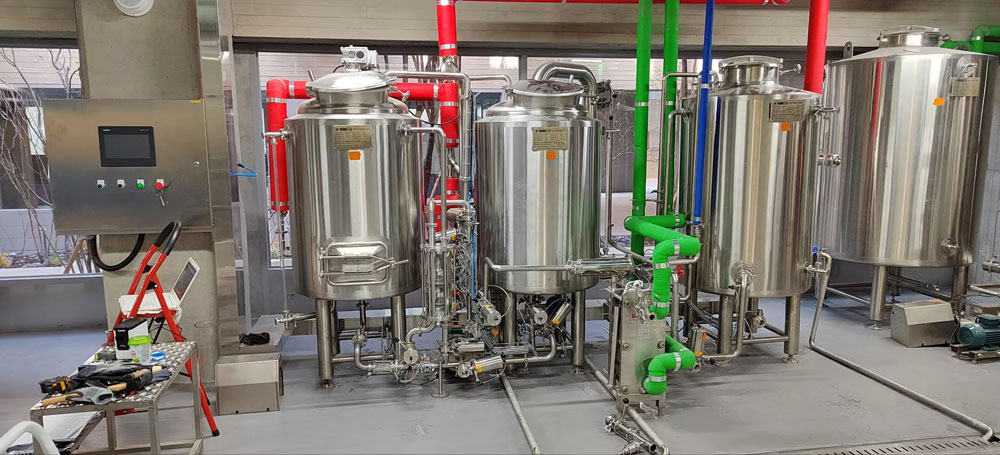
Hot Side: Core Brewhouse Equipment
The brewhouse is the heart of your operation, where brewing begins.
Mash/Lauter Tun System
Function: Converts grain starches to fermentable sugars and separates sweet wort from grain.
Key Specifications:
- Capacity: Sized for your target batch volume
- False Bottom: Wedge wire or slotted design (0.5-0.75mm gaps)
- Rake Arms: Automated or manual for grain bed management
- Temperature Control: ±1°F accuracy for optimal enzyme activity
- Insulation: Minimum 80mm polyurethane or mineral wool
Configuration Options:
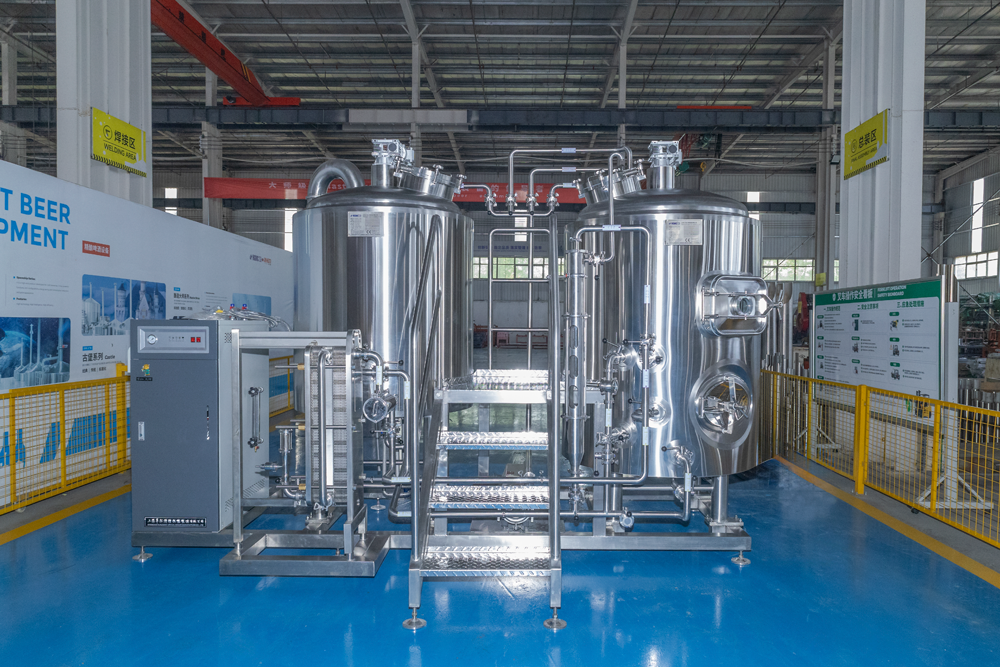
- Two-Vessel: Combined mash/lauter tun + brew kettle/whirlpool
- Three-Vessel: Separate mash tun, lauter tun, and kettle
- Four-Vessel: Separate mash, lauter, kettle, and whirlpool for high-volume operations
Brew Kettle
Function: Boils wort to sterilize, concentrate, and extract hop compounds.
Critical Features:
- Heating Method:
- Direct Fire: Traditional, excellent caramelization, higher energy costs
- Steam Jacketed: Gentle, even heating, requires boiler
- Electric Elements: Precise control, 80-90% efficiency
- Internal Calandria: Efficient for larger systems (>30 bbl)
- Evaporation Rate: Target 8-12% per hour for proper wort concentration
- Pressure Rating: Minimum 0.5 bar for effective boiling
Whirlpool Tun
Function: Separates hop debris and trub (protein coagulation) from wort.
Design Elements:
- Tangential Inlet: Creates whirlpool action for trub cone formation
- Bottom Outlet: Positioned for clean wort extraction
- Standing Time: 20-40 minutes for proper separation
Pro Tip: Many 2-vessel systems combine the brew kettle and whirlpool in one tank, adding 20-30% to vessel volume for effective whirlpooling. This saves cost while maintaining functionality for breweries under 20 barrels.
Heat Exchanger
Function: Rapidly cools hot wort to fermentation temperature.
Types:
- Plate Heat Exchanger: Compact, efficient (95%+ heat recovery), standard for most craft breweries
- Tube-in-Tube: More forgiving with hop debris, easier cleaning
Performance Target: Cool 180°F wort to 65°F in 20-30 minutes
Hot Liquor Tank (HLT)
Function: Stores and heats brewing water.
Sizing Rule: 1.5-2× brewhouse volume
Temperature: Maintains 170-180°F for mashing and sparging
Cold Side: Fermentation, Conditioning & Temperature Control
The cold side determines beer quality, capacity, and flexibility.
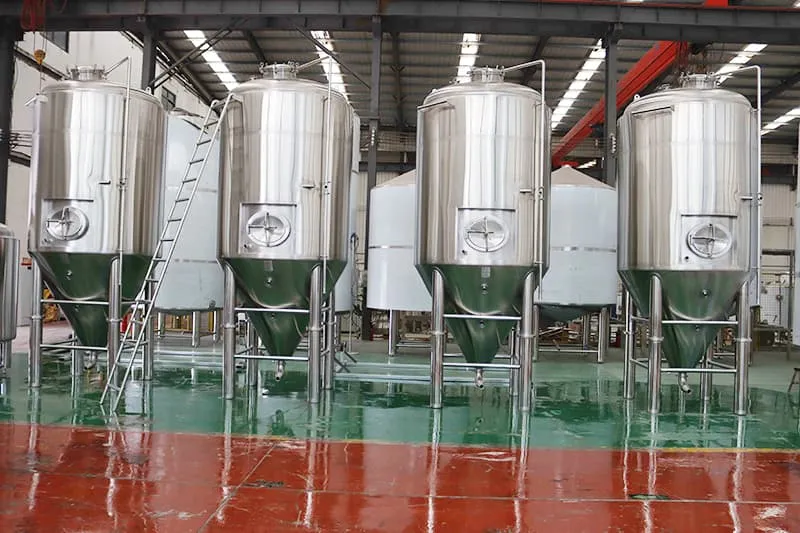
Fermentation Tanks (Unitanks)
Modern Standard: Cylindro-conical fermenters (CCF) that handle both fermentation and conditioning.
Essential Specifications:
- Capacity: Start with 3-4× your brewhouse volume
- Cone Angle: 60-70° for proper yeast collection
- Cooling Zones: Minimum 2 zones (cone + side jacket) for temperature control
- Pressure Rating: 2-3 bar for carbonation and transfers
- Insulation: 100-120mm for energy efficiency
- CIP Spray Ball: 360° coverage for automated cleaning
Material Construction:
- Vessel: 304 or 316 stainless steel, 3-4mm thickness
- Cooling Jacket: Dimple, half-pipe, or full jacket design
- Fittings: Tri-clamp sanitary connections throughout
Bright Beer Tanks (BBT)
Function: Final conditioning, carbonation, and serving storage.
Sizing: 25-50% of total fermentation capacity
Features: Full glycol jacket, 3 bar pressure rating, carbonation stone
Glycol Chilling System
Critical Component: Maintains precise fermentation temperatures.
System Sizing:
- Rule of Thumb: 1 ton of cooling per 7 barrels of fermentation capacity
- Glycol Concentration: 25-30% propylene glycol solution
- Temperature: Maintained at 28-32°F
Components:
- Chiller unit with compressor and heat exchanger
- Insulated glycol reservoir (100-200 gallons)
- Circulation pumps
- Distribution manifold with zone valves
- Temperature control system
Industry Data: According to a 2024 study by the American Society of Brewing Chemists, proper temperature control during fermentation reduces off-flavors by 85% and improves batch consistency by 92%, directly impacting product quality and customer satisfaction.
Temperature Control Systems
Options:
- Basic PID Controllers: Individual tank control, manual monitoring
- Central PLC System: Automated control of all tanks, data logging, alarm systems
- IoT-Enabled Systems: Remote monitoring, predictive maintenance, cloud data storage
Industry trend: 73% of breweries established after 2020 install automated temperature monitoring from day one (Brewers Association Tech Survey, 2024).
Packaging & Draft Service Equipment
Kegging Systems
Manual Keg Filling:
- Counter-Pressure Filler: Single-head unit for small operations
- Capacity: 4-8 kegs per hour
- Cost-Effective: Ideal for brewpubs and small production
Semi-Automatic Keg Filling:
- 2-4 Head Systems: Automated filling, manual keg handling
- Capacity: 12-20 kegs per hour
- Integration: Often includes automated CIP
Fully Automatic Keg Lines:
- Capacity: 40-120 kegs per hour
- Features: Automatic depalletizing, washing, filling, and capping
- Scale: Required for regional distribution
Canning & Bottling Lines
Market Context: According to Nielsen data (2024), canned craft beer accounts for 63% of off-premise sales, making canning capability increasingly essential.
Canning Systems:
- Manual/Semi-Auto: 10-20 cans per minute, ~$40,000-$80,000
- Automatic Lines: 30-60 CPM, $150,000-$400,000
- High-Speed Lines: 100-200 CPM, $500,000-$1,500,000+
Key Features:
- CO₂ purging to minimize oxygen pickup
- Counter-pressure filling
- Seamer inspection systems
- Date coding capability
Bottling Considerations:
- Glass Bottles: Premium image, higher cost, more fragile
- Line Speed: Typically 30-80 bottles per minute for craft scale
- Additional Equipment: Bottle rinser, filler, capper, labeler
Draft System Components
For Brewpubs & Taprooms:
- Glycol-Cooled Lines: Maintains beer temperature from cooler to tap
- CO₂/Gas Blending: Proper carbonation and dispense pressure
- Flow Control Taps: Reduces foam, improves customer experience
- Line Cleaning System: Essential for quality and hygiene
Cost Overview: What It Really Costs
Investment Breakdown by Brewery Scale
Complete Brewery Equipment Cost Ranges (2025)
3-Barrel Nanobrewery System
- Brewhouse (2-vessel): $35,000-$55,000
- Fermentation (4 tanks): $25,000-$40,000
- Glycol chiller: $8,000-$12,000
- HLT, pumps, hoses, fittings: $10,000-$15,000
- Total Equipment: $78,000-$122,000
7-Barrel Microbrewery System
- Brewhouse (2-3 vessel): $85,000-$140,000
- Fermentation (6-8 tanks): $75,000-$120,000
- Glycol system: $15,000-$25,000
- Packaging (manual kegging): $8,000-$15,000
- Auxiliary equipment: $20,000-$35,000
- Total Equipment: $203,000-$335,000
15-Barrel Production Brewery
- Brewhouse (3-vessel, automated): $220,000-$350,000
- Fermentation (10-12 tanks): $180,000-$280,000
- Glycol & utilities: $35,000-$55,000
- Canning line (semi-auto): $80,000-$150,000
- Kegging system: $25,000-$45,000
- Auxiliary & CIP: $40,000-$70,000
- Total Equipment: $580,000-$950,000
30-Barrel Regional Brewery
- Brewhouse (4-vessel, fully automated): $450,000-$750,000
- Fermentation (16-20 tanks): $400,000-$650,000
- Glycol & boiler: $80,000-$140,000
- Canning line (automatic): $250,000-$450,000
- Kegging system (automatic): $80,000-$150,000
- CIP system & controls: $100,000-$180,000
- Total Equipment: $1,360,000-$2,320,000
Additional Budget Considerations
Beyond Equipment Costs:
- Installation & Rigging: 8-15% of equipment cost
- Utilities Infrastructure: $50,000-$200,000 (electrical, plumbing, HVAC, drains)
- Building Modifications: Highly variable, $100,000-$500,000+
- Initial Ingredients & Supplies: $10,000-$30,000
- Laboratory Equipment: $5,000-$25,000
- Licensing & Permits: $5,000-$25,000
Operating Cost Factors
Per-Barrel Production Costs (Industry Averages):
- Raw Materials: $60-$120 per barrel (malt, hops, yeast, water)
- Utilities: $15-$30 per barrel (electricity, water, gas)
- Labor: $25-$60 per barrel (depending on automation)
- Packaging: $20-$50 per barrel (kegs, cans, labels)
Source: Brewers Association Cost Benchmarking Study, 2024
Financing Options
Equipment Financing Routes:
- SBA Loans: 7(a) and 504 programs for brewery equipment
- Equipment Leasing: Preserves capital, 3-7 year terms typical
- Manufacturer Financing: Some suppliers offer payment plans
- Private Investors/Crowdfunding: Increasingly popular for craft startups
Frequently Asked Questions
Equipment Selection & Specifications
Q: What size brewing system should I start with?
A: Base your decision on your 3-year business plan, not just year one. Most consultants recommend starting with capacity to produce 70-80% of your year-three projection. This provides room to grow without immediately outgrowing your equipment. For a brewpub, 3-7 barrels is typical; for production breweries, 10-15 barrels offers better economics while remaining manageable.
Q: Is it better to buy new or used brewing equipment?
A: New equipment offers warranties, modern efficiency, and customization, but costs 100% upfront. Used equipment can save 30-60%, but verify condition thoroughly—hidden repairs can exceed savings. Consider hybrid approaches: new brewhouse and fermenters (critical for quality and efficiency) with used auxiliary equipment. Always have used equipment inspected by a qualified brewery engineer.
Q: What’s the difference between 2-vessel and 3-vessel brewhouses?
A: A 2-vessel system combines mash/lauter in one vessel and kettle/whirlpool in another. It’s more affordable ($30,000-$50,000 less for 10 bbl) but limits you to one batch every 5-7 hours. A 3-vessel system separates mash, lauter, and kettle, enabling you to brew multiple batches per day since mashing can start while the previous batch is still boiling. Choose 2-vessel if brewing 4-6 times weekly; choose 3-vessel for daily multiple-batch production.
Q: How much fermentation capacity do I really need?
A: The industry standard is 3:1 to 4:1 fermenter-to-brewhouse ratio, but your beer styles matter significantly. If brewing lagers or barrel-aged beers, you need 5:1 or higher due to extended aging times. For quick-turn ales (10-14 days grain to glass), 3:1 works. Calculate based on your planned brew schedule and turnaround time: (Barrels per week × fermentation days) ÷ 7 = minimum fermenter barrels needed.
Operations & Maintenance
Q: What kind of preventive maintenance schedule should I follow?
A: Daily: Visual inspections, gasket checks, temperature logs. Weekly: Clean and sanitize all transfer lines, inspect pumps. Monthly: CIP system verification, glycol levels and concentration check, valve and fitting inspection. Quarterly: Heat exchanger deep clean, pressure relief valve testing. Annually: Professional boiler inspection (if applicable), electrical system review, glycol chiller maintenance. Proper maintenance extends equipment life by 50-100% according to ASBC studies.
Q: How do I ensure proper sanitation of my equipment?
A: Implement a robust CIP (Clean-in-Place) program. For brewhouses: hot water rinse (170°F), caustic circulation (2-3%, 160°F, 20-30 min), acid rinse (1-2%, 130°F, 15-20 min), final hot water rinse. For fermenters: similar protocol after yeast removal. Use food-grade sanitizers (PAA, iodophor, or Star San) before each use. Document every cleaning. Install a dedicated CIP system ($15,000-$50,000) if brewing more than 3-4 times weekly—the labor savings and consistency justify the investment.
Q: What are the most common equipment problems new brewers face?
A: (1) Undersized glycol systems causing fermentation temperature swings—size for peak summer load plus 20% buffer. (2) Inadequate hot liquor capacity delaying brew days—HLT should be 1.5-2× brewhouse size. (3) Poor floor drainage causing cleaning headaches—ensure 1-2% slope to drains. (4) Insufficient electrical capacity for future expansion—install 150% of initial requirement. (5) Inadequate compressed air or CO₂ supply—budget for proper gas systems from day one.
Business & Planning
Q: How long does it take from equipment order to first brew?
A: Timeline Breakdown:
- Equipment manufacturing: 12-20 weeks for custom systems
- Shipping: 2-8 weeks (domestic to international)
- Installation & commissioning: 2-4 weeks
- Testing & adjustments: 1-2 weeks
- Licensing approvals: 2-12 weeks (start early, parallel process)
- Total: 5-11 months from deposit to first commercial batch
Order equipment early—it’s often the longest lead-time item in brewery startups.
Q: What certifications should brewing equipment have?
A: Look for: (1) 3-A Sanitary Standards compliance for all product-contact surfaces, (2) ASME pressure vessel certification for any vessel operating above 15 PSI, (3) UL or CE electrical certification depending on your market, (4) Local code compliance (UPC plumbing, NEC electrical, IMC mechanical). Verify your supplier provides documentation—lack of proper certification can delay licensing and void insurance.
Q: Can I expand my brewery later, or should I buy big from the start?
A: Modular expansion is almost always smarter than over-buying initially. Start with your 3-year capacity target, but design for expansion: (1) Install utilities (electrical, water, drains, glycol) sized for 2× capacity, (2) Leave floor space for additional fermenters, (3) Choose a brewhouse that can handle extra batches per day, (4) Buy control systems that can accommodate future tanks. This approach preserves capital, reduces initial debt service, and lets you refine your equipment needs based on real production data.
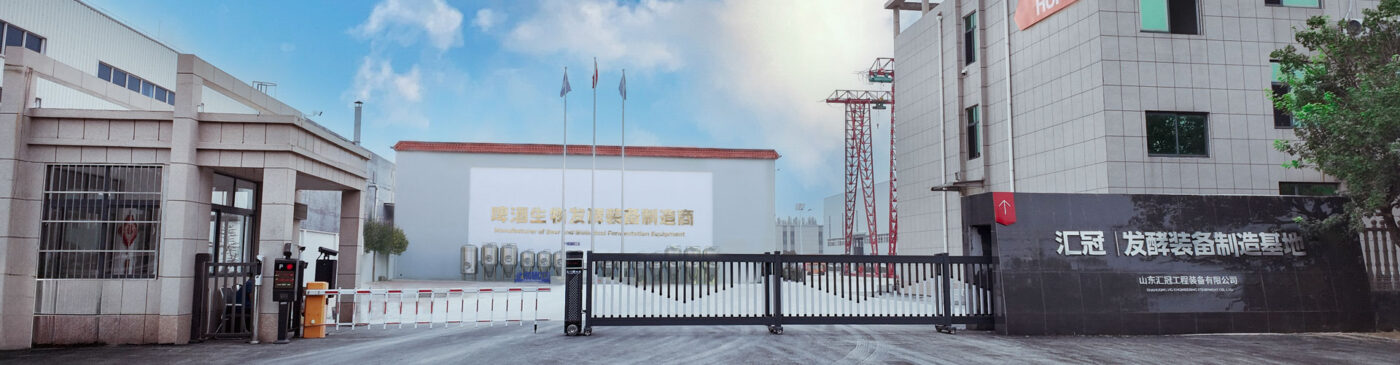
About HGMC: Your Global Brewing Equipment Partner
HGMC is the world’s leading manufacturer of beer brewing equipment. We specialize in producing comprehensive brewery equipment, beverage processing systems, and advanced canning/bottling lines for craft breweries, microbreweries, and large-scale production facilities worldwide.
Our Expertise:
- ✓ More than 30 national authorized patents
- ✓ Over 20 high-tech achievements in brewing technology
- ✓ Turnkey project solutions from design to commissioning
- ✓ Individual equipment supply for expansions and upgrades
- ✓ Exported to more than 120 countries globally
- ✓ ISO 9001 certified manufacturing
- ✓ 3-A sanitary standards compliance
Why Breweries Choose HGMC:
🔧 Complete Customization – We design systems tailored to your recipes, space, and production goals, not one-size-fits-all solutions.
🌍 Global Experience – Our equipment operates successfully in diverse climates and markets, from tropical regions to Arctic conditions.
⚙️ Advanced Manufacturing – State-of-the-art fabrication facilities with precision welding, polishing, and quality control.
📞 Comprehensive Support – Engineering consultation, installation supervision, operator training, and responsive after-sales service.
💰 Value Engineering – We optimize designs to deliver maximum functionality within your budget without compromising quality.
Client Recognition: Breweries worldwide have praised HGMC for reliable equipment, professional service, and long-term partnership. From 3-barrel nano systems to 100-barrel production brewhouses, we scale to your ambitions.
Ready to Start Your Brewing Journey?
Choosing craft beer brewing equipment is a significant investment that will shape your brewery’s success for years to come. By understanding the complete equipment ecosystem—from hot side to packaging—and making informed decisions based on your specific business goals, you’ll be positioned to produce exceptional beer efficiently and profitably.
Key Takeaways:
✓ Plan for growth – Size equipment for your 3-year projection, not just year one
✓ Prioritize quality – Premium vessels and controls pay for themselves in consistency and longevity
✓ Don’t skimp on fermentation – Cold side capacity is often the limiting factor
✓ Automate strategically – Focus automation where it impacts quality and efficiency most
✓ Choose experienced partners – Work with manufacturers who understand brewing, not just metalwork
The global craft beer market’s continued 9.4% annual growth presents tremendous opportunities for well-equipped breweries. With the right equipment foundation and expert partnership, your brewery can capture this growth and build a lasting brand.
Contact HGMC today to discuss your brewing equipment needs. Our engineering team is ready to help you design the perfect system for your vision, budget, and market.
