
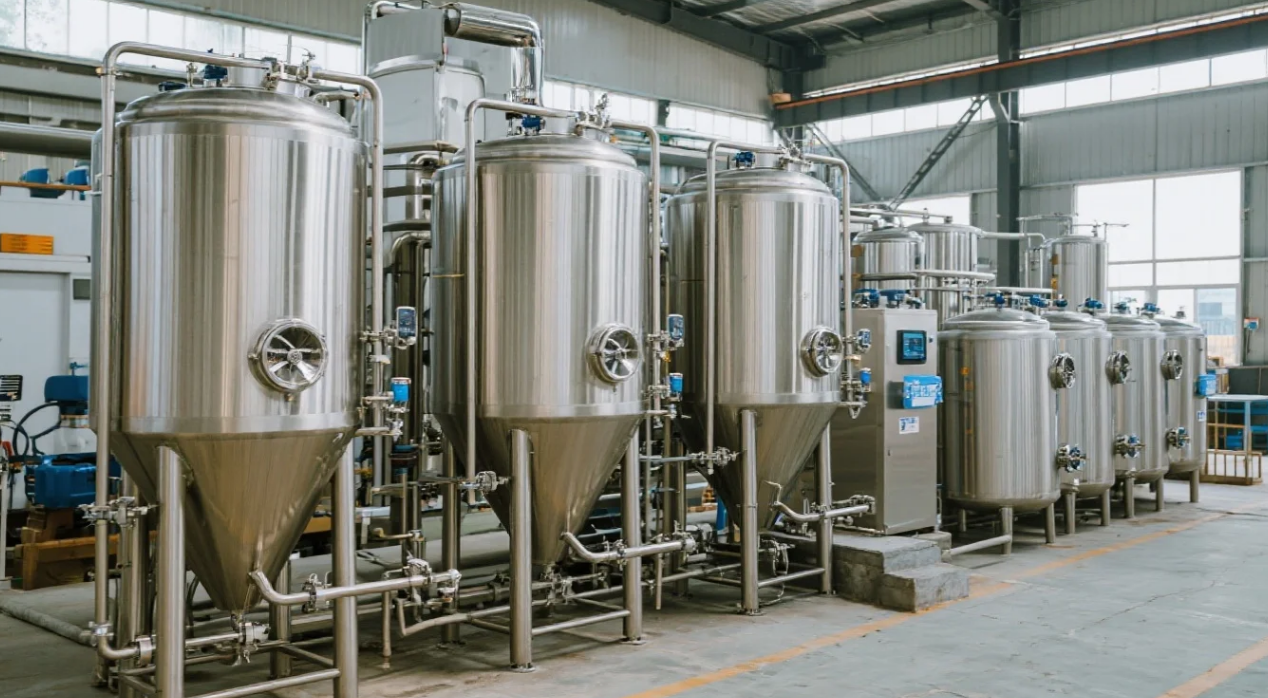
A brewery can install a large brewhouse and still miss its production target. The problem usually appears several steps downstream: fermentation tanks remain occupied, wort cooling takes too long, the CIP system delays the next batch, or the packaging line cannot handle the beer coming out of the cellar. The brewhouse looks impressive on paper, but the plant does not move enough finished beer.
The manufacturer decision should therefore be treated as a production and integration decision, not a comparison of vessel prices or tank sizes. The supplier needs to understand the brewery’s schedule, building, utilities, labor, cleaning routine, beer portfolio, and expansion plans before proposing equipment.
For high-volume production, the right manufacturer is the one that can connect brewing, fermentation, cooling, cleaning, filling, and packaging into a workable operating schedule. The proposal should show batch timing, tank demand, utility consumption, controls, installation requirements, testing procedures, and future expansion allowances—not just a list of stainless-steel vessels.
Define the Brewery’s Production Requirements Before Requesting Quotes
The first request sent to a manufacturer should contain more than an annual production target. A figure such as 10,000 hectoliters per year does not explain how the brewery intends to produce it. The supplier also needs to know whether production is steady throughout the year or concentrated into a short peak season, when demand may rise sharply and reduce the available recovery time between batches.
The brewery should convert its annual target into planned brew days and shifts per week. If the operation expects to brew four days each week during normal demand and six days during peak-season demand, the equipment proposal should be built around those conditions. A supplier that quotes a standard brewhouse without showing the required brewing cycles is leaving the most important production assumption unstated.
Beer style also changes the calculation. A lager may require a longer fermentation and maturation period than an ale, while heavily hopped beers can introduce additional transfer, filtration, or clarification work. Seasonal products may occupy tanks for weeks after the brewhouse has already moved on to another recipe. Cellar planning based only on average fermentation time can therefore understate the number of fermentation tanks required.
Before requesting proposals, the brewery should assemble:
- Annual production, peak-season demand, brew days, package mix, building constraints, utilities, labor, automation, and three-to-five-year expansion targets.
The package mix needs similar attention. Cans, bottles, and kegs do not create the same packaging schedule. A brewery selling mostly kegs may need a different buffer and cleaning routine from one running a high-speed canning line with frequent product changes. Filling equipment, keg washing, depalletizing, labeling, and changeover time all affect the number of hours available for finished-goods production.
Building information can eliminate unsuitable proposals before detailed engineering begins. Available floor space, ceiling height, drainage layout, door dimensions, column locations, and installation access should be documented. A tank that fits the quoted footprint may still be impossible to position if it cannot pass through the building entrance or be lifted into place.
Utilities should be recorded in actual site terms rather than broad descriptions. Available water pressure, power capacity, steam supply, glycol or other cooling capacity, compressed-air quality, drainage capacity, and wastewater limitations all affect the equipment configuration. A manufacturer should turn these inputs into a process recommendation rather than quote a standard tank size and leave the brewery to discover the gaps later.
Automation expectations should also be explicit. The brewery should state which operations require automatic sequencing, which tasks will remain manual, how many operators will be available per shift, and whether data collection is required for batch records or quality control. Expansion planning should cover the next 3–5 years, because a site that is already crowded cannot easily add tanks or a second packaging line later.
Match Brewhouse, Cellar, Cooling, and Packaging Capacity
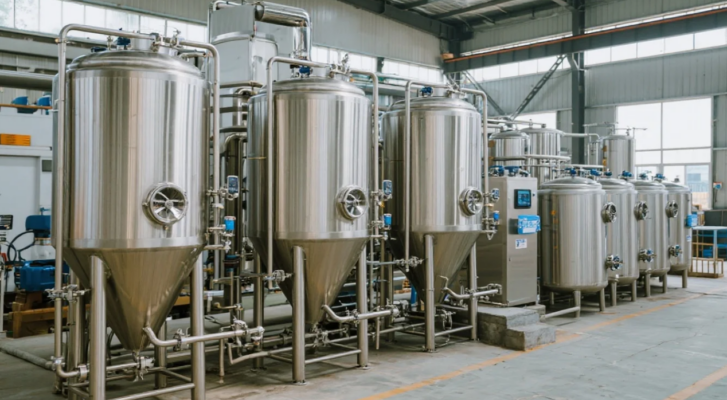
High-volume output comes from a balanced production system. A two-vessel brewhouse, three-vessel brewhouse, or four-vessel brewhouse may each be appropriate, but the choice depends on the production schedule and the capacity of the downstream process.
A two-vessel brewhouse can suit a schedule with fewer daily batches and lower process complexity. Three-vessel arrangements may separate mash and lautering functions more effectively, while four-vessel systems can provide more process control and parallel activity. Those labels do not, by themselves, indicate how much beer the brewery will produce in a week. The manufacturer should state the expected batch volume, brewing cycles per day, and the time required for mashing, lautering, boiling, whirlpool, transfer, and cleaning.
Heating method and energy demand also need to be tied to the schedule. A brewhouse that can complete a nominal batch in a short cycle may still fail to sustain that pace if heating recovery, wort cooling, or cleaning takes longer than the proposal assumes. A cycle calculation that excludes changeovers and CIP is not a production schedule; it is only a vessel sequence.
A practical proposal should show how the following stages interact:
- Milling and mash preparation, followed by lautering, boiling, and whirlpool.
- Wort cooling and transfer into available fermentation tanks.
- Fermentation, maturation, conditioning, clarification, and bright beer storage.
- Filling, packaging, cleaning, and maintenance recovery.
Fermentation tanks often become the stronger constraint. Fermentation, maturation, conditioning, or clarification may take days or weeks, depending on the beer style and process. That time turns each tank into occupied production capacity. If the cellar does not have enough volume, the brewhouse may sit idle even though the brewery has enough grain, labor, and demand.
Tank quantity should be calculated from more than the brewhouse batch size. The manufacturer should account for annual output, fermentation and maturation time, the number of beer styles, bright beer storage time, cleaning and maintenance downtime, a production buffer, and the planned expansion path. A brewery producing several styles may need additional tanks even when its average weekly output appears manageable, because the styles do not release tanks on the same schedule.
The failure is familiar in industrial projects. In one production installation, the brewery selected a large brewhouse against its expected peak demand but did not balance the fermentation cellar and packaging capacity. During the first production season, tanks remained occupied longer than the planning model allowed, while the packaging line required extended changeovers between cans and kegs. Within the first few weeks, the brewhouse was left idle on otherwise scheduled brew days, and the brewery missed its planned output despite having substantial installed vessel capacity.
The same problem can occur with cooling. Wort cooling that cannot remove heat at the required rate delays transfers and may force the brewing team to wait before the next batch. Insufficient glycol capacity can limit fermentation temperature control during warm periods. A CIP system that cleans one vessel at a time may become the hidden bottleneck when several tanks need cleaning between product changes.
Packaging deserves the same scrutiny as the brewhouse. The proposal should state line speed under actual package formats, not only an ideal speed for one container. It should include rinsing, filling, seaming or crowning, labeling, inspection, palletizing, sanitation, product changeover, and planned downtime. A packaging line operating at its theoretical maximum may still deliver less finished beer per shift than a slower line with shorter changeovers and fewer interruptions.
Published brewery benchmarking reports commonly distinguish brewhouse utilization from cellar and packaging utilization. That distinction matters because a high brewhouse utilization rate can conceal poor plant utilization if downstream stages are regularly waiting, blocked, or under maintenance. The manufacturer should model the entire process instead of presenting each vessel as an independent capacity number.
Verify Manufacturing Quality and Technical Documentation
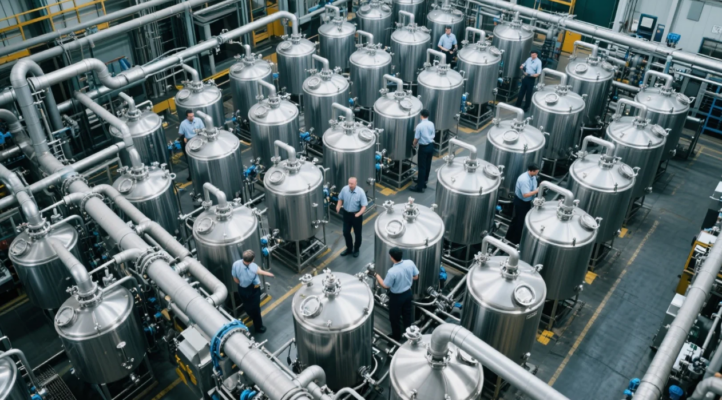
A manufacturer’s technical maturity is easier to assess through documents and test procedures than through general assurances about quality. For high-volume equipment, the brewery should ask how the system is designed, fabricated, inspected, tested, installed, and handed over to operators.
Stainless steel specifications should identify the material grades used for product-contact surfaces, tank shells, fittings, and external structures. Weld quality, surface finish, passivation, insulation, cooling jackets, valves, sanitary piping, and drainability all affect cleaning time and maintenance workload. A tank may meet a nominal volume requirement while still creating difficult-to-clean dead legs or inaccessible valve arrangements.
Cleanability should be considered in relation to the actual CIP system. The manufacturer should identify flow rates, spray-device coverage, chemical connections, return arrangements, temperature requirements, and cleaning sequences. If the brewery expects automatic CIP, the proposal should define which tanks and lines are included, how recipes are controlled, and what operators must still do manually.
The technical package should include, where applicable:
- Equipment layout drawings
- Process flow diagrams
- P&ID drawings
- Tank data sheets
- Material specifications
- Utility consumption estimates
- Control-system scope
- Installation requirements
- Factory acceptance testing procedures
The manufacturer should document the full process from milling and brewing through fermentation, cleaning, cooling, filling, and packaging. A process flow diagram can reveal missing transfers or unplanned manual steps before fabrication begins. P&ID drawings can expose whether valves, pumps, instrumentation, relief devices, and cleaning circuits have been considered as a complete system rather than added vessel by vessel.
Utility estimates should be specific enough for site planning. Steam demand should be separated from electrical load where possible. Cooling demand should identify design conditions and whether peak-season ambient temperatures have been considered. Compressed-air consumption, water use, drainage requirements, and wastewater discharge can change the building or utility project as much as the tanks do.
Control-system scope is another area where proposals often become unclear. The brewery should ask which instruments are included, how recipes are stored, what alarms are available, whether batch records are retained, and which equipment is controlled from a central interface. The phrase “automatic control” can describe anything from a few motorized valves to a coordinated system covering the brewhouse, CIP, cellar transfers, and packaging interfaces.
Factory acceptance testing should have a written procedure. It may include checking vessel dimensions, weld inspection records, valve operation, sensor calibration, control sequences, pump performance, leak testing, and simulated alarms. Site acceptance testing should then confirm that the equipment performs under the brewery’s actual utilities and process conditions. The handover should include operating manuals, maintenance schedules, spare-parts lists, drawings, software backups, and training records.
An unusual but useful signal is how readily the manufacturer explains what is not included. A clear boundary around installation, insulation, pipework, controls, commissioning, and local electrical work is more useful than a broad promise of turnkey delivery. A supplier that cannot explain utility demand, cleaning time, control scope, testing, and installation requirements may have a polished vessel specification but an incomplete project plan.
Compare Manufacturers as Long-Term Production Partners
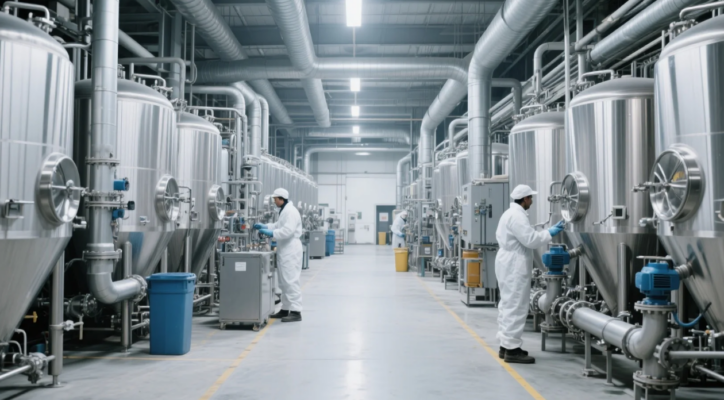
The final comparison should examine whether the supplier can integrate milling, brewing, fermentation, cleaning, cooling, filling, and packaging into one workable process. It is not enough for each component to look acceptable in isolation. The equipment must operate as a sequence under the brewery’s actual labor plan, building conditions, utilities, and production calendar.
The supplier should explain the assumptions behind every major capacity decision. That includes tank quantities, brewing cycles, wort cooling demand, packaging speed, bright beer storage, cleaning frequency, maintenance downtime, and production buffers. If a proposal assumes that a tank is available immediately after transfer, the brewery should ask how fermentation, cleaning, inspection, and temperature recovery fit into that assumption.
Installation planning can separate a realistic proposal from a preliminary quotation. The brewery should review delivery routes, lifting requirements, floor loading, anchor points, drainage connections, pipe-rack access, electrical interfaces, commissioning sequence, and the division of responsibility between the manufacturer and local contractors. A tank installation that looks straightforward on a drawing can create weeks of delay when access, rigging, or drainage has not been planned.
Maintenance implications should be reviewed before purchase. Valves, pumps, sensors, gaskets, seals, and cooling equipment need accessible service points. The brewery should ask which spare parts are normally stocked, how quickly replacement components can be supplied, whether remote diagnostics are available, and who supports the control system after commissioning. After-sales service has little value if the response process, coverage area, and escalation path are undefined.
The option to add capacity later also requires engineering discipline. Future fermentation tanks may need reserved floor space, glycol connections, CIP capacity, control-system I/O, pipework routes, and electrical capacity. A nominal expansion statement is not enough if the initial installation consumes every utility connection and leaves no safe route for later work.
A lower initial quotation can become expensive when it excludes controls, commissioning, insulation, pipework, operator training, or packaging integration. Conversely, a higher quotation is not automatically better if it contains unnecessary automation or oversized utilities that the brewery cannot use. The comparison should focus on operational fit, inspectable documentation, service support, and expansion readiness across the 3–5-year planning horizon.
The manufacturer is being evaluated as a long-term production partner, but that does not require accepting vague relationship language. The useful test is whether the supplier can show its assumptions, identify bottlenecks before installation, document the process, and accept responsibility for the interfaces between systems. Those details provide a more reliable basis for selection than a headline tank capacity or the lowest first quotation.
FAQ
Why is brewhouse size alone insufficient for a high-volume brewery?
Brewhouse size is insufficient because fermentation, cooling, CIP, bright beer storage, and packaging can limit finished output. A brewery may complete several batches per day but still miss its target if beer remains in fermentation for weeks or the packaging line loses hours to changeovers.
What information should a brewery provide before requesting an equipment proposal?
The brewery should provide annual and peak-season output, brew days, shifts, beer styles, fermentation times, package formats, building dimensions, utilities, labor plans, automation expectations, and three-to-five-year expansion targets. These details allow the manufacturer to model a process instead of quoting an isolated vessel.
How are fermentation tank quantities determined?
Fermentation tank quantities are determined from batch size, annual output, fermentation and maturation time, beer-style mix, bright beer storage, cleaning and maintenance downtime, and the required production buffer. The calculation should use the longest realistic tank-occupation period, not only the average fermentation time.
Which technical documents should an industrial brewery equipment manufacturer provide?
The manufacturer should provide layout drawings, process flow diagrams, applicable P&ID drawings, tank data sheets, material specifications, utility estimates, control-system scope, installation requirements, and factory acceptance testing procedures. Operating manuals, maintenance information, spare-parts lists, and commissioning records should be available before final handover.
Why should expansion capacity be considered before equipment is purchased?
Expansion should be considered before purchase because later tanks or packaging equipment may require reserved floor space, cooling capacity, CIP connections, electrical capacity, controls, and pipework routes. A brewery that uses all available utilities and access space during the first installation may face a much more disruptive expansion three years later.
