
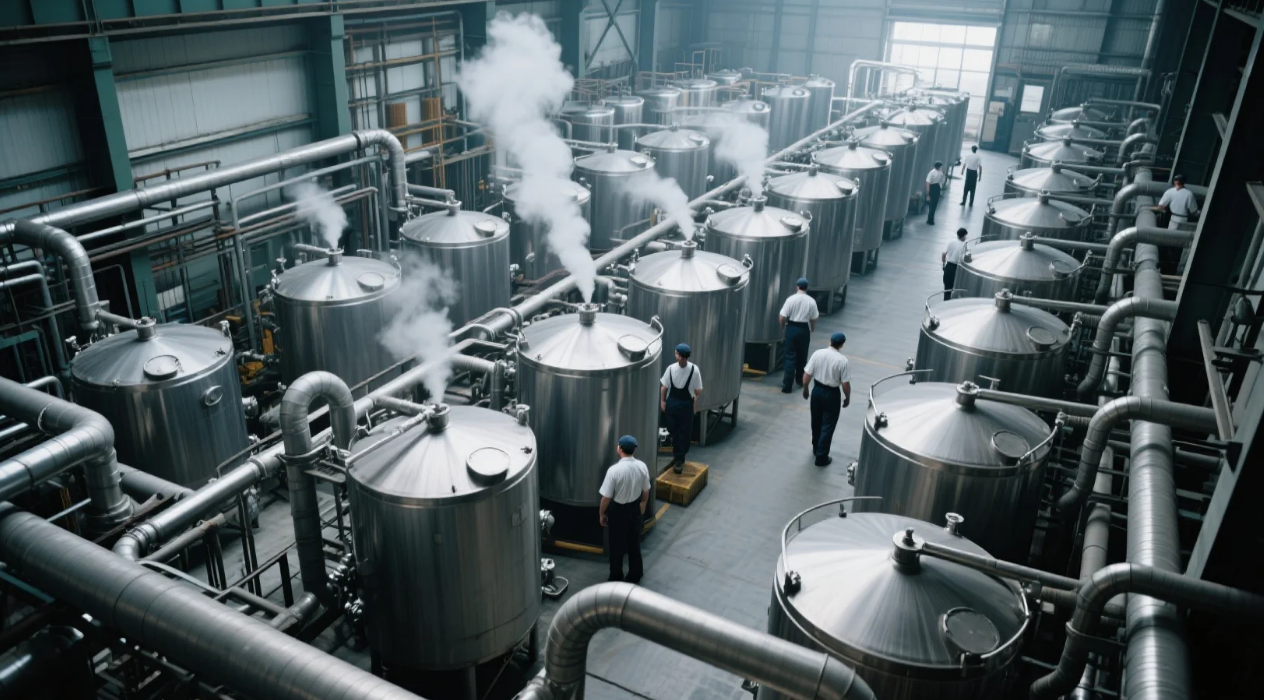
A commercial brewery may receive two brewhouse quotations that look almost identical at first glance. One lists the vessels at a surprisingly low price. The other costs more, but includes cooling, CIP, controls, process piping, installation, and commissioning. The difference often appears only when the equipment reaches the building and the production team asks what is needed to make beer reliably.
The lower headline price is not automatically the lower project cost. A brewery can reduce brewhouse beer factory price safely by matching capacity to actual demand, choosing a suitable vessel configuration, and dividing equipment into sensible investment stages. It should not reduce the cooling system, CIP, temperature control, hygienic transfer, operator controls, or expansion provisions that determine whether the plant can run consistently.
A brewhouse should be priced as part of a production system, not as a group of stainless-steel vessels. A quote that excludes utilities, installation, commissioning, or future interfaces may save capital on paper while creating a larger bill and an interrupted operating plan later.
What Actually Drives Brewhouse Beer Factory Price
A brewhouse is a configured production system rather than one standardized machine. Its price changes with batch capacity, brewing frequency, vessel arrangement, heating method, steel specification, automation level, and the amount of equipment needed to move, cool, clean, and control wort.
The quoted vessel price is only one layer. Tank thickness and insulation affect fabrication cost, while steam, electric, or direct-fire heating changes both the equipment price and the utility infrastructure. Pumps, valves, process piping, platforms, a heat exchanger, and instrumentation can represent a substantial part of the working system even when they receive little attention in a short quotation.
The nine cost-driver categories below are useful when reviewing a quotation:
- Capacity and brewing frequency
- Vessel configuration
- Heating method
- Materials, thickness, insulation, and cooling design
- Pumps, valves, pipework, platforms, and heat exchangers
- Controls and automation
- CIP system and sanitation provisions
- Fermentation, bright beer storage, filtration, and packaging
- Installation, commissioning, training, logistics, and after-sales support
The first eight categories affect what is purchased. The ninth affects whether the brewery can get the equipment operating without repeated delays, rework, or dependence on a technician who is several time zones away. A basic quote may cover the brewhouse vessels and a few pumps but leave the buyer to arrange control panels, cable routing, floor supports, drain connections, and commissioning labor.
That distinction separates the price of core brewhouse vessels from the cost of a complete brewing project. Fermentation vessels determine how often wort can be brewed before storage becomes full. Bright beer tanks affect conditioning and packaging flexibility. Filtration and the packaging line influence how finished beer reaches customers. Cooling capacity, hot-water management, and the CIP system affect whether the process can repeat cleanly.
A low quote accepted in March can become an operational problem by commissioning in August. One brewery discovered that its main vessel package did not include enough cooling capacity, the required CIP connections, complete PLC controls, or process piping. The missing items were identified after the tanks had already arrived. The project team had to revise utility connections, delay commissioning for several weeks, and order components at higher freight and installation costs. Later, when sales increased, the absence of reserved interfaces made adding fermentation vessels more disruptive than expected.
The following comparison shows why scope boundaries matter more than the first number on a proposal.
| Scope item | Often included in a basic quote | Operational consequence if omitted | When the cost appears later |
|---|---|---|---|
| Main brewhouse vessels | Yes | No production system without transfer and control equipment | During installation |
| Cooling and heat exchange | Sometimes partial | Wort cannot reach fermentation temperature reliably | Commissioning or first hot-weather production |
| CIP system and connections | Often limited | Cleaning becomes manual, inconsistent, or slow | Before regular production |
| PLC controls and instruments | Varies widely | Operators lack repeatable temperature and timing control | Commissioning and recipe setup |
| Process piping, platforms, and utilities | Frequently excluded | Tanks cannot be connected or safely accessed | Site preparation and installation |
| Fermentation vessels and bright beer tanks | Often excluded | Brewhouse output has nowhere to mature or wait for packaging | As soon as storage fills |
| Packaging line and commissioning | Usually separate | Finished beer cannot move efficiently into the sales channel | When commercial sales begin |
A buyer should ask whether the price covers equipment supply only or includes a functioning process boundary. The difference may include freight, import handling, site assembly, electrical work, water treatment, drainage, insulation, operator training, spare parts, and after-sales support. Many brewery budgets also carry a 10–15% contingency for site and integration issues; a quote with unclear exclusions can consume that allowance before the first batch.
The comparison should be made line by line. Two suppliers may both write “automatic brewhouse” while one includes PLC controls, touchscreen recipes, temperature sensors, valve manifolds, and alarms, and the other includes only a control cabinet with manual intervention. Those descriptions are not equivalent.
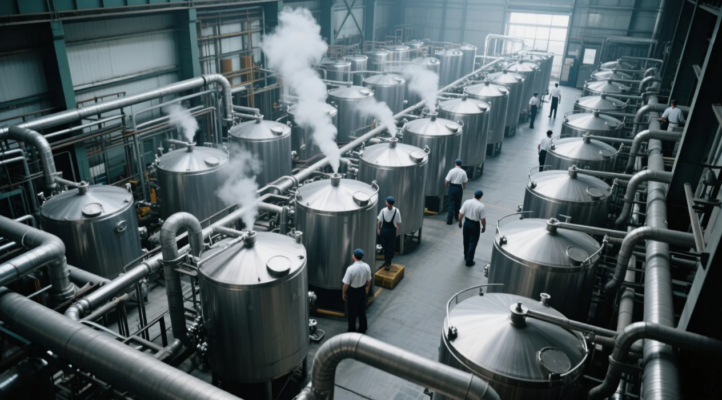
Match Brewhouse Capacity to Real Production Demand
Oversizing is an easy mistake because a larger brewhouse looks like protection against future growth. In practice, unused capacity ties up capital, occupies floor space, increases heating and cooling demand, and may force the brewery to install utilities that will not generate useful output for several years.
Capacity planning should start with two operating measures considered together: expected annual beer output and expected weekly brewing frequency. Annual output shows the volume the business expects to sell. Weekly frequency shows how often the brewhouse, fermentation vessels, cellar staff, and packaging route must actually work to produce that volume.
A brewery planning 300,000 liters per year through one or two brews each week has a different equipment problem from a brewery targeting the same annual volume through five brewing days each week. The first may need a compact brewhouse with enough fermentation capacity and scheduling flexibility. The second may need faster transfers, more simultaneous vessel activity, and a configuration that reduces waiting between mashing, lautering, boiling, and whirlpool stages.
Beer style also changes the calculation. A lager with a long fermentation time can occupy a fermentation vessel for weeks, while a faster-turning ale may release capacity sooner. A brewery that calculates only the brewhouse batch size can end up with a small-looking capital project that cannot produce the planned annual volume because fermentation time is the actual constraint.
Packaging introduces another bottleneck. If the packaging line can fill only on two days per week, adding a larger brewhouse may simply create more bright beer waiting in storage. Conversely, a small brewhouse can still be inefficient if fermentation capacity or packaging becomes the limiting stage. Lowering the vessel price does not help when the rest of the production chain remains idle or overloaded.
The building and utilities should be checked at the same time. Available floor area, drainage, steam or electrical service, chilled-water capacity, water supply, compressed air, and CO2 handling can restrict a nominally attractive equipment size. A larger system may require a service upgrade, while a smaller system may fit the existing building but need additional fermentation vessels to meet the sales plan.
Expansion timing also matters. If the brewery expects demand to rise within 12–24 months, the first installation should reserve space and utility capacity for the likely addition. That does not mean buying every future tank immediately. It means avoiding a layout in which the next fermentation vessel blocks an access aisle or requires the cooling system to be rebuilt.
A practical capacity review should map one normal production week rather than relying only on an annual target. It should show brew days, fermentation transfers, tank occupancy, cleaning windows, packaging days, and dispatch requirements. That schedule reveals whether the proposed brewhouse is genuinely productive or merely large.
There is no universal capacity recommendation. The right size depends on demand, brewing frequency, fermentation time, packaging route, available utilities, building area, and the timing of expected growth. A slightly smaller brewhouse with balanced fermentation and packaging capacity can produce a better return than a larger vessel package that runs only occasionally.
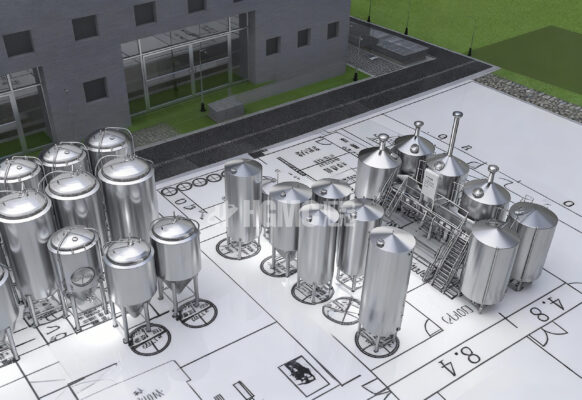
Choose Between Two-, Three-, and Four-Vessel Configurations
Vessel count changes both purchase price and the way the brewery schedules work. A two-vessel brewhouse commonly combines process stages, reducing the amount of stainless steel, pipework, instrumentation, installation work, and floor space required. It can suit moderate production, a staged launch, limited brewing frequency, restricted space, or a team that can work with a flexible schedule.
The compromise is simultaneous activity. When mashing and lautering share equipment, or when boiling and whirlpool functions are combined, the team may need to wait for one operation to finish before starting the next. That waiting time may be irrelevant at two brews per week and costly at several batches per day.
A three-vessel brewhouse separates more of the mashing, lautering, and boiling work. This can improve scheduling flexibility and reduce idle time without requiring the full complexity of a four-vessel arrangement. A four-vessel brewhouse generally provides the highest throughput potential because mashing, lautering, boiling, and whirlpool operations can be coordinated with less interference.
The extra vessels do not automatically create better economics. They bring more valves, sensors, pumps, pipework, cleaning circuits, platforms, control points, and maintenance tasks. If the brewery does not brew frequently enough to use that additional process separation, the equipment may add capital and cleaning time without improving output.
The comparison below is more useful than asking which configuration is “best.”
| Configuration | Initial complexity | Space requirement | Suitable operating pattern | Throughput potential | Main tradeoff |
|---|---|---|---|---|---|
| Two-vessel brewhouse | Low | Low to moderate | Moderate output, flexible scheduling, staged launch | Moderate | Lower cost but more waiting between stages |
| Three-vessel brewhouse | Moderate | Moderate | Regular production with some overlapping operations | Medium to high | Higher cost and controls burden |
| Four-vessel brewhouse | High | High | Frequent brewing and tight production schedules | High | Greater throughput but more capital, cleaning, and maintenance |
The cost reduction should come from removing unnecessary process duplication, not from removing process essentials. Regardless of vessel count, the system still needs stable temperature control, hygienic cleaning, dependable wort transfer, reliable pumps and valves, suitable insulation, and controls that operators can understand during a long production shift.
A brewery that chooses two vessels should test the decision against its weekly schedule. If the brewhouse must run three or four times in a day, the time lost waiting between stages may outweigh the initial saving. If the team brews once or twice weekly and has limited space, the same configuration may be entirely practical.
Heating method adds another configuration tradeoff. Electric heating may simplify some sites but require substantial electrical capacity. Steam heating can support other plant functions but brings boiler, condensate, ventilation, and safety requirements. Direct fire may have a lower equipment price in some cases while introducing different ventilation and installation demands.
A late-night commissioning problem often exposes these assumptions. During a trial batch, operators may find that a transfer takes longer than the quotation’s process diagram suggested because valve positions are manual or the pump is underspecified. The problem is not solved by adding a larger vessel. It requires checking the transfer path, control logic, pump duty, and operator sequence.
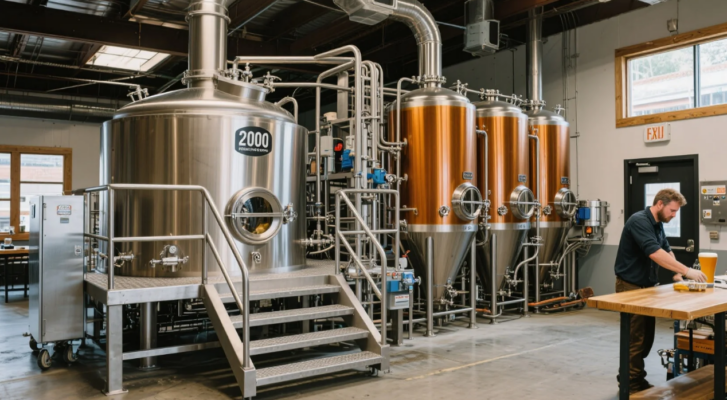
Reduce Upfront Cost Through Modular Planning and Complete Scope Review
Modular design allows a brewery to separate day-one production from later expansion without pretending that future equipment will install itself. The initial project can include a correctly sized brewhouse, essential fermentation vessels, cooling, CIP, core automation, and packaging aligned with current sales. Additional fermentation vessels, bright beer tanks, filtration equipment, advanced packaging equipment, or CO2 recovery may be deferred when the building and utilities support that decision.
The distinction is important: deferring equipment is not the same as omitting infrastructure. A deferred tank saves money only when the original project reserves floor space, access routes, drain points, cooling connections, control interfaces, and pipework provisions. Otherwise, the later purchase may involve demolition, relocation, new electrical work, and a production shutdown.
A two-stage investment plan makes the boundary easier to manage:
- Day-one production capability: brewhouse, essential fermentation capacity, cooling system, CIP, automation, utilities, installation, commissioning, and a packaging route that matches current sales.
- Expansion capability: reserved space, utility capacity, control interfaces, pipework provisions, and a layout that can accept additional tanks, bright beer storage, filtration, packaging equipment, or CO2 recovery.
The day-one scope should be tested against a real production week. If beer cannot be cooled, fermented, cleaned, transferred, packaged, and released with the first-stage equipment, the project is not modular; it is incomplete. A brewery can delay a bright beer tank more safely than it can delay the ability to clean tanks consistently or control fermentation temperature.
Cooling is often treated as an accessory because it is less visible than a brewhouse vessel. It is not. A shortage of glycol capacity may appear only during warm weather or when several fermentation vessels are filled close together. The result can be slower cooling, delayed pitching, fermentation temperature drift, and a production schedule that no longer matches the sales plan.
CIP has a similar hidden effect. Manual cleaning may seem acceptable during a staged launch, but it consumes labor and creates variation in contact time, temperature, chemical concentration, and rinse verification. If the piping and tanks were never designed for a proper CIP circuit, adding one later can be more expensive than including the connections and return paths at the start.
The quotation review should cover equipment boundaries, utilities, installation, commissioning, training, logistics, spare parts, documentation, and after-sales support. It should also identify who supplies cable, water, steam, glycol, compressed air, drainage, foundations, lifting equipment, and site labor. A supplier may reasonably exclude these items, but the buyer needs the exclusion priced elsewhere before comparing offers.
Controls deserve a separate check. A PLC control system can improve repeatability, but its value depends on the sensors, actuators, recipe structure, alarm handling, and manual override logic included in the package. A sophisticated screen connected to incomplete instrumentation does not create reliable automation. Conversely, a smaller system with clear temperature readings, dependable valve control, and accessible manual procedures may be easier for a small team to maintain.
A brewery should also ask how an expansion will affect production. Can a new fermentation vessel be connected without draining the whole cellar? Is there spare cooling capacity? Does the control panel have available inputs and outputs? Can the CIP system serve the added tank? Are replacement valves and sensors standard enough to source without a long shutdown?
The decision rule is straightforward: protect consistency, sanitation, uptime, and expansion readiness before cutting optional scope. Savings are safer when they remove unused capacity or postpone nonessential features, not when they remove the systems that make production repeatable.
FAQ
What factors have the biggest effect on brewhouse beer factory price?
Capacity, vessel configuration, heating method, materials, automation, cooling, CIP, and the wider equipment scope have the largest effects. A quotation covering only core vessels may look cheaper by 20–30% than a project scope, but the difference can reappear during installation, commissioning, or the first expansion.
Is a two-vessel brewhouse always the lowest-cost option?
No. A two-vessel brewhouse usually reduces initial equipment and floor-space requirements, but it can create longer waiting periods between mashing, lautering, boiling, and whirlpool operations. If the brewery needs several brews per day, the lost throughput over a 12-month operating schedule may outweigh the initial saving.
How can a brewery avoid paying for unused capacity?
The brewery should calculate expected annual output and weekly brewing frequency together, then test the result against fermentation time, tank occupancy, packaging days, and utility capacity. A smaller brewhouse may work well when fermentation storage is sufficient, while an oversized brewhouse can remain idle for weeks and still impose higher capital and utility costs.
Which brewery equipment features should not be removed to reduce cost?
Reliable temperature control, hygienic CIP, wort transfer, pumps, valves, cooling, and practical operator controls should remain in the first-stage system. Removing them can delay commissioning or create inconsistent production within the first few batches, even if the vessels themselves were purchased at a lower price.
Can modular brewery equipment lower the initial investment without limiting future expansion?
Yes, provided the original project reserves the required space, utilities, control interfaces, access routes, and pipework. Additional fermentation vessels or packaging equipment can be installed later, but adding them without those provisions may require relocation, construction work, and production downtime within 12–24 months.
