
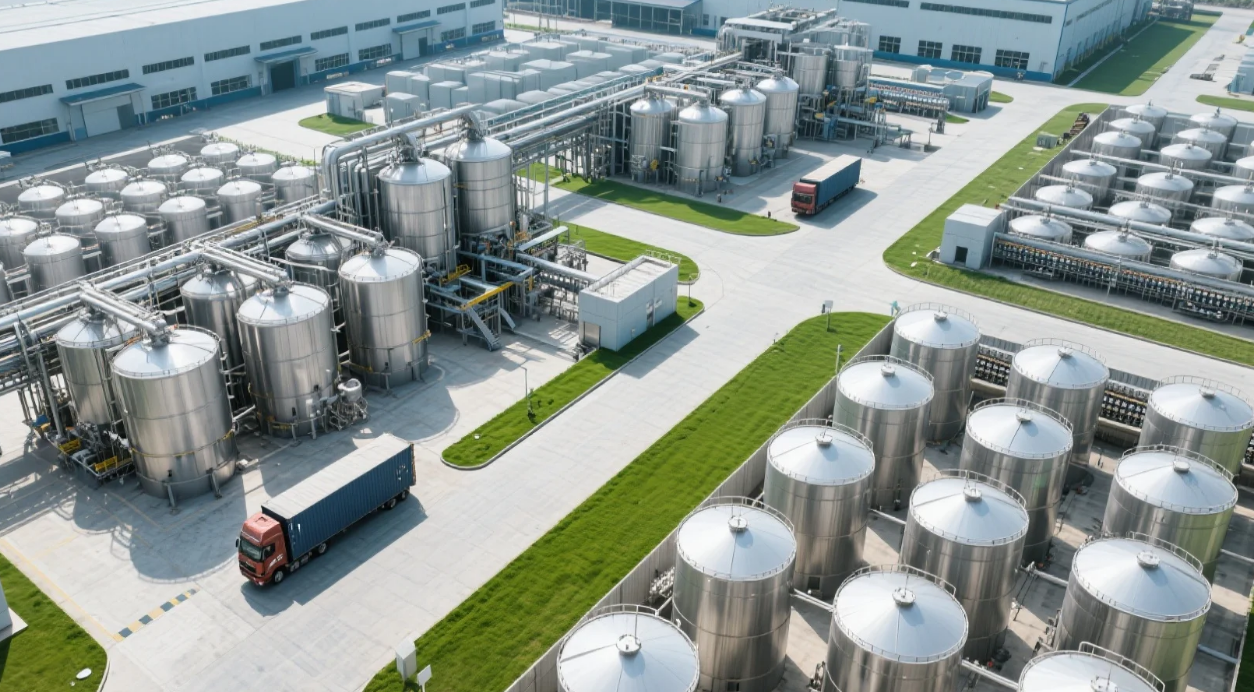
A large brewhouse can look like the obvious starting point for a commercial brewery. It is also one of the easiest ways to create an expensive bottleneck. If fermentation tanks, glycol cooling, cleaning, packaging, utilities, or floor space cannot keep pace, the brewhouse spends part of the week waiting. The plant may have impressive installed capacity but disappointing sellable output.
A beer manufacturing plant should be sized from the business model and production flow outward. The planning sequence is straightforward: estimate annual demand, convert it into monthly and weekly targets, then balance brewing, fermentation, conditioning, packaging, storage, and utilities against those targets. The largest vessel should not determine the output of the whole facility.
Production planning works best when annual demand, monthly targets, and weekly production targets are connected to batch size, tank residence time, package formats, and available operating hours. This prevents a brewery from buying equipment for theoretical volume while lacking the tanks or packaging speed needed to sell that volume.
Define the Brewery Model Before Choosing Capacity
The plant configuration depends first on how the beer will be sold. A Brewpub or restaurant brewery usually prioritizes draft beer served on-site. Its production area may be compact, and the tank layout may be visible to customers. Kegs, short transfer distances, and reliable cleaning routines can matter more than a high-speed canning line.
A local or regional craft brewery has a different operating problem. It may supply taprooms, restaurants, distributors, and retailers at the same time. That usually creates demand for more fermentation capacity, brite tanks, keg handling, cans or bottles, cold storage, and a warehouse that can hold finished goods without blocking production access.
A larger production brewery serving distributors and retailers needs still more coordination. Package formats become less flexible once a canning line or bottling line is installed, and the plant must handle packaging materials, pallets, finished-beer staging, loading access, and distributor schedules. A brewery that sells across several markets may also need greater batch consistency and more automation because a missed production run affects several sales channels at once.
Before equipment selection, the operating team should document annual output, expected monthly variation, weekly production targets, beer styles, package formats, sales channels, and growth expectations. The three planning horizons are not interchangeable. Annual demand sets the broad plant scale, monthly targets expose seasonal pressure, and weekly targets determine how often the brewhouse must run and how many tanks must be available.
Draft-focused operations can often tolerate a different plant rhythm from a packaged-beer business. Draft beer in kegs may move directly to a cold room and local delivery, while cans or bottles require filling, inspection, labeling, packing, palletizing, and additional storage. The packaging decision affects labor, utilities, cleaning, maintenance, and building circulation, not just the purchase price of the filler.
Building space and utilities should be reviewed at the same time as demand. A brewery may have enough room for the initial tanks but no practical route for adding another row of fermentation tanks. It may also lack electrical capacity, drainage, heating, compressed air, or glycol-chiller space. The U.S. Environmental Protection Agency has cited brewery water-use benchmarks of roughly 4–7 gallons of water per gallon of beer, depending on process and facility conditions. That range is a planning signal, not a guarantee; water treatment and cleaning practices can move the result considerably.
The uncomfortable part is that growth expectations are often less reliable than the physical constraints. A brewery may forecast rapid sales growth but have a landlord-approved floor plan that cannot accept additional cold-side equipment. In that situation, the future expansion plan is already being decided by the first concrete pour and utility connection.
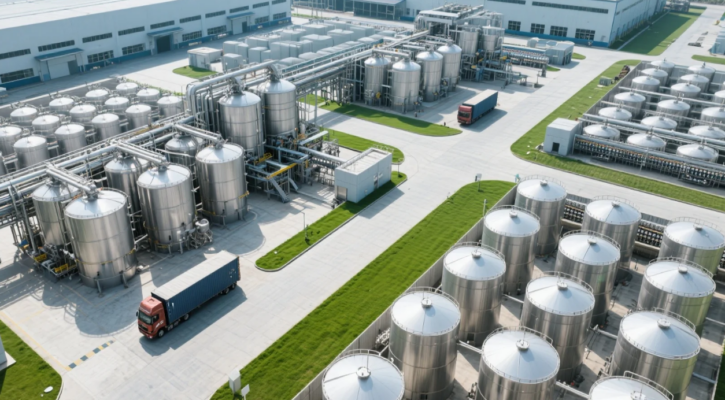
Balance Brewhouse Output With Fermentation Capacity
Brewhouse capacity should be calculated from expected sales rather than from the largest available batch size. The basic planning relationship is batch size multiplied by brews per week, adjusted for brewhouse efficiency, production days, seasonal demand, and the percentage of beer that will actually be packaged or sold.
The cold side then determines whether that theoretical volume can become finished beer. Fermentation tanks hold the beer during primary fermentation, while conditioning and maturation may occupy the same tank for additional time. Clarification and carbonation also consume tank availability, whether they occur in fermentation tanks or brite tanks. Beer may remain in a tank for several weeks across these stages, especially when the brewery produces lagers, strong beers, or brands with slower turnover.
A brewery producing several brands often needs more tanks than its weekly volume calculation first suggests. Different yeast schedules, dry-hopping windows, release dates, and package commitments prevent every tank from being treated as interchangeable. A 10,000-liter tank that is technically empty may still be unavailable because it is being cleaned, settled, sampled, or held for a scheduled packaging run.
| Brewery type | Primary sales channel | Package formats | Fermentation and storage requirements | Packaging complexity |
|---|---|---|---|---|
| Brewpub | On-site service and local draft | Draft beer and kegs | Compact cellar, limited cold storage | Low to moderate |
| Regional craft brewery | Taprooms, distributors, restaurants, retailers | Kegs, cans, sometimes bottles | More fermentation tanks, brite tanks, and cold warehouse space | Moderate to high |
| Larger production brewery | Distributors and broad retail networks | High-volume cans or bottles, plus kegs | Large tank farm, staging space, and finished-goods storage | High |
The common failure is oversizing the Brewhouse while leaving too little fermentation capacity. In one commissioning case, a brewery selected a large brewhouse before confirming sales demand, tank residence time, and packaging schedules. Within the first few months of commercial operation, the brewhouse could complete its planned weekly brews, but fermentation tanks remained occupied for several weeks. The cellar became full, the cooling load stayed high, and the team began delaying brew days. The consequence was lower finished-beer output despite having more hot-side capacity than the sales plan required.
That bottleneck is easy to miss during equipment purchasing because the brewhouse is visible, expensive, and frequently used as the headline capacity figure. The plant’s effective output is constrained by the least-balanced stage. A smaller brewhouse with sufficient fermentation capacity can produce more sellable beer over a year than a larger brewhouse that repeatedly waits for tanks.
Cooling creates another hidden limit. Glycol systems must remove heat from newly filled fermentation tanks and maintain the temperature of beer already in the cellar. If the glycol chiller is sized only for average conditions, a warm brew day or simultaneous tank crash-cooling cycle can push the system beyond its practical capacity. Operators then slow transfers or postpone production, although the tank volume appears adequate on paper.
Cleaning has a similar effect. CIP time is often excluded from optimistic production schedules. A tank that takes two hours to clean, inspect, and release is not available immediately after packaging. When several vessels finish at once, the CIP system, operators, drainage, and chemical storage become part of the production schedule.
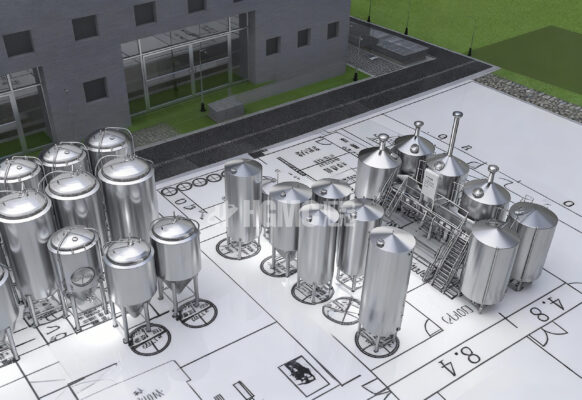
Select Equipment as One Connected Process
A beer manufacturing plant should be traced as a continuous process, beginning with malt storage and milling and ending with packaged beer in finished-goods storage. The material path normally runs through mashing, lautering, boiling, whirlpool separation, heat exchange, fermentation, conditioning, carbonation, packaging, and warehouse handling. Each transfer introduces requirements for sanitary piping, pump sizing, cleaning access, temperature control, and operator visibility.
On the hot side, malt storage must feed the malt mill without creating dust, congestion, or manual handling that exceeds the labor plan. The brewhouse may use a two-vessel, three-vessel, or four-vessel configuration. Two-vessel systems can suit smaller operations or lower brew frequency, while three- and four-vessel arrangements may separate mash, lauter, kettle, and whirlpool functions to support higher production frequency. The choice affects footprint, labor, heat recovery, cleaning, and the time between batches.
The hot liquor tank and cold liquor tank are not secondary details. Water temperature, available volume, treatment requirements, and the timing of liquor demand affect mash-in, sparging, cleaning, and wort cooling. A plate heat exchanger must be matched with the cold-water and glycol systems so that wort can reach fermentation temperature at the required transfer rate. If the water system cannot accept or supply the expected flow, the heat exchanger will not deliver its nominal performance.
On the cold side, fermentation tanks, brite tanks, glycol cooling, sanitary pumps, and piping must be considered together. Fermentation capacity determines scheduling, brite tanks influence carbonation and packaging flexibility, and piping routes affect both transfer time and cleaning reliability. A short, accessible sanitary route is often easier to validate than a complicated network with multiple low points and dead legs.
Support systems can quietly determine whether the plant operates as planned:
- Malt storage and milling feed the hot side; liquor tanks, water treatment, and heating support brewhouse operation; glycol, compressed air, CIP, controls, and drainage support the cold side and packaging.
The CIP system deserves particular scrutiny. Its tank volume, pump capacity, heating method, return paths, chemical storage, and drain capacity must match the vessels being cleaned. A plant may have enough fermentation tanks but not enough CIP throughput to release them on schedule. The U.S. EPA water-use benchmark also becomes operationally relevant here: poor cleaning design can increase water consumption without improving sanitation.
Packaging equipment should be selected only after package volume and weekly scheduling are understood. Keg washer and keg filler capacity may be enough for a draft-led brewpub but inadequate for a regional craft brewery filling hundreds of kegs between delivery days. A canning line or bottling line adds conveyors, rinsing, filling, seaming or capping, inspection, labeling, packing, palletizing, compressed air, and packaging-material storage.
Filtration or centrifugation may become necessary when the beer portfolio, clarity targets, or packaging speed makes tank settling insufficient. That equipment can shorten some processing steps, but it also adds cleaning, maintenance, product-loss, and quality-control work. A brewery should not install it simply because it is available. The decision belongs in the production flow calculation.
The control panel and automation system also need a practical boundary. Automation can improve repeatability and reduce manual valve operations, but poorly defined control logic can make fault diagnosis slower. During commissioning, an operator may need to know whether a missed transfer came from a pump interlock, a sensor, a valve position, or a real process condition. A sophisticated interface does not remove the need for accessible equipment and clear sanitary piping.
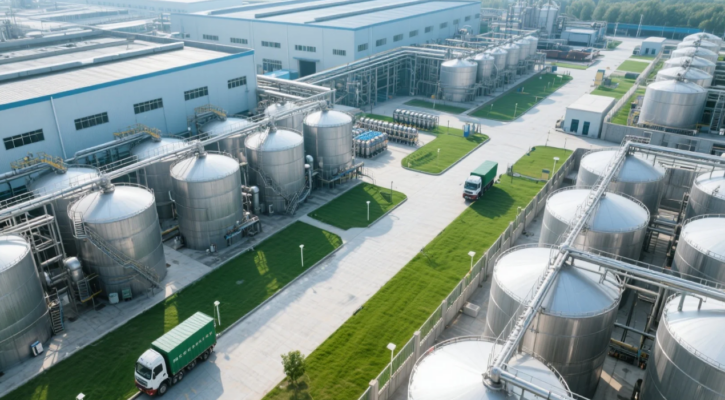
Design the Factory Layout for Safe, One-Directional Movement
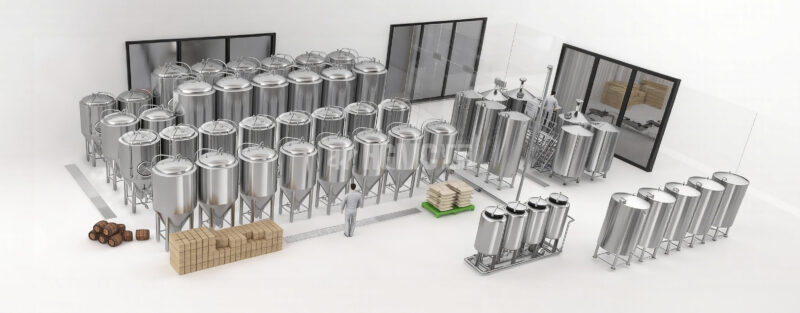
The Factory layout should follow one direction: raw materials arrive, beer is brewed and fermented, finished beer is packaged, and product leaves for cold storage or distribution. Reversing that movement creates extra handling and increases the chance that packaging materials, forklifts, chemicals, and finished beer cross paths unnecessarily.
The main zones usually include malt storage and milling, the brewhouse, the fermentation cellar, the brite tank cellar, utilities, the CIP station, chemical storage, packaging, packaging-material storage, a cold warehouse, a laboratory, quality-control space, and a maintenance area. These zones do not need to be arranged in a perfect straight line, but their connections should be obvious and short enough to inspect.
The fermentation cellar and brite tank cellar need working clearance around valves, manways, sample points, and hoses. Tank height must be checked against the building structure and service access, not just the vessel dimensions. Maintenance teams need room to remove pumps, heat-exchanger plates, motors, and sensors without dismantling half the plant.
The glycol system, water treatment, heating, and compressed air should sit where service access is possible without interrupting production. Utility runs that cross operator walkways or pass through packaging areas may create both safety and maintenance problems. Drainage is equally important. A low-cost layout that forces wash water across traffic routes usually becomes a daily nuisance and a sanitation concern.
Packaging areas need enough room for empty cans or bottles, labels, cartons, pallets, quality checks, rejected product, and finished cases. Packaging-material storage is often underestimated because the materials arrive flat or nested. Once a brewery begins running multiple package formats, that storage can expand faster than the tank cellar.
The laboratory or quality-control area should be connected to production without being placed inside a wet, high-traffic zone. Samples need a controlled place for gravity, pH, temperature, carbonation, microbiological checks, and package inspection. It is counterintuitive, but a laboratory placed too far from the cellar may be used less consistently, delaying the discovery of fermentation or packaging problems.
Floor space influences expansion as much as the initial equipment purchase. Leaving a clear area for additional fermentation tanks may be more useful than filling every available square meter with the first packaging configuration. Utility capacity must be reserved as well. A future tank addition may require extra glycol, power, drainage, cooling-water flow, or compressed air that the original design did not include.
A one-directional flow also helps installation. Large vessels, heat exchangers, and packaging machines need routes through doors and structural openings before the building is closed. If process planning is postponed until equipment arrives, the installation team may discover that the only available route passes through finished offices or requires removing recently installed services.
Check the Plant Before Commercial Production
Before commissioning, the project team should review the complete production flow from raw-material storage through packaging and finished-goods distribution. This review should not stop at vessel volume. It should test whether the brewhouse schedule fits fermentation availability, whether utilities can support simultaneous operations, whether sanitary piping can be cleaned, and whether packaging throughput matches the weekly sales plan.
Installation planning and process planning should be reviewed together before equipment is fixed in place. Pump locations, hose lengths, valve access, floor drains, cable trays, control-panel visibility, and maintenance clearances can all become expensive to change after installation. A brewery may accept a slower transfer during a test run, only to discover later that the same delay occurs on every packaging day.
The review should cover the full chain:
- Confirm demand and package commitments.
- Map brewing, fermentation, conditioning, cleaning, packaging, and storage.
- Balance vessels, cooling, utilities, labor, and throughput.
- Validate the factory layout and sanitary access.
- Plan commissioning tests, quality checks, and expansion space.
Commissioning should include actual operating sequences rather than isolated equipment demonstrations. The team should test a brew-to-fermentation transfer, a CIP cycle, glycol recovery after a high-load brew day, a packaging run, and movement of finished pallets into cold storage. These trials expose interfaces that individual equipment tests miss.
The quality-control laboratory should be ready before commercial production begins. Consistency problems often appear first as small changes in fermentation time, attenuation, pH, carbonation, dissolved oxygen, or package fill level. Without routine sampling and records, the brewery may notice a customer complaint before it notices the process drift.
Expansion planning should also be checked against the building and utilities. Space for additional fermentation tanks is useful only if the floor can support them, the glycol system can cool them, the CIP station can clean them, and the packaging schedule can absorb their output. The same applies to a future canning line, bottling line, cold warehouse, or loading area.
A beer manufacturing plant is ready for commercial production when its stages work as a timed chain rather than as separate purchases. Demand should be confirmed first, then production flow mapped, equipment balanced, layout validated, and commissioning organized around real operating sequences. That review is less dramatic than ordering a larger brewhouse, but it gives the plant a better chance of producing the volume the business can actually sell.
FAQ
How should a brewery calculate the capacity of a beer manufacturing plant?
A brewery should calculate capacity from annual demand, monthly seasonality, weekly production targets, batch size, fermentation time, packaging speed, and storage space. The calculation should also include cleaning and changeover time; a plant scheduled for five brews per week may have practical capacity for fewer once CIP and maintenance are included.
Why can a large brewhouse still produce less beer than expected?
A large brewhouse can produce less beer when fermentation tanks, glycol cooling, CIP, packaging, or warehouse space cannot keep pace. The limitation may appear several weeks after commissioning, when tanks remain occupied and the brewhouse must wait despite having available mash and kettle capacity.
What equipment is needed on the cold side of a commercial brewery?
The cold side normally includes fermentation tanks, brite tanks, glycol cooling, sanitary pumps and piping, CIP equipment, carbonation capability, and temperature controls. Depending on the beer styles and package formats, filtration or centrifugation, keg handling, and additional laboratory controls may also be required.
How should a brewery arrange its factory layout?
A brewery should arrange the factory for one-directional movement from malt receipt and milling through brewing, fermentation, packaging, and finished-beer distribution. Utility access, drainage, maintenance clearance, chemical separation, laboratory placement, and safe forklift and operator routes should be reviewed before equipment is permanently installed.
When should a brewery plan for expansion?
Expansion should be planned before the first equipment is fixed in place, even if additional tanks or packaging equipment will not be purchased immediately. The initial layout should reserve floor space, structural capacity, utility connections, drainage, and access routes so that a future addition does not require production shutdown or major demolition.
