

A small brewery that has been running a 1-barrel system for a couple of years eventually hits a ceiling. Demand grows faster than fermentation space allows, and the jump to a 3-vessel 5-barrel setup can easily cost $50,000 or more before installation. Many brewers in this position want to increase volume without doubling their equipment budget or floor space. An affordable 1000L 2-vessel system fills that gap — it roughly triples output from nano scale without requiring a second mortgage on the building.
A 1000L 2-vessel brewing system, producing roughly 8.5 US barrels per batch, offers small breweries a practical volume increase at roughly 25–30% lower upfront cost than an equivalent 3-vessel line, with reduced floor space and simpler cleaning routines. The tradeoff comes in slightly longer lautering times, but careful grain management brings efficiency close to 3-vessel standards. The configuration has become a realistic stepping stone for breweries that need more capacity without taking on significant debt.
The Capacity Sweet Spot for Growing Breweries
The jump from a 1-barrel nano system to a 5-barrel production brewery represents a massive operational and financial step. Many breweries find themselves stuck at 3–4 barrels of weekly output, unable to justify the cost of a full 3-vessel line. A 1000L system, which converts to roughly 8.5 US barrels, offers a more natural progression.
Most breweries in this tier run 1–2 batches per week, producing between 500 and 1,000 liters of finished beer. That output supports a taproom open 4–5 days per week or a small wholesale route serving 10–15 accounts. The batch size also aligns well with common unitank sizes — many breweries pair a 1000L brewhouse with 1000L or 2000L fermenters, allowing two batches to fill a single fermentation vessel.
The capacity sweet spot is not just about volume. It is about utilization. A 2-vessel system running two batches per week keeps fermenters cycling and minimizes idle tank time. Breweries that push beyond two batches often find themselves constrained by fermentation space rather than brewhouse capacity, which is a better problem to have. The batch-per-week metric becomes a practical planning tool — at 1.5 batches per week with 80% efficiency, a brewery produces roughly 600 liters of saleable beer per week, enough to keep a modest packaging line running without overextending the team.
For breweries evaluating affordable options, the sizing also affects raw material purchasing. A 1000L batch consumes approximately 180–220 kg of grain per brew, depending on the style. That quantity fits into standard sack deliveries and does not require bulk silo storage, which keeps overhead manageable for a small operation.
Cost Efficiency of a 2‑Vessel Setup vs. Traditional 3‑Vessel Systems
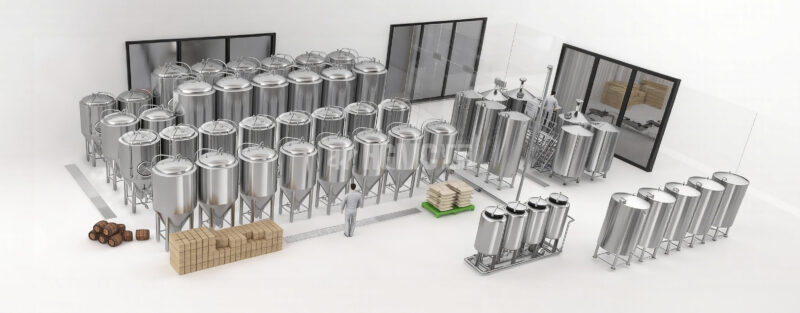
The most obvious advantage of a 2-vessel system is the lower upfront cost. One fewer vessel means one fewer set of pumps, valves, heat exchangers, and temperature controls. For a 1000L system, the savings typically land between 25% and 30% compared to an equivalent 3-vessel configuration.
Space is another factor. A 2-vessel layout generally requires 30–40% less floor area, which matters in leased spaces where every square foot carries a monthly cost. Installation is simpler too — fewer connections, less welding, and a shorter commissioning timeline. Brewers who have been through both setups often mention that the 2-vessel installation felt less disruptive to their regular production schedule.
Ongoing operational costs also favor the simpler setup. Cleaning a 2-vessel line requires less caustic solution and less water, and total CIP time per batch runs about 1.5 hours compared to 2.5 hours for a 3-vessel system. Over a year of 100 batches, those hours add up to more than 100 hours of labor saved.
| Feature | 2‑Vessel | 3‑Vessel |
|---|---|---|
| Initial Investment | ~$28,000 | ~$42,000 |
| Floor Space Required | ~70 sq ft | ~110 sq ft |
| Cleaning Time | ~1.5 hours per batch | ~2.5 hours per batch |
| Batch Consistency | 8/10 | 8/10 |
For breweries evaluating affordable options, the 1000L 2 Vessel Beer Brewing Equipment offers a practical configuration that reduces upfront investment while maintaining production capacity. The system eliminates one vessel without compromising the core brewing workflow. The reduced capital outlay means a brewery can redirect funds toward fermentation capacity or cooling infrastructure, which often become the next bottleneck anyway.
The recurring savings should not be underestimated either. Less cleaning solution means lower chemical costs. Shorter CIP cycles mean less hot water consumption. Smaller floor space means lower rent allocation for the brewhouse. These line items do not make a dramatic difference month to month, but over a 3-year equipment life they offset a meaningful portion of the initial purchase price.
Performance and Quality Considerations in 2‑Vessel Brewing
The common concern with 2-vessel systems is whether they can match the efficiency and consistency of a 3-vessel setup. In practice, modern 2-vessel designs that combine the mash and lauter functions into one tank achieve mash efficiencies of 80–85% with proper technique — comparable to many 3-vessel systems in the same size range.
The key is recirculation. A well-designed 2-vessel system uses a recirculation pump to maintain even temperature distribution through the grain bed, which drives conversion. The false bottom and proper grain crush depth support clear runoff without channeling. Wort clarity from a 2-vessel system is generally acceptable for most ale styles, and hop utilization during the whirlpool phase remains consistent when the system includes a separate kettle with adequate surface area.
The main tradeoff is lautering time. Some brewers report lautering taking 15–20 minutes longer on a 2-vessel system because the combined mash/lauter tun requires more careful management of grain bed depth and flow rate. A stuck sparge is more likely if the crush is too fine or the mash temperature drifts. One brewery I know lost an entire batch when a pocket of unmilled grain caused a channel that took 45 minutes to clear — they had to dump the mash and start over. Adjusting the grain crush slightly coarser and holding mash temperature steady at 68°C brings lautering times in line with 3-vessel performance. It takes a few batches to dial in, but most brewers get there within the first month of operation.
On the positive side, the reduced number of vessels often encourages more consistent cleaning routines. With only two vessels to CIP, brewers tend to be more thorough on each one rather than rushing through three or four tanks. Several small breweries I have spoken with report fewer sanitation issues after switching from a 3-vessel system, simply because the cleaning workflow is easier to maintain consistently. There is a psychological factor too — knowing you have fewer tanks makes you less likely to skip a cleaning step at the end of a long brew day.
Another benefit that is rarely discussed: the combined mash/lauter tun sits at a height that makes grain-in and grain-out less physically demanding. On a 3-vessel system, mash tuns are often low and require stooping or kneeling to access. The combined vessel in a 2-vessel system, sized for both mashing and lautering, tends to be taller and easier to work with, reducing strain on brewers during repeated batch cycles. After a double brew day, that difference in posture matters.

Key Features to Look for in an Affordable 1000L 2‑Vessel System
Not all 2-vessel systems are built the same, and the affordable end of the market requires careful evaluation. Here are the features that matter most in daily operation.
Stainless steel grade: 304 stainless steel is standard and sufficient for most applications. 316 stainless offers better corrosion resistance in high-chloride environments but adds cost. For a 1000L system in a standard taproom setting, 304 is the practical choice. Check the gauge thickness on the vessel walls — thinner steel saves manufacturing cost but loses heat faster and dents more easily during cleaning.
Control system: Manual operation keeps costs low, but a PID controller for mash temperature improves consistency significantly. Automated temperature control removes one variable that affects lautering performance and batch repeatability. Some budget systems ship with basic on-off thermostats that allow temperature swings of 3–5°C, which will hurt efficiency. A proper PID controller holds mash temperature within 0.5°C.
Pump sizing and fittings: Look for tri-clamp sanitary fittings throughout. They are easier to disassemble and clean than threaded connections. The recirculation pump should be sized for the grain bed depth — underpowered pumps cause slow runoff and extended lautering cycles. A pump rated for 30–40 L/min is appropriate for a 1000L system.
CIP-friendliness: The vessel design should include spray ball coverage for the entire interior surface. Vessel bottoms with a sufficient slope drain completely, preventing standing water and bacterial growth. A typical CIP cycle for a 1000L 2-vessel system takes 45–60 minutes. Systems with flat bottoms or poor spray ball placement will require manual scrubbing, which defeats the purpose of a CIP setup.
Manufacturer support: Check warranty terms and spare parts availability. A pump seal or temperature probe that takes three weeks to ship can halt production. Ask for references from other breweries that have bought from the same supplier before committing.
FAQ
What is the typical price range for an affordable 1000L 2-vessel brewing system?
Most systems in this category range from $22,000 to $35,000, depending on automation level, stainless steel grade, and included accessories. Entry-level manual systems start around $22,000, while semi-automated configurations with PID control and CIP spray balls land closer to $35,000. Shipping and import duties add 10–15% for international buyers.
Can a 1000L 2-vessel system produce beer quality equal to a 3-vessel system?
Yes, with proper technique. Modern 2-vessel designs with recirculation and temperature control achieve mash efficiencies of 80–85% and produce wort clarity comparable to 3-vessel systems. The main difference is lautering time, which runs 15–20 minutes longer if grain management is not optimized. Blind taste tests between beers brewed on 2-vessel and 3-vessel systems rarely show detectable differences in the final product.
How much space is needed for a 1000L 2-vessel brewery?
A 2-vessel brewhouse footprint typically requires 60–80 square feet, not counting fermentation and serving tanks. Including walkways and work space, a total area of 200–300 square feet is recommended for the brewing area. Fermentation space requires additional room — plan for 100–150 square feet for 4–6 unitanks.
What are the utility requirements for a 1000L system?
Most 1000L systems are configured for either direct-fire gas or electric heating. Gas systems require a propane or natural gas connection with appropriate BTUs — typically 150,000–200,000 BTU for a 1000L kettle. Electric systems typically need 208–240V, 3-phase power, drawing 30–50 amps depending on the heating element configuration. Water supply should deliver at least 15 L/min with a pressure of 40–60 PSI.
How long does it take to brew a batch on a 2-vessel system?
A typical brew day runs 6–8 hours from mash-in to knockout, including cleaning. The mash and lautering phase takes 3–4 hours, followed by a 60–90 minute boil. CIP adds another 45–60 minutes after the batch is transferred. Double batches extend the day to 10–12 hours, but many breweries with a single 1000L system find that one batch per day keeps the taproom supplied without exhausting the brewing staff.
