
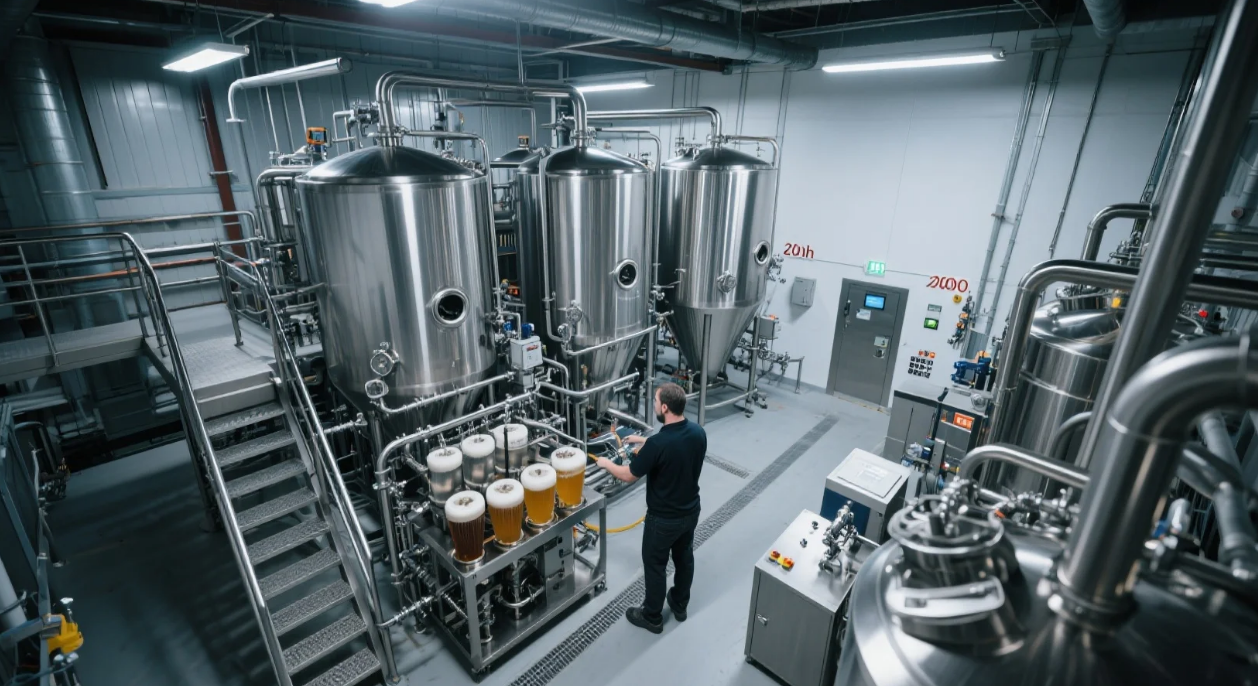
The 500L nano system worked fine for the first two years. Taproom crowds were consistent, local beer festivals brought in some recognition, and the small batch approach gave you room to experiment with recipes. Then the numbers shifted. You started selling out of your core IPA by Thursday evening. Local accounts wanted kegs delivered weekly. Suddenly, running four back-to-back 500L batches just to cover basic demand stopped feeling like passion and started feeling like exhaustion.
Jumping straight to a 50hl industrial system would mean new facility construction, additional staff, and a completely different operating model. That is not always the right next step. A 2000L high-efficiency brewing system sits in a practical middle ground—enough volume to serve a busy taproom and handle limited distribution, while still keeping the brewhouse small enough that one experienced brewer can manage the process. A single 2000L batch yields approximately 20 hl of beer, roughly the output of four 500L batches in one brew day. But the volume alone is not the point. The efficiency improvements built into well-designed 2000L equipment determine whether that capacity actually translates into faster turnaround, lower energy use, and fewer labor hours per barrel.
What a 2000L High-Efficiency Brewing Line Typically Includes
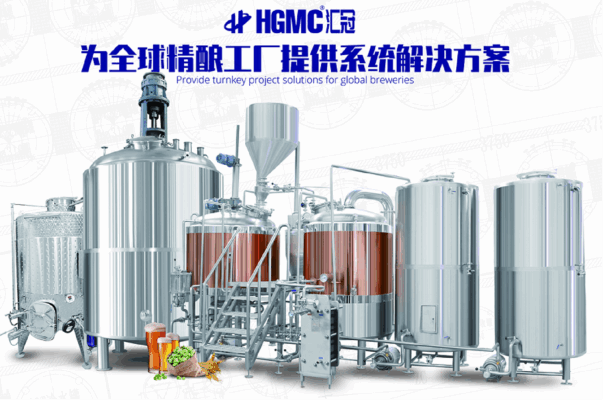
A complete 2000L brewing line covers every stage from mash-in to conditioning, and the efficiency gains depend on how each component connects to the next. A typical package includes the brewhouse section, fermentation and conditioning tanks, and a set of support systems designed to reduce manual work.
The brewhouse starts with a mash-lauter system, which handles both mashing and lautering in one or two vessels depending on the layout. At 2000L, combined mash-lauter systems save floor space and reduce transfer steps, though separate vessels give more control over mash thickness and sparge timing. The kettle and whirlpool handle boiling and trub separation. A well-designed kettle with adequate heating surface area maintains consistent boil-off rates batch after batch, and a properly shaped whirlpool vessel collects trub cleanly so less sediment reaches the heat exchanger. Speaking of the heat exchanger—a plate or tubular unit sized for 2000L throughput cools wort from boiling to pitching temperature in twenty to thirty minutes, which matters when you are trying to hit two turns in a single day.
The fermentation and conditioning section typically includes one or more 2000L cylindroconfermenters and bright beer tanks for maturation and carbonation. A single fermenter per batch is the minimum, but breweries that plan to run the brewhouse more than once per week quickly add additional tanks to keep the schedule moving.
Support systems make or break the efficiency label. A glycol cooling system sized for the current tank count, with room to expand, keeps fermentation temperatures stable without overtaxing the chiller. A CIP station with spray balls installed in every vessel and transfer line means cleaning does not require someone to manually scrub each tank. Control panels, from simple temperature controllers to semi-automated systems, handle the repetitive monitoring tasks so the brewer focuses on the decisions that affect beer quality.
The difference between a generic 2000L setup and truly high-efficiency equipment lies in how these parts are designed to work together—smooth transfers, quick cleaning, and responsive temperature control. Listing components is easy. Making them function as a coherent system takes intentional design.
Brewhouse Design Elements That Boost Efficiency at 2000L
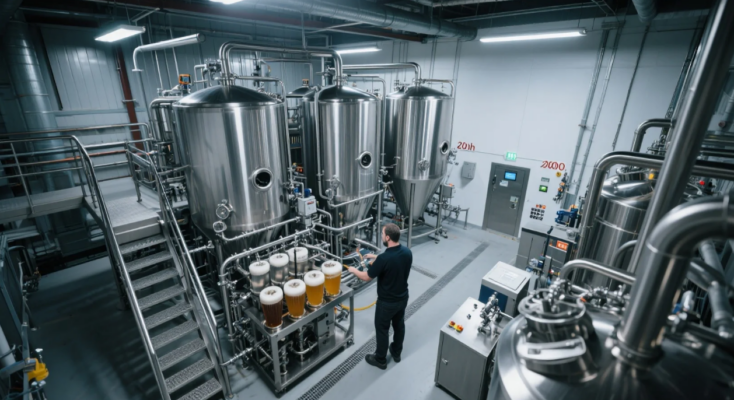
The brewhouse is where most brewers naturally look for efficiency gains, and at 2000L scale, the design details have an outsized impact on daily operations.
An optimized mash-lauter system starts with reliable rakes and well-designed false bottoms. These components directly affect wort clarity and extract efficiency. A mash-lauter with poorly spaced rakes or uneven false bottom slots increases the risk of stuck mashes, which add thirty minutes to an hour to the brew day while you recirculate, add rice hulls, or manually break the grain bed. Over the course of a year running two batches per week, those delays add up to roughly 50 to 100 hours of lost production time. A properly engineered mash-lauter at 2000L volume reduces that risk significantly.
Kettle and whirlpool design matter for repeatability. Kettles with adequate heating surfaces—either direct-fire or steam, depending on the facility—allow stable boil behavior across seasonal ambient temperature changes. A whirlpool vessel with the correct internal geometry and tangential inlet design collects trub into a compact cone, which means less hop material and protein carryover into the heat exchanger and fermenter. That directly reduces cleaning frequency downstream.
Rightsized pumps and piping are one of those details that nobody notices until something goes wrong. A pump sized for 2000L flow rates and the specific gravity of finished wort moves liquid efficiently without excessive shear. Piping routes that minimize dead legs and awkward connections save transfer time and reduce the number of fittings that need manual disassembly for cleaning. Thoughtful piping layout also reduces the hose changes required between transfer steps, which cuts down on both time and the small spill losses that accumulate over a brew day.
Operator comfort is an underappreciated efficiency factor. Platforms and stairs arranged so the brewer can reach manways, valves, and sampling points without stretching or climbing awkwardly reduce physical fatigue. A tired brewer is more likely to skip a step, misread a temperature, or forget to close a valve. In a 2000L brewhouse, mistakes that waste half a batch represent a significant financial loss. Designing for operator reach improves consistency and reduces human error.
Fermentation and Bright Beer – Efficiency Beyond the Brewhouse
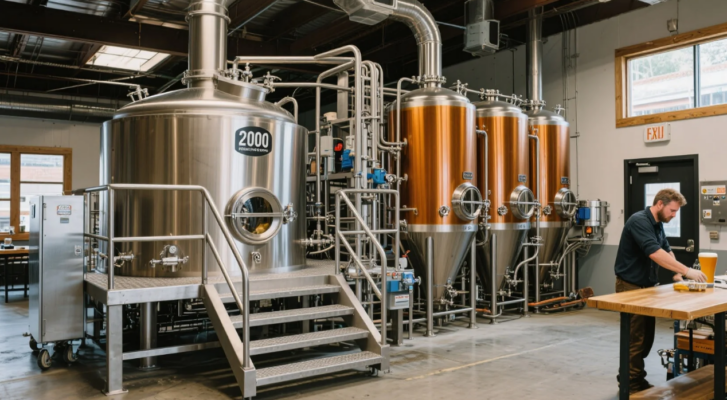
Efficiency does not stop when wort goes through the heat exchanger. The cellar is where capacity meets tank turnaround time, and design choices at 2000L scale determine how many batches you can produce per month.
Multizone cooling jackets on cylindroconical fermenters maintain even temperature profiles during fermentation. A single cooling zone at the bottom of the tank tends to stratify temperature, with warmer beer rising and cooler beer sinking, which forces the yeast into uneven activity. Multiple zones—typically two or three along the tank wall—allow the brewer to control fermentation temperature in sections, helping yeast complete fermentation predictably and reducing the need for manual adjustments during active fermentation.
Tank insulation is a deceptively simple efficiency upgrade. A well-insulated 2000L fermenter cuts cooling energy demand by 15 to 20 percent during active fermentation. Over a summer of running six to eight fermentation cycles per tank, that reduction translates into lower glycol system runtime and less wear on the chiller. Many breweries insulate fermenters but skip insulation on bright beer tanks, only to find that those uninsulated vessels struggle to hold serving temperature when the cellar temperature fluctuates overnight.
Tank layout in the cellar is rarely given enough attention during the equipment selection process. Logically positioning 2000L fermenters and bright tanks with short transfer paths and clear CIP routes cuts walking time and reduces the number of hose connections required per transfer. A cellar where tanks are arranged in a straight row with a central walkway allows one person to manage four to six tanks without running back and forth for hose changes or valve adjustments. That same layout also simplifies CIP routing, since the cleaning station can feed multiple tanks through a single manifold.
Outlet design and internal surface finish affect product loss during transfers. Smooth internal surfaces with correctly placed outlets reduce the volume of beer left in the tank after transfer. At 2000L, losing five liters per tank to poor geometry might not seem significant, but multiplied across dozens of transfers per year and multiple tanks, the cumulative loss exceeds several full batches of lost yield. Domed bottoms with center outlets and conical tanks with steep angles drain more completely than flat-bottom or shallow-cone designs.
Cleaning Systems – Turning Tanks Faster Without Compromising Hygiene
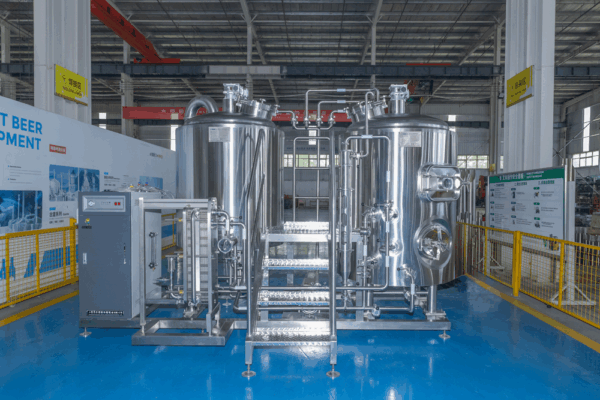
Cleaning efficiency is one of the most underestimated factors in brewhouse and cellar throughput. A well-designed CIP system can reduce total cleaning time by 30 to 40 percent compared to manual methods, which directly increases how many batches a brewery can produce in a week.
Integrated spray devices—spray balls or rotary spray heads—installed in every vessel ensure cleaning solutions reach all internal surfaces without requiring manual scrubbing. In a 2000L fermenter, a fixed spray ball with the correct flow rate and pressure cleans the tank in a programmed cycle while the brewer works on other tasks. Rotary spray heads cover larger surface areas more aggressively and work well for kettles and whirlpools where protein and hop residue can be stubborn.
The CIP pump and heat exchanger must be correctly sized for the 2000L system. An undersized pump reduces spray ball pressure, leaving dead spots in tank coverage. An oversized pump wastes energy and can damage spray heads over time. Heat exchangers in the CIP loop must maintain cleaning solution temperature within the effective range—typically 70 to 80 degrees Celsius for caustic cycles—because cold caustic does not remove protein and organic residue effectively, and overheated caustic can damage tank surfaces.
Control panels for CIP can range from simple timers to fully automated sequences with programmable cycle parameters. At 2000L scale, semi-automated control is usually the practical middle ground. The brewer selects the cycle type—caustic, acid, rinse, sanitize—and the panel manages pump speed, temperature hold, and cycle duration while the brewer handles other tasks. Fully manual CIP, where someone monitors every step, ties up labor for 45 to 90 minutes per tank and is more prone to errors like forgetting to close a valve or running a rinse at the wrong temperature.
One failure I have seen repeatedly: breweries that invest in a 2000L brewhouse but only buy a single 2000L fermenter. The brewhouse can produce one batch in four to five hours. Fermentation takes seven to fourteen days depending on the style. With one fermenter, the brewhouse sits idle for most of that time because there is no empty tank to receive the next batch. The solution is to match fermentation capacity to brewhouse output—typically three to four 2000L fermenters for a brewery running two batches per week, plus bright beer tanks for conditioning and serving. Ignoring that ratio turns efficient brewhouse design into an expensive bottleneck.
Is 2000L Right for Your Brewery?
Deciding whether 2000L is the right jump requires evaluating current production, growth rate, and facility constraints.
Breweries that are taproom-focused with limited local distribution can often justify the investment based on taproom revenue alone. A 2000L system producing two batches per week yields roughly 160 hl per month. At typical taproom margins, that volume covers the equipment cost within 18 to 24 months. Breweries that rely primarily on distribution, where margins are thinner and competition is higher, need to calculate whether the volume increase justifies the capital expense before committing.
Space requirements for a 2000L system are significant but manageable. A brewhouse with mash-lauter, kettle, whirlpool, and control panels typically needs 80 to 100 square meters. Fermentation and bright beer storage requires another 100 to 150 square meters depending on tank count. Any facility being retrofitted should confirm door widths, ceiling height, and floor load capacity before ordering equipment. I have seen breweries order 2000L tanks without checking ceiling clearance, only to discover that installing the tanks requires cutting a hole in the roof—an expensive surprise that delayed commissioning by two months.
Scalability is worth considering. A well-designed 2000L brewhouse can usually support additional fermenters and bright tanks as production grows, as long as the glycol system, CIP pump, and electrical service were sized for future expansion. Breweries that anticipate steady growth over five years should spec these support systems at 150 percent of current capacity, not at the bare minimum. The cost difference is small upfront, but retrofitting an undersized glycol chiller or upgrading electrical panels later can cost three to four times the initial premium.
Many breweries target 5 to 7 barrels per batch as the first step beyond nano systems, with 2000L representing roughly 17 barrels. That jump is significant but manageable—large enough to supply a growing taproom and a few local accounts, but not so large that it requires a specialized production crew. Breweries that skip this intermediate scale and jump directly to 50hl or 100hl often spend the first two years operating below capacity while they build distribution to fill the tank volume.
FAQ
What is the typical batch yield from a 2000L brewing system?
A standard 2000L batch yields approximately 20 hl of finished beer after accounting for losses during transfer, trub removal, and fermentation. Actual yield depends on recipe, process efficiency, and how well the equipment is designed for minimal product loss, with well-designed systems achieving 90 to 95 percent of theoretical volume.
How much floor space does a 2000L brewhouse and cellar require?
A complete 2000L system, including brewhouse vessels, four to six fermenters, bright beer tanks, glycol chiller, and CIP station, typically requires 200 to 300 square meters of total floor space. Brewhouse height clearance of 4 to 5 meters is needed depending on vessel geometry and whether tanks include top-mounted manways.
Can a 2000L system be expanded later without replacing the brewhouse?
Yes, if the glycol system, electrical service, and CIP pump were sized for expansion during initial installation. Most 2000L brewhouses can support 6 to 8 fermenters and additional bright beer tanks without modifying the brewhouse itself, as long as support infrastructure was designed with headroom.
What are the main operating cost differences between a 2000L and a 1000L system?
The 2000L system requires roughly 60 to 70 percent more energy per batch for heating and cooling, but energy cost per hectoliter decreases by 15 to 25 percent due to better vessel surface-area-to-volume ratios. Labor cost per hectoliter drops significantly because one brewer can produce double the volume in roughly the same brew day duration. Cleaning chemical usage per hectoliter also decreases with larger vessel sizes.
