
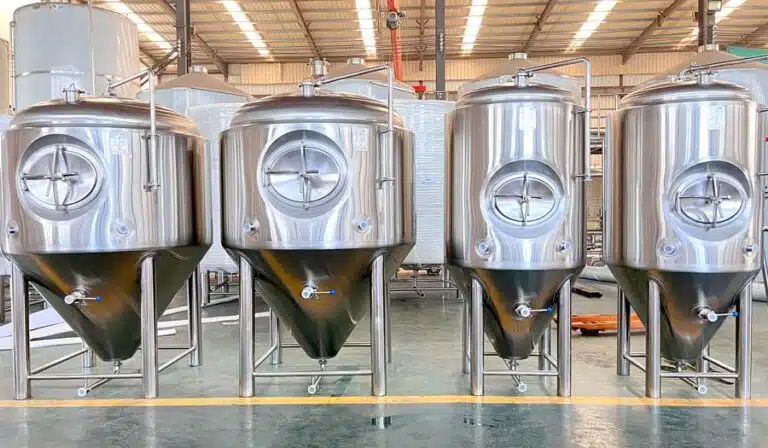
In modern beer production, the fermenter (also called a beer fermentation tank or FV) is where wort becomes beer—and where consistency is won or lost. A well-designed industrial brewing fermenter helps a brewery control temperature, pressure, sanitation, and yeast performance at scale, which directly impacts flavor stability, yield, and throughput.
This guide explains what an industrial beer fermenter is, why it matters, the most important design features to evaluate, and how to choose the right tank configuration for your brewhouse and production goals.
What Is an Industrial Brewing Fermenter?
An industrial brewing fermenter is a sealed, sanitary vessel used for large-scale beer fermentation. It is engineered to provide stable conditions for yeast to metabolize sugars into alcohol and CO₂ while allowing the brewer to manage critical parameters such as:
- Temperature (via glycol jackets or coils)
- Pressure (for spunding/pressure fermentation and safe carbonation handling)
- Oxygen exposure (minimizing oxidation risk)
- Sanitation and cleanability (CIP capability, hygienic welds, proper internal finishes)
- Sampling and monitoring (sample valves, pressure gauges, temperature probes, optional sensors)
In commercial brewing, these vessels are typically made from food-grade stainless steel (commonly 304 or 316L), with polished internal surfaces designed to reduce contamination risk and improve cleanability.
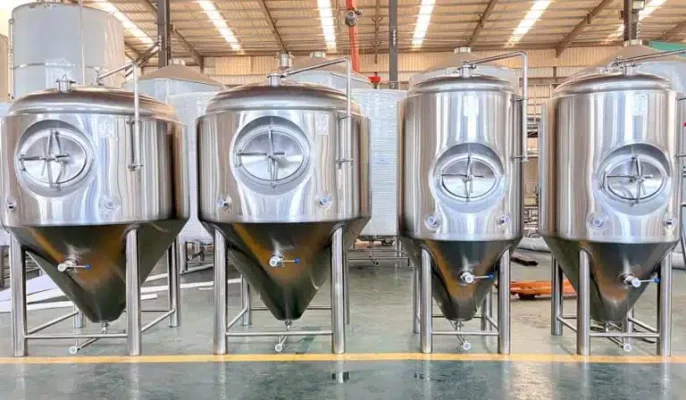
Why Industrial Fermentation Tanks Matter (Quality, Efficiency, and Safety)
1) Consistent fermentation = consistent beer
Beer is sensitive to fermentation variability. Controlling fermentation conditions helps maintain repeatable flavor profiles and stable attenuation across batches. Research on brewery fermentation management emphasizes that fermentation parameters and yeast handling are key drivers of beer quality and yeast performance.
2) Production efficiency and market demand
Larger fermenters support higher-volume, more continuous production—reducing downtime between batches and improving output per unit time. This matters in markets where breweries must deliver consistent supply, seasonal rotations, and fast-moving SKUs.
3) Food safety and sanitation (CIP is non-negotiable)
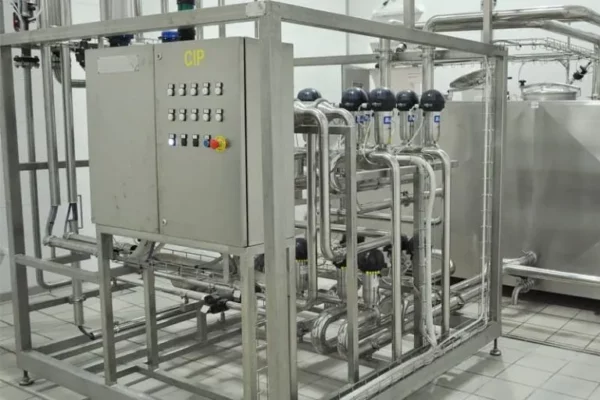
Industrial fermenters must be designed for hygienic operation and fast, repeatable cleaning. Clean-in-place (CIP) systems are widely used in food and beverage processing to clean tanks and process lines without disassembly, reducing contamination risk and downtime.
4) Pressure safety and compliance
If your fermenter will operate above certain pressures, pressure-vessel standards and certification become critical. The Brewers Association notes that for brewing process tanks operating above 15 psi, an ASME-rated tank is typically required, and they recommend using ASME-rated tanks when processes require pressure above that threshold.
Industry Context: Why Fermentation Equipment Decisions Are Strategic
Even in mature beer markets, production volumes and economic value are significant—making fermentation capacity planning and reliability financially important.
For example, the Brewers Association reports that U.S. craft brewers produced 23.1 million barrels of beer in 2024 and that craft beer holds a meaningful share of the U.S. beer market by volume.
Related BA stats page: https://www.brewersassociation.org/statistics-and-data/national-beer-stats/
On the regulatory reporting side, the U.S. Alcohol and Tobacco Tax and Trade Bureau (TTB) publishes official beer statistics and datasets (monthly/yearly).
Source: https://www.ttb.gov/regulated-commodities/beverage-alcohol/beer/statistics
These data points don’t just show “industry size”—they highlight why breweries prioritize:
- uptime (less downtime = more packaged beer)
- sanitation (less contamination = fewer dumped batches)
- repeatability (stable quality = stronger brand trust)
Key Features of a High-Performance Industrial Beer Fermenter
1) Tank geometry: conical vs. flat-bottom (and why it matters)
Conical fermenters are popular because the cone helps yeast and trub settle into a collection zone. This supports:
- easier yeast harvesting
- more efficient dumping of sediment
- reduced transfers (lower oxidation/contamination risk)
What to check in industrial conicals
- Cone angle suited to yeast dumping and solids flow
- Proper racking arm design for clean beer pickup
- Adequate headspace (especially for high kräusen or heavily dry-hopped beers)
2) Temperature control: jackets, zones, and insulation
Temperature control is one of the most important fermenter functions. Look for:
- Glycol jackets sized appropriately for your wort temperature, ambient conditions, and fermentation heat load
- Multi-zone jacketing (e.g., cone + mid + upper zones) to reduce gradients
- Insulation and cladding to stabilize control and reduce energy waste
- Proper probe placement for accurate readings
3) Materials and internal finish: 304 vs. 316L, weld quality, polish
Stainless steel is preferred because it is durable, corrosion-resistant, and cleanable—when fabricated correctly.
When comparing vendors, ask about:
- steel grade (304 or 316L depending on chemical exposure, brewery practices, and customer requirements)
- internal surface finish (polish level/roughness targets)
- weld procedures and passivation
- hygienic design (avoid dead legs, crevices, poor drainability)
4) CIP cleaning design: spray devices, drainability, and verification
A fermenter is only as good as its cleanability. Evaluate:
- spray ball or rotary jet head selection
- full-coverage cleaning performance
- proper slope and bottom drain configuration
- CIP ports, return routing, and access for inspection
- documentation support (SOPs, recommended CIP recipes, verification approach)
CIP is widely used specifically because it cleans internal surfaces of tanks and process equipment without dismantling, improving hygiene and productivity.
5) Pressure rating and safety package
If you plan to:
- naturally carbonate (spunding)
- run closed transfers under pressure
- perform pressure fermentation
- integrate with brite tanks and CO₂ management
…then pressure rating and safety components become essential:
- PRV (pressure relief valve) sized and certified appropriately
- pressure/vacuum protection if needed
- pressure gauges/transmitters
- compliant manway design
- documentation supporting code compliance (e.g., ASME where required)
Brewers Association guidance is a strong starting point for understanding when pressure-rated vessels and ASME rating matter in breweries.
How to Choose the Right Industrial Brewing Fermenter (Step-by-Step Checklist)
Step 1: Define your beer portfolio and process
Different beer styles and processes influence fermenter specs:
- high-gravity beers may generate more heat and require stronger cooling capacity
- hop-forward beers may need dry-hop ports and hop dosing options
- lager programs may benefit from pressure capability and cold conditioning
Step 2: Size the fermenter for your production plan
Sizing is not just “bigger is better.” Consider:
- brewhouse batch size (e.g., 10 hL, 20 hL, 30 bbl)
- target turns per month
- fermentation time + conditioning time
- peak season demand and SKU complexity
A common mistake is buying fermenters that don’t align with brewhouse output (creating bottlenecks) or buying too large too early (hurting tank utilization).
Step 3: Select the right tank configuration
Key choices:
- Unitank vs dedicated FV + brite tank workflow
- Single-zone vs multi-zone jacketing
- Top manway vs side manway (site constraints and cleaning preferences)
- Fixed legs vs adjustable legs (floor slope, drain alignment)
- Automation level: manual, semi-auto, or fully integrated controls
Step 4: Confirm utilities and site constraints
Before finalizing a spec, verify:
- glycol chiller capacity and temperature
- steam/hot water availability (if applicable for CIP heating)
- ceiling height and rigging access
- door widths and transport routes
- floor loading and drainage layout
- control system integration (signals, alarms, data logging)
Step 5: Demand documentation and quality controls from the supplier
A professional vendor should provide:
- drawings (GA and fabrication)
- material certificates (when required)
- weld maps and QA/QC records (as applicable)
- pressure testing documentation
- operating and cleaning manuals
FAQ (Q&A): Industrial Beer Fermentation Tanks
Q1: What is the best fermenter type for a commercial brewery—unitank or traditional fermenter?
Answer: A unitank allows fermentation, conditioning, and often carbonation in a single vessel, reducing transfers (and oxidation risk) and improving workflow efficiency. Traditional setups (FV + brite) can be advantageous when a brewery wants to maximize throughput flexibility or separate fermentation from carbonation/serving operations. The “best” choice depends on SKU mix, packaging method, tank turns, and cellar workflow.
Q2: Why do most industrial brewing fermenters use stainless steel?
Answer: Stainless steel is widely used because it is durable, corrosion-resistant, and well-suited to hygienic design and CIP cleaning—key requirements in food and beverage production environments. Hygienic design guidance emphasizes smooth, cleanable, nonporous surfaces and CIP compatibility.
Source: https://asbe.org/article/hygienic-design-of-tanks/
Q3: Do I need an ASME-rated fermenter?
Answer: If your brewing process requires operating above certain pressure thresholds, you may need a pressure vessel built and certified to applicable codes. The Brewers Association notes that an ASME-rated tank is generally needed for brewing process tanks where working pressures exceed 15 psi, and recommends ASME-rated tanks when the process requires pressure above that level.
Source: https://www.brewersassociation.org/brewing-industry-updates/brewery-pressure-rated-vessels-faq/
Q4: What is CIP, and why is it important for fermenters?
Answer: CIP (Clean-in-place) is a cleaning method for tanks and process equipment that cleans internal surfaces by circulating cleaning/rinsing/sanitizing solutions without disassembling the system. It improves sanitation consistency, reduces labor, and helps minimize contamination risk.
Q5: What are the most common mistakes when buying industrial fermenters?
Answer: Common pitfalls include:
- undersized cooling jackets (temperature control struggles)
- poor hygienic design (dead legs, poor drainability, hard-to-clean areas)
- insufficient pressure rating for intended operations
- incorrect sizing relative to brewhouse output (creating bottlenecks)
- weak documentation/QA from the supplier (harder commissioning and maintenance)
Q6: How can fermentation monitoring improve consistency?
Answer: Monitoring parameters like temperature, gravity, pressure, pH, and dissolved oxygen helps breweries diagnose deviations early and standardize fermentation behavior across batches. Fermentation data visualization examples show how these signals change over time and how brewers interpret them operationally.
Source: https://www.precisionfermentation.com/blog/brewmonitor-fermentation-data-curves-gravity-examples/
Summary: What “Good” Looks Like in an Industrial Brewing Fermenter
A high-quality industrial brewing fermenter is not just a tank—it’s a controlled, hygienic, pressure-capable production asset. When selecting fermentation tanks for a brewery, prioritize:
- sanitary stainless-steel construction and hygienic design
- robust, correctly sized temperature control (jackets + insulation)
- CIP-friendly geometry and cleaning coverage
- pressure rating aligned with your process (and code compliance where required)
- strong supplier QA, documentation, and support
When these elements are specified correctly, breweries gain better beer consistency, higher cellar efficiency, safer operations, and a fermentation platform that supports growth.
References (Cited Sources)
- Brewers Association – 2024 U.S. craft brewing industry figures: https://www.brewersassociation.org/association-news/brewers-association-reports-2024-u-s-craft-brewing-industry-figures/
- Brewers Association – National beer stats: https://www.brewersassociation.org/statistics-and-data/national-beer-stats/
- Brewers Association – Brewery pressure-rated vessels FAQ (ASME, >15 psi guidance): https://www.brewersassociation.org/brewing-industry-updates/brewery-pressure-rated-vessels-faq/
- ASME – Boiler and Pressure Vessel Code overview: https://www.asme.org/codes-standards/bpvc-standards
- TTB – Beer statistics datasets: https://www.ttb.gov/regulated-commodities/beverage-alcohol/beer/statistics
- CSI Designs – CIP definition and 5-step CIP cycle: https://www.csidesigns.com/blog/articles/5-steps-in-a-common-food-dairy-beverage-clean-in-place-cycle
- SPX FLOW (APV) – CIP and sanitation of process plant (PDF): https://www.spxflow.com/assets/pdf/apv-cip-systems-22003-05-02-2013-gb.pdf
- MDPI Processes – Fermentation parameters and yeast management (peer-reviewed): https://www.mdpi.com/2227-9717/13/3/906
- Precision Fermentation – Fermentation data curves and tracked parameters: https://www.precisionfermentation.com/blog/brewmonitor-fermentation-data-curves-gravity-examples/
- ASBE – Hygienic design of tanks: https://asbe.org/article/hygienic-design-of-tanks/
- Northern Brewer – Conical fermenter benefits (general explanation of why conicals help with yeast/trub handling): https://www.northernbrewer.com/blogs/brewing-techniques/why-should-i-use-a-conical-fermenter
