
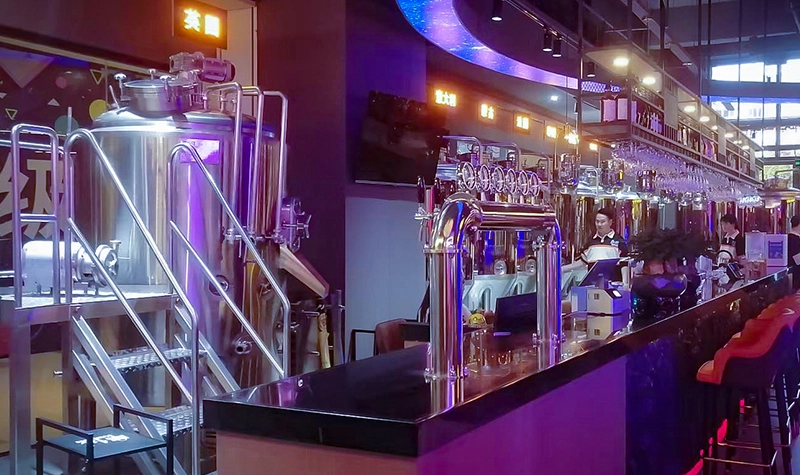
China remains the world’s largest beer-consuming country, reflecting both its population scale and a mature, highly competitive beer ecosystem. At the same time, the market has been shifting from pure volume growth to value growth—driven by premiumization, product differentiation, and new retail/distribution models. Industry reporting also highlights that China produced 37.9 million kiloliters (KL) of beer in 2023, underscoring the country’s continued importance for anyone building, expanding, or upgrading a brewery.
For brewery investors and operators, this landscape creates a clear requirement: equipment choices must match both today’s production needs and tomorrow’s market direction (premium products, stable quality, lower energy use, and higher automation).
Key Considerations for Choosing a Brewing System in China
Selecting a brewing system in China isn’t only about brewhouse size—it’s about building a reliable, compliant, and cost-effective production capability that can adapt to changing consumer preferences.
1) Target product positioning (mainstream vs. premium/craft)
China’s beer market has been undergoing a transition, with industry commentary noting volume stability and a growing premium segment. If your portfolio includes premium lagers, wheat beers, IPAs, stouts, or fruit/sour styles, the system should support:
Precise temperature control (mash rests, whirlpool, fermentation profiles)
Oxygen control and closed transfers
Consistent filtration/clarification options (or haze management for certain styles)
Scalable dry-hopping and flavor additions (if relevant)
2) Energy and utilities: steam, electricity, water, cooling
Energy can be a major operating cost. Brewing literature and technology suppliers emphasize that process heat is a dominant share of brewery energy demand (often the majority), making heat efficiency and recovery increasingly important. In practice, system decisions that influence OPEX include:
Wort boiling system efficiency (evaporation targets, heat recovery)
Hot water tank sizing and heat integration
Glycol system sizing and insulation quality
CIP optimization (chemical, water, and heating demand)
3) Automation level and quality control
Even mid-sized breweries increasingly adopt automated or semi-automated control to stabilize quality, reduce manual variability, and improve traceability. Key elements include:
PLC + HMI control (recipes, alarms, batch reporting)
Flowmeters and inline sensors (temperature, pressure, conductivity, DO where needed)
Repeatable CIP programs and validation logs
4) Compliance, safety, and serviceability
A “best-fit” system is serviceable locally and engineered with safety in mind:
Pressure vessel design, relief valves, and safe venting
Hygienic welds, dead-leg minimization, sanitary fittings
Documentation (manuals, drawings, spare parts lists)
Local commissioning and training support
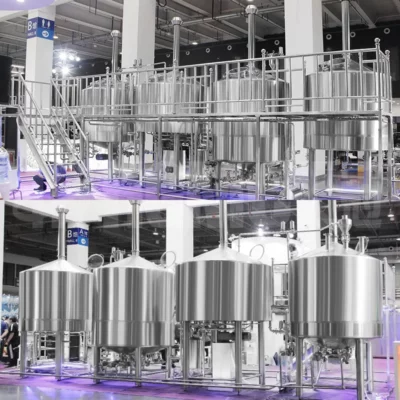
Types of Brewing System Available in the Chinese Market
Breweries in China range from small brewpubs to large industrial plants, so system types vary widely. Common categories include:
1) Brewpub / Pilot systems (e.g., 100–1,000 L)
Best for:
Taprooms, R&D, recipe development, seasonal releases
Typical features:
Compact skid design, manual/semiautomatic operation
Direct-fire, steam, or electric heating options
Single-vessel or two-vessel brewhouse layouts
2) Microbrewery / Craft production systems (e.g., 5–30 hL)
Best for:
Regional distribution, multi-style portfolios
Typical features:
2–4 vessel brewhouse (Mash/Lauter/Kettle/Whirlpool variations)
Multiple fermenters and BBTs
Robust CIP, cold room design, optional canning
3) Industrial brewing systems (e.g., 50–500+ hL)
Best for:
High throughput and efficiency
Typical features:
High automation, energy recovery, advanced boiling systems
High-gravity brewing capability
High-speed packaging lines, inline QC, strong utilities integration
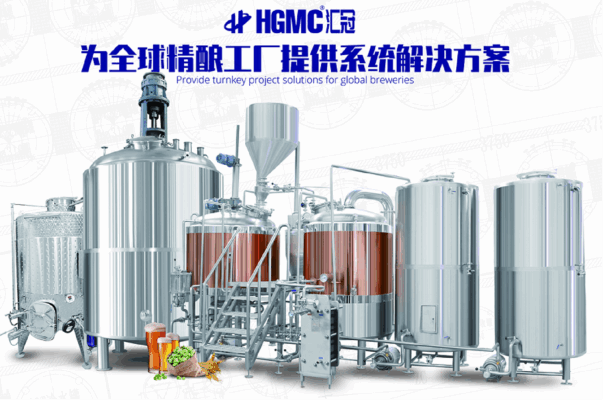
4) Turnkey brewery projects
For investors and expanding producers, turnkey delivery can reduce coordination risk by bundling:
Brewhouse + cellar + utilities + CIP + controls
Packaging line (canning/bottling) and ancillary equipment
Layout design, installation, commissioning, training
Top Beer Brewing system Brands and Their Unique Features
China’s beer competitive environment includes highly scaled national players and fast-evolving premium/craft participants. Industry research commonly cites a competitive landscape concentrated around major national brands (e.g., Snow, Tsingtao, Yanjing, Budweiser) and emphasizes the ongoing “high-end transformation” and pricing improvements.
For equipment buyers, the key takeaway is not to copy a single brand’s setup—but to recognize the operational realities behind successful brands:
Large-scale producers win on cost efficiency, stable quality, and packaging speed.
Premium/craft brands win on differentiation, freshness management, and flexible production planning.
A well-designed system can support both approaches by combining efficiency (energy + time) and flexibility (multi-style capability).
Comparative Analysis of Brewing System Capacities and Outputs
Below is a practical way to think about capacity planning. Output depends on:
Brewhouse size (hL/batch)
Batches per day
Fermentation time (typically 10–21+ days depending on beer style and process)
Number and size of fermenters
Packaging capacity (often the true bottleneck)
Simple planning example (illustrative)
If you run a 20 hL brewhouse:
2 batches/day → 40 hL wort/day (when operating)
If fermentation averages 14 days and you want continuous production, you’ll typically need enough FV volume to “hold” at least two weeks of brews plus buffer (seasonality, maintenance, dry-hopping time, yeast handling, etc.).
Rule of thumb: Many breweries underbuild fermentation and overfocus on brewhouse size. In reality, fermentation and packaging constraints often define your true monthly output.
Matching capacity to channel strategy
Taproom-first breweries: prioritize variety + fast changeovers; packaging may be limited.
Distribution breweries: prioritize stable core SKUs, QA consistency, and packaging uptime.
Contract/ODM production: prioritize flexible scheduling, fast CIP, and documentation/traceability.
Cost Factors to Consider When Investing in Brewing Equipment
A successful equipment investment model considers both CAPEX and OPEX.
CAPEX drivers (one-time costs)
1) Brewhouse vessels and controls (automation level changes pricing significantly)
2) Cellar tanks (FV/BBT counts and jacket design)
3) Utilities and infrastructure
Steam boiler or electric heating
Chiller and glycol loop
Air compressor, CO₂ system, water treatment
4) Packaging lines
Canning/bottling line, labeling, coding, conveyors
5) Installation + commissioning
Site prep, piping, electrical, training
OPEX drivers (ongoing costs)
1) Energy consumption
Wort boiling is one of the most energy-intensive steps. Advanced boiling solutions and retrofits are promoted for reducing energy use, sometimes citing significant reductions versus reference configurations.
2) Water and wastewater
CIP optimization and cleaning design can significantly impact operating cost.
3) Labor
Automation and ergonomic layout reduce headcount pressure and process variability.
4) Consumables
Filter media, cleaning chemicals, gaskets, parts wear.
Investment tip: Evaluate “cost per hectoliter packaged” rather than only sticker price. Two systems with the same brewhouse volume can have very different energy, downtime, and yield performance.
Future Trends in China’s Beer Brewing Technology and Innovation
1) Premiumization + diversified styles
Market commentary continues to highlight the move toward premium offerings and differentiated experiences, especially in urban segments.
2) Energy efficiency and heat recovery
Process heat is a major share of brewery energy demand, making electrification, heat recovery, and smarter thermal management increasingly relevant for modern plants.
3) Advanced wort boiling and lower evaporation concepts
Industry publications and supplier announcements discuss newer wort boiling approaches designed to reduce heat consumption while maintaining wort quality targets.
4) Higher automation and data-driven brewing
Automation is expanding beyond “push-button brewing” into:
Batch traceability
Predictive maintenance (pumps, valves, sensors)
QA integration (DO, carbonation consistency, packaging checks)
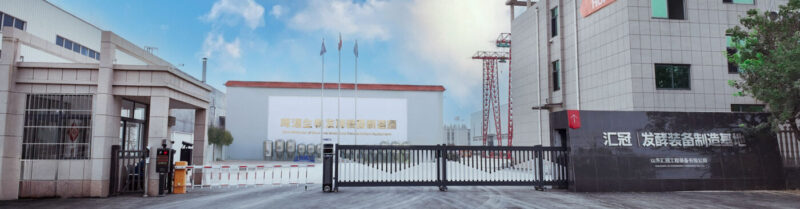
Why HGMC (Beer Brewing Equipment Manufacturer)
HGMC is the world’s leading manufacturer of beer brewing equipment. We produce brewery equipment, beverage equipment and canning/bottling lines. We have more than 30 national authorized patents and more than 20 high-tech achievements. We provide a full range of services, including individual equipment and turnkey projects. Our systems have been exported to more than 120 countries, and have won recognition and praise from customers.
For breweries operating in a market as demanding and dynamic as China—where quality consistency, cost control, and adaptability matter—HGMC focuses on delivering:
Reliable brewhouse and cellar engineering
Practical automation for repeatable quality
Packaging integration (canning/bottling lines)
Turnkey support from design to commissioning
Q&A (FAQ): Brewing System in China
Q1: What brewing system size should I choose for the China market?
Choose based on your route-to-market and expansion plan:
Taproom model: prioritize flexibility (more tank variety) over maximum brewhouse volume.
Distribution model: prioritize consistent core SKUs and packaging capacity.
A practical approach is to plan fermentation and packaging first, then size the brewhouse to keep those assets fully utilized.
Q2: Is China still a “big enough” beer market to justify new investment?
China remains the largest beer-consuming country globally. Even when volume growth is modest, value opportunities can remain strong—especially for premium and differentiated products.
Q3: What’s the most common mistake when buying brewing equipment?
Underestimating total system needs. Common gaps include:
Insufficient fermentation/BBT capacity
Underpowered cooling and glycol systems
Poor CIP design that increases downtime and cleaning cost
Packaging line mismatch (the “real bottleneck”)
Q4: How can I reduce energy cost in brewing without hurting beer quality?
Focus on the biggest thermal loads:
Wort boiling efficiency and heat recovery (a major energy lever)
Hot water system integration
Insulation quality and cold-side optimization
Evaluate solutions with transparent baselines and measurable KPIs (kWh/hL, steam kg/hL, downtime impact).
Q5: Should I choose canning or bottling for China distribution?
It depends on brand positioning, channel, and logistics:
Cans are strong for portability, light-blocking, and modern branding.
Bottles can fit premium presentation and certain on-trade channels.
Many growing breweries choose a line that can scale (or a modular approach) as volumes and channels expand.
Q6: What data supports China’s scale as a brewing market?
Industry reporting cites China beer production of 37.9 million KL in 2023, highlighting the country’s ongoing scale and relevance for brewing operations and supply chains.
Conclusion
China’s beer industry is large, competitive, and increasingly shaped by premiumization, efficiency, and technology-driven consistency. For brewery owners and investors, choosing the right brewing system means aligning capacity, utilities, automation, and packaging with real market needs—not just theoretical output.
If you’re building a new brewery or upgrading an existing plant, HGMC can support you with brewery equipment, beverage equipment, and canning/bottling lines—covering everything from individual tanks to complete turnkey projects—backed by patented capabilities, proven export experience, and a commitment to dependable, modern brewing engineering.
