
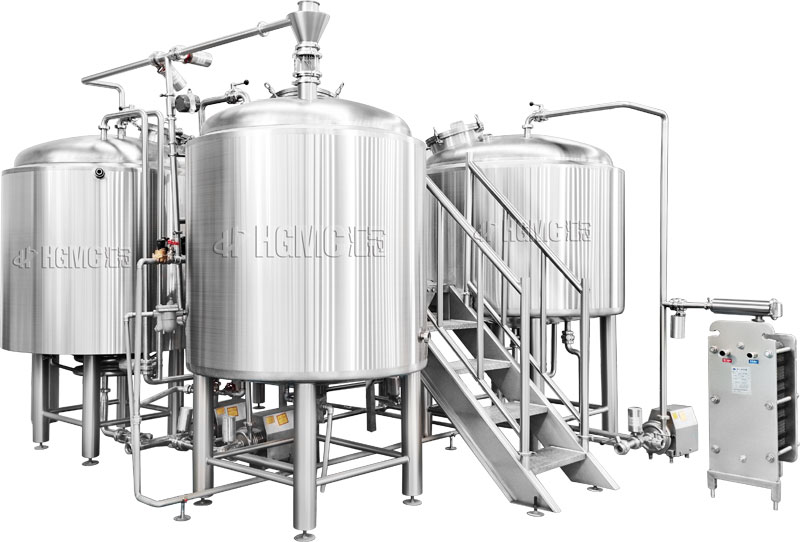
Scaling from a small pilot setup to a 1000L–3000L micro craft brewery system is not simply “buying bigger tanks.” At this production tier, the physics of heat transfer, fluid handling, oxygen pickup, and cleaning repeatability begin to dominate outcomes. The right equipment package—brewhouse, cellar, utilities, and automation—makes the difference between inconsistent “artisanal guesswork” and stable, repeatable beer that can survive wider distribution.
What “1000L to 3000L Brewing” Actually Means (and Why It Changes Everything)
A 1000L brewhouse typically produces about 10 hL (hectoliters) of wort per batch; a 3000L brewhouse produces about 30 hL per batch. At these volumes:
Heat loads during mashing/boiling and fermentation become large enough that undersized steam, chilling, or glycol systems create measurable quality defects and schedule delays.
Mechanical forces (torque on lauter rakes, pump head pressure, pipe velocities) increase significantly.
Cleaning and sanitation must become more standardized and verifiable, because “manual scrubbing” does not scale reliably.
Dissolved oxygen (DO) control becomes critical on the cold side (post-boil), especially if you plan any distribution footprint.
The source article frames this jump as a shift toward “automated fluid dynamics and precision thermal management,” including faster knockout cooling, multi-zone glycol jackets, hard piping to reduce oxygen pickup, and automated CIP to maintain hygiene across repeated tank turns.
Brewery Sizing Context: Microbrewery vs Craft Brewer (Industry Definitions)
“Microbrewery” can mean different things globally, but in the U.S. the Brewers Association provides widely cited definitions:
Craft brewer (BA): “small and independent,” with “small” defined as ≤ 6 million barrels annually (plus independence criteria).
Microbrewery (BA market segment): produces < 15,000 barrels/year and sells 75% or more off-site (distribution-heavy model vs brewpub).
A 1000L–3000L system can fit many business models (taproom-focused, mixed, or distribution-heavy). The equipment decisions—especially cellar size, chilling, packaging, and QA—should align with the route-to-market.
Core Equipment Blocks for 1000L–3000L Brewing (and What Changes When You Scale)
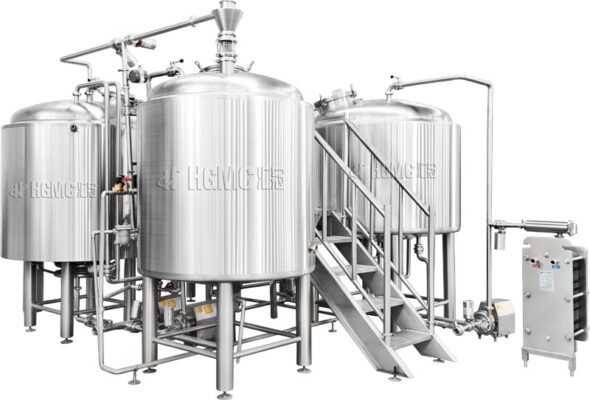
1) The Brewhouse: Mash/Lauter + Kettle/Whirlpool (Thermal and Mechanical Upgrades)
At 1000L–3000L, a brewhouse must deliver consistent extract efficiency, predictable wort quality, and repeatable timing.
The source highlights several scaling-driven design needs:
Higher lauter rake torque as vessel size increases (due to larger grain beds and geometry changes).
Laser-cut wedge wire false bottoms (e.g., ~0.7 mm spacing cited) to support larger grain bills while maintaining runoff quality.
Automated sparge rings to improve extract recovery versus manual sparging.
Whirlpool inlet design and flow rates to improve trub cone formation and reduce wort/beer loss.
Why this matters to beer quality
If lauter performance is unstable, you get:
Variable wort gravity → variable ABV and mouthfeel
Variable pH and tannin extraction risk → astringency risk
Schedule overruns → downstream fermentation scheduling disruptions
Scaling also increases the incentive to instrument the process (flow measurement, temperature stability, and repeatable liquor-to-grist ratio), because small deviations become costly at larger batch sizes.
2) Wort Cooling (Knockout): Heat Exchangers and Knockout Time
In professional brewing, fast and consistent knockout (cooling wort after boiling to fermentation temperature) supports:
Reduced oxidation and contamination risk
Better process repeatability
More predictable yeast performance at pitch
The source claims that multi-stage heat exchanger setups can reduce knockout times to under ~50 minutes in the 1000–3000L bracket and associates slower knockouts with increased oxidation risk.
Practical equipment takeaway:
When you scale up, the question isn’t just “Do you have a heat exchanger?” It’s whether the exchanger, cold liquor, and glycol capacity are sized so that knockout time remains stable even in summer water temperatures and high-gravity brews.
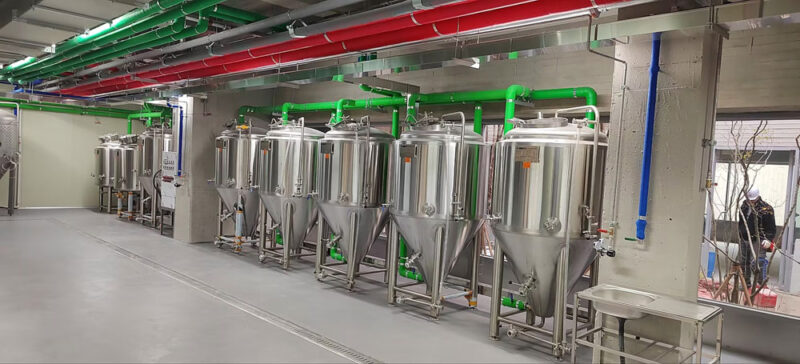
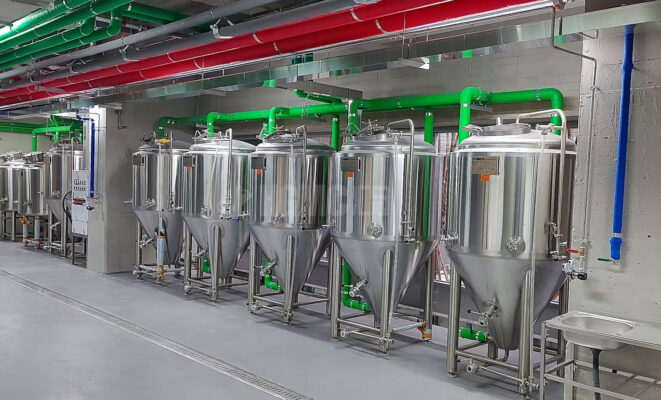
3) Fermentation & Cellar: Unitanks, Multi-Zone Jackets, and Pressure Rating
For 1000L–3000L systems, the cellar is usually where money is made or lost. Fermenters must control exothermic fermentation heat and maintain uniform temperature through the entire liquid column.
The linked article emphasizes:
2000L unitanks with dual-zone glycol jackets reducing thermal stratification risk
Data claims about temperature gradients in tanks without multi-zone cooling
±0.2°C tolerance across volume for properly jacketed tanks (as stated)
Unitanks rated to 30 psi enabling natural carbonation and CO₂ savings (as stated)
Yeast brinks and standardized pitch rates for reproducibility (as stated)
Large dry hop ports (e.g., 4-inch) to add hops at scale with reduced oxygen ingress (as stated)
What readers should understand
Even if the exact percentages in the article are site-specific, the underlying engineering principle is mainstream: as tank size increases, temperature gradients and cooling response become more important, and multi-zone jackets plus automation improve fermentation consistency.
4) Cold-Side Oxygen Control: Hard Piping, Flow Paths, and DO Targets
If you plan distribution—even regional—oxygen pickup becomes a key shelf-life limiter. Cold-side oxidation can dull hop aroma, accelerate staling, and reduce consistency.
The source makes several oxygen-control claims, including that moving from flexible hoses to centralized hard piping can dramatically reduce oxygen pickup, and it references very low DO targets (ppb-level) for finished beer.
Equipment implications at 1000L–3000L:
Prefer fixed piping on critical cold-side transfers
Use appropriate valves, purge points, and CO₂/nitrogen management
Add instrumentation where feasible (DO meter, flow meters, pressure sensors)
Even without going “full macro,” microbreweries that distribute typically invest in oxygen discipline earlier than taproom-only operations.
5) Clean-in-Place (CIP): Scaling Sanitation from “Manual” to Verifiable
Cleaning is not glamorous, but it directly determines whether you can package stable beer consistently.
The source stresses automated CIP cycles with defined flow velocity through spray balls and claims high pass rates on ATP-based hygiene tests when CIP is executed properly. It also mentions automated chemical dosing to reduce human error and protect stainless steel over time.
This aligns with the general industry direction: as production grows, sanitation must become:
Repeatable (same cycle, same time/temp/chemical concentration)
Documentable (records for QA and troubleshooting)
Efficient (time and chemical use optimized)
A reputable brewing reference definition captures the essence of CIP as cleaning the interior surfaces of tanks/pipes without disassembly—a key enabler of modern closed-process breweries.
6) Utilities and Process Stability: Steam Boiler, Glycol Chiller, Pumps, and Automation
At 1000L–3000L, utilities are no longer “support”—they are production capacity.
The source calls out:
Steam boiler sizing buffers (e.g., extra headroom to maintain heating ramp rates)
Glycol chiller capacity scaling (example table showing larger HP needs at 3000L)
VFD-controlled pumps and accurate flow metering to stabilize ratios and reduce drift
Modular PLC architecture for expansion and sensor integration
Real-world translation:
Underpowered steam = longer brew days, poorer boil vigor stability
Underpowered glycol = fermentation temp drift and slow crash cooling
Weak pump/control = inconsistent mash/lauter results and transfer variability
No automation = higher labor cost and higher “human variability” risk
Production Planning: The Hidden Constraint Is Fermentation Capacity
A common scaling mistake is focusing on brewhouse size alone. In most breweries, the brewhouse can produce wort quickly—but fermentation tanks hold beer for days to weeks.
The article points out that faster operations can enable double or triple brew days and that scheduling may be driven by the need to fill larger fermenters efficiently.
Planning heuristic for readers:
If you increase brewhouse size (or batches per day), you must proportionally increase:
Fermenter volume
Cooling capacity
CIP throughput
Packaging and cold storage capacity
Otherwise, you create a bottleneck where the brewhouse is idle waiting for tank space.
Market Reality: Why Precision Matters in a Competitive Beer Industry
Beer is produced at massive scale worldwide, and competition is intense. Global market reports like BarthHaas regularly track worldwide output and the largest brewers’ production volumes, highlighting how competitive and efficiency-driven the industry is.
Sources:
For a 1000L–3000L microbrewery, you’re not competing on “being big.” You’re competing on:
Consistency
Distinctive flavor
Freshness (especially for hop-forward styles)
Operational reliability and cost control
Equipment that reduces variability—temperature gradients, oxygen pickup, inconsistent cleaning—directly protects your brand.
Q&A: 1000L–3000L Micro Brewery Equipment
Q1: What is the main difference between a 1000L and 3000L system?
The biggest differences are utility sizing and process control: steam, glycol, pumping, and cleaning must scale to maintain the same process outcomes (heat transfer, flow consistency, sanitation). The linked source highlights upgrades like dual-zone jackets, larger boilers, stronger lauter mechanics, and automated CIP as volumes increase.
Q2: Do I really need a unitank at this size?
Not strictly required, but unitanks are common because they combine fermentation and carbonation/conditioning capability, saving footprint and transfers. The source also notes pressure ratings (e.g., 30 psi) as enabling natural carbonation and CO₂ savings (as stated).
Q3: Why is multi-zone glycol jacketing important in larger fermenters?
As tank volume and height increase, temperature gradients become more likely. Multi-zone cooling and better sensing help maintain uniform fermentation temperature, improving flavor consistency and yeast performance.
Q4: What does CIP mean, and why is it essential for scaling?
CIP (“clean-in-place”) cleans tanks and piping without disassembly, enabling closed-process sanitation at scale. It becomes essential when you need consistent, repeatable cleaning across many batches and tanks.
Q5: Are “microbrewery” and “craft brewery” the same thing?
Not necessarily. The Brewers Association defines “craft brewer” based on being small and independent, and defines “microbrewery” as a specific market segment with <15,000 barrels/year and predominantly off-site sales.
Sources:
Q6: What’s the most common scaling mistake at 1000L–3000L?
Undersizing the cellar and utilities—especially glycol, steam, and CIP throughput—so the brewery cannot maintain process targets or keep up with planned brewing frequency. The linked source repeatedly emphasizes utility headroom, automation, and repeatability as the real “support system” for this tier.
Conclusion
A 1000L–3000L microbrewery is where brewing moves from “small-scale craft” into a true manufacturing environment—without losing creativity. The equipment that supports success at this tier isn’t just larger vessels; it’s precision thermal management, controlled fluid handling, oxygen discipline, verifiable sanitation, and right-sized utilities.
The core message from the source is clear: when hardware and automation are engineered to handle the physical and thermal realities of 1000L–3000L volumes, breweries gain the ability to reproduce the pilot recipe reliably—every time—even as production frequency and distribution demands grow.
