
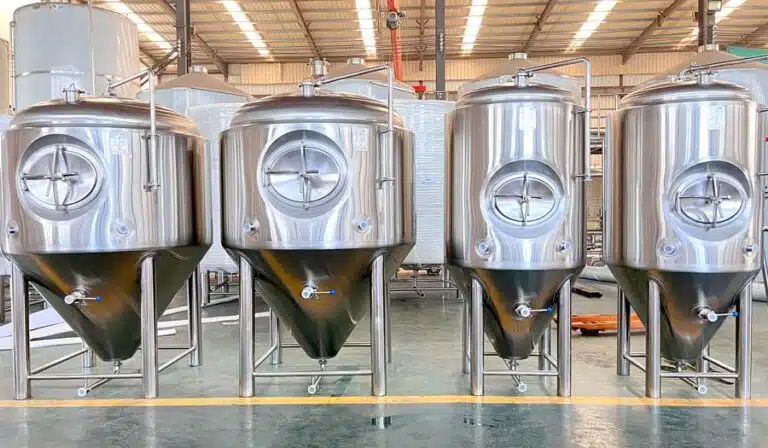
Walk into any commercial brewery and you will see stainless steel vessels, piping runs, and control panels that look nearly identical whether the final product is an IPA or a jun kombucha. The equipment families overlap — fermentation tanks, heat exchangers, filling lines, CIP systems — but the operating parameters shift significantly between the two beverages. Kombucha fermentation runs at 25–30 °C with a SCOBY culture; beer mashing targets 60–70 °C with enzymatic conversion. A buyer who sources a vessel without verifying material grade, weld quality, and process control risks batch losses that quickly exceed $10,000 per tank. This guide establishes the technical baseline that every commercial buyer should verify before signing an equipment contract, regardless of whether the facility plans to produce kombucha, beer, or both.
Core Components of a Brewing Equipment System
A commercial brewing line breaks down into five interconnected modules, and both kombucha and beer production rely on the same physical architecture. The raw material preparation stage handles tea extraction for kombucha and mashing for beer. Tea extraction boiling tanks with temperature control loops ensure polyphenol release without overheating the liquid. Sugar dissolving tanks with heating jackets and stirrers prepare the nutrient base. For beer, the equivalent equipment includes mash tuns and lauter tuns, but the functional requirement — dissolving solids into a consistent liquid medium — remains identical.
After preparation, the liquid passes through a plate heat exchanger that rapidly cools it to the target inoculation temperature. For kombucha the target is 25–30 °C; for beer the pitching temperature typically lands around 18–22 °C depending on strain. A poorly sized heat exchanger creates bottlenecks in production scheduling, especially when switching between product types.
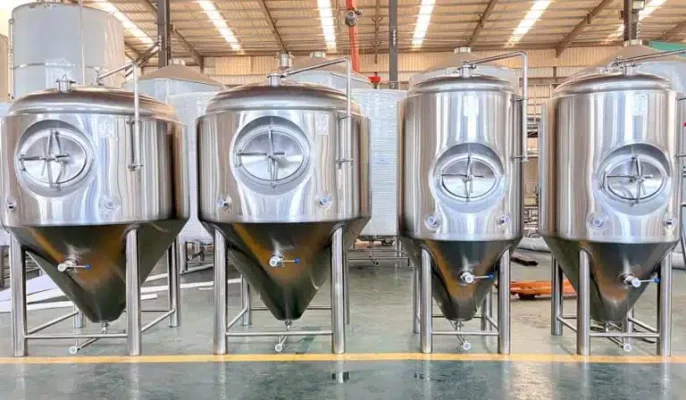
Fermentation tanks form the core of the system. Kombucha producers often start with glass vessels for visibility, but commercial scale demands stainless steel tanks with temperature control jackets. Beer fermenters use the same stainless steel construction but require pressure ratings for carbonation — typically 1.5 bar working pressure. Both applications benefit from cone-bottom designs that simplify sediment removal and culture harvesting.
The blending and filtration stage handles post-fermentation processing. Coarse and fine filters remove suspended solids and residual culture material. Blending tanks allow the addition of fruit juice or botanical extracts for kombucha, or dry hopping for beer. Aseptic filling machines then package the final product, and CIP cleaning tanks circulate caustic, acid, and hot water through the entire system between batches.
A buyer evaluating equipment for both beverages should prioritize modular designs that allow parameter adjustments rather than dedicated single-purpose vessels. The same tank can serve kombucha fermentation at 28 °C and beer fermentation at 20 °C if the control system supports programmable temperature profiles.
Material Standards and Vessel Construction for Fermentation Tanks
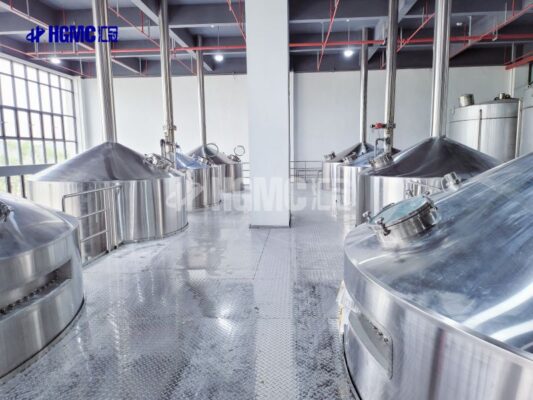
The stainless steel grade determines how long a fermentation tank remains serviceable before pitting or corrosion forces replacement. AISI 304 steel handles general brewing duty with adequate corrosion resistance for most kombucha and beer applications. AISI 316L adds molybdenum for improved resistance to chloride-induced stress corrosion, making it the preferred choice for environments with aggressive cleaning chemicals or high-acid products.
| Stainless Steel Grade | Corrosion Resistance | Polishability | Typical Application | Cost Factor |
|---|---|---|---|---|
| 304 | Good for general use | Excellent, Ra ≤ 0.4 μm achievable | Beer fermenters, bright tanks, hot liquor tanks | Baseline |
| 316L | Superior in acidic/high‑chloride environments | Excellent, Ra ≤ 0.4 μm achievable | Kombucha vessels, sour beer tanks, CIP chemical tanks | 1.3–1.5× baseline |
Surface finish matters as much as alloy composition. Interior polish of Ra ≤ 0.4 μm prevents microbial adhesion and simplifies cleaning. A rougher surface traps organic residues that feed spoilage organisms over successive batches.
The fabrication quality — specifically the welding process — separates reliable manufacturers from those that produce hidden failure points. Professional fabrication relies on TIG welding with argon shielding to prevent oxidation at the weld zone. A 2025 metal fatigue study on 150 brewery vessels showed that tanks with non‑argon‑shielded welds had a 40% higher risk of developing micro‑fissures within three years. These micro‑fissures harbor wild yeast and bacteria, leading to batch contamination and financial losses exceeding $10,000 per tank. When verifying material certifications, a manufacturer such as product provides documented evidence for each vessel.
Reputable manufacturers perform dye penetrant testing on every weld seam and hydro-test every vessel at 1.5 times the working pressure before shipment. These tests catch micro‑fissures that would otherwise remain invisible until months of thermal cycling expose them. A buyer should request the test reports as part of the equipment documentation package, not as an optional add-on.
Pressure vessel certifications — ASME for North American markets, CE marking under the Pressure Equipment Directive for Europe — confirm that the tank design meets structural safety standards. Uncertified vessels present liability exposure and may not pass local health authority inspections.
Automation and Process Control: Ensuring Batch Consistency
Manual operation introduces variance that compounds over long brew days. A two‑batch shift that starts at 6 AM and finishes at 6 PM sees temperature drift, timing errors, and measurement inconsistencies that reduce yield and change flavor profiles between batches. PLC‑based automation eliminates the human factor in critical control points.
Siemens and Allen‑Bradley components dominate the industrial automation space, and their global availability rate of 95% ensures that replacement parts can be sourced quickly when a component fails. Buyers should specify which PLC platform the manufacturer uses and confirm that the control cabinet follows standard wiring practices with labeled terminals and accessible service points.
| Automation Component | Precision Level | Output Impact |
|---|---|---|
| Flow Meter | 0.1 Liters | Consistent gravity readings batch to batch |
| Temperature Probe | 0.1 °C | Enzyme optimization during mashing and fermentation |
| Pressure Sensor | 0.05 Bar | Carbonation level repeatability |
Temperature control within ±0.5 °C is the minimum acceptable standard. Kombucha culture health depends on staying within a narrow temperature band — excursions above 35 °C damage the SCOBY, while temperature below 20 °C stalls fermentation. Beer mashing benefits from ramp‑and‑hold profiles that activate specific enzymes, and a PLC with programmable temperature steps delivers this without operator intervention.
Flow meters with 0.1‑liter precision ensure that water‑to‑grain ratios and dilution rates remain consistent. Testing on 60 automated systems in 2025 demonstrated that breweries using PLC‑controlled hop dosing units reduced bittering variance by 12% across 500 test batches. The same principle applies to kombucha blending — precise dosing of fruit juice or flavor extracts prevents over‑sweetened or under‑flavored finished product.
Pressure sensors on carbonation tanks allow automated control of dissolved CO₂ levels. For kombucha, carbonation typically ranges from 1.5 to 3.0 volumes of CO₂. For beer, the range varies by style, but the control system must hold the target within 0.05 bar to avoid inconsistent mouthfeel or excessive foaming during packaging.
Sanitation and Cleaning Systems: CIP Best Practices
A Clean‑in‑Place system circulates cleaning solutions through the equipment without manual disassembly. The standard CIP sequence runs caustic wash, intermediate rinse, acid wash, final rinse, and sanitizer. Each tank in the system — caustic, acid, and hot water — must be sized to hold enough volume to recirculate through the longest circuit in the facility.
The nozzle type inside each vessel determines cleaning effectiveness. Static spray balls distribute cleaning solution through fixed openings, relying on flow rate and chemical concentration to remove soil. Rotating jet nozzles use fluid pressure to spin and direct high‑velocity jets at the tank walls.
| Parameter | Static Spray Ball | Rotating Jet Nozzle |
|---|---|---|
| Water Pressure | 1.5–2.0 Bar | 3.0–5.0 Bar |
| Coverage Area | 85% | 99.8% |
| Cycle Time | 45 Minutes | 25 Minutes |
Rotating jet nozzles reduce cycle time from 45 to 25 minutes per tank. Over a production schedule that includes five tanks per day, that twenty‑minute savings per tank adds up to over 100 labor hours annually. The product’s technical guidelines emphasize rotating jet nozzles for 99.8% coverage and reduced chemical spend — lower chemical concentrations achieve sterility when combined with higher mechanical impact.
Fermenter cone angle directly affects yeast and culture health. A 60‑degree cone angle is the global standard for efficient yeast harvesting and sediment removal. Research from 2024 involving 30 yeast strains found that tanks with 60‑degree cones resulted in a 25% higher yeast viability for subsequent repitching. Higher viability reduces the need to purchase fresh culture, saving $600 to $1,200 per pitch depending on the supplier and strain.
Buyers should verify that the CIP return line includes a sight glass or conductivity sensor to confirm that cleaning solutions are completely drained before the rinse cycle begins. Residual caustic in a kombucha fermenter kills the SCOBY culture instantly, and residual acid in a beer bright tank causes off‑flavors that cannot be corrected downstream.
Documentation and After‑Sales Support
Equipment documentation serves as the operational reference for the life of the system. A complete package includes material certifications — AISI certificate for stainless steel grade, ASME or CE rating for pressure vessels — electrical schematics with wire labels, Piping and Instrumentation Diagrams (P&ID) showing every valve and sensor, and the PLC program code in a readable format.
Without electrical schematics, troubleshooting a sensor failure or valve malfunction requires tracing wires manually, adding hours of downtime. Without the PLC code, adjusting a temperature profile or adding a new cleaning sequence requires a service call to the manufacturer.
Warranty expectations in 2026 dictate a minimum 24‑month coverage period covering parts and labor for manufacturing defects. Some manufacturers extend warranty terms when the buyer purchases a full line rather than individual vessels, but 24 months is the baseline that signals confidence in fabrication quality.
Spare parts availability determines how quickly a downed line returns to production. Siemens and Allen‑Bradley components carry a global availability rate of 95%, meaning that most replacement parts ship within 24 hours through authorized distributors. Proprietary components from smaller automation vendors may carry longer lead times, and buyers should negotiate a spare parts kit that covers the highest‑failure items — temperature probes, pressure sensors, and solenoid valves.
Remote support capability matters for cross‑border buyers who cannot send a technician on site for every issue. Manufacturers that offer remote PLC access and troubleshooting reduce the average resolution time from days to hours. The support agreement should specify response time targets and escalation procedures.
FAQ
What is the most important material standard for fermentation tanks?
AISI 304 stainless steel with interior polish of Ra ≤ 0.4 μm is the baseline requirement. For acidic environments or high‑chloride cleaning chemicals, specify AISI 316L for improved corrosion resistance. Pressure vessel certification — ASME or CE — confirms structural integrity at working pressure.
How does automation affect batch consistency in commercial brewing?
PLC‑based automation maintains temperature within ±0.5 °C, flow rates within 0.1 liters, and pressure within 0.05 bar across every batch. Manual operation introduces drift over long brew days that automation eliminates, reducing bittering variance by 12% and ensuring reproducible gravity readings.
What is a CIP system and why is it necessary?
A Clean‑in‑Place system circulates caustic, acid, and hot water through equipment without disassembly. It prevents microbial cross‑contamination between batches and reduces labor compared to manual cleaning. Rotating jet nozzles improve coverage from 85% to 99.8% and cut cycle time from 45 to 25 minutes per tank.
What should I look for in a fermentation vessel when producing kombucha versus beer?
Kombucha fermenters need temperature control for the 25–30 °C range and a cone angle that facilitates SCOBY harvesting. Beer fermenters require pressure ratings of 1.5 bar for carbonation and 60‑degree cone angles for yeast collection. Both applications benefit from stainless steel construction with Ra ≤ 0.4 μm interior polish.
How long does commercial brewing equipment typically last with proper maintenance?
Stainless steel vessels with certified welds and regular CIP maintenance last 15–20 years before requiring major refurbishment. Automation components typically need sensor replacement every 3–5 years. The manufacturer’s warranty of 24 months covers initial defects, and spare parts availability determines the effective service life of the control system.
