The quoted price for a brew house rarely matches what a buyer actually hands over. I have seen purchase orders where the line item for a 10-BBL system sat at $180,000, but after factoring in the boiler, the glycol chiller, the water treatment skid, and the installation contractor, the total project cost climbed past $350,000. That gap between advertised equipment pricing and real-world investment is where most first-time brewery owners get caught off guard.
By 2026, the brewing equipment market has matured into a transparent but segmented landscape. Nano systems from 1 to 3 BBL run between $10,000 and $50,000, small craft breweries at 5 to 15 BBL fall between $100,000 and $500,000, and commercial plants at 30 BBL and above often require $500,000 to $1,000,000. These ranges, however, are only meaningful when a buyer understands exactly what each dollar buys—and what hidden costs sit outside the equipment line item.
This article breaks down what the 2026 pricing actually looks like at every stage of the brewhouse, what drives the cost differences between manufacturers, and which technical standards a buyer should verify before signing anything.
The 2026 Brewing Equipment Price Landscape
The global brewing equipment industry reached roughly $20.52 billion in 2024 and is projected to hit $21.69 billion in 2025, according to The Business Research Company, representing a compound annual growth rate of about 5.7%. Craft beer demand in both emerging and developed markets, along with investment in automation and sustainability, continues to push the market upward.
But the headline growth figures mask sharp tiered differences in equipment pricing. A nano brewery at 1 to 3 BBL operates in a completely different financial reality than a 50-BBL commercial plant.
| Scale Type | Typical Capacity (BBL) | Investment Range (USD) | Main Application Scenarios |
|---|---|---|---|
| Nano System | 1-3 | 10,000 – 50,000 | Brewpubs, restaurants, labs, entry-level startups |
| Small Craft Brewery | 5-15 | 100,000 – 500,000 | Independent craft breweries, small-batch specialty brewing |
| Commercial Large Plant | 30+ | 500,000 – 1,000,000 | Large-scale production, often including automation, cooling, and packaging lines |
A Nano 2-BBL system priced at $35,000 might work for a brewpub where the equipment sits in the dining room and the owner doubles as the brewer. That same budget would not cover the glycol system alone for a 30-BBL commercial plant.
What the table does not show is that within each tier, the variation is driven by geography, automation level, and whether the manufacturer includes installation in the quoted price. A small craft system in North America can cost 30% more than the equivalent system shipped from a Chinese fabricator, but the tradeoff often shows up in lead time and documentation quality.
Breaking Down Costs by Equipment Stage
When a manufacturer quotes a brew house price, they are bundling multiple subsystems. Buyers who treat the quote as a single lump sum risk underestimating the budget for later stages. Here is how the major equipment stages break down individually.
The raw material processing stage—sifting, destoning, and milling—costs between $2,000 for a small grinder and $20,000 for a larger automated system. Most entry-level buyers overlook this stage entirely, assuming the grain supplier handles it.
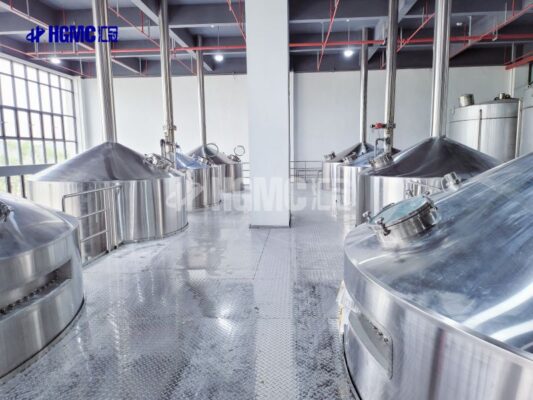
The mashing system, including the mash tun, stirring mechanism, and heating controls, typically costs $50,000 to $200,000 for a complete setup. A single mash tun alone runs $10,000 to $50,000. The wort filtration and boiling stage adds another $25,000 to $180,000, combining membrane filters, boiling kettles, and whirlpool tanks.
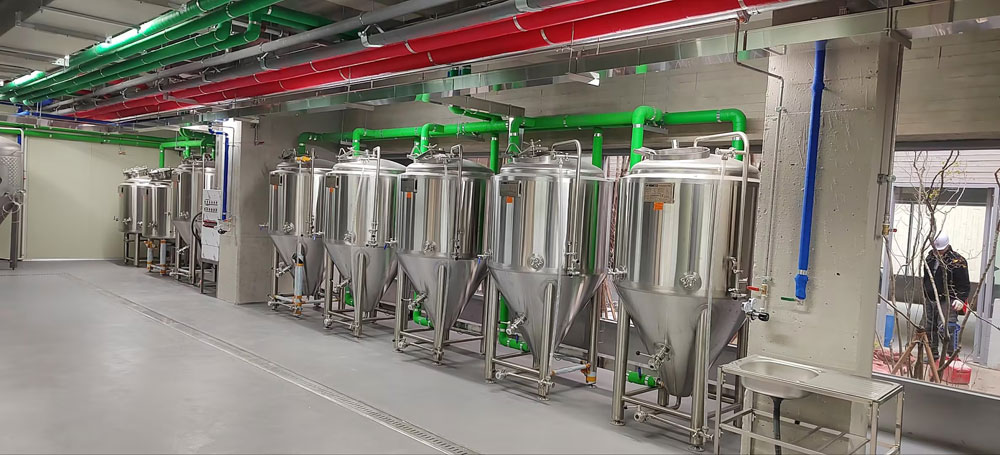
The cooling and fermentation stage often surprises buyers. Plate heat exchangers cost $5,000 to $30,000, while each conical fermentation tank ranges from $5,000 to $50,000 depending on capacity and whether it includes temperature control jacketing. A 15-BBL brewery with six fermenters can expect to spend $60,000 to $150,000 on this stage alone.
Conditioning and clarification equipment—conditioning tanks, diatomaceous earth filters, centrifuges—adds $15,000 to $140,000. Packaging equipment ranges from $10,000 for a semi-automatic line to $500,000 or more for a fully automated line. And the auxiliary systems—boilers, refrigeration units, water treatment, air compressors—collectively cost $50,000 to $200,000.
A buyer who only looks at the brew house price and ignores the auxiliary and packaging budget will run out of capital before the brewery opens.
Key Factors That Influence Equipment Pricing
Once the buyer understands which stages cost what, the next question is why two manufacturers can quote wildly different prices for what looks like the same system.
Automation level is the single biggest differentiator. Manual equipment is the cheapest upfront, but it demands constant operator attention and produces inconsistent results. Semi-automatic systems introduce sensors and some PLC control. Fully automated systems with PLC and SCADA integration monitor every parameter in real time and adjust without human intervention. Automation alone can add 30% to 50% to the base vessel cost.
This is where a buyer should stop assuming that a high automation quote is just markup. To verify automation specs, a buyer should review the product documentation that lists component models and control logic. A system that uses Siemens or Allen-Bradley PLCs with documented sensor calibration schedules costs more upfront, but it reduces water and energy consumption measurably over the first year of operation.
Material standards drive the next layer of cost variation. Vessels fabricated from AISI 304 stainless steel are standard and acceptable for most breweries. AISI 316L, with its added molybdenum content, resists chloride corrosion better and is essential for breweries using high-chloride water or aggressive CIP chemicals. The price difference between 304 and 316L varies by market conditions but generally adds 15% to 25% to the vessel cost.
Transportation and installation costs are the silent budget killer. A 30-BBL fermentation tank might cost $40,000 FOB from the factory, but freight, customs clearance, crane rental, and rigging can add another $15,000 to $25,000 depending on the destination. Installation, which includes piping, electrical connection, and commissioning, can consume 10% to 20% of the total equipment budget.
Technical Standards to Verify Before Purchase
A price quote means nothing if the equipment fails within two years. The problem is that most buyers do not know which technical standards to demand from a manufacturer.
Material certification is the starting point. A buyer should request the AISI 304 or 316L mill certificate showing the actual chemical composition. The interior surface finish should meet Ra 0.4 μm—anything rougher creates crevices where bacteria hide and cleaning cycles fail.
Welding integrity matters more than most buyers realize. Professional fabrication uses TIG welding with argon shielding to prevent oxidation on the weld seam. A 2025 metal fatigue study on 150 brewery vessels found that tanks with non-argon-shielded welds had a 40% higher risk of developing micro-fissures within three years. These micro-fissures harbor wild yeast and bacteria, which can ruin a batch and cause financial losses exceeding $10,000 per tank in a single week.
Reliable manufacturers mitigate this by performing dye-penetrant testing and hydro-testing every vessel at 1.5 times the working pressure before shipment. A buyer should request the test reports as part of the documentation package. For pressure vessel compliance, ASME and CE certifications are the recognized standards; a vessel without either is a liability.
The automation components themselves should be traceable. A system with unnamed PLC modules or off-brand sensors introduces risk when a component fails and no replacement is available locally. Siemens and Allen-Bradley components have approximately 95% global availability for replacement parts. The documentation package should include PID schematics and electrical diagrams—without these, a future maintenance issue becomes a speculative guessing game that delays production.
The Real Cost of Ownership: Installation, Maintenance, and Efficiency
The purchase price is just the entry fee. The real cost of owning brewing equipment shows up in shipping, customs clearance, installation labor, commissioning delays, and ongoing operational expenses.
A high-efficiency steam jacket reduces gas consumption by 18% compared to electric immersion elements in 20-BBL systems, according to 2024 industrial data. That difference pays back the higher upfront cost within two to three years for a brewery running regular production cycles. Heat recovery systems that pre-heat strike water using heat from the cooling wort further reduce energy bills, but they require automated valve control and properly sized heat exchangers that most budget systems lack.
Water and chemical savings come from modern CIP systems. Effective CIP with rotating nozzles reduces chemical concentrations by 20% and shortens cleaning cycles by 20 minutes per tank. Over the course of a year, that saves more than 100 labor hours and reduces water discharge fees. A static spray ball cannot match the coverage area or cycle time of a rotating jet nozzle.
Yeast management improves with fermenter geometry. Tanks built with a 60-degree cone angle, the global standard for efficient yeast harvesting, resulted in 25% higher yeast viability for repitching according to a 2024 study involving 30 yeast strains. Higher viability means fewer purchases of fresh yeast cultures at $600 to $1,200 per pitch.
What often goes overlooked is the documentation package. A buyer who does not request PID schematics, electrical diagrams, component part lists, and maintenance schedules upfront will discover during the first breakdown that repairs become speculative and expensive. The cost of a service technician diagnosing a non-documented electrical system can exceed the value of a 5% discount on the original equipment.
FAQ
What is the typical price range for a nano brewing system in 2025?
A nano system at 1 to 3 BBL runs between $10,000 and $50,000. The lower end covers basic vessels with manual controls, while the higher end includes temperature-controlled fermentation and basic automation suitable for a brewpub or lab setting.
How much does automation add to brewing equipment costs?
Automation adds 30% to 50% to the base vessel cost. A manual 10-BBL brew house might cost $80,000, while the same system with full PLC/SCADA integration, flow meters, and automated valve control climbs to $110,000 to $130,000.
What material certifications should a buyer request from a manufacturer?
Request the AISI 304 or 316L mill certificate and confirm the interior polish meets Ra 0.4 μm. For pressure vessels, require ASME or CE certification and hydro-test reports at 1.5 times the working pressure.
Are there hidden costs beyond the equipment price itself?
Yes. Shipping, customs, installation, and commissioning often add 15% to 30% to the equipment cost. Auxiliary systems—boilers, glycol chillers, water treatment—can equal the cost of the brew house itself.
How can I verify that a manufacturer’s vessels meet pressure safety standards?
Request the dye-penetrant test report and hydro-test certificate for each vessel. Confirm the weld procedure uses TIG welding with argon shielding. If the manufacturer cannot provide these documents, the vessel is not verified.
