
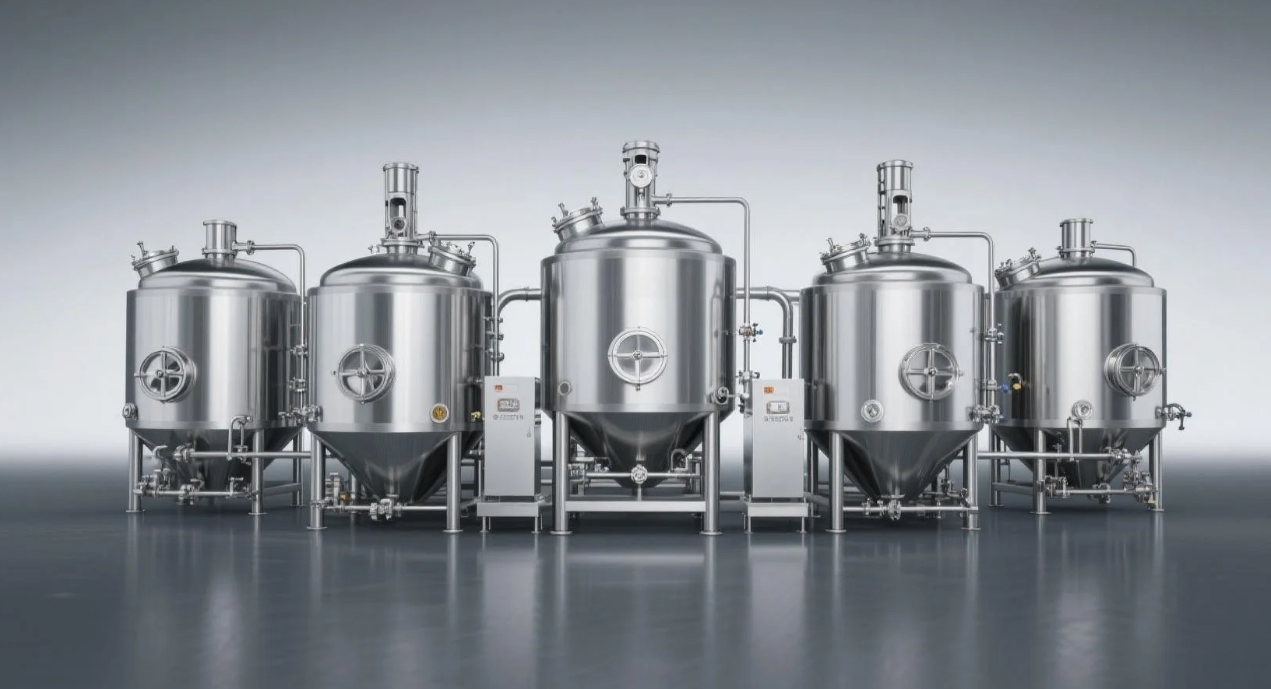
Buyers researching brewery equipment costs usually expect a single number. After a few weeks of quoting, most realize that number does not exist. The final investment is shaped by production goals, vessel configuration, fermentation volume, automation, heating method, packaging requirements, factory utilities, and installation scope.
A compact brewpub setup and a regional production facility share almost no line items beyond the basics. A realistic budget has to cover the complete production process, not just the hot-side brewhouse. Starting with a clear process plan — how many batches per week, how long each style sits in a tank, whether packaged sales are planned — preserves a viable path for expansion without forcing a rebuild later.
How Much Does Commercial Beer Brewing Equipment Cost?
Commercial beer brewing equipment generally ranges from tens of thousands of dollars for a smaller project to several hundred thousand dollars or more for a fully equipped production brewery. The spread is wide because the scope changes completely between scales.
A compact 100–500 L system suits brewpubs, restaurant breweries, and taproom-focused projects. The typical configuration includes a brewhouse, fermentation tanks, a glycol chiller, a heat exchanger, process pumps, and essential piping. This is the entry point for most new operators, and the price stays at the lower end of the range — provided the buyer does not add automation or packaging.
A 500–2,000 L brewery is the next step up, often selected by businesses serving local bars, restaurants, taprooms, and regional distributors. This scale requires more fermentation capacity, larger utilities, a more complete CIP system, and tighter control over the brewing process. At this stage, buyers need to think about brew frequency per week and how long each beer style occupies a tank, because those two numbers determine how many tanks are actually needed.
Above 2,000 L per batch, planning becomes more complex. Larger production systems typically require automated process control, centralized cleaning, higher-capacity refrigeration, more sophisticated material handling, filtration, and packaging equipment. The budget climbs significantly if the brewery intends to package beer at high speed in cans or bottles.
| Project scale | Typical setup | Appropriate for | Price direction |
|---|---|---|---|
| 100–500 L | Compact brewhouse, fermentation tanks, glycol chiller, pumps | Brewpub, taproom, restaurant brewery | Lower end of range |
| 500–2,000 L | Larger fermentation capacity, complete CIP, more utilities | Local bars, restaurants, regional distribution | Mid range |
| Above 2,000 L | Automated controls, centralized cleaning, packaging line | Large commercial production | Top of range |
The pattern is consistent: costs climb with added tank capacity, automation, and packaging equipment. A 1,000 L brewhouse with four open fermenters costs far less than the same brewhouse with eight jacketed tanks, a canning line, and a full control system.
What Equipment Is Actually Included in the Price?
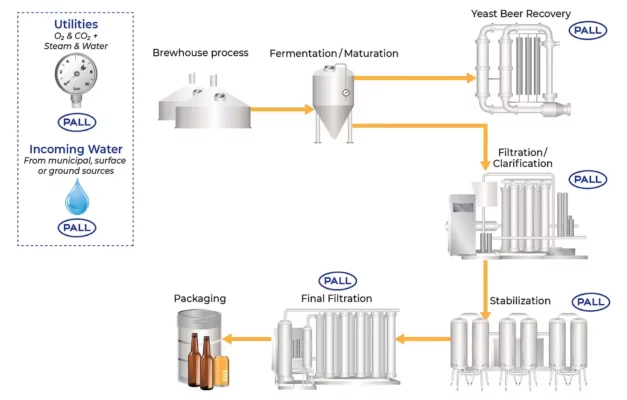
The most common budgeting mistake is assuming a brewhouse quotation includes everything needed for daily production. It usually does not. A complete brewery quotation should itemize every piece of equipment, and buyers should never assume supporting systems are bundled in.
A commercial brewery commonly needs:
- Malt milling and grain handling equipment
- Brewhouse system
- Hot liquor and cold liquor tanks
- Wort pumps and plate heat exchanger
- Process piping, valves, and work platforms
- Fermentation tanks and brite tanks
- Glycol chiller and cooling piping
- CIP cleaning equipment
- Electrical and control system
- Keg washing and filling equipment
- Canning or bottling equipment, if packaged sales are planned
That is roughly a dozen categories, and each one carries its own cost. A buyer who compares two quotes by headline price alone will almost certainly compare different scopes.
The exclusions are where real costs inflate. A lower initial quote often omits local installation support, freight, process piping, insulation, electrical connection, training, spare parts, and commissioning. These eight items are not optional extras — they are essential for getting the brewery running and keeping it running. Process piping alone can add a meaningful percentage to the total, and insulation on tanks and lines is frequently overlooked until the glycol bill arrives.
The practical move is to ask the supplier directly what is and is not in the quote before comparing prices. A quote that includes piping, insulation, and commissioning may look more expensive on paper but can end up cheaper than a bare-bones figure that requires thousands in additional work before the first batch.
Why Brewhouse Configuration Drives Cost
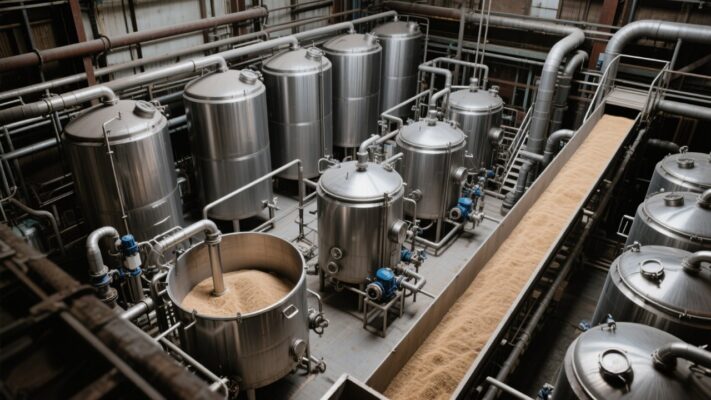
Vessel count is one of the biggest influences on equipment price. The brewhouse is the most visible part of any brewery, and it is also the easiest place to overspend.
A two-vessel system is compact and cost-effective. It suits breweries with limited floor space, lower brewing frequency, or a smaller startup budget. It still produces high-quality beer when designed properly and operated with a clear brewing schedule. The tradeoff is workflow: with only two vessels, some process steps share equipment, which slows down multi-batch days.
A three-vessel brewhouse separates more process functions, improving workflow and allowing brewers to complete multiple tasks more efficiently. It is a reasonable choice for breweries that need more production flexibility or plan to brew multiple batches per day. The added vessel costs more, but it buys a meaningful reduction in turnaround time between batches.
A four-vessel brewhouse serves higher throughput, complex brewing schedules, or a wider beer portfolio. It offers the most flexibility, but it also demands more floor space, utilities, controls, and capital investment. For a brewery running two or three styles across multiple tanks, the extra vessel can pay for itself. For a small operation brewing once or twice a week, it is mostly idle capacity.
Configuration should be a deliberate operational decision, not a status choice. Sales forecasts, expected brew frequency, available floor space, and intended automation level should drive the decision. A two-vessel system that runs consistently beats a four-vessel system that sits half-empty.
Why Fermentation Capacity Is the Real Bottleneck
A brewhouse produces wort, but fermentation tanks determine how much beer a brewery can keep in process. This is the counterintuitive part of brewery planning: the visible hot-side equipment is easy to spend on, while fermentation volume quietly limits actual output.
Consider the math. A brewery that brews twice per week with a 1,000 L brewhouse produces roughly 2,000 L of wort per week. If a beer style occupies a fermentation tank for two weeks, the brewery needs enough tank volume to hold two weeks of production — around 4,000 L of fermentation capacity, plus brite tanks for conditioning and serving. Buyers who spend most of their budget on the brewhouse and underbuild fermentation capacity end up with a system that can brew faster than it can ferment, which caps production no matter how capable the hot side is.
Brew frequency per week and tank occupancy time per beer style directly determine required fermentation capacity. A brewery running a quick-turn ale that clears a tank in ten days needs less volume than one running a lager that sits for three weeks. The planning should start with those two numbers, then work backward to tank count and volume.
Brite tanks and glycol cooling scale with fermentation volume, so underestimating fermentation capacity also means underestimating cooling load and serving capacity. The brewhouse might be the centerpiece of the budget, but fermentation is what actually determines how much beer reaches the taproom or the distributor.
FAQ
How much does commercial beer brewing equipment cost?
Commercial systems generally range from tens of thousands of dollars for a compact 100–500 L setup to several hundred thousand dollars or more for a fully equipped production brewery above 2,000 L per batch. The final figure depends on vessel configuration, fermentation capacity, automation, and whether packaging equipment is included.
What is the difference between a two-vessel and a four-vessel brewhouse?
A two-vessel system combines some process steps into shared equipment, which keeps cost and floor space down but slows multi-batch workflows. A four-vessel brewhouse separates more functions, allowing higher throughput and more complex brewing schedules, but it requires more space, utilities, controls, and capital.
Does the quoted price include installation, piping, and training?
Often not. Installation support, freight, process piping, insulation, electrical connection, training, spare parts, and commissioning are frequently excluded from initial quotes. Buyers should ask the supplier to itemize the scope before comparing prices across vendors.
How do I know which brewery size I need?
Start with expected sales volume and brew frequency per week, then calculate fermentation capacity based on how long each beer style occupies a tank. A 100–500 L system suits brewpubs and taprooms, while 500–2,000 L serves local distribution, and above 2,000 L targets larger commercial production.
Why is fermentation capacity more important than brewhouse size?
The brewhouse produces wort, but fermentation tanks determine how much beer can stay in process at any given time. Underbuilding fermentation capacity caps total output regardless of how fast the brewhouse can brew, so tank volume should be planned before finalizing the hot-side budget.
