
A small-to-mid-size brewery can execute a flawless brew day and nail fermentation temperature, yet find its beer developing cardboard-like flavours and dulling hop aromas within six weeks. The fermentation team swears the numbers were right. The lab reports show healthy yeast. But distribution partners are sending back kegs labelled “stale.” In almost every case, the root cause traces back to a single, under-engineered step: the transfer from fermenter to bright tank.
The Hidden Danger of Dissolved Oxygen
Your beer doesn’t need much oxygen to oxidise. Even 50 ppb of dissolved oxygen (DO) after fermentation is enough to trigger reactions that produce stale, papery flavours and strip away volatile hop compounds. The industry standard for craft breweries is 30 ppb during transfer, and many operations struggle to stay under that threshold.
The problem is that post-fermentation oxygen is invisible. You won’t taste the damage immediately. It takes two to four weeks for the oxidation products—trans-2-nonenal, mostly—to accumulate past the flavour threshold. By then, the beer is already in distribution. A 2023 survey of regional US breweries found that 37% identified oxidation as the primary cause of quality complaints from retailers. Yet fewer than 15% were monitoring DO at the transfer stage.
The common failure points are well documented: un-purged tri-clamp connections that trap atmospheric air, manual butterfly valves that churn beer past gas pockets, and dead-legs in fittings where oxygen-rich liquid stagnates. A single connection left un-purged can introduce 200 to 500 ppb of DO, instantly exceeding the acceptable limit. The frustrating part is that the beer looks fine leaving the fermenter. The damage is already happening inside the bright tank.
The Gold Standard – Closed, Pressurised Transfer
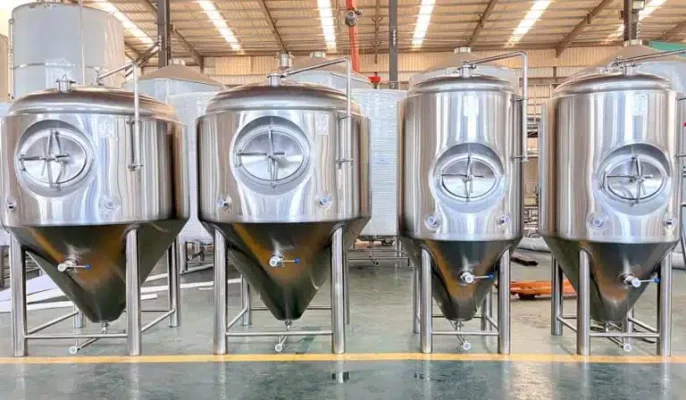
A closed, pressurised transfer uses CO₂ or nitrogen to push beer from the fermenter to the bright tank without exposing the liquid to air. This is not a novel concept—large commercial breweries have done it for decades. But the execution details matter more than the principle.
Start with the fittings. Sanitary diaphragm valves with zero dead-legs eliminate the pockets where oxygen hides. Every connection between the fermenter outlet and the bright tank inlet should be purged before beer flows. Manual purging, where an operator cracks each valve to let CO₂ escape, is unreliable. A tired brewer forgetting one purge sequence on a Friday night shift is a recurring scenario.
Automated purging sequences remove this variability. The system flushes the transfer line with CO₂ until an inline DO sensor reads 5 ppb, then opens the valves. No manual steps, no forgotten connections. The capital cost is real—a complete transfer skid with sensors and automated valves runs $8,000 to $15,000 depending on capacity—but the payback comes from reduced waste and extended shelf life. A brewery producing 10,000 barrels per year losing 3% to oxidation waste saves roughly 300 barrels annually, which at $100 per barrel wholesale covers the equipment cost within two production cycles.
Inline DO sensors with alarm setpoints are not optional. They give you a real-time readout during the transfer. If the number spikes above 30 ppb, the system can halt the flow automatically, forcing you to investigate the leak before proceeding. Without a sensor, you are flying blind.
Carbonation Trade-offs – Fermenter vs. Dedicated Bright Tank
Carbonating directly in the fermenter is common among breweries trying to save on capital equipment. You crash the beer, raise the pressure, and let the yeast absorb and metabolise some of the CO₂. The advantage is that you skip the bright tank transfer entirely, removing one oxygen exposure point. But the trade-offs are significant.
Holding pressure inside a fermenter stresses the yeast. Higher hydrostatic pressure can cause yeast cells to flocculate prematurely, reducing ester production and leaving behind a thinner mouthfeel. The pressure also extends the conditioning time because yeast under stress autolyses faster, releasing fatty acids that contribute to oxidation downstream. A standard ale fermented in five days may require ten to twelve days under pressure to carbonate properly, tying up tank space that could be used for the next batch.
Carbonation consistency is another issue. Fermenters were not designed for precise carbonation control. The pressure fluctuates as the beer level drops and the headspace expands, leading to inconsistent CO₂ volumes from batch to batch. Your first run might hit 2.5 volumes perfectly, then the next lands at 2.1 with no obvious explanation.
A dedicated bright tank with a stone carbonation system solves these problems. The tank is jacketed and insulated, maintaining ±0.5°C stability throughout the carbonation cycle. The carbonation stone uses sintered stainless steel with 2 µm pores, producing micro-bubbles that dissolve much faster than the bubbles from standard stones. The absorption efficiency reaches 80%, compared to roughly 60% with coarser stones. This means you reach your target carbonation volume—2.5 for ales, 2.7 for lagers—in less time and with less CO₂ waste.
The bright tank also decouples carbonation from fermentation. You can crash the fermenter, transfer the beer, crash the bright tank separately, and carbonate at your exact temperature and pressure. The fermenter is free for the next batch within 24 hours instead of sitting pressurised for a week.
Consistency and Verification – Temperature Control and Leak Testing
Carbonation consistency depends on three variables: temperature, pressure, and time. A ±1°C swing can shift the equilibrium CO₂ volume by 0.15 volumes, which is enough to push a lager from 2.7 volumes to 2.55. The difference is perceptible on the palate. Jacketed, insulated bright tanks hold temperature within ±0.5°C, eliminating this variable.
The carbonation stone needs a dedicated flow meter and pressure regulator. A shared CO₂ line supplying multiple tanks creates pressure drops when another tank demands gas. A dedicated regulator set to 15 PSI with a flow meter calibrated to 0.5 L/min ensures each tank receives the same conditions every time. A carbonation curve chart—mapping time vs. pressure at your specific temperature—removes the guesswork. If your beer is at 1°C and you want 2.5 volumes, the chart tells you to carb at 12 PSI for 36 hours.
Verifying the system’s oxygen tightness is a separate process that often gets skipped. The vacuum decay test is simple: after filling the bright tank, pull a slight vacuum of about −15 inHg and monitor pressure loss over 15 minutes. If the pressure rises by more than 0.5 inHg within that window, you have a leak. The leak could be a worn gasket, a cracked sight glass, or a valve seat that no longer seals. Every tank that passes this test with zero loss should have the result documented and attached to the batch record.
This is the step that separates breweries with consistently fresh beer from those chasing off-flavours batch after batch. A beer that stays fresh for 90 days instead of 60 opens new distribution channels—broader geographic reach, longer retail shelf presence—and reduces return rates. Transfer engineering is the last line of defence between your brewhouse and your customer’s glass.
FAQ
Can I carbonate in the fermenter instead of using a bright tank?
Yes, but it ties up your fermenter for extra days and increases yeast stress from pressure, which can produce thinner mouthfeel and inconsistent carbonation. A dedicated bright tank with a stone carbonation system gives you precise control over volumes and leaves the fermenter free for the next batch within 24 hours.
What is the best way to transfer beer with minimal oxygen pick-up?
A closed, pressurised transfer using CO₂ or nitrogen with automated purging is the most reliable method. The system flushes the transfer line until an inline DO sensor reads 5 ppb before allowing beer to flow, eliminating the human error factor in manual purging.
How do I test if my transfer system is oxygen-tight?
Use a vacuum decay test. Pull a slight vacuum of −15 inHg on the bright tank and monitor pressure loss over 15 minutes. A rise of more than 0.5 inHg indicates a leak that needs to be identified and repaired before the next transfer.
What causes inconsistent carbonation, such as high foam or flatness?
The most common causes are temperature fluctuation, inadequate pressure regulation, or poor stone quality. Jacketed tanks holding ±0.5°C stability, a dedicated flow meter and pressure regulator, and sintered stainless steel stones with 2 µm pores solve the majority of inconsistency issues.
How much dissolved oxygen is acceptable during beer transfer?
The industry standard is 30 ppb maximum during transfer. Readings above 50 ppb will produce detectable oxidation flavours within weeks. Automated systems using inline DO sensors with alarm setpoints help maintain this threshold consistently.
