
Most new brewery founders search “how much does it cost to set up a brewery” and land on articles that bundle rent, licensing, construction, and labor into a single number. That number rarely matches reality because equipment alone varies more than most guides admit. From our perspective as a brewery equipment manufacturer, we see the same mistake repeatedly: buyers budget based on averaged estimates that don’t account for the specific configuration they actually need. This breakdown isolates equipment-only costs across four common brewery sizes, with current 2026 pricing and the hidden factors that actually swing the total.
If you are planning a commercial brewery, your equipment budget depends primarily on batch size, automation level, and material specifications. A nano system for a taproom costs a fraction of an industrial line, but the gap between manual and fully automatic equipment is roughly 2x for the same capacity, and the long-term labor savings change the math entirely. Below is what each price tier actually buys.
What Factors Affect Brewery Equipment Pricing?
Brewery equipment prices vary so wildly because five core variables compound against each other. Understanding them before you start shopping saves you from comparing quote A to quote B on unequal terms.
Brewing capacity in BBL is the single largest price driver. A 3 BBL system uses smaller vessels, thinner steel, and simpler piping than a 30 BBL system. Double the batch size and you roughly double the material cost, but the relationship is not linear — larger tanks require thicker walls to withstand hydrostatic pressure, and the jump from 15 BBL to 30 BBL often requires upgrading your entire utility infrastructure.
Automation level creates the biggest price gap within the same capacity. Manual systems require an experienced brewer to open valves, monitor temperatures, and transfer wort by hand. Semi-automatic systems add digital temperature control and automated valve sequences. Fully automatic systems handle the entire brew cycle from a control panel. Automation can add 30–50% to upfront cost but reduces long-term labor expenses by roughly one full-time position per shift.
Material quality is where many buyers overpay relative to their actual needs. SUS304 stainless steel meets food-grade standards for the vast majority of brewery applications. SUS316 adds molybdenum for corrosion resistance against chloride environments and acidic cleaning agents. For a nano or microbrewery operating indoors with standard CIP cycles, SUS304 performs identically to SUS316 for the first decade of use. The upgrade matters for coastal facilities or breweries running high-chloride cleaning protocols, not for a standard taproom.
Configuration completeness determines whether the quoted price covers just the brewhouse or a full production line including fermenters, bright tanks, glycol cooling, CIP systems, and control panels. Many first-time buyers compare a bare brewhouse quote against a turnkey package and assume the gap reflects a better deal.
Customization extras such as copper cladding, dual-purpose fermentation vessels, automated yeast handling, or remote monitoring systems add 10–25% to the base price depending on complexity.

Nano Brewery Equipment Costs (3–7 BBL)
Nano breweries serve a specific purpose: taproom-only sales, brewpub operations, and hyperlocal distribution within a few miles of the brewery. The equipment is compact enough to fit in a 400-square-foot space and requires only single-phase power in most configurations.
Total equipment cost: $10,000–$50,000
A standard nano package includes a 2-vessel manual or semi-automatic brewhouse, two to four fermentation tanks, a basic glycol cooling system, and CIP cleaning tools. The 2-vessel layout combines the mash tun and lauter tun into one vessel, which saves floor space but limits your ability to do step mashes or fly sparge efficiently.
The low entry cost comes with a clear tradeoff. A 3 BBL manual system requires roughly eight to ten hours of hands-on labor per batch. At that scale, you cannot cover wholesale accounts beyond a few local bars without running multiple batches per day, which quickly becomes exhausting. Many nano breweries that grow to regional distribution end up selling their original equipment within two years and upgrading, which effectively doubles their initial capital outlay.
Semi-automatic is the smarter choice at this scale if you can stretch the budget. The added $8,000–$12,000 for digital temperature control and automated pump sequences cuts labor per batch by three to four hours and improves repeatability. For a taproom brewing two batches per week, that payback period is roughly six months.
Microbrewery Equipment Costs (10–15 BBL)
The 10–15 BBL range is the most popular size for local and regional distribution. This is the sweet spot where batch size becomes large enough to supply a consistent wholesale route without requiring industrial-scale infrastructure.
Total equipment cost: $50,000–$120,000
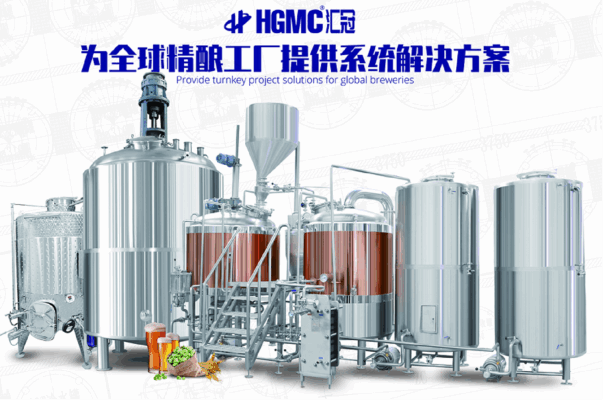
A microbrewery package typically includes a semi-automatic 2- or 3-vessel brewhouse, five to eight fermentation tanks, a dedicated bright beer tank, an integrated glycol cooling unit, digital temperature controls, and a standard CIP line. The 3-vessel configuration separates the mash tun and lauter tun, which improves mash efficiency and gives you the flexibility to brew a wider range of styles.
The jump from nano pricing — roughly 3x to 4x — buys more than just larger vessels. At this scale, the brewhouse includes a wort chiller rated for the full batch volume, a control panel with programmable brew profiles, and pumps sized for the increased flow rate. Fermenters come with cooling jackets and digital temperature control as standard rather than optional.
Consistency improves noticeably at this tier. A semi-automatic 10 BBL system can produce the same recipe within a narrow gravity and bitterness range batch after batch, which matters when you are supplying accounts that expect uniform product. The reduced manual labor also means one brewer can handle a double batch day without assistance.
One hidden cost at this scale: freight and rigging. A 15 BBL fermenter weighs approximately 1,200 pounds empty and requires a forklift with sufficient capacity and a loading dock. If your brewery space lacks truck access, you will need a crane service, which can add $2,000–$5,000 to the installation cost.
Medium Commercial Brewery Equipment Costs (20–50 BBL)
Medium breweries serve regional wholesale markets with predictable rotation schedules. This is the scale where automation shifts from a convenience to an operational necessity.
Total equipment cost: $120,000–$300,000
Equipment at this tier includes a fully automatic brewhouse, large-capacity fermentation and bright tank fleets, industrial-grade glycol cooling systems, automated CIP lines, pressure and temperature monitoring systems, and auxiliary equipment such as malt mills and wort pumps. The brewhouse is typically 3- or 4-vessel with automated grain handling, lauter control, and kettle management.
Full automation reduces human error significantly. A temperature deviation during mashing that a manual brewer might catch after ten minutes is corrected within seconds by an automated system with RTD sensors and PID control loops. Over a 40-barrel batch, that precision translates to measurable consistency gains and reduced yield loss.
The jump from semi-auto to full auto at this scale is roughly 2x the equipment cost. Based on the brewing schedules we see from clients in this range, the labor savings pay back that premium within two to three years. A medium brewery running five batches per week typically operates with three brewers per shift on semi-automatic equipment and two brewers per shift on fully automatic equipment.
Installation and commissioning costs are not included in the base equipment price and typically add 15–25% for a system in this range. This covers rigging, plumbing connections, electrical work, glycol loop installation, control system integration, and on-site training. We have seen a $200,000 equipment quote turn into a $250,000 total project cost because the buyer allocated nothing for installation.
Industrial Large-Scale Brewery Equipment Costs (50+ BBL)
Industrial breweries target mass production with national or international distribution. The equipment is fully custom, modular, and engineered for high-intensity, long-term operation.
Total equipment cost: $300,000–$1,000,000+
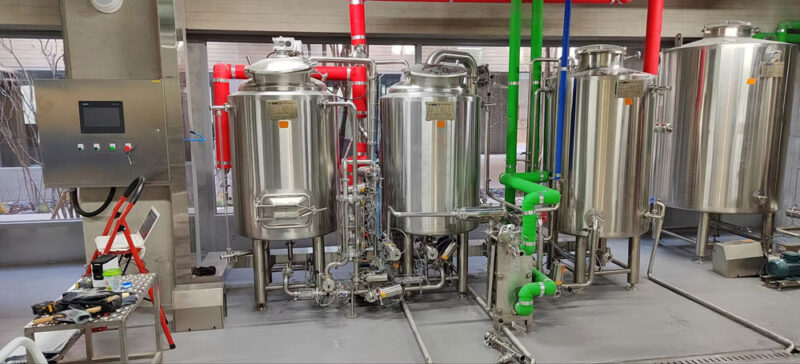
This tier includes full automatic multi-vessel brewhouses, tens of high-capacity fermenters, industrial filtration and sterilization systems, automatic filling and packaging lines, and intelligent central control systems. All vessels use high-grade stainless steel — typically SUS304 with the option to upgrade to SUS316 for specific process streams — and are designed for continuous operation across multiple shifts.
Pricing at this scale depends heavily on layout, capacity, and automation specifications. A 50 BBL brewhouse with six 50 BBL fermenters costs differently from a 100 BBL system with twenty 100 BBL fermenters and a canning line rated at 300 cans per minute. The difference in floor area, utility requirements, and control system complexity makes every quote unique.
The massive upfront cost brings one major advantage: unit cost per barrel drops steeply. A nano brewery may spend $3–5 per barrel in equipment depreciation, while an industrial operation can push that below $0.50 per barrel over the equipment’s fifteen- to twenty-year lifespan. The catch is that you must sell enough volume to justify the minimum batch size. A 100 BBL brewhouse running at less than 40% capacity burns overhead faster than it generates margin.
Industrial buyers should budget for a dedicated project manager during the commissioning phase. A system of this scale takes three to six months to install and another one to two months to commission fully. The cost of idle time during commissioning can exceed the equipment cost itself if distribution contracts are already active.

FAQ
What is the most affordable brewery size to start?
A 3 BBL nano system in the $10,000–$15,000 range for a manual 2-vessel package is the lowest equipment entry point. This works for a taproom model where all revenue comes from on-site sales. The tradeoff is that you will be brewing two to three times per week to keep taps full, and the physical labor is demanding.
Does the price include shipping and installation?
Almost never. Most brewery equipment quotes are ex-works or FOB, meaning you pay freight, insurance, customs clearance, and inland transportation separately. Installation, including rigging, plumbing, electrical work, and glycol loop setup, typically adds 15–30% to the equipment total. Always ask for a delivered-and-installed quote before finalizing your budget.
How long does it take to break even on brewery equipment investment?
For a nano brewery with low overhead, equipment payback can come in 12–18 months if taproom margins are healthy. For a microbrewery with wholesale distribution, the equipment payback period is typically 3–5 years. At the industrial scale, payback stretches to 5–8 years because the investment is larger and distribution takes time to build.
What hidden costs should I budget for besides the brewhouse?
Freight and rigging, facility modifications for drainage and ventilation, glycol loop installation, electrical panel upgrades, permitting and licensing fees, initial consumables (cleaning chemicals, yeast, hops contracts), and spare parts inventory. In our experience, these add up to 20–30% of the equipment cost for a first-time installation.
Is it better to buy a used system or new?
Used equipment can save 40–60% upfront, but you inherit the previous owner’s wear patterns. Fermenter cooling jackets fail silently, control panel wiring degrades, and tanks may have developed stress cracks from improper cleaning cycles. We recommend a third-party inspection before purchase. For nano and micro scales, new equipment with a warranty often costs less over five years when you factor in downtime and replacement parts.
