
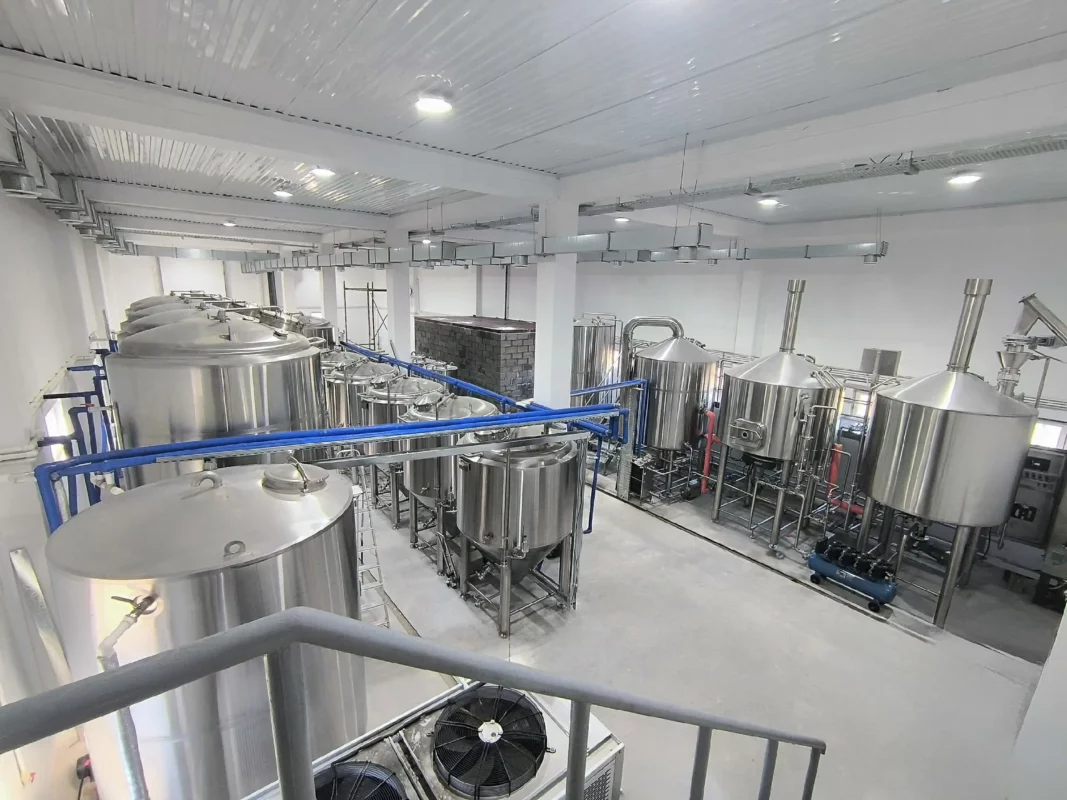
Selecting large scale brewery equipment is one of the biggest decisions a growing brewery (or a new industrial brewery project) will make. The right brewhouse and tank cellar can raise throughput, stabilize quality, reduce energy and water costs, and make your operation safer and easier to expand. The wrong choices can lock you into capacity bottlenecks, inconsistent beer, difficult cleaning, and expensive retrofits.
This guide explains how to evaluate your real production needs, set an equipment budget that matches your business model, compare brewing technologies, and build a specification that suppliers can quote accurately. It also includes an FAQ section and a references list with authoritative sources.
“Large scale” usually means the brewery is operating beyond a small taproom model and needs repeatable, high-efficiency production—often with packaging (cans/bottles/kegs), distribution, and more formal compliance requirements.
At this stage, your equipment decisions must account for:
Throughput (hl/day or bbl/day): not just annual capacity, but daily and weekly rhythm.
Beer portfolio: lagers, high-gravity beers, heavily dry-hopped styles, seasonal rotations, etc.
Hygiene and cleanability: clean-in-place (CIP) design, dead-leg control, and surface finishing.
Utilities and site constraints: steam vs electric heat, glycol load, water supply, wastewater treatment, and ceiling height.
Safety and codes: pressure-rated vessels, steam system safety, and food-contact material requirements.
From a market perspective, it’s also useful to recognize that beer is a high-volume, global industry. For example, the BarthHaas Report 2022/2023 press release reported global beer output of ~1.89 billion hectoliters in 2022 (an increase of 1.3%). This scale is exactly why industrial breweries focus heavily on standardized process control, reliability, and efficiency.
Source: BarthHaas Report press release (2023) (PDF) https://www.barthhaas.com/fileadmin/user_upload/PR_world-beer-market_2023.pdf
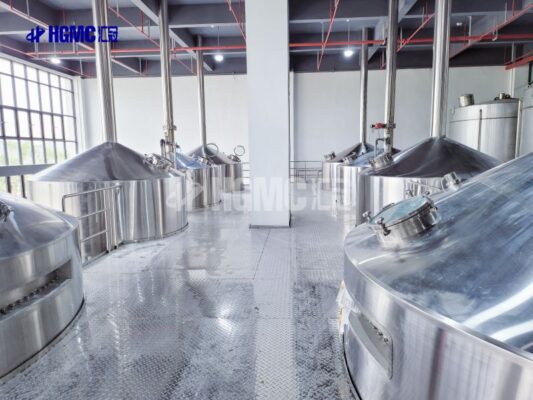
2) Key Factors Influencing Brewery Equipment Selection and Budgeting
A smart equipment plan begins with a clear “design basis” document. In large scale projects, budgets fail most often when the design basis is vague.
The main factors that drive cost (and should drive your spec)
Target output & growth timeline
Designing for today’s volume can be a trap. If you’re likely to double within 24–36 months, equipment layout and utilities should allow expansion without shutting down production.
Packaging strategy
Draft-only breweries can be simpler. Once packaging enters the picture, you may need:
filtration or centrifugation,
pasteurization (or robust cold chain),
dissolved oxygen (DO) management,
higher-capacity glycol and compressed air.
Automation level
PLC/SCADA automation, recipe management, inline sensors, and batch reporting increase capex but often reduce losses and labor cost, especially for multi-shift operations.
Material and finish requirements
Stainless grade, internal surface roughness targets, and weld quality strongly impact both longevity and cleanability.
Local compliance and inspection needs
Pressure-rated vessels and safety devices may be required depending on operating pressure. The Brewers Association notes that tanks operating above 15 psi generally require ASME-rated considerations (U.S. context).
Source: Brewers Association – “Brewery Pressure-Rated Vessels FAQ” https://www.brewersassociation.org/brewing-industry-updates/brewery-pressure-rated-vessels-faq/
Practical budgeting tip: separate “core process” vs “site integration”
When comparing vendor quotes, split costs into:
Process equipment (brewhouse, tanks, piping, CIP, controls)
Utilities and installation (steam/electric, glycol, compressed air, drains, foundations, insulation, commissioning)
Many projects underestimate the second category.
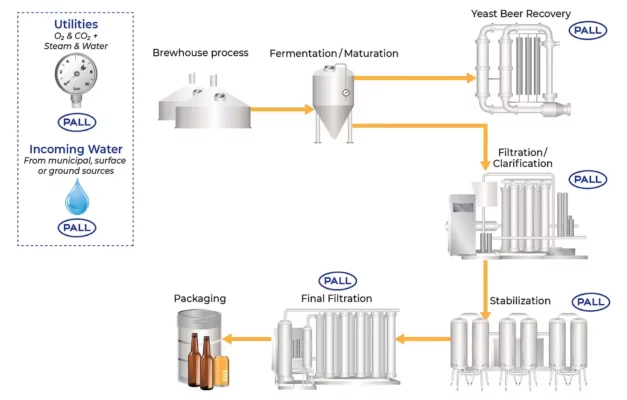
3) Evaluating Production Capacity: Analyzing Daily Beer Output Requirements
Large breweries don’t design around “brewhouse size” alone. They design around packaged beer shipped, and then back-calculate required fermentation, filtration, bright beer, and packaging capacity.
Step-by-step capacity logic (simplified)
Define your target daily/weekly packaged volume
Example: 200 hl/day packaged beer average.
Adjust for losses and downtime
Consider:
yeast and trub losses,
filter losses,
packaging losses,
planned downtime for CIP, maintenance, and changeovers.
Calculate fermentation cellar volume
Fermentation time is the real “capacity governor.”
Ales may turn faster than lagers (in general), but dry-hopping, conditioning, and QA holds can extend time.
More SKUs often means more tank fragmentation.
Decide your brewing cadence
Will you brew:
1–2 turns/day, 5–6 days/week?
3 turns/day with a high-capacity wort cooling and automation setup?
continuous or semi-continuous operations?
A useful perspective: capacity utilization
Breweries that grow quickly often become “capacity constrained” even if they own a decent-sized brewhouse—because fermentation, bright beer, or packaging becomes the bottleneck. The Brewers Association’s discussion of capacity utilization shows how frequently breweries operate near high utilization, highlighting why expansion planning matters.
Source: Brewers Association – “Craft Brewer Capacity” https://www.brewersassociation.org/insights/craft-brewer-capacity/
4) Comparing Brewing Technologies and Their Impact on Beer Quality
When choosing large scale brewery equipment, technology choices affect both flavor outcomes and process robustness.
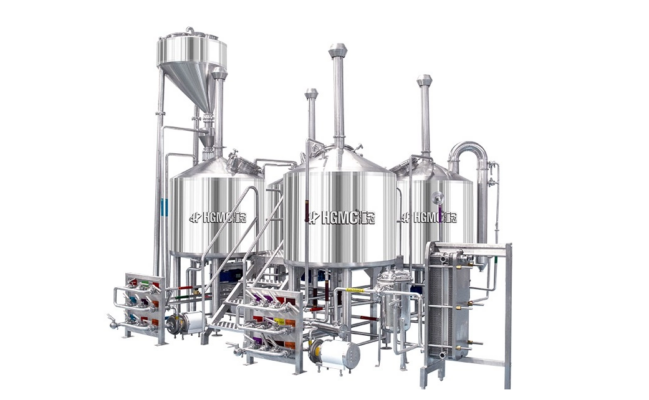
Brewhouse configuration: 2-vessel, 3-vessel, 4-vessel, or more
Fewer vessels can reduce capex and footprint, but may limit turns/day.
More vessels can increase throughput and flexibility (e.g., separate lauter tun and kettle), but requires stronger utilities and controls.
Lautering vs mash filtration
Lauter tuns are traditional and widely used.
Mash filters can increase extract yield and reduce cycle time for certain recipes, but often require more complex operation and maintenance.
Wort boiling and energy approach
Boil vigor and stripping affect bitterness, DMS removal, and aroma handling. Energy strategy matters too:
steam jackets,
internal calandria,
external wort boilers,
heat recovery systems.
Inline oxygen control, carbonation, and DO management
For packaged beer shelf life, DO and pickup control can be decisive. This is where:
hygienic piping design,
proper valve selection,
sensor placement,
and stable automation
make the difference between “good” and “export-ready.”
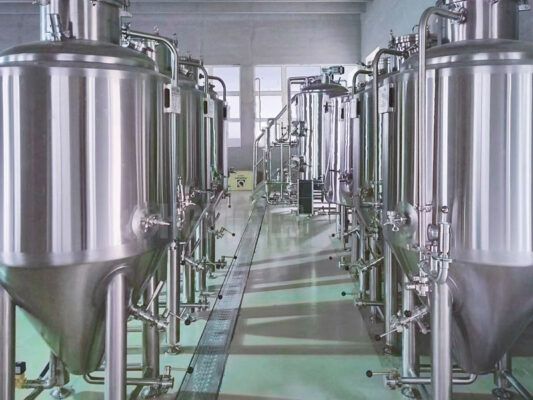
5) Essential Components of Large Scale Brewing Systems Explained
Below is a practical checklist of the typical equipment blocks in a large brewery, with “why it matters” notes.
Brewhouse (hot side)
Malt handling and milling: consistent grist = consistent extract and lauter performance.
Mash mixer / mash tun: temperature control and homogeneity.
Lauter tun or mash filter: wort clarity and extract yield.
Kettle / whirlpool: bitterness control, wort sterilization, trub separation.
Wort cooling (plate heat exchanger): stable pitching temperature and energy recovery.
Cold side (fermentation & conditioning)
Cylindroconical fermenters (CCVs): sized for your SKU mix and cycle times.
Brite beer tanks (BBTs): buffering packaging, carbonation, and blending.
Glycol system: often underestimated; design for peak loads and future expansion.
CIP (clean-in-place) system
For large scale operations, CIP is not optional—it’s the backbone of consistency:
dedicated CIP tanks (caustic, acid, hot water),
dosing and conductivity control,
return temperature management,
spray devices sized for vessels.
Filtration / clarification (if required)
DE filtration, sheet filtration, centrifuge, membrane filtration—each has tradeoffs for oxygen pickup, flavor impact, and operating complexity.
Packaging (if required)
canning/bottling line,
kegging line,
pasteurization (tunnel or flash) or alternative shelf-life strategy,
inline QA instruments (DO/CO₂, turbidity, seam inspection, etc.).
Piping, valves, and hygienic design standards
Even the best tanks can be undermined by poor piping design (dead legs, poor drainability, or inconsistent weld quality). Many hygienic design principles used across food and high-purity industries are codified in standards such as ASME BPE (bioprocessing equipment). While breweries aren’t pharmaceuticals, BPE is a widely recognized reference for hygienic fabrication, materials, inspection, and cleanability thinking.
Source: ASME BPE overview (example explainer) https://www.csidesigns.com/blog/articles/what-is-bpe
(And ASME’s own BPE documentation is available via ASME/ANSI storefronts; the standard itself is typically paid.)
6) Trends in Brewery Equipment Innovations and Industry Standards
Large breweries are shifting from “buy tanks” to “buy a controllable, data-driven process.” Key trends include:
Higher automation + better traceability
Batch reporting, electronic records, and predictive maintenance reduce variability and downtime.
Energy efficiency and heat recovery
Brewing is energy intensive. A well-known technical reference from Lawrence Berkeley National Laboratory discusses energy intensity and identifies significant efficiency opportunities in breweries.
Source: LBNL report “Energy Efficiency Opportunities in the Brewery Industry” (PDF) https://eta-publications.lbl.gov/sites/default/files/lbnl-50979.pdf
(This report provides context on energy use and improvement opportunities; exact consumption varies by brewery type and packaging mix.)
Sustainability as an engineering requirement
Water reuse, lower chemical consumption, and wastewater pretreatment increasingly influence equipment selection.
Shelf-life and quality standards in distribution markets
The European Brewery Convention (EBC) publishes technical opinions and guidance on topics like beer shelf-life and best-before practices, reflecting the emphasis on stability in modern distribution.
7) Cost Analysis: Balancing Equipment Investment and Operational Efficiency
“Cheapest equipment” is rarely the cheapest brewery.
A simple way to evaluate total cost of ownership (TCO)
Compare options using a 3–7 year view:
Capex: equipment + installation
Opex: utilities (steam/electricity, water), chemicals, labor
Yield and loss: extract yield, beer loss in process/packaging
Downtime risk: maintenance, spare parts availability, vendor support
Quality risk: oxygen pickup, contamination risk, inconsistent temperature control
Why energy matters in large scale selection
Energy can be a meaningful share of production costs. The LBNL brewery efficiency report notes that energy consumption is often a few percent of beer production cost and highlights wide variation across breweries and processes. Improving heat recovery, insulation, and system integration can create large savings at scale.
Source: LBNL report (PDF) https://eta-publications.lbl.gov/sites/default/files/lbnl-50979.pdf
The “right” investment level depends on your route-to-market
Local taproom focus: flexibility and variety may matter more than maximum throughput.
Regional distribution: stability, packaging quality, and repeatability become core.
Export / long shelf-life channels: oxygen control, microbiological stability, and packaging discipline are critical.
Q&A: Large Scale Brewery Equipment Selection
Q1: What is the biggest mistake breweries make when choosing large scale equipment?
A: Designing only for brewhouse size, and not for the full system bottlenecks—especially fermentation capacity, BBT buffering, and packaging downtime. Capacity utilization data and real-world growth patterns show how quickly breweries can become constrained without expansion planning.
Source: Brewers Association – capacity utilization discussion https://www.brewersassociation.org/insights/craft-brewer-capacity/
Q2: Do we need ASME-rated tanks?
A: If your vessels operate above certain pressures, local regulations may require pressure-rated construction and certified safety devices. In the U.S., the Brewers Association notes that working pressures exceeding 15 psi generally trigger ASME-rated considerations for brewing process tanks. Always confirm local code requirements with your engineering team and inspectors.
Source: Brewers Association – pressure-rated vessels FAQ https://www.brewersassociation.org/brewing-industry-updates/brewery-pressure-rated-vessels-faq/
Q3: How do we choose between expanding tank volume vs increasing brewhouse turns per day?
A: If fermentation is the bottleneck, more tank volume (and cooling capacity) often yields faster growth than an oversized brewhouse. If the brewhouse is limiting, adding vessels or automation to increase turns/day can help—but only if your cellar and packaging can absorb the extra volume.
Q4: What role do hygienic standards play in brewery equipment specs?
A: Hygienic design affects cleanability, contamination risk, and oxygen pickup. Many breweries reference hygienic principles similar to those described in standards like ASME BPE to guide materials, fabrication quality, and inspection practices—even if the brewery isn’t required to fully comply with BPE.
Source: ASME BPE explainer https://www.csidesigns.com/blog/articles/what-is-bpe
Q5: How can we make a large brewery more energy efficient through equipment choices?
A: Prioritize heat recovery (wort cooling to hot water), insulation, efficient boiling systems, optimized CIP heating, and properly sized utilities. Technical work from LBNL summarizes common efficiency opportunities and explains why energy intensity varies widely across brewery types.
Source: LBNL report (PDF) https://eta-publications.lbl.gov/sites/default/files/lbnl-50979.pdf
References (Authoritative Sources)
BarthHaas Report 2022/2023 press release (global beer output figure). PDF: https://www.barthhaas.com/fileadmin/user_upload/PR_world-beer-market_2023.pdf
Brewers Association – Brewery Pressure-Rated Vessels FAQ: https://www.brewersassociation.org/brewing-industry-updates/brewery-pressure-rated-vessels-faq/
Brewers Association – Craft Brewer Capacity (capacity utilization discussion): https://www.brewersassociation.org/insights/craft-brewer-capacity/
Lawrence Berkeley National Laboratory (LBNL) – Energy Efficiency Opportunities in the Brewery Industry (PDF): https://eta-publications.lbl.gov/sites/default/files/lbnl-50979.pdf
European Brewery Convention (EBC) – statement on beer shelf-life / best-before: https://brewup.eu/news/european-brewery-convention-ebc-statement-on-beer-shelf-life-and-best-before-dates-for-beer-in-general-and-keg-beer-in-particular
ASME BPE overview (industry explainer): https://www.csidesigns.com/blog/articles/what-is-bpe
