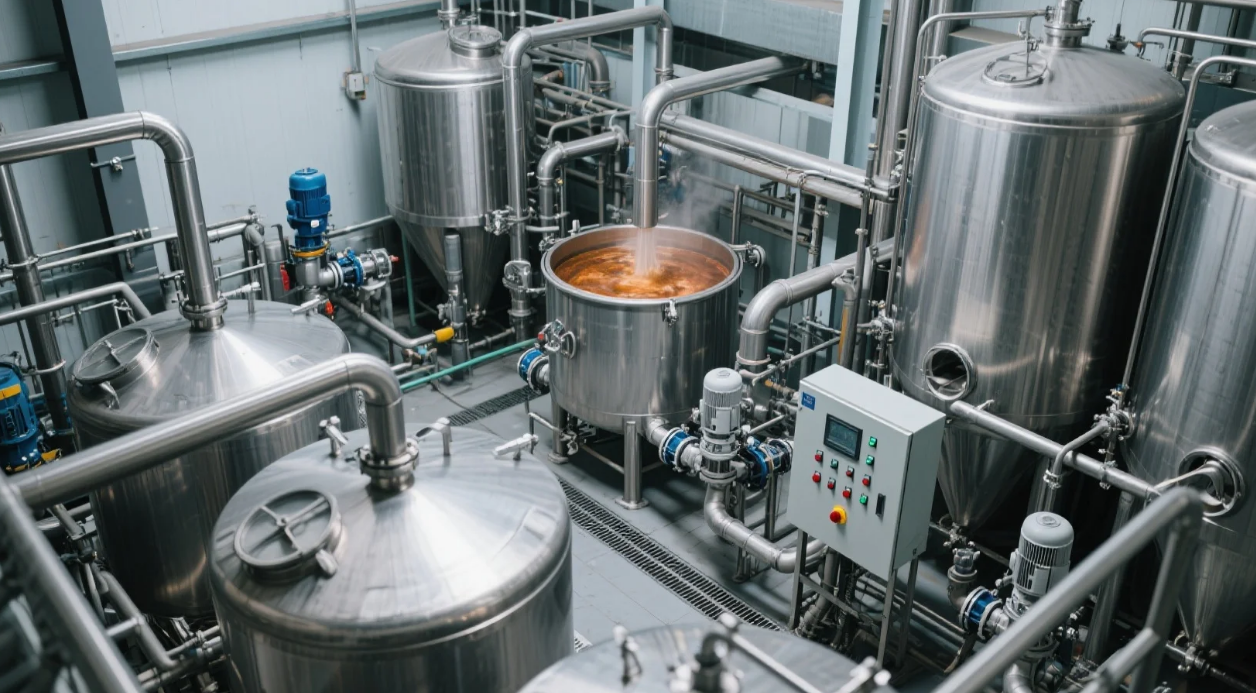
A brewery that has outgrown its 1,000-liter brewery system and is considering a jump to 10,000 liters often assumes the upgrade is just bigger tanks. The thinking goes: buy a larger brewhouse, add a few more fermenters, and volume goes up. In reality, a full 10,000-liter brewery system is a complete production system where brewhouse, fermentation, cleaning, cooling, controls, and layout must work as one integrated plant. A missing piece or undersized subsystem can stop production just as fast as a failed pump.
This article breaks down what actually comes in a full set, the cost drivers that matter at this scale, and the practical questions buyers should ask before placing an order. Breweries that treat the purchase as an equipment list rather than a system integration project often discover the gap between what the quotation says and what the brewery needs only after installation begins.
What “Full Set” Means at the 10,000-Liter Scale
A full 10,000-liter brewery system set is more than a larger brewhouse. At this scale, the brewery becomes a production system that must connect brewing, fermentation, cleaning, cooling, controls, and layout into one working plant. The goal is not simply to make more beer. The goal is to make large volumes consistently, safely, and with a workflow that does not become chaotic as output increases.
For breweries considering this size, the first question is usually whether the business can support the volume. A 10,000L brewery system is best suited to breweries with strong sales channels, stable demand, and a clear growth plan. If demand is still developing, a brewery risks running a system at partial capacity, which increases cost per liter and puts pressure on margins.
If the market is ready, a full set at this level can support flagship beers, seasonal products, and ongoing distribution without forcing the team to work around bottlenecks every day.
The term “full set” itself requires clarification. Some suppliers list a brewhouse plus a few tanks and call it complete. A genuine full set for 10,000 liters includes the brewhouse, fermentation and conditioning vessels, a cleaning-in-place (CIP) system, a glycol cooling system, control panels, pumps and piping, platforms and access structures, and often a grain handling system.
If any of these pieces is missing or undersized, the system cannot run at its intended output. Breweries that discover this gap after installation face expensive retrofits.
The Core Components of a 10,000-Liter Brewery System
Breaking down a 10,000-liter system by subsystem helps buyers evaluate what they are actually getting. Each component must be matched to the production rhythm, not just to the brewhouse capacity.
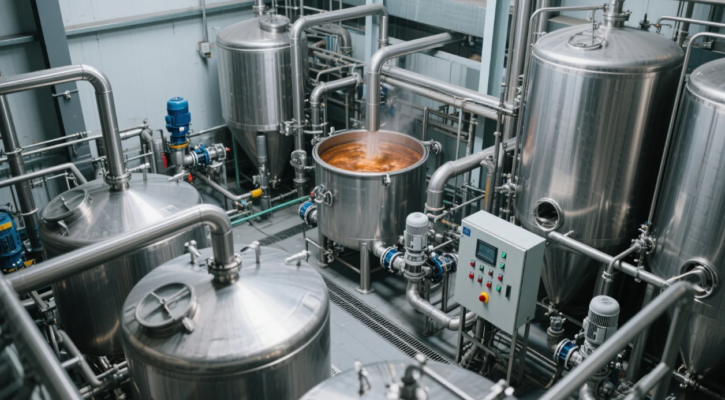
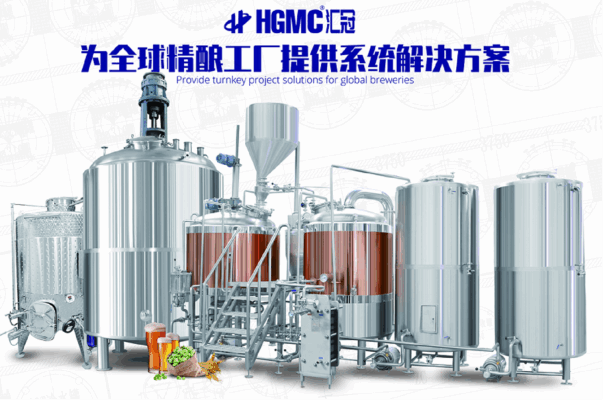
Brewhouse section. This is the core of the system and normally includes: mash tun, lauter tun, kettle, whirlpool, heat exchanger, pumps and sanitary piping, and platforms with access structures. At 10,000 liters, the brewhouse must be designed for stable flow and efficient transfers. The vessel arrangement may be a 3-vessel or a 4-vessel configuration, depending on how many brews per day the brewery expects to run.
A 4-vessel setup allows better process overlap—mashing in one vessel while lautering finishes in another—but it comes with higher cost and more stainless steel. For breweries running one or two brews per day, a well-designed 3-vessel brewhouse is often sufficient. For breweries targeting three or more brews daily, the 4-vessel arrangement is usually the safer choice.
Fermentation and conditioning section. The cellar is just as important as the brewhouse. A full set typically includes large cylindroconical fermentation tanks, bright beer tanks, cooling jackets and insulation, sample valves, pressure fittings, and manways. These tanks must be sized to the production rhythm, not to a maximum theoretical number. If fermentation takes several days or weeks—typical for ales and standard lagers—the cellar must have enough capacity to keep the brewhouse from waiting.
A common mistake is ordering a 10,000-liter brewhouse with only a few fermenters, assuming production is linear. In practice, the brewhouse finishes a batch faster than fermentation clears a tank, so the cellar fills up quickly.
Cleaning and support systems. The cleaning-in-place system is often underestimated but becomes a major bottleneck at 10,000 liters if not sized and routed correctly. A 10,000-liter brewery needs a CIP station with properly sized pumps, chemical circulation lines, spray balls for every vessel and pipe run, and enough chemical holding capacity to cover the longest cleaning circuit.
Without reliable CIP, a brewery may have a large brewhouse but still struggle with hygiene, downtime, and cleaning delays. The glycol cooling system must also be matched to the total heat load—not just vessel volume, but also peak cooling demand during fermentation and crash cooling. Control panels and instrumentation tie the whole system together. At this scale, manual operation becomes impractical for more than a few brews per week.
Understanding the Cost Drivers at This Scale
The cost of a 10,000-liter brewery system depends on several factors, and it is usually more useful to think in terms of system scope than single equipment prices. The main cost drivers are:
Brewhouse configuration. A 4-vessel brewhouse generally costs more than a 3-vessel setup, but it can support higher output and better process overlap. The difference in price is not trivial—often 20–30% more for the brewhouse alone.
Tank count and tank volume. More fermenters and bright tanks mean more stainless steel, more fabrication, and more installation work. A brewery that needs ten 10,000-liter fermenters instead of six will see the equipment cost climb significantly.
Material and finishing. Wall thickness, internal polishing grade, and external cladding all influence cost and durability. Thicker stainless steel costs more but lasts longer in a busy production environment. Cladding reduces heat loss and improves appearance but adds to the fabrication bill.
Automation level. Basic control with manual valves is less expensive upfront, but more advanced automation adds cost while improving consistency and labor efficiency. At 10,000 liters, the labor cost of running a manual system for multiple brews per day usually outweighs the automation investment within a year or two.
Utility systems. Cooling, CIP, power distribution, and related systems are a major part of the total budget. A glycol system that is undersized for a 10,000-liter brewery will force slow fermentation and long turnaround times, which cuts into production capacity.
A well-planned system usually saves money over time by reducing downtime, cleaning delays, and product loss. The cheapest option on a quotation is rarely the best option when viewed over a three-year operating horizon. Buyers should ask for line-item breakdowns and understand where the money is going, rather than comparing only the total figure.
Planning the Layout for a 10,000-Liter Brewery System
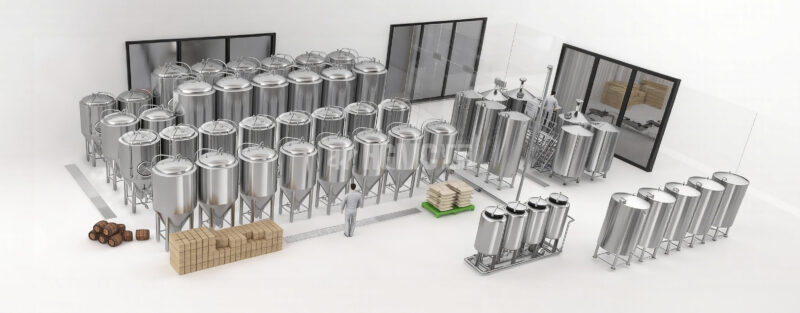
A 10,000-liter brewery only works well if the layout is planned correctly. This scale needs enough room for the brewhouse, cellar, cleaning area, utility access, and safe movement for staff and materials. If the equipment is installed in a cramped or awkward layout, even a well-built brewery can feel difficult to run.
The layout should support clear flow from grain handling to brewing to fermentation to packaging. Short and logical transfer routes reduce pump time and product loss. Easy access for cleaning and maintenance means operators can actually reach every CIP connection, valve, and tank manway without ladders or awkward positions.
Safe walkways and platforms are not just a regulatory requirement—they prevent accidents that stop production for hours. Space for future expansion is often ignored but becomes expensive when a brewery outgrows its layout within two years.
Layout planning should happen simultaneously with equipment selection, not after. Retrofitting a cramped space destroys workflow efficiency. A brewery that chooses equipment first and then tries to fit it into an existing building often ends up with transfer lines that are too long, cleaning routes that are impractical, or cooling pipes that cannot be insulated properly. These problems are hard to fix after installation.
One practical approach is to have the equipment supplier review the building drawings before the order is placed. Many suppliers will adjust vessel dimensions, tank leg heights, or access platform configurations to match the available space. Breweries that skip this step often face installation delays and unexpected costs for structural modifications.
Key Questions to Ask Before Buying a 10,000-Liter brewery System
Before committing to a 10,000-liter system, buyers should ask practical questions that reveal whether the system fits their brewery. These questions help prevent a common mistake: buying a large system that looks complete on paper but does not match the brewery’s real operating rhythm.
How many brews per day do we want to run? The answer determines the brewhouse configuration, vessel sizing, and overall production schedule. A brewery targeting one brew per day has different design requirements than one aiming for four.
How many fermentation tanks are needed to keep the brewhouse productive? If the brewhouse can produce one batch every four hours, and each fermenter holds a batch for two weeks, the cellar must have enough tanks to hold the output during that entire fermentation period. A brewery with ten fermenters may still run out of capacity if the brewhouse operates at full speed and beer sits in tanks for packaging delays.
Does the cellar have enough cooling capacity? Cooling requirements peak during fermentation and crash cooling. An undersized glycol system will extend fermentation times and delay tank turnover, reducing effective capacity.
Can the cleaning system reach every vessel and line? If a CIP circuit requires manual reconfiguration for each tank, cleaning time increases and errors become more frequent. At 10,000 liters, a well-routed CIP system with automated valve groups saves hours per day.
Is the control system suitable for the team that will operate it? A complex automation system that the team cannot troubleshoot is worse than manual control. Training time and supplier support must be factored into the decision.
Will the layout work in the actual building, not just on paper? This question is worth verifying with a site visit or detailed measurements before purchase.
Buyers who skip these questions often discover the gaps after installation: a brewhouse that waits for fermenters, a cellar that cannot cool, a CIP system that takes too long, or a layout that makes daily operation exhausting. At the 10,000-liter scale, the cost of fixing these problems after installation usually exceeds the cost of getting them right the first time.
FAQ
How much does a 10,000-liter brewery system typically cost?
A full 10,000-liter system usually falls within a broad range depending on configuration, automation, and customization. Buyers should expect a significant investment that covers the brewhouse, fermentation tanks, cooling, CIP, controls, and installation. The cheapest option in a quotation often excludes critical subsystems, so comparing line-item scope is more useful than comparing total price.
How long does it take to install and commission a full 10,000L brewery system?
Installation typically takes several months from delivery to first brew, depending on site readiness, building modifications, and the complexity of the system. Commissioning includes piping, electrical work, cooling system connection, CIP trials, and process validation. Breweries should plan for downtime during this period.
What level of automation is recommended for this scale?
For breweries running two or more brews per day, semi-automated or fully automated control is recommended. Manual operation at the 10,000-liter scale requires a large team and increases the risk of inconsistencies. Automation also helps with data collection and batch tracking, which becomes important at higher volumes.
Can a 10,000L system be installed in an existing building, or does it require a purpose-built facility?
A 10,000-liter system can be installed in an existing building, but the space must meet requirements for ceiling height, floor loading, ventilation, drainage, and access for tank delivery. Layout adjustments are usually needed. Retrofitting an existing space often costs less than new construction but requires careful planning to avoid operational compromises.
How many fermenters does a 10,000L brewery usually need?
The number depends on production schedule and fermentation time. A common starting point is four to six 10,000-liter fermenters for a single-brew-per-day operation, with more needed for higher output or longer fermentation cycles. Bright beer tanks for conditioning and serving are additional.
