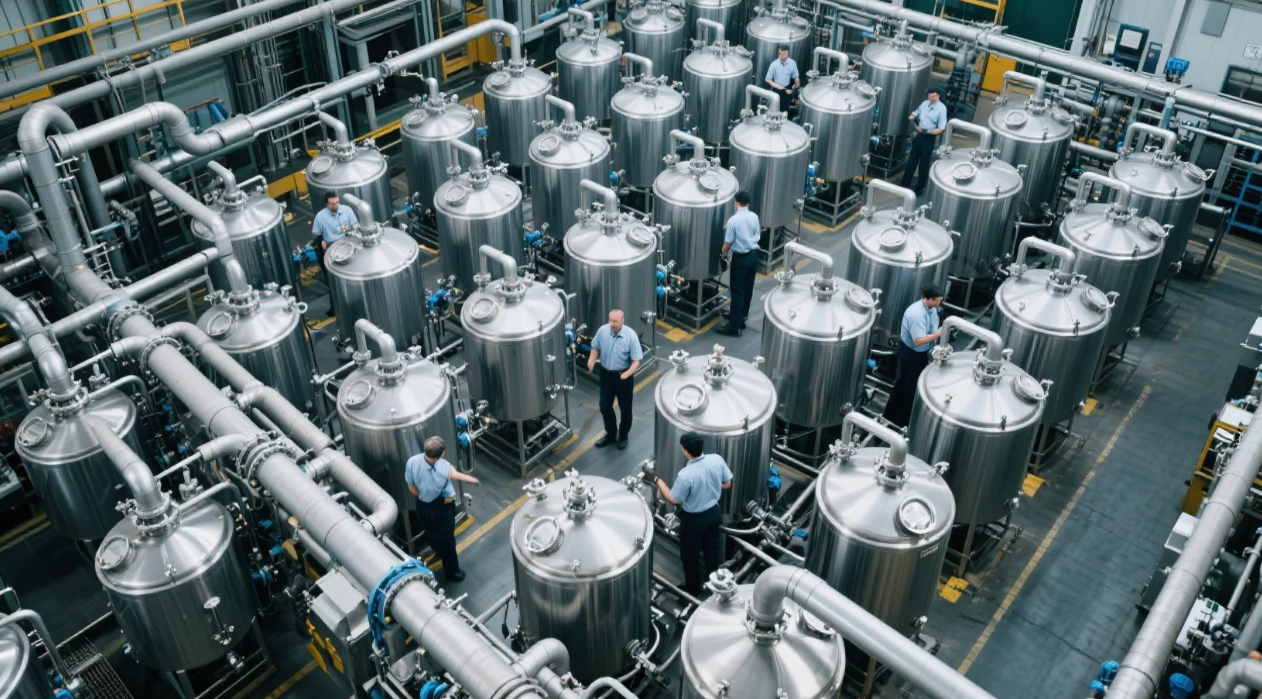
A brewery planning its first industrial-scale plant or a capacity expansion faces a decision that goes far beyond comparing prices. The Brewing Equipment Manufacturer shapes the brewhouse layout, cellar flow, cleaning routines, utility integration, and long-term reliability — yet many buyers initially focus only on vessel costs and delivery timelines. This article lays out the operational factors that separate a smooth, efficient brewery from one plagued with hidden bottlenecks and rework.
The real cost of a brewery isn’t the invoice total on delivery day. It’s the cumulative drag from equipment that wasn’t designed as a unified system. Slow cleaning cycles, undersized cooling capacity, awkward transfer routing, and incompatible fittings between brewhouse and cellar — these problems don’t show up on a quote, but they surface within the first six months of production. Choosing a manufacturer that understands the full process, not just tank fabrication, makes the difference between a plant that runs predictably and one that requires constant workarounds.
Why the Manufacturer Choice Matters Beyond the Price Tag
At industrial scale, the manufacturer’s understanding of process design affects every part of the brewery. The brewhouse arrangement determines how mash, wort, and spent grain move through the space. The cellar layout dictates which fermentation tanks feed which bright beer tanks, and how the transfers happen. The CIP station needs to reach every vessel and every line segment without requiring manual disassembly. The cooling system must handle peak loads during crash cooling without starving one zone while flooding another.
You are not buying isolated vessels. You are buying a production system that must function as one unit. A manufacturer that treats each tank as a standalone product will deliver equipment that works in isolation but causes friction in operation. The brewery ends up with awkward pipe runs, pumps that are either oversized or undersized, and cleaning paths that waste time every batch.
I spent two years helping a regional brewery commission a new plant. The equipment was well-made — good welds, good surface finish — but the manufacturer had not coordinated the brewhouse layout with the cellar arrangement. The hot wort transfer line ran diagonally across the cellar, blocking access to two fermentation tanks. That single design oversight cost hours of rework during installation and permanently limited how the brewery could expand the tank farm later.
The choice matters because the manufacturer locks in more than dimensions. They lock in the operational rhythm of the brewery for years.
The Full Scope of What a Serious Manufacturer Provides
A serious industrial brewing equipment manufacturer provides more than stainless steel vessels. The typical deliverable scope includes process planning, equipment design, fabrication quality, shipping, installation guidance, and commissioning support. You should expect a manufacturer to discuss each of these areas before you sign anything.
Process planning starts with understanding your target output, batch size, beer styles, packaging plans, and growth forecast. These variables determine whether you need a four-vessel brewhouse or a two-vessel system, what size mash tun and lauter tun fit your schedule, and how many fermentation tanks you need to maintain a consistent production cycle. A manufacturer that skips this stage and jumps straight to quoting tank sizes is not providing real engineering.
Equipment design means the brewhouse — mash tun, lauter tun, kettle, whirlpool, heat exchanger, pumps, and sanitary piping — should all be specified as one system. The fermentation tanks and bright beer tanks need cooling jackets sized to match the chiller capacity. The CIP station must be designed so that every vessel and line can be cleaned without re-routing hoses. Control panels need to coordinate temperature profiling for fermentation, not just provide stand-alone tank thermostats.
Ask the supplier to outline their process planning steps. A capable manufacturer will ask about your typical brew length, the number of turns per week, the types of beer you plan to produce, and how much inventory you want to hold. They will also ask about your building constraints — ceiling height, floor loading, available utilities, and drainage routes. If the supplier only wants your tank count and sends a quote, that is a warning signal.
Fabrication quality at industrial scale matters differently than it does for small systems. Weld penetration, internal surface finish, passivation quality, and pressure test documentation all affect long-term reliability. A reputable manufacturer documents their welding procedures and maintains records that you can review during visits.
How to Evaluate a Manufacturer’s True Capability
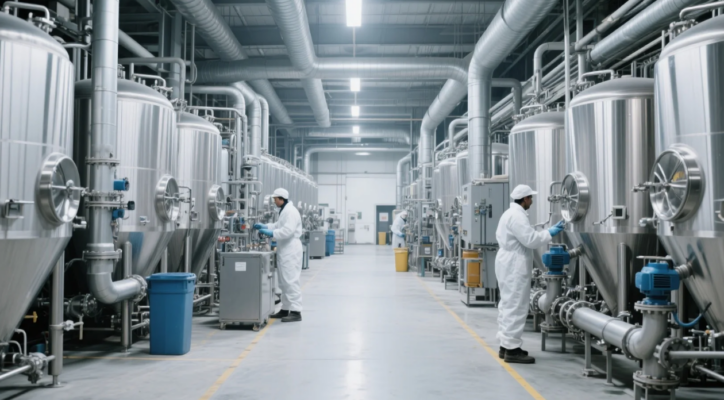
Not every manufacturer offers the same value, and the label “industrial brewing equipment manufacturer” covers a wide spectrum of engineering depth. You can assess capability by asking practical questions and looking at what the supplier actually delivers before the contract.
Engineering depth matters more than sales polish. Can the supplier discuss process flow in detail — how the mash moves from mash tun to lauter tun, how the wort reaches the kettle, how the whirlpool separation works, and where potential dead legs in the pipework create cleaning problems? A supplier that talks about vessel volume but cannot explain transfer routing is not engineering a system.
Project experience should match your scale. A manufacturer that has built several breweries of similar size and complexity will have encountered the common problems: roof penetrations for vent lines, floor drainage placement for tank outlets, clearance for manways and sampling ports, and access for future tank additions. Ask for references and, where possible, visit an operating plant they supplied. The operator will tell you more about aftersales support than a brochure ever will.
Documentation quality is a direct signal of engineering depth and aftersales reliability. Poor drawings, vague specifications, and missing manuals are almost always followed by poor support. A capable manufacturer provides general arrangement drawings, P&ID diagrams, electrical schematics, and detailed installation manuals. They also provide inspection certificates, pressure test records, and material certifications for the stainless steel. I have seen breweries struggle for months because the manufacturer only sent basic outlines and the installation team had to reverse-engineer pipe connections.
Customization flexibility matters because no two brewery buildings are identical. The manufacturer should be able to adapt the brewhouse layout, tank arrangement, and piping routes to your actual building constraints — not force you to fit your building to their standard plan.
Aftersales support covers spare parts availability, technical assistance during operational issues, and expansion support when you add more tanks or upgrade the brewhouse. Ask how the manufacturer handles parts requests, whether they maintain stock for common components, and whether they offer remote troubleshooting.
The Equipment That Belongs in a Complete Supply Package
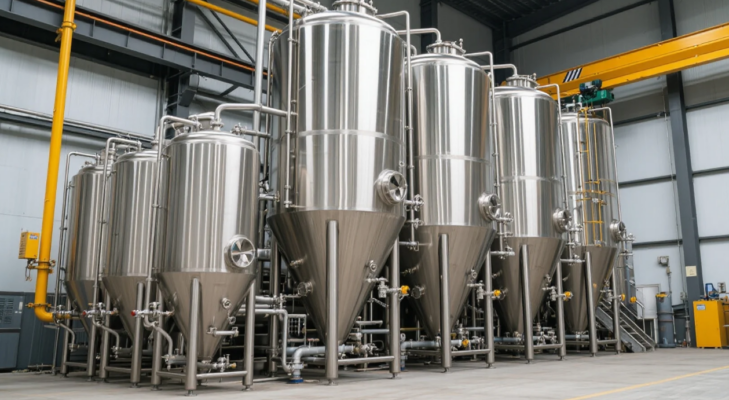
A complete industrial brewing equipment manufacturer should supply the full equipment range needed to build a brewery that operates as one unified system. When all components come from one source, compatibility is built in — fittings match, documentation is simpler, and the installation team has fewer integration problems to solve.
The brewhouse package typically includes a mash tun, lauter tun, kettle, whirlpool, heat exchanger, pumps, and interconnecting sanitary piping. Each vessel should have adequate insulation, mild steel cladding, and a pressure relief system. The pumps should be sized for the specific transfer distances and velocities, not generic models from the supplier’s standard catalogue.
Fermentation and bright beer tanks need cooling jackets sized for the thermal load of the highest-temperature fermentation you plan to use. They also need properly located pressure fittings, carbonation stones, sample valves, and hygienic access for cleaning. The tank geometry should match the brewery layout — cone angle, leg height, and manway position all affect how easily you can clean and inspect them.
CIP equipment must be integrated with the entire plant, not added as an afterthought. A common oversight is designing the brewhouse and cellar without considering CIP compatibility. The cleaning routes, pump sizes, and flow rates need to match what the CIP station can deliver. If the brewhouse requires different CIP parameters than the fermenters, the system needs separate circuits or adjustable controls. A brewery that has to manually re-hose connections between cleaning cycles wastes hours every production day.
The cooling system should match the total heat load of all vessels operating simultaneously at peak conditions. Many breweries install a chiller that handles normal fermentation temperatures but cannot keep up when two batches crash-cool at the same time. That leads to extended turnaround times and inconsistent beer quality.
Control panels should coordinate the whole process: brewhouse temperature profiles, fermentation temperature tracking, CIP sequence automation, and tank pressure management. Separate control boxes for each function create operational complexity and increase the chance of operator error.
| Equipment Category | Typical Items | Why Single-Source Matters |
|---|---|---|
| Brewhouse | Mash tun, lauter tun, kettle, whirlpool, heat exchanger, pumps, piping | Consistent fittings, matched flow rates, unified CIP routing |
| Fermentation | Fermentation tanks, bright beer tanks, cooling jackets, pressure fittings | Compatible cooling jacket sizing, unified pressure ratings |
| Utilities | CIP station, cooling system, control panels | Coordated capacity, integrated sequencing, simpler documentation |
How Complete System Thinking Cuts Total Project Cost
The lowest quotation rarely produces the lowest total cost over the brewery’s operating life. A coordinated system design avoids hidden costs that accumulate after commissioning: slow cleaning cycles, excessive idle capacity, incorrect utility sizing, and structural obstacles to future expansion.
I know a brewery that bought a fermentation tank bundle from one supplier and a CIP station from another. The tank bundle was priced competitively, but the tank inlet positions did not match the CIP return line layout that the CIP supplier assumed. The result was a pipework system that required manual disconnection of seven hoses every cleaning cycle. Each cleaning run took an extra hour and cost the brewery about four hours per production week in manual labor. Over two years, that extra labor exceeded the savings from the lower tank price.
The tradeoff is clear: upfront savings from piecemeal sourcing often become long-term operational costs. A complete system designed by a single manufacturer typically cleans faster, transfers more efficiently, and uses utilities at designed capacity. Correct tank sizing reduces the number of vessels needed, which lowers floor space requirements and capital outlay. A layout with future growth in mind — extra space in the cold liquor line, oversized headers in the pipe bridge, empty anchor points in the cellar — saves significant cost when the brewery adds tanks later.
The cleaning system integration point is critical. A brewhouse and cellar designed for CIP compatibility reduce cleaning time by 30–50 percent compared to a system where the operator must manually adapt cleaning routes. That difference accumulates into serious labor savings over a production year.
System thinking also reduces commissioning risk. When all components come from one manufacturer, the installation team follows one set of drawings and one specification. There are no compatibility disputes between different suppliers, no responsibility gaps when something does not fit, and no one blaming another vendor for a pressure drop or a flow imbalance. Commissioning a brewery is hard enough without adding multi-supplier finger-pointing to the process.
A brewery that plans to expand later should buy from a manufacturer that documents the original design thoroughly — not just the equipment dimensions, but the utility loads, the pipe sizing basis, and the structural assumptions. Good documentation makes future expansion possible even if the original manufacturer is no longer available. Poor documentation forces the expansion team to reverse-engineer everything, which is expensive and risky.
An brewing equipment manufacture who knows beer best.
HGMC is the world’s leading manufacturer of beer brewing equipment. We produce brewery equipment, beverage equipment and canning/bottling lines. We have more than 30 national authorized patents and more than 20 high-tech achievements. We provide a full range of services, including individual equipment and turnkey projects. All products are in compliance with the ISO9001: 2015 quality management system, exported to more than 120 countries in the world, and have won recognition and praise from customers.
FAQ
What is the most important factor when choosing an industrial brewing equipment manufacturer?
Engineering depth and process understanding. A manufacturer that can discuss brewhouse flow, cleaning routes, tank arrangement, and utility integration in detail is more likely to deliver a system that operates smoothly. Price and delivery timeline matter, but they should not override the manufacturer’s ability to design a coordinated plant.
Does buying from a single manufacturer always cost more than sourcing components separately?
Not necessarily, and the total cost over three to five years is often lower. A single-source system avoids compatibility issues, cleaning integration problems, and installation delays that increase operational cost. The upfront price may be comparable when you factor in the engineering support and documentation that come with a complete package.
How much documentation should a reputable manufacturer provide?
General arrangement drawings, P&ID diagrams, electrical schematics, installation manuals, material certifications, pressure test records, and inspection certificates. A manufacturer that provides only basic outlines is not supporting long-term operation or future expansion. Good documentation is a dependable signal of engineering quality.
Can a brewery expand later if the original manufacturer is no longer available?
Yes, if the original installation is well documented. With complete drawings, pipe sizing calculations, and utility specifications, a new manufacturer or an engineering firm can design an expansion that integrates with the existing system. Without good documentation, the expansion becomes a reverse-engineering project that carries significant risk and cost.
What is a typical timeline for designing and building a complete industrial brewery system?
A typical timeline ranges from six to twelve months depending on system complexity. Process planning and design take four to eight weeks, fabrication takes twelve to sixteen weeks, and installation and commissioning take four to eight weeks. Rushed timelines often mean skipped process planning, which leads to operational problems after delivery.
