

A brewery buyer comparing quotes for a commercial brewhouse often hits the same wall. Two suppliers bid a 1,000 L system, and the numbers look nothing alike. The lower quote rarely stays the lowest once installation begins, because brewhouse pricing tracks process capability and technical specification, not nominal tank volume. Buyers who anchor on headline capacity or the cheapest figure tend to discover hidden site-work, utility, and installation costs after the decision is locked in.
The reliable way to compare brewhouses is to compare what each system can actually produce per day and what it takes to run it on your site, not the volume printed on the tank nameplate.
How “1,000 L” Means Different Things to Different Suppliers
Nominal capacity is only one line in a quotation. When a supplier states 1,000 L, the figure could refer to total vessel volume, effective working volume, or the intended wort volume per batch. Those three numbers are not the same, and quoting practices vary enough that two systems labeled identically can deliver very different usable output.
Usable output depends on process time, transfer efficiency, cleaning time, and operator workflow. A brewhouse rated at 1,000 L total volume might only produce 800 L of wort per batch once dead space, evaporation, and trub losses are accounted for. Another system with the same nameplate could be engineered around a higher effective working volume and better transfer efficiency, pushing closer to 900 L per batch. Over a year of operation, that gap compounds into a meaningful difference in the annual beer-production target a brewery can hit.
The number of brews completed per day is often the real determinant of value. A smaller system running three well-scheduled batches can outperform a larger one that only manages one because of slow heating or lengthy cleaning cycles. Buyers sometimes oversize on paper, then find the equipment sits underused while still consuming floor space and capital.
Before requesting any quotation, a buyer should define these parameters:
- target batch size and planned brews per week
- annual beer-production target
- beer styles and recipe range
- shift pattern and staffing level
- available floor area and ceiling height
- available heating, water, electrical, and drainage infrastructure
Each of these definitions moves the price. A system built for three brews per day needs stronger heating, more automation, and more vessel separation than one running a single batch. Specifying these details up front is what separates a comparable quote from one that only looks comparable.

How 2-, 3-, and 4-Vessel Designs Change the Quotation
Vessel count reshapes the entire project scope. The number of vessels determines process layout, workflow flexibility, footprint, platform structure, valve arrangement, piping, automation requirements, and ultimately the price.
A 2-vessel brewhouse combines process functions into fewer tanks. It fits commercial breweries that need a compact layout and controlled batch production. Fewer vessels mean fewer process connections, less platform complexity, and a lower overall cost. For a brewery with limited floor area and a modest production rhythm, this configuration is often the practical choice.
A 3-vessel design separates brewing functions across dedicated vessels, which allows greater workflow flexibility and more overlapping process steps. While one vessel handles lautering, another can be heating toward boil. That overlap shortens total batch time. The tradeoff is visible in the quotation: the additional vessel, pipework, pumps, valves, platform structure, and controls all add cost.
A 4-vessel configuration takes separation further, dedicating vessels to mashing, lautering, boiling, and whirlpool. It earns its place where the brewery needs a higher brewing rhythm or faces demanding production schedules. The footprint is larger, and the equipment and installation scope broadens accordingly.
The right arrangement depends on actual weekly operation, not the assumption that more vessels are inherently better. A brewery running two brews per day on a 3-vessel system may see no output gain from adding a fourth vessel, only higher capital cost. Define the weekly operating target first, then match the vessel count to it. Comparing commercial brewhouse configurations side by side helps clarify where that tradeoff lands for different production targets, and HGMC publishes layout options that make the footprint and process differences easier to visualize before committing to a design.
| Vessel arrangement | Process layout | Workflow flexibility | Footprint & infrastructure | Relative price impact |
|---|---|---|---|---|
| 2-vessel brewhouse | Combined functions | Lower, sequential batches | Compact | Lowest |
| 3-vessel brewhouse | Partially separated | Moderate overlap | Medium | Higher |
| 4-vessel brewhouse | Fully separated | High overlap | Large | Highest |
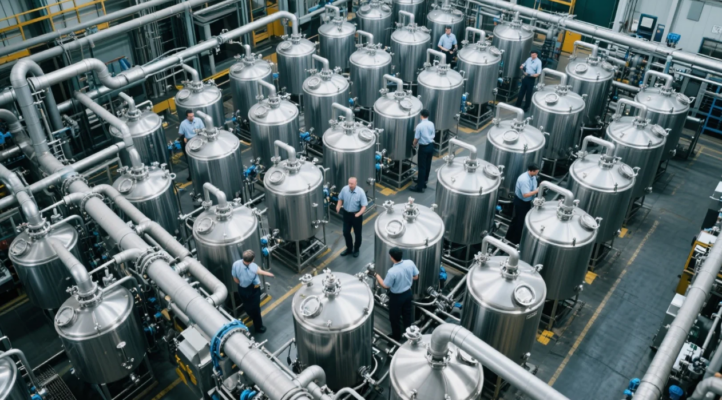
Which Heating Method Fits Your Facility and Available Budget
Heating method affects both the equipment quotation and the site work required to run the brewery. Four commercial options dominate: electric, steam, direct-fire, and thermal-oil heating. Each shifts cost into a different part of the facility.
Electric heating concentrates cost in electrical demand, panel capacity, installation, and heating control. The building’s power supply must be confirmed before anything else. A brewhouse designed for electric heating at a given voltage and frequency will not perform if the facility cannot deliver that load.
Steam heating introduces boiler scope, steam piping, condensate handling, and heat-transfer requirements. If steam is not already available on site, the project must include a boiler system, which adds a substantial line item that has nothing to do with the brewhouse itself.
Direct-fire heating brings fuel supply, exhaust, ventilation, combustion air, and local safety constraints. The site must support the chosen fuel source and exhaust arrangement, and some jurisdictions impose stricter permitting on open-flame systems.
Thermal-oil heating requires a heater package, circulation system, and dedicated controls. It suits specific production targets but carries its own infrastructure demands.
The correct heating source depends on local energy availability, operating cost, utility capacity, regulations, batch size, and production rhythm. This is where the hidden site work often adds more to total project cost than the brewhouse price difference itself. A brewery that anchored only on stated tank volume and the lowest quote discovered after installation that its facility lacked the electrical capacity for the electric heating system. The utility upgrade required a new transformer and panel work, a process that took six weeks and added roughly a quarter of the original equipment cost. The initial savings evaporated entirely, and production startup was delayed past the planned launch date.

Which Vessel Specifications Actually Shift the Price
Two brewhouses with identical vessel layouts can still carry materially different quotations purely on specification level. The vessel count and nominal capacity might match, but the price gap comes from what the tanks and components are actually made of.
Stainless-steel material grade is the first differentiator. Higher-grade steel with better corrosion resistance costs more per kilogram, and in a vessel holding several thousand liters, that difference adds up quickly. Vessel thickness follows the same logic. Thicker walls handle pressure and thermal cycling better and last longer, but they use more material and drive the price upward.
Instrumentation and electrical standards matter just as much. A system built to one electrical standard with basic instrumentation will quote lower than one engineered to a stricter standard with more precise temperature and pressure control. Pumps, valves, and piping quality vary widely between suppliers, and the supply boundary of the quote determines which of these components are even included.
Comparing the technical specification sheet is more reliable than comparing the stated tank volume and the headline price. Buyers should request the full specification document from each supplier, covering material grade, wall thickness, component brands, instrumentation list, and the exact supply boundary. HGMC and other established manufacturers provide these documents on request, and the specification depth is where the real per-liter cost variance lives. A quote that looks expensive against a competitor often reveals its value in better steel, more robust components, and a clearer definition of what is included.
FAQ
What is the most reliable way to compare two brewhouse quotes with the same nominal capacity?
Compare the technical specification sheets, not the headline price. Check stainless-steel material grade, vessel thickness, component brands, instrumentation, and the supply boundary. Two systems with identical stated capacity can differ by 30 percent or more in quotation purely on specification level.
What portion of a brewhouse budget should be reserved for site work and utilities?
Experienced buyers typically reserve 20 to 30 percent of the equipment budget for site work, depending on the heating method. Electric and steam systems often require the most significant utility upgrades. Confirm power supply, boiler availability, and drainage capacity before finalizing the equipment purchase.
How many brews per day can a typical commercial brewhouse realistically complete?
A well-configured system can complete two to three brews per day, but the actual number depends on heating performance, transfer efficiency, and cleaning time. Electric heating tends to extend batch time compared to steam or direct-fire. A 3-vessel design with overlapping process steps generally achieves more brews per day than a 2-vessel system.
Are more brewhouse vessels always worth the extra equipment cost?
No. Additional vessels only pay off if the production schedule requires overlapping process steps. A brewery running two brews per day may see no output gain from moving from three vessels to four, only higher capital and maintenance costs. Match vessel count to the actual weekly operating target.
How much does steel grade and vessel thickness influence the final quotation?
Substantially. Higher-grade stainless steel and thicker vessel walls can add 15 to 25 percent to the vessel cost. The difference shows up in durability and pressure-handling capacity over the equipment’s lifespan, which makes the specification comparison essential before negotiating.
