
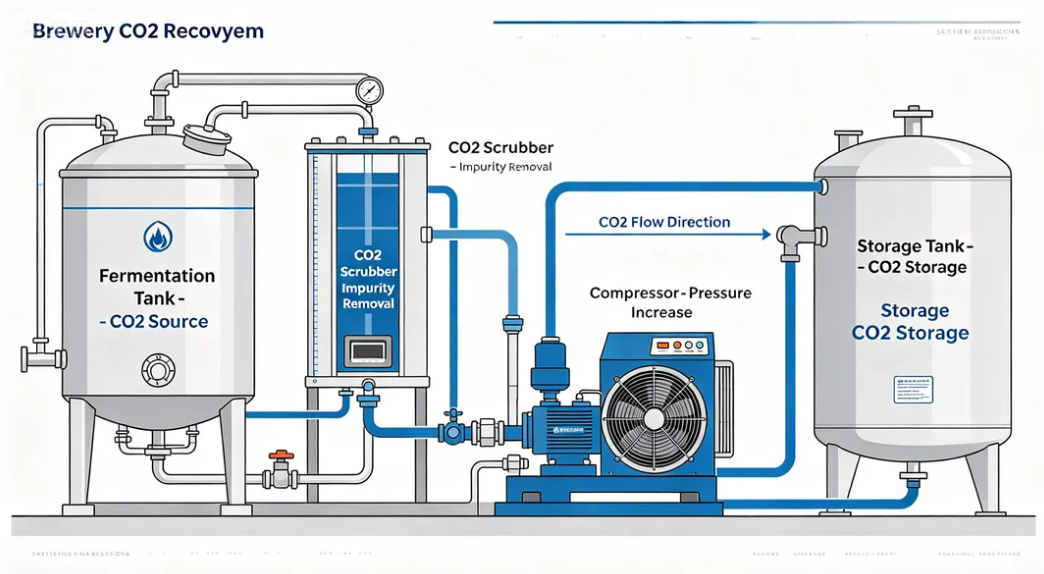
A brewery CO2 recovery system helps commercial breweries capture carbon dioxide generated during fermentation, purify it, and reuse it in production. For breweries with consistent fermentation output and regular CO2 demand, investing in recovery equipment can reduce external CO2 purchases, improve resource utilization, and support more stable gas supply. Buyers should evaluate recovery capacity, purification technology, final CO2 purity, automation, and operating costs before selecting a system.
Why Should Commercial Breweries Invest in a CO2 Recovery System?
A CO2 recovery system can turn fermentation gas into a reusable production resource. During alcoholic fermentation, yeast converts fermentable sugars into alcohol and carbon dioxide. Much of this gas is normally released from fermentation tanks.
However, breweries also consume CO2 during several production stages, including:
- Purging fermentation and bright beer tanks.
- Transferring beer between vessels.
- Carbonating finished beer.
- Preparing pipelines and equipment before production.
Without recovery equipment, breweries may need to purchase additional CO2 while releasing fermentation gas into the atmosphere.
By collecting and processing fermentation CO2, breweries can reuse part of the gas they generate. The actual savings depend on beer production volume, fermentation efficiency, recovery rate, energy consumption, and local CO2 prices.
How Does a Brewery CO2 Recovery System Work?
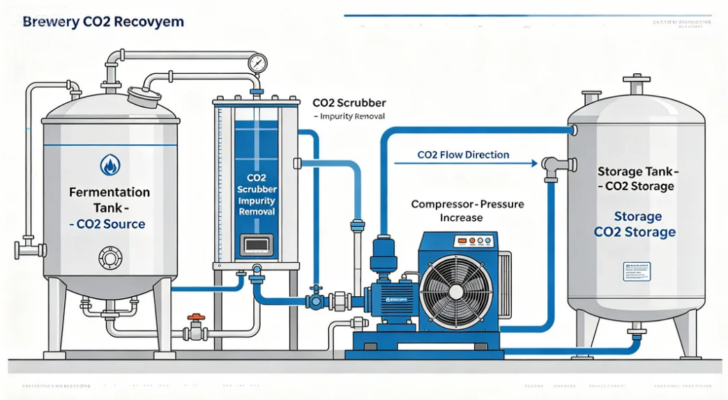
A brewery CO2 recovery system uses several treatment stages to convert raw fermentation gas into reusable CO2. Each stage has a specific function in improving gas quality and preparing it for storage or production use.
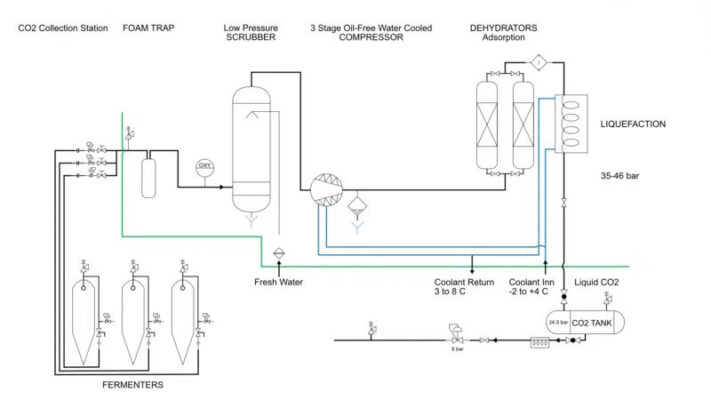
1. CO2 Collection from Fermentation Tanks
The process starts when yeast generates CO2 inside fermentation tanks. Dedicated gas outlets collect the released gas and transport it through pipelines to the recovery unit.
For breweries operating multiple fermenters, pipeline design should consider tank capacity, fermentation schedules, and variations in gas production. Proper connections help maintain stable gas collection and reduce unnecessary losses.
2. Gas Washing and Filtration
Raw fermentation gas contains moisture, foam droplets, yeast particles, and other contaminants. These impurities must be removed before further purification.
A gas washing system uses a scrubber to improve gas cleanliness, while filtration removes remaining particles and protects downstream equipment.
HGMC incorporates structured packing technology in its scrubber column to improve gas-liquid contact. Its product specifications indicate water consumption of approximately 0.25 kg per kg of finished CO2.
3. CO2 Compression and Purification
After pretreatment, the gas enters the compression and purification stages. Compression prepares CO2 for subsequent processing, while additional purification removes residual impurities and non-condensable gases.
HGMC offers PUR-D final purification technology, which uses distillation-column rectification to reduce residual oxygen and improve the quality of recovered CO2.
4. CO2 Liquefaction and Storage
Depending on system configuration, purified CO2 can be liquefied and transferred into storage tanks.
Liquid CO2 storage provides a reserve for periods when brewery demand exceeds current fermentation gas production. Buyers should therefore consider storage capacity together with recovery capacity and daily CO2 consumption.
What Technical Parameters Should Buyers Compare?
Buyers should compare purification performance, water consumption, and automation rather than selecting equipment based on processing capacity alone.
The following table summarizes important reference specifications and configuration considerations.
| Comparison Parameter | HGMC Reference Specification | Buyer Consideration |
|---|---|---|
| CO2 recovery source | Fermentation gas | Compatible with fermenter connections |
| Gas washing technology | Structured packing scrubber | Gas-liquid contact efficiency |
| Water consumption | Approx. 0.25 kg/kg finished CO2 | Water and operating costs |
| Final purification | PUR-D distillation rectification | Residual impurity removal |
| CO2 purity | ≥99.998% (PUR-D option) | Match application requirements |
| Residual oxygen | Below 5 ppm by volume (PUR-D option) | Important for oxidation-sensitive processes |
| Control system | Electronic touchscreen control | Operating convenience |
| Storage configuration | Optional liquid CO2 storage | Match production demand |
Note: The purity and oxygen figures refer to the specified PUR-D purification option, not necessarily every standard configuration. Final specifications should be confirmed in the equipment quotation.
What Benefits Can a CO2 Recovery System Bring to a Brewery?
A properly configured recovery system can improve brewery operating efficiency in several ways.
Reduce Purchased CO2 Costs
Recovering fermentation gas creates an additional CO2 supply for brewery operations. This can reduce dependence on external suppliers, particularly for breweries with high production volumes and consistent fermentation schedules.
Improve Resource Utilization
Fermentation CO2 becomes a reusable resource instead of being entirely discharged. This supports more efficient use of production materials and utilities.
Improve Supply Planning
Liquid CO2 storage helps balance differences between fermentation gas generation and production consumption. Breweries can maintain a more flexible supply arrangement when fermentation activity fluctuates.
What Should Buyers Consider Before Purchasing CO2 Recovery Equipment?
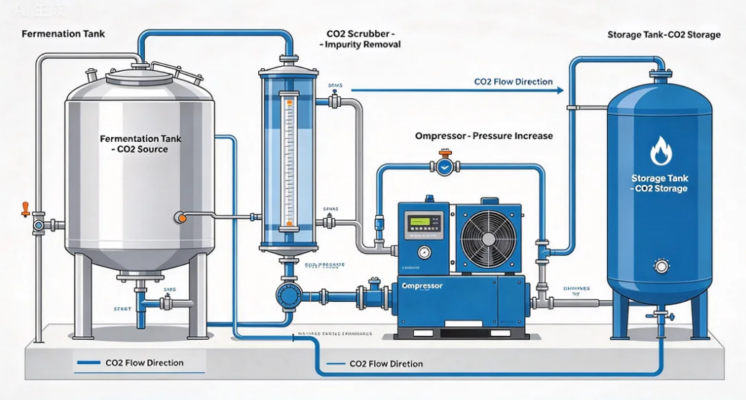
Selecting the right system requires an evaluation of both production conditions and long-term operating requirements.
First, calculate available fermentation CO2. Consider annual beer production, fermentation tank numbers, tank volumes, and brewing schedules. These factors help estimate the amount of gas available for recovery.
Second, identify actual CO2 demand. Calculate consumption during tank purging, beer transfer, and carbonation. The recovery system should match realistic demand rather than an assumed maximum requirement.
Third, define gas quality requirements. Different applications may require different purity and oxygen levels. Confirm the applicable quality standards before choosing purification technology.
Fourth, check installation conditions. Review available floor space, electrical supply, cooling utilities, gas pipeline connections, and liquid CO2 storage arrangements.
Finally, evaluate automation and maintenance. A touchscreen control system, automatic startup sequence, operating alarms, and accessible maintenance components can help simplify daily operation.
CO2 safety also deserves attention. Because carbon dioxide can displace oxygen, installation planning should include suitable ventilation, gas detection, pressure protection, and operator training.
How Can Buyers Integrate CO2 Recovery into a Complete Brewery Project?
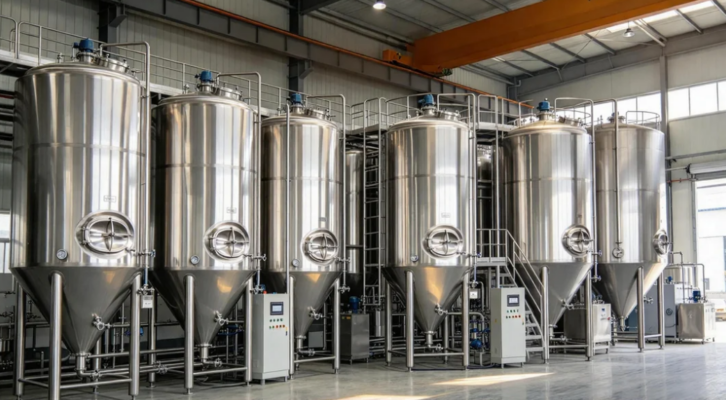
CO2 recovery equipment should be planned together with fermentation tanks and the wider brewery production system. This allows manufacturers to coordinate gas outlets, pipelines, utility connections, and equipment layout before installation.
HGMC provides brewery CO2 recovery solutions with gas washing, filtration, and optional PUR-D final purification. Its equipment configuration can be adjusted according to brewery production capacity, gas quality requirements, and installation conditions.
For buyers planning a new commercial brewery or upgrading an existing facility, providing fermentation capacity, expected CO2 consumption, required purity, and available installation space will help manufacturers prepare a more suitable technical proposal.
Explore Commercial Brewery Equipment and Brewery Fermentation Tanks, or contact HGMC to discuss your CO2 recovery project.
Frequently Asked Questions
1. What Is the Main Function of a Brewery CO2 Recovery System?
Its main function is to collect carbon dioxide generated during beer fermentation, remove impurities, and prepare the gas for reuse in brewery operations.
2. Can Recovered CO2 Be Used Directly in Beer Production?
No. Raw fermentation gas contains moisture, oxygen, and other contaminants. It must undergo appropriate washing, filtration, and purification before reuse.
3. What CO2 Purity Can a Recovery System Achieve?
HGMC’s PUR-D purification option specifies a CO2 volume fraction of at least 99.998%, with residual oxygen below 5 ppm by volume. Actual performance depends on the selected configuration and operating conditions.
4. Is a CO2 Recovery System Worth the Investment for a Small Brewery?
It depends on fermentation output, CO2 consumption, local gas prices, equipment investment, and operating costs. Small breweries should compare potential annual savings with total ownership costs before making a purchasing decision.
