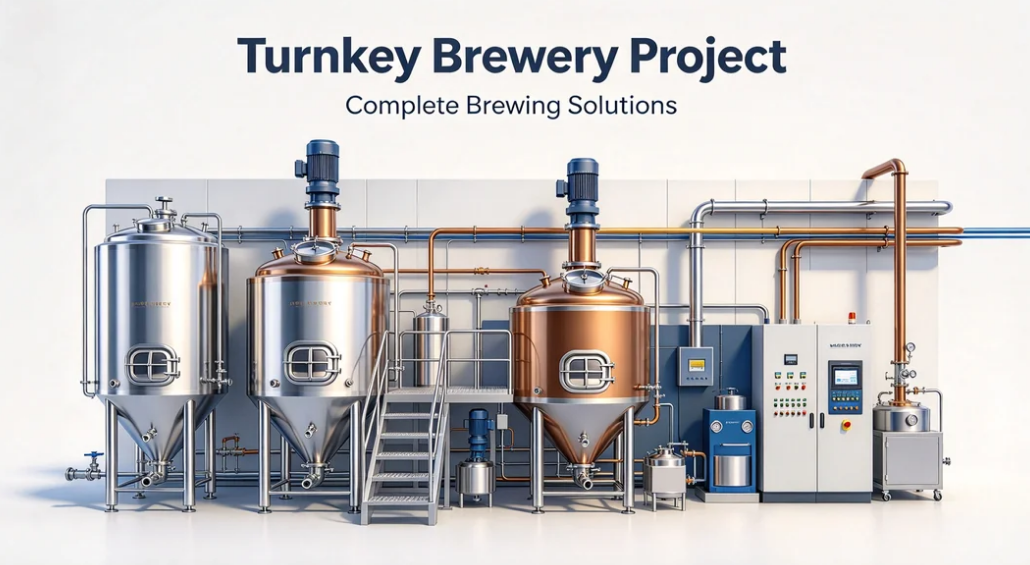
Starting a turnkey brewery project requires more than selecting brewing equipment. Buyers should first define their production capacity, beer styles, packaging requirements, facility conditions, and investment budget. Preparing these details helps equipment manufacturers recommend a suitable brewing system, avoid unnecessary costs, and develop a complete brewery solution that supports both current production and future expansion.
1. What Production Capacity Should Buyers Determine First?
Production capacity is the first factor buyers should clarify because it determines the size, quantity, and configuration of the main brewery equipment.
Before requesting a quotation, estimate your expected daily, monthly, and annual beer production. Consider current market demand as well as potential business growth over the next three to five years.
However, brewhouse capacity and total brewery output are not the same. Fermentation time, tank availability, cooling performance, and packaging speed all influence actual production capacity.
For example, a brewery with a 1,000L brewhouse may require several fermentation tanks to maintain continuous production. If fermentation capacity is insufficient, the brewing system may not achieve its expected output.
Buyers should therefore evaluate the entire production cycle rather than choosing equipment based on batch volume alone.
2. Which Beer Styles and Brewing Processes Should Be Confirmed?
Different beer styles require different brewing conditions, so buyers should identify their product range before selecting equipment.
Lager, IPA, Stout, Wheat Beer, and Pale Ale may have different fermentation temperatures, yeast requirements, and conditioning periods. These differences influence fermentation tank configuration, temperature control, and production scheduling.
For breweries producing multiple beer styles, flexible equipment configurations are particularly important.
Before contacting a manufacturer, consider the following questions:
- Which beer styles will you produce initially?
- Will you manufacture multiple recipes using the same brewhouse?
- Do certain products require separate fermentation arrangements?
- How frequently will you change recipes?
- Do you plan to introduce additional beer styles later?
A well-designed brewing system should support your actual recipes and production schedule instead of relying on a standard equipment package.
3. What Equipment Parameters Should Buyers Compare?
Comparing equipment specifications helps buyers understand whether different brewery proposals meet their production requirements. Instead of focusing only on vessel volume, evaluate the complete system configuration.
The following table provides a practical reference for comparing major brewery equipment components.
| Equipment | Key Parameters to Compare | Main Function |
|---|---|---|
| Brewhouse System | Batch capacity, vessel configuration, heating method | Mashing, lautering, boiling |
| Fermentation Tanks | Working volume, tank quantity, cooling zones | Beer fermentation |
| Bright Beer Tanks | Capacity, pressure rating, cooling requirements | Beer maturation and storage |
| Glycol Cooling System | Cooling capacity, temperature range | Process temperature control |
| CIP System | Tank volume, cleaning circuits, automation | Equipment cleaning |
| Beer Filling Line | Filling speed, packaging format | Bottling, canning, or kegging |
| Control System | Manual, semi-automatic, or automatic | Production management |
These specifications should be evaluated together. For example, increasing brewhouse capacity without expanding fermentation capacity may create production bottlenecks.
Buyers should also request equipment drawings, material specifications, electrical requirements, and detailed quotations to make accurate comparisons.
4. What Packaging Requirements Should Be Included?
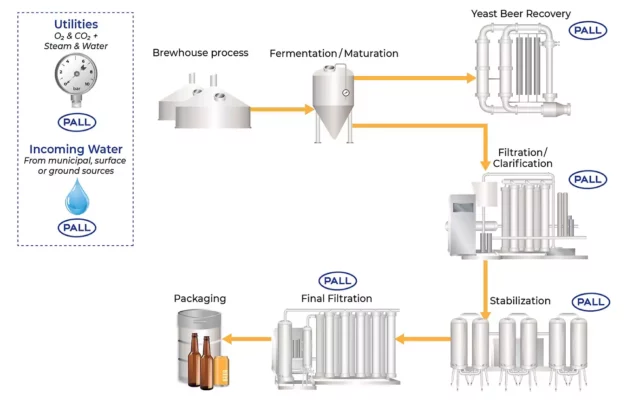
Packaging requirements directly affect the final brewery equipment configuration and overall investment.
Commercial breweries commonly use three packaging formats:
Glass Bottles: Suitable for retail distribution, supermarkets, and restaurants. Buyers should consider bottle sizes, filling speed, and labeling requirements.
Aluminum Cans: Popular among craft breweries because they are lightweight and convenient for transportation. Can filling capacity and packaging automation should match the planned production volume.
Beer Kegs: Appropriate for bars, restaurants, breweries, and draft beer distribution. Keg washing and filling equipment should be included when required.
If you intend to introduce additional packaging formats in the future, discuss expansion possibilities during the initial design stage. This can reduce the cost of modifying the production line later.
5. What Facility Information Do Manufacturers Need?
The available building space and utility conditions determine whether the proposed equipment can be installed and operated efficiently.
Buyers should provide accurate building dimensions, including floor area, ceiling height, door dimensions, and equipment access routes.
Other important facility details include:
- Raw material and finished beer storage areas.
- Brewing and fermentation room dimensions.
- Floor drainage and wastewater arrangements.
- Equipment maintenance space and operator walkways.
- Water supply pressure, volume, and quality.
- Electricity voltage, frequency, and available power.
- Steam or electric heating requirements.
- Glycol cooling and compressed air availability.
Providing these details allows manufacturers to prepare equipment layouts and identify potential installation problems before production begins.
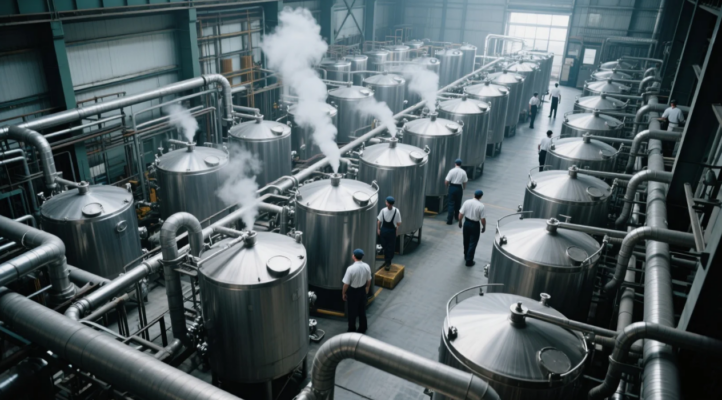
6. How Much Automation Does Your Brewery Need?
The appropriate automation level depends on production scale, labor availability, and operating experience.
A semi-automatic brewery may be suitable for smaller operations where experienced brewers prefer direct control over individual processes. It generally offers a balance between investment costs and operational flexibility.
A fully automatic brewery can provide centralized process monitoring, automated temperature control, pump and valve operation, and more consistent production management.
When comparing automation configurations, buyers should examine the control system, sensor accuracy, operating interface, and maintenance requirements.
The goal is not to purchase the most advanced system available, but to select automation that improves efficiency without creating unnecessary investment.
7. What Budget Information Should Buyers Prepare?
A realistic project budget should cover more than the main brewing vessels.
Depending on the project scope, buyers may need to include:
- Brewhouse and fermentation equipment.
- Bright beer tanks and cooling systems.
- Pumps, valves, and pipelines.
- CIP cleaning equipment.
- Bottling, canning, or keg filling machinery.
- Electrical control and automation systems.
- Transportation, installation, and commissioning.
- Operator training and after-sales support.
When comparing supplier quotations, make sure each proposal covers similar equipment and service requirements. A lower initial price does not necessarily represent a lower total project cost.
It is also important to distinguish between essential equipment and optional expansion components.
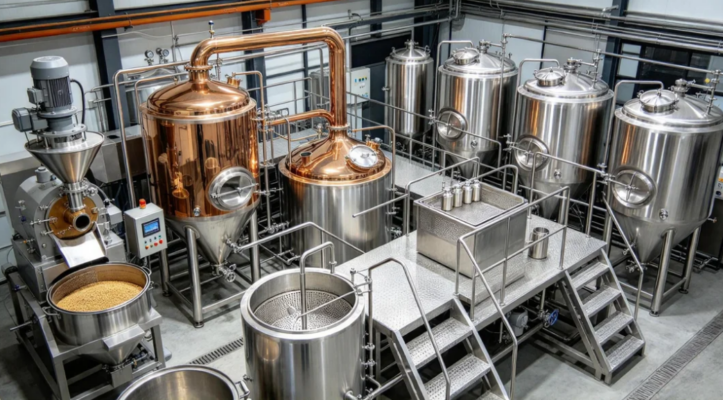
8. How Can Buyers Get a More Accurate Turnkey Brewery Proposal?
The more complete your project information, the easier it is for manufacturers to develop a suitable brewery solution.
Before requesting a quotation, prepare your target production capacity, beer styles, packaging formats, building dimensions, utility conditions, preferred automation level, and estimated budget.
At HGMC, brewery equipment configurations can be developed according to individual production requirements. A coordinated proposal may include brewhouse systems, fermentation tanks, cooling equipment, CIP systems, packaging machinery, and supporting facilities.
Buyers can also request equipment specifications, process flow diagrams, and brewery layout drawings before confirming the final configuration.
A carefully planned project helps reduce equipment mismatches, control investment costs, and establish a reliable foundation for commercial beer production.
If you are planning a new brewery or expanding an existing facility, share your project requirements with HGMC to discuss a customized turnkey brewery solution.
Frequently Asked Questions
1. What information is needed to start a turnkey brewery project?
Buyers should prepare production capacity, beer styles, packaging requirements, facility dimensions, utility conditions, automation preferences, and budget expectations.
2. How do I choose the right brewery production capacity?
Estimate expected market demand, daily production targets, fermentation time, and future expansion plans. The brewhouse and fermentation systems should be sized together.
3. Does a turnkey brewery include packaging equipment?
Not necessarily. Packaging equipment depends on the agreed project scope. Buyers should confirm whether bottling, canning, keg filling, and associated cleaning systems are included in the quotation.
4. How can I reduce the investment cost of a turnkey brewery?
Choose equipment according to actual production requirements, compare complete supplier quotations, prioritize essential components, and reserve space for future expansion. Avoid purchasing oversized equipment that cannot be efficiently utilized.
