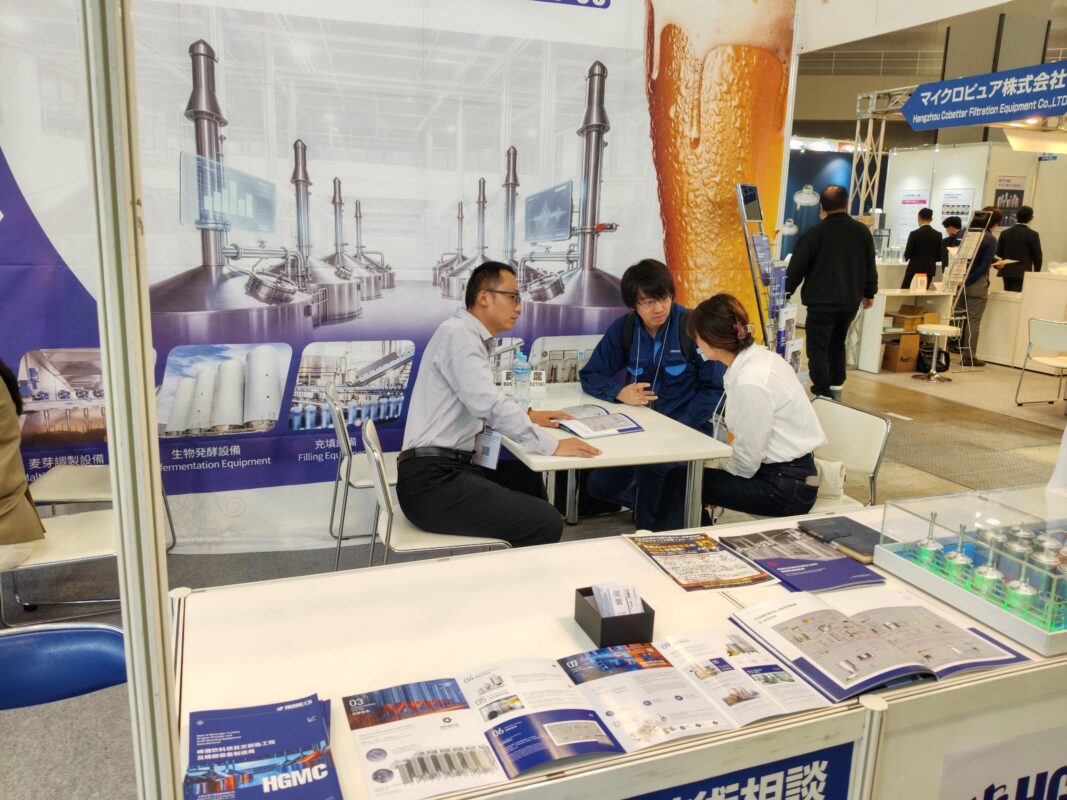
Shandong HG Engineering Equipment Co., Ltd. (HGMC) will exhibit at the 11th Drink Japan, held from November 18 to 20, 2026, at Tokyo Big Sight, East Halls 7 and 8. At this dedicated B2B trade show for beverage and liquid food development and manufacturing, HGMC will present brewing solutions built around a specific market reality: Japan’s craft beer sector is expanding rapidly, but the producers driving that growth need equipment that is smaller, more flexible, and less dependent on specialized labor than conventional brewery lines.
Why Japan, and Why Flexibility Matters
Japan’s craft beer market reached USD 9.0 billion in 2025 and is projected to approach USD 24.9 billion by 2034, growing at a compound annual rate of 11.62%. The number of breweries producing craft beer within Tokyo’s 23 wards has increased roughly sixfold over the past decade, reflecting a steady emergence of microbreweries, brewpubs, and small-batch producers in urban and semi-urban locations. This growth is not driven by large-capacity production. It is driven by small teams producing multiple beer styles, rotating seasonal batches, and experimenting with local ingredients — often within limited floor space and strict capital budgets.
For equipment suppliers, that market profile changes what “good” looks like. A brewery with a 1,000L to 3,000L batch size does not need a scaled-down version of a large industrial brewhouse. It needs vessels that can be configured around its process, a control system that matches its staffing level, and a path to add capacity without replacing the entire line. HGMC’s exhibition at Drink Japan is organized around that premise.
Flexible Brewhouse Configurations, Not Fixed Packages
HGMC’s micro craft brewery systems cover batch capacities from 1,000L to 3,000L, with multi-vessel combinations that can be arranged around the customer’s brewing process rather than forcing the process into a pre-set package. Heating options include electric, steam, and direct fire. Control levels range from PID panel operation to PLC-based semi-automatic touchscreen interfaces and fully automatic PLC control. For a start-up brewpub beginning with a 5–10 HL system, or a small regional brand scaling toward 20 HL brewhouses with multiple fermenters, the same modular logic applies: equipment grows with the brewery instead of being outgrown by it.
Materials and fabrication standards are central to the proposition. Tanks are constructed from 304 or 316 stainless steel with plate thickness controlled at 2mm to 3mm, and each unit undergoes water and air pressure testing, finished-product inspection, and a 48-hour water running test before shipment. For craft producers whose product consistency depends on repeatable temperature control and clean fermentation environments, those fabrication details are not cosmetic — they are the baseline for batch-to-batch reliability.
iBrew 4.0: Automation Aimed at Labor Reality, Not Labor Replacement
Alongside its hardware configurations, HGMC will introduce the iBrew 4.0 intelligent brewing system to the Japanese market. First launched globally at CBCE 2025 in Shanghai, iBrew 4.0 integrates AI-assisted brewing parameter optimization, real-time energy consumption monitoring, and a remote operation and maintenance platform. The system is designed to achieve a 98% automation rate across the brewing process and to shorten fault response time to approximately 15 minutes.
For Japanese microbreweries facing a constrained pool of experienced brewers, the value of this level of automation lies less in reducing headcount than in freeing limited technical staff from repetitive monitoring and adjustment. The system supports production process visualization, intelligent early warning and fault diagnosis, and integrated recipe management — functions that allow a small team to maintain consistency across multiple beer styles without adding operational complexity. At a time when Japan’s craft sector is defined by variety and experimentation rather than volume, that balance between automation and flexibility is directly relevant to how small breweries actually operate.
Complementing the brewhouse and control systems, HGMC’s canning and bottling lines cover semi-automatic formats from roughly 300 cans per hour up to fully automatic lines exceeding 2,000 cans per hour, accommodating lagers, ales, stouts, wheat beers, ciders, and carbonated soft drinks. For a microbrewery moving from draft-only distribution to packaged retail, this allows production to scale within a single supplier relationship rather than requiring a separate packaging equipment search.
A Track Record Built Across Markets
HGMC’s approach at Drink Japan follows a pattern established through its 2025 international exhibition schedule. At KIBEX 2025 in Seoul, the company presented modular craft beer equipment and intelligent fermentation control systems tailored to small and medium-sized brewing scenarios; during the show, three leading Korean companies signed strategic cooperation agreements on-site. At CBCE 2025 in Shanghai, HGMC launched iBrew 4.0 and engaged with more than 200 industry experts on topics including digital transformation and low-carbon brewing. The company has also exhibited at Drinktec 2025, where it presented intelligent brewing equipment and customized solutions under the theme of “Smart Manufacturing in China”.
On the corporate side, HGMC brings more than 20 years of experience in beer equipment, a 30,000-square-meter manufacturing facility, more than 30 national authorized patents, ISO 9001:2015 quality management system certification, and equipment supplied to customers in over 120 countries and regions. For Japanese craft brewers evaluating suppliers for long-term service and spare-parts support, these qualifications provide a practical baseline for commercial due diligence.
Meeting the Japanese Market on Its Own Terms
Drink Japan’s significance for HGMC extends beyond the three-day exhibition. Japan’s craft beer growth is occurring at the small-batch, high-variety end of the production spectrum, where the ability to configure equipment around a brewery’s process — rather than around a fixed catalog specification — determines whether a system is actually usable. HGMC’s exhibition at Drink Japan 2026 is structured to address that requirement directly, through modular brewhouse configurations, tiered automation options, and a service model oriented toward long-term local support rather than one-time equipment delivery.
Exhibition Information
-
Event: Drink Japan 2026 (11th Beverage & Liquid Food Development/Manufacturing Expo)
-
Dates: November 18 (Wed) – November 20 (Fri), 2026, 10:00–17:00
-
Venue: Tokyo Big Sight, East Halls 7 & 8
-
Business Contact: [email protected] | +86 531 86418866
