
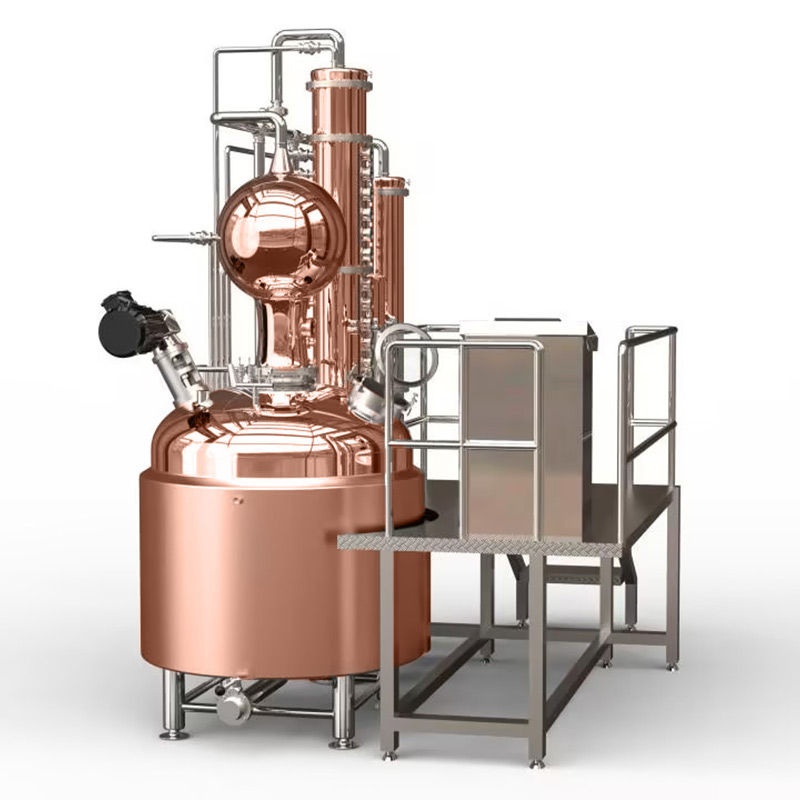
In early 2025, the craft distillery landscape shifted again. New regulations, rising ingredient costs, and a saturated market for premium bourbon forced many startups to rethink their equipment strategy. The dream of a 500-liter copper pot still faded quickly when the quote came in at $40,000 plus installation. That’s when a different number started appearing in distillery forums and trade shows: 150 liters.
For small craft distilleries, an affordable 150L distillery equipment provides the ideal balance between production capacity, capital cost, and operational simplicity, making it the most practical entry point for spirit production in 2026.
The Capacity Trap
Three years ago, a friend’s distillery in Oregon bought a 50-liter pot still because it was cheap and fit their tiny garage. Within six months, they were running four batches a day just to keep their tasting room stocked. The still was on for 16 hours straight most Saturdays. The operator burned out, the product consistency suffered, and they eventually mothballed the setup.
On the other end, a startup in Colorado went straight for a 300-liter still after a successful Kickstarter. They couldn’t fill the wash consistently—their fermentation capacity was half that size. The still sat idle three days a week, and the loan payments on the equipment ate into their margin before they’d sold a single bottle.
The 150-liter size sits in a narrow band where most small operations can actually use it fully without overextending. A standard 200-liter fermenter (common and cheap) feeds one 150-liter stripping run nicely. The ratio feels natural: one fermenter, one stripping charge, one spirit run. No gaps, no waste.
After three months of fighting a cheap 100-liter still that leaked at the seam, the team replaced it with 150L Distillery Equipment. The difference in weld quality and copper thickness was immediately apparent. The unit had TP2 red copper on the inner tank—3mm thick—and a stainless steel jacket that didn’t warp under heat. The first stripping run held pressure without a single drop of leakage. That alone saved them two hours of troubleshooting per batch.
What $5,000 to $10,000 Actually Buys You
Let’s be blunt: a lot of cheap distillery equipment on the market in 2025 is dangerous. Thin stainless, poorly aligned columns, and valves that seize after three heat cycles. The 150L segment has matured, though. Manufacturers like HGMC now offer a configuration that includes:
- TP2 copper inner tank (3mm wall)
- Stainless steel outer jacket for safety and insulation
- Choice of electric or interlayer steam heating (steam vastly preferred for flavor control)
- 4–6 tray column with sightglasses
- Copper whiskey head
- Condenser with adequate surface area for the capacity
The price tag typically lands between $5,000 and $10,000 depending on options. That’s a fraction of what a 300-liter still costs, yet the production difference is narrower than expected. Why? Because you can run a 150-liter still twice—or even three times—in the time it takes to heat up and cool down a larger vessel.
Two weeks into using the 150L distillery equipment, the team noticed an unexpected benefit: the smaller volume meant they could experiment with different wash recipes without committing 300 liters of grain to a potential mistake. They ran a rye mash on Tuesday, a rum on Thursday, and a neutral spirit on Saturday. The product diversity let them test three different SKUs before choosing which one to scale.
Real-World Throughput: How Many Cases Can You Actually Produce?
After dialing in their process, the team ran two stripping charges and one spirit run per day—about a 10-hour shift. Each full cycle (mash, ferment, distill) took about a week, but the still itself was active only 4–5 hours per batch.
The numbers: a 150-liter still, filled to roughly 80% (120 liters wash at 10% ABV), yields about 12–15 liters of low wines after stripping. A spirit run combining two low wines charges gives roughly 25 liters of hearts at 65% ABV. That translates to about 40–45 bottles of 750ml at 40% ABV after dilution.
Two strips and one spirit run per day, five days a week, yields approximately 200–225 bottles per week. That’s roughly 10,000 bottles a year—enough to service a small tasting room, a handful of local retailers, and a monthly club shipment.
But the biggest surprise came when they ran a double-shift for two weeks before a holiday: 600 bottles per week without any major breakdown. The still handled the load, though the condenser started showing signs of thermal stress on the final day. A quick flush with water and it was fine, but it underlined that continuous heavy use requires a slightly oversized cooling system.
Material Choices: Copper vs. Stainless in a Small Still
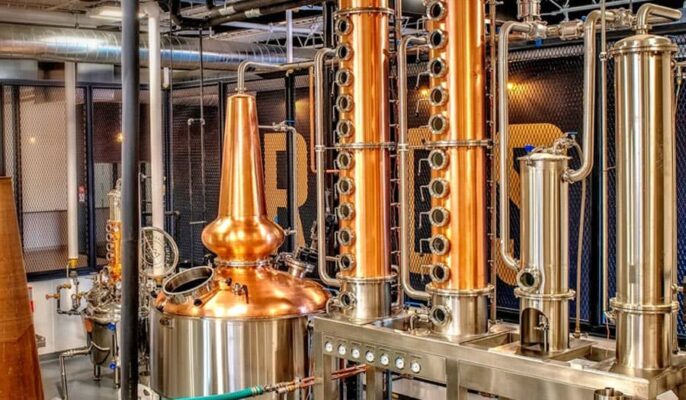
For whiskey and rum, copper is not optional—it catalytically removes sulphur compounds that give harsh notes. Many entry-level stills use copper only in the column or a small section. The 150L distillery equipment from HGMC uses a full copper inner tank. That’s important because the vapor spends less time in contact with copper in a small still compared to a large one, so every square inch counts.
Stainless steel is easier to clean and doesn’t patina, but the stainless outer jacket here serves as the heating jacket, not the product contact surface. After 18 months of continuous use, the copper showed a uniform patina and no pitting. The team had worried that 3mm copper might be too thin for repeated thermal cycling, but it held up better than the 5mm stainless-only still they had previously used—likely because copper conducts heat more evenly, reducing local hot spots.
There was a moment of hesitation when the CIP system first arrived; the spray ball sputtered instead of coating the walls evenly. A quick adjustment to the pump pressure solved it, but it reinforced that commissioning any still—even a well-built one—always reveals a few surprises.
Hidden Costs That Surprised Every Operator
The still itself is only half the equation. Cooling capacity, ventilation, and floor prep can add 30–50% to the total project cost.
A 150-liter still with a 5‑plate column needs a condenser capable of knocking down ~25 liters per hour of ethanol vapor at full power. That requires a water flow of roughly 8–10 gallons per minute if using mains water (at $0.005 per gallon, that’s about $50/month in the Midwest—close to $200 in California). A recirculating chiller adds $2,000–$3,000 upfront but pays for itself within a year. The team went with a chiller after their first month’s water bill hit $180.
Ventilation is often underestimated. Ethanol vapor sinks, so a floor-level exhaust is required. A 150-liter still produces enough vapor that a standard kitchen hood won’t cut it. They installed an explosion-proof fan rated for 300 CFM and ducted it outside. That cost $1,200 including labor.
Floor drains and sloped floors for washdowns? Not required by code in their county, but the team regretted skipping it after the first spill. A mop works, but it’s not adequate for routine cleaning.
Why 150L Makes Sense in the 2025 Market
Grain prices have stabilized after the spike, but labor costs haven’t come down. A 150-liter still can be operated by one person, whereas anything over 200 liters often requires a helper for safety during lifting and transferring. The 150 size fits on a standard pallet, installs through a 32-inch doorway, and runs on 240V single-phase power (electric heating option). No three-phase power upgrade, which can cost $5,000–$10,000 depending on distance from the transformer.
By sticking with the 150L distillery equipment, the distillery kept its initial capital under $10,000 and avoided the debt trap that has closed so many craft distilleries in the last five years. The ROI calculation was simple: at 40 bottles per week sold at $40 retail, gross revenue of $1,600/week, the equipment paid for itself in about 10 weeks.
Of course, that assumes you can sell everything you make. Distribution is another challenge, but at least the equipment cost isn’t the barrier.
FAQ
Is a 150L still enough to start a craft distillery?
Yes, if you’re targeting local sales and a small tasting room. Most distilleries that fail do so because they overscale their equipment and take on debt they can’t service. A 150-liter still with a 200-liter fermenter can reliably produce 200–250 bottles per week, which is enough to test the market without burning cash.
How much does affordable 150L distillery equipment cost in 2025?
Expect to pay between $5,000 and $10,000 for a complete setup including column, condenser, and heating system. Options like electric vs. steam, copper vs. stainless column trays, and automatic controls can push the price higher. The HGMC configuration with TP2 copper inner tank and electric heating is typically in the lower end of that range.
What spirits can I make with a 150L still?
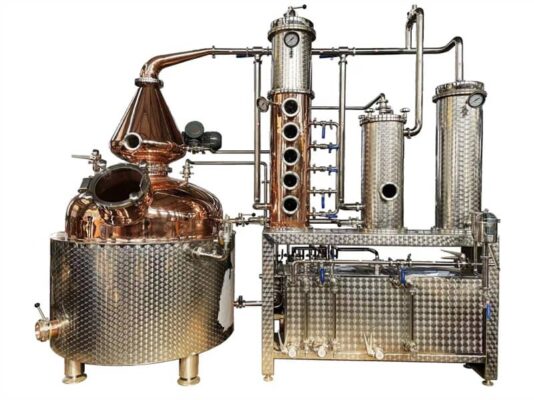
Whiskey, vodka, gin, rum, brandy, and neutral spirits. A multi-purpose 150L still with a 4‑6 plate column and a copper whiskey head can produce everything from a clean neutral to a heavy pot-still whiskey. Swapping the column for a gin basket is straightforward.
What are the space requirements for a 150L distillery setup?
You need roughly 8 feet by 10 feet for the still, fermenters, and work area. Ceiling height should be at least 10 feet to accommodate the column and a ladder for cleaning. Ventilation and floor drainage add some footprint, but the whole system can fit in a one-car garage.
How does 150L compare to 100L or 200L stills?
A 100L still limits you to about 15–18 liters of hearts per run, meaning you’d need three runs to match one 150L run. A 200L still is better on throughput per run but requires larger fermenters and often three-phase power. The 150L strikes the best balance for a single-operator micro-distillery.
