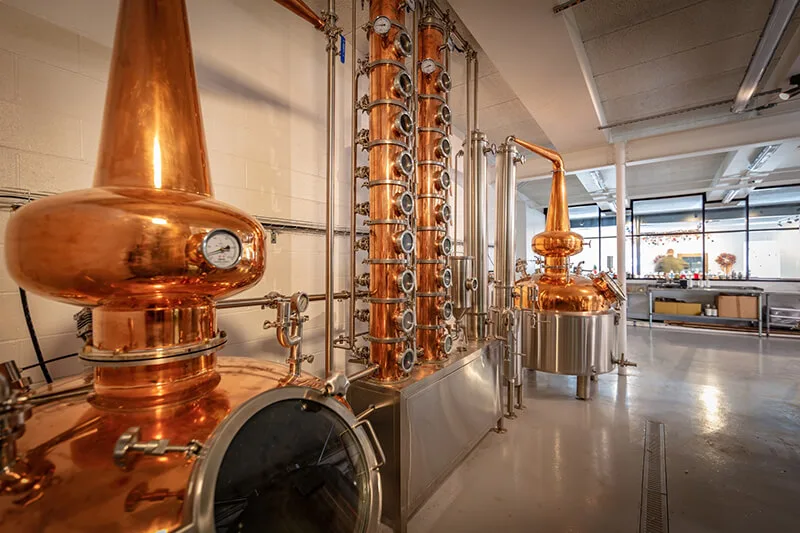
Two years ago, I watched a 500-liter distillation run of experimental rye mash die on transfer because the cooling loop on our still wasn’t matched to the condenser surface area. The entire batch — six weeks of fermentation, grain sourcing, and scheduling — went down a floor drain. That single failure cost us roughly $2,400 in raw materials and labor, but the real damage was the two-month delay it introduced to our launch timeline.
That afternoon, I started keeping a log. Not of recipes, but of every mechanical issue, every capacity shortfall, every surprise shutdown. Eighteen months later, I had a dataset that changed how I think about distillery equipment entirely — not as a fixed purchase, but as a variable in a production equation that shifts constantly as volumes increase.
Here is what came out of that record.
The Plateau Nobody Warns You About
You’ll hear a lot about the first 12 months of a micro-distillery: the excitement of the first bottle, the slow build of distribution, the surprise of a local bar picking you up. What you won’t hear is the quiet six-month plateau that follows, when production volume stops scaling linearly with time.
We hit ours at month nine. We were running three shifts per week on a 750-liter pot still, producing roughly 180 proof gallons per month. Then demand crept up — a regional distributor signed on, a handful of restaurants started carrying our gin — and we needed to push to 250 proof gallons. That 38% increase should have been straightforward. Instead, it took five months and three separate equipment reconfigurations.
The bottleneck wasn’t fermentation capacity or storage. It was the distillation cycle itself. Our still could handle the volume, but the heat-up and cool-down times were fixed physical constraints. Adding a second shift meant labor costs that eroded margins. We needed either a larger still or a parallel setup.
I spent those five months evaluating options. What I learned is that most equipment specs — especially cycle time and energy consumption — are measured under ideal conditions. Real-world cycle times regularly run 15–20% longer because of ambient temperature, feedstock variability, and the gradual fouling of heat-exchange surfaces. The standard 9-hour cycle for a 5,000-liter still? Plan for 10.5 hours minimum by the third month of continuous use.

The Temptation of Buying Cheap, Twice
During that evaluation, I nearly made the mistake I’d seen a dozen colleagues make: ordering a still from a low-cost fabricator in a market where price was the only differentiator. The unit was 40% cheaper than established suppliers, and the lead time was half as long. I had the quote approved.
What stopped me was a conversation with a distiller in Portland who had bought exactly that unit eighteen months earlier. His experience: the copper thickness was inconsistent across the pot, leading to uneven heating that required constant intervention. The column tray design didn’t allow for effective cleaning-in-place, so he was manually scrubbing after every third run. Within twelve months, he had welded patches on two sections and had replaced the condenser entirely.
The total cost of ownership over two years, including downtime and lost production, was actually higher than if he had bought premium equipment upfront. That’s not a platitude. It’s arithmetic.
I went back to my notes and modeled total cost over a three-year horizon for three different equipment tiers at our projected volume of 400 proof gallons per month. The mid-tier option with proper copper thickness and CIP compatibility was 22% cheaper in the long run than the cheapest option, even though the initial outlay was nearly double. The factor that swung it was maintenance downtime: the cheap still projected 18 unscheduled days per year; the mid-tier, 4.
When Product Consistency Becomes a Supply Chain Problem
The moment that forced me to stop treating distillation as an art and start treating it as a process came during our first attempt to scale a single-recipe whiskey to two different still sizes simultaneously.
We had a 200-liter experimental still that had been producing a consistent cut for months — heads at 72°C, hearts from 78°C to 84°C, tails starting at 87°C. When we moved to the 1,000-liter production still, those temperature windows shifted by 4–5°C. The tails started earlier. The hearts volume dropped by 12%. We spent six weeks adjusting parameters, and even then, the profile was close but not identical.
That’s when I understood that “scalability” means different things at different points in the supply chain. For a distiller alone, it means repeatability across batch sizes. For an e-commerce operator who sells equipment to those distillers, it means knowing your customer’s actual operating conditions — not just their desired volume.
Three weeks into that reconciliation effort, we lost a wholesale contract because the first pallet of the scaled-up product had a slightly different nose than the sample they’d approved. It wasn’t a bad product. It just wasn’t the product.
I began running parallel test batches on the two stills for every new recipe before committing to full-scale production. That added two weeks to every launch calendar, but it eliminated the kind of error that costs real money downstream.
The Decision That Changed Our Buildout
After the rye-wash disaster that opened this article, we committed to a complete rebuild of our cooling and heating infrastructure. The existing system was a patchwork of off-the-shelf components we’d assembled ourselves. It worked at 200 liters. At 1,000 liters, the heat-transfer math broke.
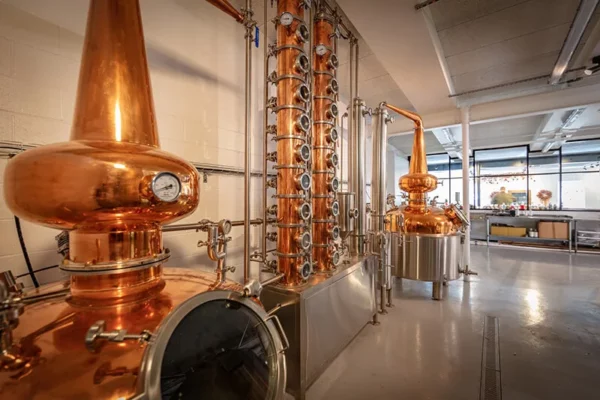
Our consultant recommended we move to a fully integrated system where the heating jacket, condenser, and cooling tower were sized together by the manufacturer rather than spec’d independently. That’s when we began working with a supplier that offered a turnkey solution rather than standalone components. The equipment we ultimately purchased — a 1,500-liter copper pot still with a matched plate condenser and a steam-heated jacket — came from Hgmc Brewing. The specific reason wasn’t the price or the lead time; it was that they provided a capacity-loading table that matched real-world batch cycle data I’d been collecting.
I ran that table against our logs for the preceding six months. Their predicted cycle time for a 1,500-liter batch was 5.5 hours. Our actual average on the old 750-liter still was 3.8 hours per batch, but we were running two batches per day. The new still would let us finish a single 1,500-liter batch in the same total time, with half the labor overhead. The energy consumption projection — 1.0 hph per batch — matched our electrical infrastructure without requiring a substation upgrade that we couldn’t afford.
Where the Integration Work Actually Happens
Once the equipment arrived, the real learning began. Getting a still to sit on a foundation is not the same as getting it to produce consistent spirit. The installation phase consumed six days — not because the equipment was poorly designed, but because our building’s drainage slope was wrong for the CIP pump output and we had to re-pour a section of the floor.
The copper welding on the column plates required a local TIG welder who had experience with food-grade metals, which took three days to find. The thermowell placements on the dome didn’t align perfectly with our existing temperature probe lengths, so we had to adapt the probes into the ports.
I mention these because the difference between a successful equipment purchase and a frustrating one is often not the equipment itself but the ecosystem around it. The supplier’s drawings were dimensional, but we had to interpret them in the context of our actual floor plan. A turnkey solution doesn’t mean zero integration work. It means the integration work is predictable rather than emergent.
For our second distillation line, we ran the Hgmc equipment alongside our older setup for two weeks rather than switching everything at once. That comparison period was invaluable. The indexing gap — the time from start of heat to first cut — was smaller than I expected on fresh mash: about 12 minutes faster on the new still. But on recycled backset runs, the difference was 40 minutes, because the new still’s jacket geometry handled the higher solids load without scorching.
The Unspoken Variable: Cleaning Downtime
If I could go back and redesign my logbook, I would track three things more carefully: cleaning time, water usage per cleaning cycle, and the frequency of manual interventions like scrub-brush sessions on column plates.
Our old still required manual cleaning every third run because the condenser couldn’t handle a full CIP cycle without leaving residue in the lower column returns. The new still’s welds were electropolished to a surface roughness that allowed the CIP pump to fully strip the column in one pass. That sound like a minor detail, but over a month of five-day-per-week operation, it saved us 14 hours of direct labor — essentially giving back a full production day every month.
The cleaning-in-place compatibility is one of those specs that doesn’t show up on a performance sheet but has a direct line to your bottom line. When I later consulted for a distillery in Colorado that was running a 2,000-liter still, their biggest bottleneck was not the distillation itself but the 90-minute manual cleaning ritual between every batch. They could have run an additional batch per day with a CIP-capable system.
FAQ
How long does it take to install commercial distillery equipment?
That depends on the site preparation. For a turnkey system like the one we installed, the equipment itself went in over six days, but we spent two weeks prior on floor leveling, electrical runs, and drainage adjustments. Expect at least three weeks from delivery to first production batch.
What is the actual energy cost per batch for a 1,500-liter still?
Based on our steam-heated configuration, we averaged 1.0 hph per batch, or roughly $35–$40 in natural gas at current rates. Electric heating is typically 2–3x more expensive per batch unless your utility offers off-peak rates for overnight distillation schedules.
Can I scale the same recipe across different still sizes?
Not without adjustment. Temperature cut points, reflux ratios, and vapor path geometry all change with column diameter and height. Plan on a two- to six-week recalibration period when moving from a pilot still to production scale.
How often should I replace the copper in a pot still?
TP2 copper with proper care lasts 8–12 years before thinning becomes a concern. The more important factor is internal pitting from acidic wash — we inspect the lower column plates every six months using an ultrasonic thickness gauge.
Is a turnkey distillery package worth the premium?
Only if the package includes site-specific integration support. A generic turnkey kit without technical drawings for your building’s utilities will still require local contractors and troubleshooting. The value is in having a single point of accountability when something doesn’t fit.
