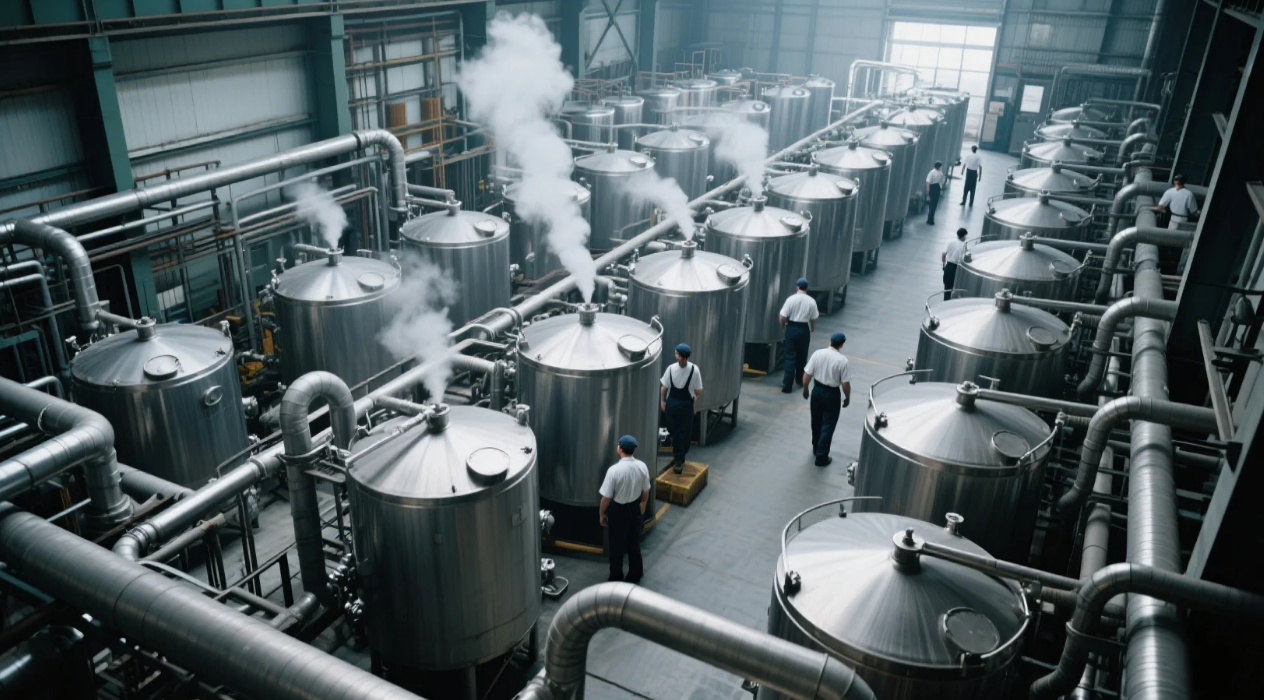
A brewery project often starts with a brewhouse quotation. The problem appears later, usually after the equipment has been ordered: the fermentation cellar is too small, the glycol system cannot pull down wort quickly enough, a tank cannot pass through the building entrance, or the packaging line cannot keep up with finished beer production. The brewhouse was selected correctly in isolation and incorrectly as part of the plant.
One brewery encountered this during its first 18 months of operation. It had planned around a single batch size and a brewhouse capable of several brews per day, but fermentation tanks filled faster than they emptied. Packaging was scheduled around tank availability, cooling demand peaked during the same production windows, and expansion had to wait while the building layout was reconsidered. The result was underused brewhouse capacity and delayed growth.
A commercial brewery should define capacity as a connected production system: business model, brew length, fermentation time, cooling, utilities, packaging, building access, commissioning, and future expansion must be reviewed together before equipment manufacturing begins. The largest vessel is not automatically the plant’s capacity; the slowest or least flexible interface usually decides what can actually be sold.
Start with the Brewery’s Operating Model
Capacity is a business and workflow decision before it becomes an equipment decision. A taproom may sell most beer directly from draft beer lines and kegs, allowing a broad range of styles in relatively small batches. A brewpub may need compact equipment, frequent recipe changes, and a layout that works around a kitchen, dining room, and restricted delivery access.
A regional distributor changes the calculation. Cans or glass bottles may become the main sales format, finished beer must be available in predictable lots, and packaging storage can take more floor area than expected. A production brewery selling a smaller number of high-volume brands may prefer fewer recipe changes, longer production runs, and a cellar sized for consistent tank turnover.
The first planning exercise should cover the following:
- expected annual output, production in the first one to three years, beer styles, sales channels, packaging formats, batch frequency, fermentation time, building area, ceiling height, loading access, utilities, automation level, and planned expansion
The first one to three years matter more than the launch month. A brewery that designs only for its opening volume can avoid initial capital expenditure but create an awkward plant almost immediately. Conversely, designing for a distant target without a credible sales path can leave tanks, pumps, and cooling equipment idle while still generating maintenance and cleaning work.
Beer styles also affect the production model. A lager program may occupy fermentation tanks for substantially longer than an ale program. Sour or specialty beers can require separate handling, additional cleaning controls, or dedicated vessels to avoid contamination. A taproom with twelve rotating beers does not necessarily need the same cellar arrangement as a distributor-focused brewery with three repeatable brands.
Building conditions should be checked before equipment drawings are finalized. Ceiling height affects the ability to install tall fermentation tanks, lift vessels into position, and service valves or manways. Loading access determines whether a tank can physically enter the building. Door width, turning radius, floor loading, drainage falls, and access for a crane or forklift can invalidate an otherwise suitable design.
Local utilities are equally physical constraints. The design review should confirm electricity supply, water quality and pressure, drainage capacity, steam availability, compressed air, and the conditions required for process cooling. A brewery may have enough connected electrical power on paper but insufficient peak capacity when the brewhouse, glycol cooling, pumps, packaging, and ventilation operate together.
Automation adds another planning decision. A highly manual plant can be flexible at small scale, but it depends heavily on operator consistency and may require more people during a long brew day. Automation can improve repeatability and data capture, yet it also introduces control-panel requirements, sensor maintenance, software configuration, and operator training. If expansion is likely, the initial control architecture should leave room for additional tanks, valves, and packaging signals rather than forcing a second disconnected system later.
Balance Brewhouse Output with Fermentation Capacity
The brewhouse is where mashing, lautering, boiling, whirlpooling, and wort cooling are coordinated. Its vessel configuration affects how often the brewery can brew, how much flexibility operators have between process steps, and how much space and capital the installation requires.
A two-vessel brewhouse commonly combines some process functions to reduce footprint and cost. It can suit a brewery with moderate brewing frequency, straightforward recipes, and limited space, but the shared vessels may restrict scheduling when several batches need to overlap.
A three-vessel brewhouse separates more of the mash, lauter, and boiling or whirlpool functions. That arrangement can improve scheduling and recipe flexibility without requiring the full footprint of a four-vessel system. It still depends on careful timing, pump sizing, and operator coordination.
A four-vessel brewhouse provides more separation between process stages and can support frequent brewing or a wider range of recipes. It also requires more floor space, piping, controls, cleaning points, and capital. The additional vessel capacity only has value if fermentation, cooling, utilities, and packaging can absorb the resulting output.
| Brewhouse configuration | Useful planning context | Main constraint to assess |
|---|---|---|
| Two-vessel | Moderate frequency, compact layout, controlled budget | Overlap between process steps and limited scheduling flexibility |
| Three-vessel | Mixed recipes, regular production, balanced footprint | Coordination of timing, pumps, and operator access |
| Four-vessel | Frequent brewing, higher flexibility, larger production plans | Floor area, utilities, cleaning complexity, and cellar capacity |
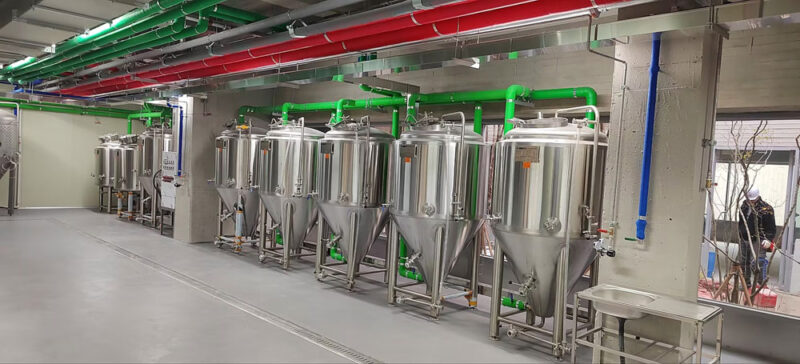
The common planning error is to calculate output from brewhouse batches alone. If a brewhouse can produce three batches in a day but the available fermentation tanks can only accept one batch without extending the schedule, the plant does not have three-batch daily capacity. It has a cellar bottleneck.
Fermentation tanks determine how long wort remains committed to production. Beer may need time for primary fermentation, maturation, clarification, carbonation, and packaging preparation. Even when fermentation itself is complete, a tank may remain occupied while the beer is tested, transferred, conditioned, or held for a packaging slot. Depending on the beer style and process, turnover may be measured in days or weeks rather than hours.
A useful capacity calculation therefore connects brew length with tank quantity and turnover time. A 20-hectoliter brew length does not automatically require 20 hectoliters of fermentation volume; the number of tanks, working volume, headspace, beer styles, cleaning time, and production schedule all affect the result. Bright beer tanks may add flexibility for clarification and carbonation, but they can also become a staging bottleneck if the packaging line is slower than cellar transfers.
Glycol cooling is another hidden limit. Wort cooling creates a sharp demand immediately after boiling, while fermentation generates a continuing heat load across several tanks. A cooling system sized only for average demand may struggle during warm-water conditions or when several tanks are filled within a short period. A commonly used engineering planning rule is to allow roughly 10–20% spare utility capacity where future production is credible, although the final allowance should come from a heat-load calculation rather than a generic percentage.
The failure described earlier followed this pattern. The brewery selected its brewhouse around one batch size and a projected daily brew frequency. During the first year, the taproom and distributor orders grew unevenly, so several styles were brewed close together. By month 18, fermentation tanks were occupied beyond the assumed turnover time, the glycol system was working near its practical limit, and cans waited for available packaging windows. The brewhouse could physically make more wort, but the plant could not turn that wort into packaged beer. Expansion was delayed because the original tank locations also left little room for safe access and future pipe runs.
Yeast handling equipment should be included in the same discussion. Yeast collection, storage, propagation, and reuse affect tank scheduling and product consistency. A brewery that intends to reuse yeast needs a process for selecting, testing, storing, and retiring it. Without that workflow, additional fermentation tanks may increase volume while increasing uncertainty around yeast quality.
Define the Supporting Systems and Interfaces
A brewery plant is not a brewhouse surrounded by tanks. It is a set of process interfaces that must transfer grain, wort, beer, yeast, cleaning chemicals, heat, cooling, and information without creating unsafe or unserviceable workarounds.
The design review should cover at least eight areas:
- malt handling and milling
- brewhouse process equipment
- fermentation and bright beer capacity
- yeast management
- glycol cooling and temperature control
- CIP system design
- process piping, pumps, valves, and controls
- building utilities and drainage
The malt mill and grain handling equipment establish how raw materials reach the brewhouse. Their position affects dust control, operator movement, storage access, and the distance grain must be conveyed. A mill that fits the production calculation may still be a poor installation if bags or bulk deliveries cannot reach it without crossing finished-beer areas.
Pumps, valves, and sanitary piping determine whether the calculated process can be performed reliably. Pipe diameter, line length, elevation changes, valve orientation, drainability, and dead legs all influence transfer time and cleaning performance. Separate suppliers may provide technically compliant equipment that becomes difficult to connect because tri-clamp sizes, control signals, pressure ratings, or service clearances do not match.
The CIP system should be planned from the number and size of vessels, cleaning sequence, chemical concentration, recovery strategy, and available water and drainage. A small CIP system can appear economical until operators must clean tanks one at a time during production hours. A larger system can improve scheduling but may demand additional storage, heating, controls, and floor drainage.
Temperature control belongs in production planning, not in the final equipment list. The glycol cooling system must account for the brewhouse wort cooling step, fermentation heat, bright beer conditioning, ambient conditions, insulation, and the number of vessels that may be filled simultaneously. Tank temperature probes, control valves, alarm points, and manual override procedures also affect how operators manage a fault.
Water, steam, compressed air, electricity, and drainage should be documented as interfaces with defined connection points and operating conditions. Water chemistry may require treatment before brewing. Steam demand can rise sharply during boiling and CIP. Compressed air quality matters where it contacts process equipment or actuates valves. Drainage must handle hot water, cleaning chemicals, solids, and peak discharge without backing up into production areas.
Process controls should show more than vessel temperatures. Operators may need transfer status, valve position, pump permissives, tank pressure, CIP step confirmation, alarms, and batch records. The control system should make abnormal conditions visible without making routine operation dependent on a specialist who is not present on every shift.
CO₂ recovery can be considered when production volume and local operating costs justify it, but it changes the gas-handling, storage, filtration, and safety requirements. It is not simply an accessory added to fermentation tanks. Similarly, a yeast propagation system affects sterile air, cleaning, temperature control, and the schedule for pitching yeast.
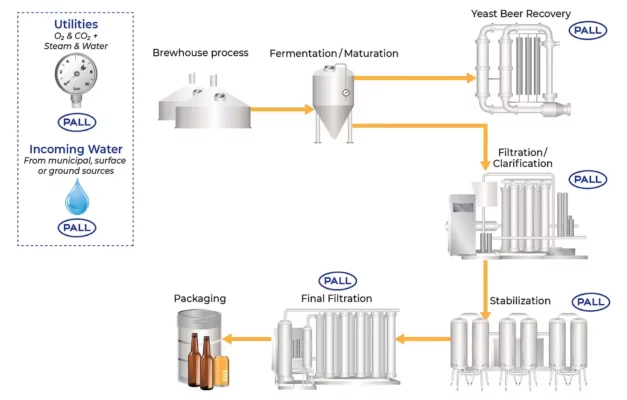
Coordination between suppliers reduces some compatibility risk, but it does not remove the need for a detailed interface review. The brewery still needs a consolidated equipment schedule, utility load summary, pipe and instrument list, and responsibility matrix showing who supplies each connection. Many late project problems occur in the gaps between packages rather than inside the individual machines.
Connect Packaging, Commissioning, and Expansion to the Initial Plan
Packaging choices shape the plant layout as much as the brewhouse does. Keg filling equipment may suit a taproom or local draft beer route, but kegs require washing, storage, return handling, and vehicle access. Can filling equipment supports regional distribution and usually requires depalletizing, rinsing or air cleaning, seaming, coding, packing, and finished-goods storage. Glass-bottle filling equipment adds different handling, breakage, inspection, and packaging requirements.
The brewery should assess at least three packaging routes against sales channels, space, and planned distribution:
- kegs for direct service and local draft accounts
- cans for wider distribution, efficient pallet use, and brand variety
- glass bottles for markets or products where bottle presentation and handling infrastructure are already established
Finished beer availability must be connected to packaging scheduling. If fermentation tanks are released in irregular batches but the packaging line requires long, planned runs, bright beer tanks may be needed as a buffer. If packaging capacity is much lower than cellar output, finished beer accumulates and tank turnover slows. If packaging is oversized, the brewery may carry unnecessary labor, cleaning, and maintenance costs while sales volume develops.
Layout planning should include personnel routes, raw material movement, beer flow, chemical storage, forklift paths, maintenance access, emergency exits, and the eventual addition of tanks or a larger filler. A tank location that saves pipe length today may block a future canning line or make a heat exchanger impossible to remove. Ceiling height and loading access should be checked against installation equipment, not just against the dimensions printed on a quotation.
Installation and commissioning are part of the production project. Commissioning should cover pressure tests, water runs, control checks, pump rotation, valve sequencing, CIP verification, temperature response, and trial transfers before saleable beer is made. Operator training must include normal recipes as well as fault recovery, manual bypasses, cleaning procedures, pressure safety, yeast handling, and shutdown steps.
A coordinated turnkey approach can be useful when it includes engineering responsibility, interface documentation, installation support, commissioning, and operator training. It should not be treated as a simple equipment bundle. A collection of matched machines can still fail if the utility loads are wrong, the floor cannot support the tanks, or no one has assigned responsibility for connecting controls and sanitary piping.
Future expansion should be drawn before manufacturing begins. The plan should identify where additional fermentation tanks could stand, how glycol and process lines would extend, whether the control system has spare inputs and outputs, and whether the electrical and drainage systems can accept another packaging route. Expansion does not require every future tank to be purchased at launch, but it does require enough access and capacity to avoid dismantling the original plant.
An operational decision framework is therefore fairly plain: define the first one to three years of sales and production, calculate actual tank turnover, confirm utility and building limits, select packaging around the sales route, and test the complete layout before fabrication. If one part cannot support the schedule, the project should reduce the brew frequency, add cellar capacity, change the packaging plan, or revise the building—not simply enlarge the brewhouse.
FAQ
Why should brewery capacity be defined before selecting equipment?
Because equipment size follows the production schedule, sales channels, and beer styles. A brewery should model at least the first one to three years, including batch frequency, fermentation turnover, packaging demand, and utility loads, before approving a brewhouse.
How does fermentation capacity limit brewery output?
Fermentation capacity limits output when tanks remain occupied for fermentation, maturation, clarification, carbonation, testing, or packaging delays. A brewhouse may produce several batches per day, but the usable output is governed by the number of tanks and their actual turnover time.
What is the difference between a two-vessel, three-vessel, and four-vessel brewhouse?
A two-vessel brewhouse usually combines process functions and saves space. A three-vessel system separates more stages for improved scheduling, while a four-vessel system provides greater process separation and flexibility at the cost of more space, utilities, cleaning work, and capital.
Which utilities and building conditions should be reviewed before brewery equipment manufacturing?
The review should confirm electricity, water quality and pressure, drainage, steam, compressed air, cooling, floor loading, ceiling height, door dimensions, loading access, and maintenance clearance. These checks should be completed before fabrication because a tank that cannot enter or be serviced is not a usable production asset.
What should a turnkey brewery solution include besides tanks and a brewhouse?
It should address malt handling, pumps, sanitary piping, process controls, CIP, yeast management, glycol cooling, utilities, packaging, layout planning, installation, commissioning, and operator training. The practical test is whether the connected systems can move from raw materials to packaged beer without unresolved supplier interfaces.
