
The most common failure pattern in brewery projects is consistent: an owner selects an impressive brewhouse first, then tries to make the rest of the plant fit around it. Only later does the reality surface—fermentation space runs short, packaging cannot keep pace, or utilities buckle under the load. The plant looks capable on paper but cannot actually ship what it brews.
A commercial brewery should be sized as one coordinated production system, not a collection of separately selected tanks and machines. Production capacity is the volume that can move consistently through mashing, fermentation, conditioning, packaging, and dispatch without one stage throttling the next. Any single-stage figure—brewhouse batch volume, tank count, line speed—misleads project planning if treated in isolation. The useful question is not “how big is the brewhouse” but “how much finished beer can move through the entire chain per week.”
Why Production Capacity Is About Throughput, Not Batch Volume
Batch volume is the number most people quote when describing a brewery, and it is the least useful number for planning. A 20-hectoliter brewhouse can out-produce a 50-hectoliter system if the smaller one runs three brews per day while the larger one sits idle waiting for fermentation space. Capacity only becomes meaningful when expressed as throughput—the volume that clears every stage from wort production to loaded pallets.
The distinction matters because each stage operates on a different timescale. The brewhouse converts grain to wort in hours. Fermentation and conditioning hold that wort for days or weeks. Packaging runs at a rate determined by line speed and shift structure. Dispatch depends on cold storage and distribution schedules. When these stages are sized independently, the mismatch appears later as stranded capacity: brewing ability that cannot become finished beer because the cellar is full.
A useful capacity target must break out from annual output into monthly and weekly production targets before any equipment is discussed. Annual figures hide seasonality. A brewery planning 10,000 hectoliters per year might need to produce 1,200 hectoliters in a peak summer month and only 500 in January. Equipment sized for the annual average will fail during the peak. Weekly targets, derived from monthly ones, reveal how many brews are actually required in an average production week and how much buffer exists for disruption.
This framing shifts the planning conversation. Instead of asking “what size brewhouse should we buy,” the project team asks “what weekly throughput do we need, and which stage will constrain it first.” That sequence produces different answers.
What to Define Before Any Tank Is Sized
Before the first equipment specification, roughly eight questions need answers. Skipping any of them tends to surface later as a redesign, a capacity shortfall, or underused capital.
The full question set:
- What annual and monthly production volume is required?
- How many brew days are available each week?
- Which beer styles will be produced, and how long will each occupy a fermentation tank?
- How many core brands and seasonal products will run at the same time?
- Will the brewery sell mainly through kegs, cans, bottles, or a combination of formats?
- Is the project intended for current demand only, or for phased market expansion?
- What space, water, steam, electrical power, refrigeration, drainage, and compressed-air resources are available?
- What is the realistic sales ramp in the first 12 to 24 months of operation?
The format question deserves particular attention because it drives packaging investment more than any other factor. A brewery selling primarily through kegs needs substantially less packaging infrastructure than one running a canning line. Keg washing, filling, and cold storage occupy space and consume utilities differently than can or bottle lines. The sales mix also affects how much buffer tank capacity is needed, since packaged product moves out faster than kegged product in some distribution models.
Utilities are the most commonly underestimated constraint. Steam generation, electrical supply, refrigeration load, drainage capacity, and compressed air are often assumed to be adequate until the first full production week reveals otherwise. A brewhouse that needs 500 kilograms of steam per hour cannot run on a boiler sized for 300. Refrigeration load spikes during crash cooling and cold conditioning. Drainage must handle hot wort spills, tank cleaning, and floor washing simultaneously.
This checklist prevents the planning mistake named earlier: selecting the largest brewhouse first and forcing the rest of the plant to fit around it. Capacity should follow sales expectations and production rhythm, while the complete system must support how the brewery will actually operate.
Matching Brewhouse Size to the Production Target
The brewhouse is the starting point of daily production, so its batch size and brewing frequency must work together. The anchor calculation for any sizing exercise is straightforward:
Daily brewhouse output = batch size × brews per day
A brewery targeting a larger weekly output can reach that goal with a larger single batch, multiple brews per day, or a combination. The choice depends on production schedule, staffing, recipe portfolio, available utilities, and the flexibility the operation needs. A brewery producing a limited range of core beers may benefit from a system that supports repeated, efficient batches. A brewery running frequent recipe changes, small seasonal releases, or pilot development may value flexible operation and faster cleaning transitions more than raw throughput.
The number of vessels shapes how the brewhouse handles those transitions.
| Vessel configuration | Best suited to | Operating advantage |
|---|---|---|
| 2-vessel | Simpler production schedules, lower daily brewing frequency | Fewer process stages to manage |
| 3-vessel | More continuous workflow | Key process stages separated |
| 4-vessel and higher | Higher-output operations needing parallel processing | Reduced turnaround between brews |
A 2-vessel system suits projects where the brewhouse runs one or two brews per day with predictable recipes. A 3-vessel configuration separates mash and lautering from wort boiling, allowing a more continuous workflow. A 4-vessel or higher system supports parallel processing—mashing one batch while boiling another—which reduces turnaround time and raises daily output without increasing batch size.
The vessel decision should follow the production target, not the other way around. A project team that knows it needs four brews per day on a 30-hectoliter system will reach different conclusions about vessel configuration than a team running one 60-hectoliter batch per day. Both may produce similar weekly volume, but the operational character differs: more brews mean more cleaning cycles, more staff hours, and more utility draw per hectoliter.
Planning Fermentation Capacity Together With the Brewhouse
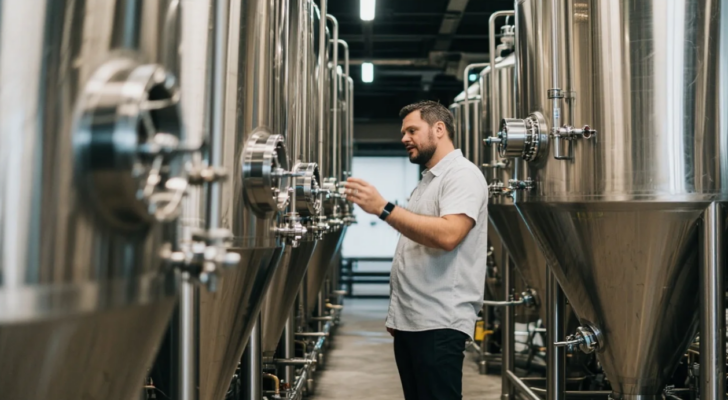
The brewhouse can produce wort in a few hours, but beer remains in fermentation and conditioning tanks for much longer. This timing mismatch is the mechanism behind most underperforming plants. The cellar, not the kettle, usually dictates what the brewery can actually ship.
Two failure modes dominate. The first is insufficient tank space: the brewhouse can brew more batches, but no tank is available to receive the wort. Production stops not because brewing capacity is exhausted but because fermentation is full. The second is an oversized tank farm: a large investment in vessels sits underused because the brewhouse, packaging plan, or sales schedule cannot keep it productive. Both failures trace back to sizing fermentation without reference to the full production chain.
When planning fermentation capacity, the project team must weigh several factors together:
- Brewhouse batch volume
- Brews planned per week
- Fermentation and maturation time for each beer style
- Number of beers produced simultaneously
- Dry hopping, clarification, carbonation, and conditioning requirements
- Seasonal volume changes
- Buffer capacity for cleaning, maintenance, and production changes
The dwell contrast is stark. A brewhouse produces wort in 4 to 8 hours per batch. That same wort occupies a fermentation tank for 7 to 21 days depending on style, and conditioning can extend residence further. A beer that spends two weeks in the tank requires roughly 12 times the tank volume of the brewhouse batch that produced it, before accounting for buffer. This is why fermentation capacity is planned first in practice—it is the largest capital investment and the hardest constraint to change after installation.
Dry hopping and conditioning requirements complicate the math. A heavily dry-hopped IPA needs tank time for hop addition and subsequent settling that a clean lager does not. If multiple hoppy beers run simultaneously, tank demand rises even when brewhouse output stays constant. Seasonal swings add another layer: summer ale production may require more tank capacity than winter lager production because of shorter conditioning times or vice versa, depending on the portfolio.
Buffer capacity for cleaning, maintenance, and production changes is the factor most often trimmed during budget discussions. A tank farm sized without buffer runs at 100 percent utilization during peak weeks, which means no time for cleaning, no room for a delayed fermentation, and no flexibility when a tank underperforms. Most operators find that planning for 80 to 85 percent effective utilization—reserving the remainder for cleaning and disruption—produces a more reliable plant than pushing toward theoretical maximum.
Tank selection should also support the brewery’s preferred batch strategy. In some projects, fermentation tank volume closely follows brewhouse batch size, so each brew fills one tank. In others, larger tanks receive multiple brews, which reduces tank count but extends the filling window and complicates yeast management. The right answer depends on the recipe portfolio and production rhythm defined in the earlier planning questions.
The practical sequence, then, is to define sales targets, translate them into weekly brewhouse output, size fermentation around the dwell time of the slowest beers in the portfolio, and only then confirm that packaging and utilities can clear the finished volume. Equipment selection follows the production plan. The plant that ships consistently is the one where no single stage silently throttles the rest.
FAQ
How many brews per day does a brewery need to plan for?
Most commercial breweries plan for one to three brews per day, with two being the most common operating point. The number depends on weekly production targets divided by batch size, then adjusted for cleaning time between brews. A brewery running three brews per day needs roughly 2 hours of turnaround between batches for vessel cleaning and setup.
Does fermentation tank volume always have to match brewhouse batch size?
No. Fermentation tanks can be sized larger than the brewhouse batch to receive multiple brews, which reduces tank count but extends filling time. Many breweries use tanks at 1.5 to 2 times batch volume to allow for yeast cropping, dry hopping, and headspace. The ratio depends on beer style and production strategy.
Which vessel configuration is right for a new brewery?
A 2-vessel system suits breweries running one or two predictable brews per day with a limited recipe range. A 3-vessel configuration fits operations needing more continuous workflow and recipe flexibility. A 4-vessel system makes sense only when daily brewing frequency is high enough to justify parallel processing.
How much buffer capacity should be reserved for cleaning and maintenance?
Most operators plan for 80 to 85 percent effective tank utilization, reserving the remainder for cleaning, maintenance, and production disruptions. A tank farm sized to run at 100 percent during peak weeks leaves no room for a delayed fermentation or an unscheduled cleaning cycle.
Why do sales format choices affect how the plant is sized?
Keg, can, and bottle distribution each require different packaging infrastructure, cold storage, and labor. A keg-focused brewery needs less packaging line capacity but more cold room for finished kegs. A canning operation requires line speed, seamer maintenance, and packaging material storage. The sales mix determines how fast finished beer leaves t
