
A 10-barrel batch that once felt generous now forces back-to-back brew days. The mash tun runs from 6 a.m., the kettle fires up again by noon, and by late afternoon the whirlpool is still spinning while you are already planning tomorrow’s schedule. The obvious fix is increasing production capacity with larger equipment, but every brewer knows the risk: scale up too fast and the beer that earned your reputation can start tasting dull, scorched, or oxidized before it reaches the taproom.
The 1000L brewing equipment sits at a sweet spot for growing breweries. It is large enough to support regional distribution, yet compact enough that brewers can still maintain direct control over wort quality. The difference between a good 1000L brewing equipment and a frustrating one comes down to a handful of engineering choices—vessel configuration, heating method, oxygen management, and automation—each of which determines whether the upgrade preserves or degrades what goes into the glass.
A brewhouse is not a collection of tanks. It is an integrated system where each vessel must work in sequence without becoming a bottleneck. Get the configuration wrong at this scale, and you end up with a larger kettle that still produces only one batch per day—just more of it. The real throughput gain comes from parallel processing, not from volume alone.
Three-Vessel Configuration: The Production Bottleneck Fix
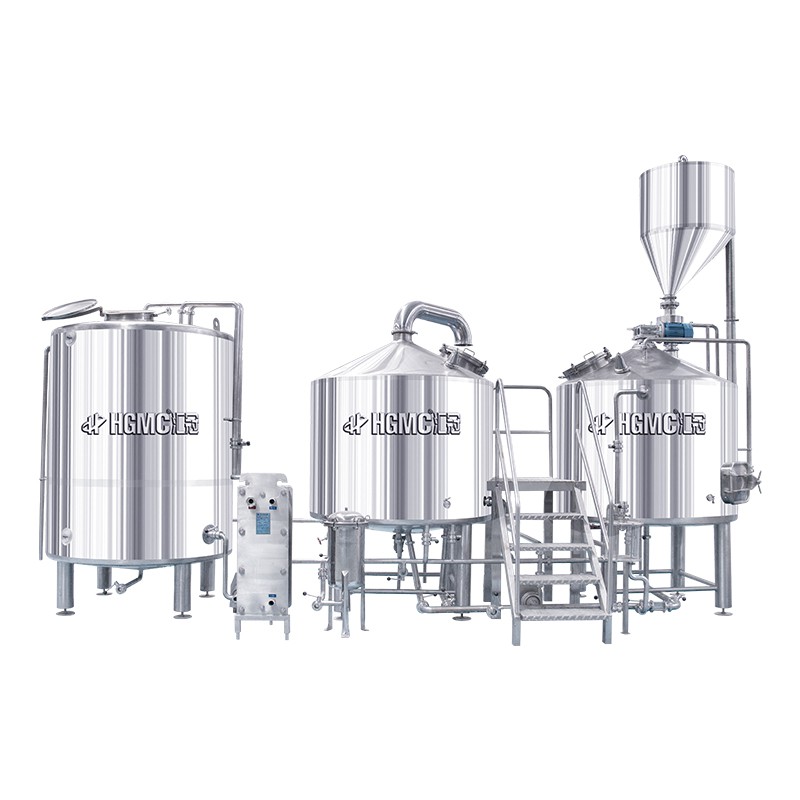
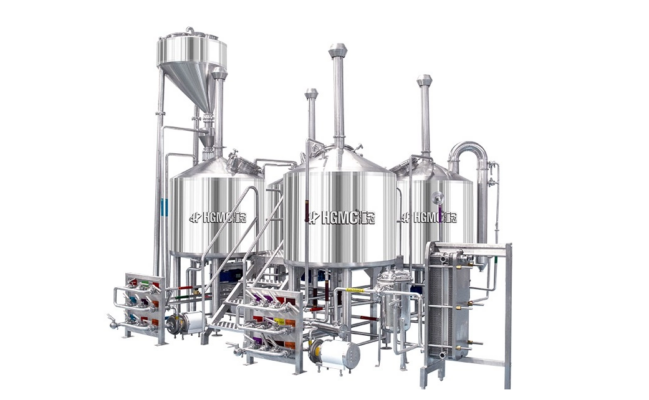
The three-vessel configuration—mash/lauter tun, brew kettle, and whirlpool tank—is the standard in 1000L brewing equipment precisely because it enables simultaneous processing. While one batch is boiling in the kettle, the mash tun can already be mashed in for the next. This effectively cuts brew-day time nearly in half compared to single-vessel or combi-unit operations. If you are running two batches per day on a regular basis, that floor space starts paying for itself quickly.
The mash/lauter tun handles both mashing and lautering in a single vessel. Maintaining temperature within a narrow range during conversion is essential for consistent wort quality, and the false bottom is designed to minimize stuck mashes—a frustrating failure that can delay an entire production day by an hour or more. The brew kettle then receives the lautered wort, while the whirlpool tank spins the finished wort to separate trub and coagulated proteins, delivering clearer wort to the fermenter.
For breweries constrained by floor space, a combi-unit that integrates multiple functions into a single vessel is an alternative. The tradeoff is clear: a combi saves space but sacrifices the parallel processing that makes the 1000L scale efficient. Brewers who choose a combi strictly for square footage often discover six months later that they are still limited to one batch per day, negating the production increase they expected from the volume upgrade.
HGMC’s 1000L brewing equipment uses the three-vessel layout. The interior finish of every vessel is polished to a mirror surface between 0.2 and 0.4 micrometres Ra. This is not cosmetic. A surface below 0.5 micrometres discourages biofilm formation and reduces clean-in-place (CIP) cycles from four hours to under three in production environments. Rock-wool insulation wraps each vessel, keeping the exterior temperature low enough to touch safely while cutting energy loss during rests and boils.
The closed-loop design integrates the vessels as a single system rather than standalone tanks. This matters more at 1000L than at smaller scales because manual transfer between uncoordinated vessels becomes impractical when each batch represents a significant capital investment in raw ingredients.
Steam Heating vs. Direct Fire: Eliminating Scorched Off-Flavors
Direct-fire kettles are still common in smaller systems. They are cheaper to manufacture and simpler to install. But they come with a chronic risk: hot spots on the kettle floor can scorch wort solids, producing burnt off-flavors that no amount of hops can mask. The problem often does not surface immediately. A brewery might commission a 1000L direct-fire system, run the first few batches successfully, and then start receiving complaints about a dull, caramelized finish in beers that were previously crisp. By the time the pattern is clear, the equipment budget is already spent.
Steam heating eliminates this risk by providing uniform temperature control across the entire heating surface. A jacketed heater circulates steam around a stainless steel jacket, delivering consistent heat without flame impingement or localized overheating. The boil is vigorous but gentle—no scorching, no burnt solids accumulating on the kettle floor.
The tangible outcome is a cleaner malt profile. Brewers who move from direct-fire to steam-heated systems often report that their pale ales and lagers taste brighter, with fewer caramelized notes in the finish. This is especially noticeable in styles where malt character is meant to be clean—a German pilsner or a lightly hopped pale ale will reveal off-flavors from scorching far more readily than an aggressively hopped IPA.
Steam heating also improves hop utilization because the boil drives off volatile compounds more gently. Delicate aroma hops that would normally lose their character in an aggressive direct-fire boil retain more of their essential oils. The difference becomes apparent when comparing a single-hop IPA made on each system: the steam-heated version typically shows more pronounced hop character at the same addition rate.
The tradeoff is upfront cost. A steam-heated jacketed kettle adds capital expense compared to a direct-fire equivalent, and the brewery needs a steam boiler or an external steam source. For a 1000L system, the additional investment usually runs between fifteen and twenty-five percent above a direct-fire setup. But for breweries that plan to distribute regionally—where off-flavors in a single batch can affect wholesale accounts—the cost is generally easier to justify than the reputational damage of a scorched batch.
Oxygen Management During Mash and Sparge
Oxygen management is the engineering detail that most brewhouses ignore until oxidation shows up in the pint. Most brewhouses introduce oxygen during the mash and sparge through vortexing—the spinning motion created by conventional stirring paddles draws air into the liquid. This is subtle enough that it rarely registers during a brew day, but over weeks of production the accumulated effect on finished beer stability becomes measurable.
The mash is where enzymatic conversion takes place, and oxygen exposure at this stage can degrade both the enzymatic activity and the finished beer’s shelf stability. Conventional stirring paddles operate at higher RPM and create a pronounced vortex that pulls air from the surface into the mash. The result is unpredictable oxidative reactions that shorten the beer’s peak flavor window.
HGMC’s anti-oxidation stirring paddles operate at low speed and are designed to create minimal vortex. The double-layer stirring mechanism moves the mash horizontally rather than vertically, keeping oxygen uptake to a minimum during the critical period when enzymatic activity is highest. Low-speed horizontal motion keeps oxygen uptake to a minimum throughout the mash rest.
This is a lesser-known differentiator. Most equipment manufacturers focus on vessel volume and heating capacity, leaving oxygen management as an afterthought. Brewers who upgrade to 1000L equipment without considering oxygen pickup often report that their beers start showing stale notes earlier than they did on the smaller system—not because the larger system is inherently worse, but because the increased batch size amplifies the effect of oxidation that was present but less noticeable at smaller volumes.
The anti-oxidation design does not eliminate oxygen entirely—some exposure is unavoidable during transfer and sparge—but it reduces the baseline enough that the brewer has more control over the variables that remain. In practice, this means finished beer retains its intended flavor profile longer in the keg or bottle, which becomes critical when those kegs are sitting in distribution warehouses for weeks before reaching the customer.
Fit and Finish: Surface Polish, Insulation, and CIP Efficiency
The interior surface finish of brewing vessels is one of those specifications that looks like a minor detail on paper but determines how much time the brewer spends cleaning versus brewing. A mirror polish between 0.2 and 0.4 μm Ra is standard on well-designed 1000L equipment, but many budget systems skip the final polishing steps to save cost.
The difference is measurable. A surface below 0.5 μm Ra discourages biofilm formation because bacteria and organic residues have fewer microscopic crevices to cling to. In production, this translates to shorter CIP cycles. A vessel polished to 0.2–0.4 μm Ra typically completes a clean-in-place cycle in under three hours, whereas a rougher surface at 0.8 μm or above can require four hours or more. Over a production week, that difference adds up to several hours of recovered brewing time.
Rock-wool insulation is another detail that separates production-ready equipment from entry-level systems. Each vessel is wrapped with insulation that keeps the exterior temperature low enough to safely touch while cutting energy loss during temperature rests and boils. On a 1000L brewing equipment, the energy savings from proper insulation are significant—uninsulated vessels lose heat at a rate that forces the heating system to work harder to maintain temperature, increasing both energy bills and the wear on heating elements.
The closed-loop system design ties these details together. Temperature control, transfer timing, and CIP programming are coordinated across all vessels, reducing the manual oversight required during a brew day. For a brewery running two batches daily, this consistency means fewer variables between batches and more predictable results.
| Aspect | Well-Designed 1000L System | Budget System |
|---|---|---|
| Surface finish | 0.2–0.4 μm Ra mirror polish | 0.8 μm+ unpolished |
| CIP cycle duration | Under 3 hours | 4 hours or more |
| Insulation | Rock-wool wrapped | Minimal or absent |
| Energy loss during boil | Low, stable temperature | Higher, variable |
The insulation and surface finish are not glamorous selling points, but they determine whether the brewhouse operates efficiently on a daily basis. Brewers who skip these details during procurement often find themselves retrofitting insulation or re-polishing vessels within the first year of operation—a frustrating and expensive correction that could have been avoided with the initial specification.
FAQ
What is the advantage of a three-vessel system over a two-vessel or combi system?
A three-vessel system enables parallel processing—mashing in one vessel while boiling in another—which can nearly double daily throughput compared to a combi-unit that forces sequential operations. The tradeoff is that a three-vessel configuration requires more floor space, typically around thirty to forty percent more than an equivalent combi setup.
How does steam heating improve beer quality compared to direct fire?
Steam heating eliminates hot spots on the kettle floor that can scorch wort solids and produce burnt off-flavors. The uniform heat distribution preserves a cleaner malt profile and improves hop utilization because delicate aroma oils are not driven off by aggressive localized overheating. The tradeoff is higher upfront equipment cost and the need for a steam boiler.
Why is oxygen management important during the mash?
Oxygen exposure during the mash can degrade enzymatic activity and accelerate staling reactions that shorten the finished beer’s shelf stability. Conventional stirring paddles create a vortex that draws air into the mash, while anti-oxidation paddles use low-speed horizontal motion to minimize oxygen pickup. Brewers who ignore this often see stale notes appear earlier in beers produced on larger systems.
What surface finish is recommended for brewing vessels to prevent contamination?
A mirror polish between 0.2 and 0.4 micrometres Ra is recommended. Surfaces below 0.5 μm Ra discourage biofilm formation because bacteria have fewer microscopic crevices to adhere to. Smoother surfaces also reduce CIP cycle times, typically from four hours down to under three.
Can a 1000L brewing equipment support regional distribution without sacrificing quality?
Yes, provided the system includes three-vessel parallel processing, steam heating or equivalent uniform heat control, oxygen management during mash, and polished interior surfaces. These engineering choices determine whether scaling up preserves beer quality or introduces off-flavors and stability issues that become visible only after the beer leaves the brewery.
