

Two brewhouse quotations sit side by side on the desk. Both state “304 stainless steel” in the material specification section. The prices diverge by tens of thousands of dollars. A buyer who has spent weeks comparing suppliers might reasonably ask what the grade actually guarantees — and whether the cheaper option is the smarter procurement decision.
The honest answer is more complicated than most sales conversations suggest. 304 stainless steel determines a vessel’s corrosion resistance, mechanical strength, and cleanability, but it says nothing about tank thickness, welding quality, interior finishing, jacket design, or the controls that make a brewhouse function as a production system. Treating 304 as a line item rather than a system specification is what leads breweries into a false economy, where savings on the initial quote turn into sanitation and maintenance costs later.
What 304 Stainless Steel Actually Determines in a Brewery System
Investors compare material grade first because it is the most visible specification on any equipment proposal. 304 stainless steel is widely used across food and beverage processing for good reasons: it offers corrosion resistance against the acidic environment of wort and beer, mechanical strength for pressure-bearing vessels, and a surface that can be cleaned and maintained through repeated production cycles. In a facility running heat, moisture, carbon dioxide, and frequent CIP cleaning, those properties matter.
But 304 should never be treated as a complete quality specification. Two equipment proposals can both list the same grade while differing substantially in tank thickness, welding quality, polishing, jacket design, insulation, valves, fittings, controls, and engineering support. A brewhouse system can differ by significant margins in these hidden variables even when every proposal claims identical material. The metal itself is only part of the story — the fabrication around it determines whether that metal performs as intended.
Welding quality and interior finishing can change cleanability more than the metal itself. A poorly executed weld seam creates crevices where bacteria and beer stone accumulate, regardless of whether the base material is certified 304. The same grade supplied by the same mill can produce dramatically different sanitation outcomes depending on who welds it and how the interior surface is polished. This is the first non-obvious reality of brewery equipment procurement: the material certificate tells you what the metal is, not how well it was made into a vessel.

Evaluating Brewery Equipment Cost Beyond the Initial Quotation
The evaluation checklist for brewery equipment extends far beyond material grade and price per vessel. Buyers comparing quotations should assess vessel thickness and pressure-related design requirements, interior welding and finishing quality, cooling-jacket and insulation configuration, CIP and cleaning accessibility, included valves, pumps, piping, automation scope, installation, commissioning, training, warranty, and service support.
| Evaluation factor | What to inspect | Typical consequence if neglected |
|---|---|---|
| Vessel thickness and pressure design | Shell and head thickness, pressure ratings, dimple or channel jackets | Deformation under thermal cycling, shortened service life |
| Interior welding and finishing | Weld seam quality, surface roughness, passivation | Bacterial harborage, difficult sanitation, off-flavors |
| Cooling-jacket and insulation configuration | Jacket coverage area, coolant flow paths, insulation quality | Inefficient temperature control, high energy consumption |
| CIP and cleaning accessibility | Spray ball coverage, manway size, drain design | Incomplete cleaning, extended downtime between batches |
| Included valves, pumps, and automation scope | What is bundled versus optional, control system capability | Unexpected add-on costs, production limitations after startup |
| Installation, training, warranty, and service support | Commissioning scope, documentation, response times | Operational delays, unresolved issues during first production cycles |
Two equipment proposals can state identical material grades while producing materially different lifecycle operating value. The cost difference plays out after installation, not at purchase. The false economy emerges when the lowest initial quotation is selected, then higher maintenance requirements, sanitation difficulties, or production limitations surface during the first production cycles — typically within the first several months of operation, when the system should be ramping up rather than requiring rework.
One brewery operator described the pattern plainly: the savings on the initial quote disappeared within the first year through replacement of undersized pumps, re-polishing of interior surfaces that could not be cleaned effectively, and lost production time during extended CIP cycles. The material was 304 in both cases. The difference was in how the vessels were designed and fabricated around that material.

Where 304 Earns Its Keep: Brewhouse and Hot-Side Vessels
Material choice matters most on the hot side of the brewery. Mash tuns, lauter tuns, kettles, whirlpools, hot liquor tanks, process piping, and fittings work under demanding process conditions — sustained heat, aggressive cleaning chemicals, and mechanical stress from agitation and thermal expansion. These vessels see the harshest environment in the facility, which is why 304 stainless steel is the standard for product-contact surfaces in this area.
The brewhouse is central to the production process, and its vessels must work together as an integrated system rather than as individual pieces of equipment. Material selection should be reviewed alongside vessel arrangement, heating method, automation level, and planned batch frequency. A brewery planning multiple recipes or future production expansion needs a system design that supports flexible operation. This is where brewhouse configurations from suppliers like hgmcbrew need to be aligned with a brewery’s production plan rather than selected from a one-size-fits-all format. The material specification should fit the overall process concept — not be separated from capacity, vessel count, floor layout, or utility planning.
A brewery running four batches per day has different hot-side requirements than one running two batches every other day. The former needs thicker vessel walls to withstand more frequent thermal cycling, more robust jacket designs for faster heating and cooling, and automation that reduces operator fatigue. The latter might prioritize simpler controls and easier manual access. Both can be built from 304 stainless steel. The grade alone does not distinguish them.
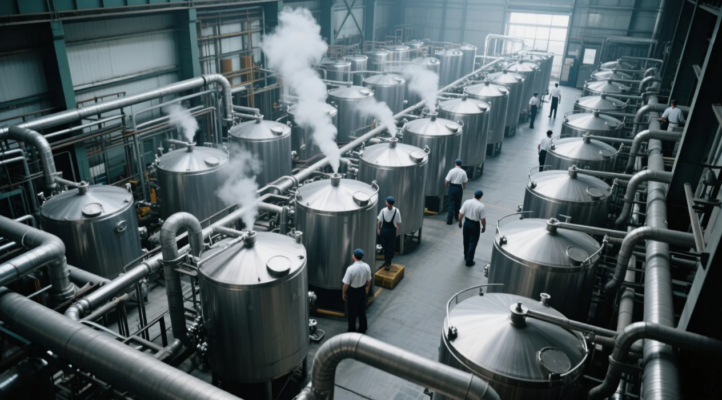
Fermentation and Cold-Side Considerations for Stainless Steel
Fermentation vessels require a different evaluation lens than hot-side equipment, even within the same material grade. These vessels need design that supports temperature management, pressure-related operating conditions, and cleaning access. They hold beer and carbon dioxide in repeated contact over extended periods — a fermentation tank might sit full for two to four weeks per batch, compared to a brew kettle that cycles in hours. The corrosion and sanitation demands are different in character.
The cold side plays a distinct role in overall sanitation routines. Fermentation vessels and conditioning tanks must maintain a cleanable interior surface across months of continuous operation, with periodic CIP cycles between batches. The vessel finish affects how thoroughly cleaning solutions reach every surface and how easily biofilm develops over time. A rough interior finish on a fermentation tank is more problematic than the same finish on a brew kettle, simply because the tank holds product longer and provides more time for microbial communities to establish.
304 stainless steel should be specified according to component function, meaning hot-side and cold-side vessels can warrant different evaluation priorities even within the same material grade. For fermentation vessels, the critical factors are pressure vessel design, cooling jacket configuration for temperature management, and interior finish quality. Equipment suppliers offering vessel arrangements across different capacity requirements — including those from hgmcbrew — should be evaluated on how their fermentation tank designs handle these specific operational demands rather than on material grade alone.
The practical reality is that vessel arrangement and production capacity planning drive most fermentation tank decisions. A brewery expanding from 10-barrel to 30-barrel batches faces different tank geometry, cooling requirements, and cleaning challenges than one adding tanks at the same batch size. The material stays the same; the engineering around it changes.
FAQ
Is 304 stainless steel more expensive than other grades used in brewery equipment?
Yes, 304 typically costs more than lower-grade stainless steels or carbon steel with coatings. The price difference reflects its corrosion resistance and cleanability. For brewery applications, the additional upfront cost usually pays for itself through reduced maintenance and longer vessel life, but the grade is only one factor in total equipment cost.
Can two brewery equipment quotes both state 304 stainless steel and still differ in quality?
Absolutely. Material grade is just one specification among many. Tank thickness, welding quality, interior polishing, jacket design, and included components can all differ significantly between quotes that list the same 304 grade. Buyers should compare the full equipment specification, not just the material line.
Which parts of a brewery benefit most from 304 stainless steel?
The brewhouse and hot-side vessels — mash tuns, lauter tuns, kettles, whirlpools, and hot liquor tanks — benefit most because they face the harshest conditions. Fermentation vessels and conditioning tanks also need 304 for temperature management, pressure handling, and sanitation, though the evaluation priorities differ from hot-side equipment.
Should material grade be the deciding factor when comparing brewery equipment bids?
No. Material grade should be one item on a longer evaluation checklist that includes vessel thickness, welding and finishing quality, cooling jacket design, CIP accessibility, automation scope, and after-sales support. Selecting equipment based on material grade alone — or on the lowest initial quotation — often leads to higher costs after installation.
