
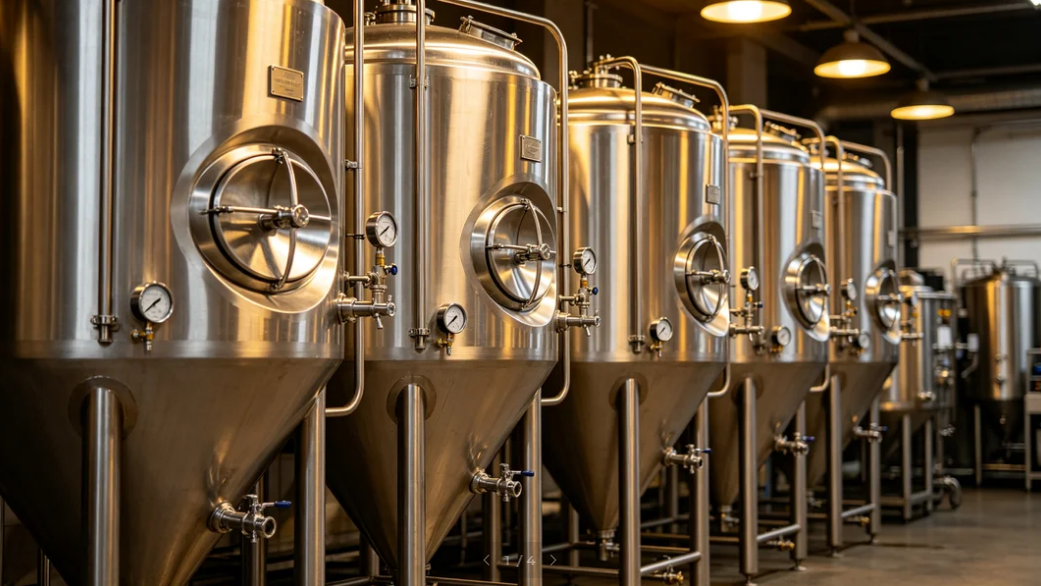
Choosing the right Beer Production Tanks is one of the most important decisions when building or expanding a brewery. The best tank configuration is not simply the cheapest or largest option. Buyers should match tank type, working volume, material, pressure rating, cooling capacity, CIP design, and production schedule with the brewery’s actual output. For most breweries, conical fermenters handle fermentation, Brite Tanks handle conditioning and carbonation, while Unitanks combine both functions to save space and improve flexibility.
What Are Beer Production Tanks and Why Are They Important?
Beer Production Tanks are specialized stainless steel vessels designed to control different stages of beer production, especially fermentation, maturation, carbonation, storage, and packaging preparation.
Unlike simple storage containers, professional brewery tanks are engineered around temperature control, pressure management, sanitary processing, yeast removal, carbonation, and cleaning efficiency.
A complete beer production system may include:
- Conical fermentation tanks
- Brite Beer Tanks
- Unitanks
- Serving tanks
- Beer storage tanks
- Yeast collection tanks
- Hot liquor and cold liquor tanks
- Wort holding tanks
For most breweries, however, fermentation tanks and Brite Tanks represent the core cold-side equipment.
The correct combination allows a brewery to maintain stable fermentation temperatures, improve beer consistency, shorten tank occupancy time, and prepare finished beer efficiently for kegs, bottles, or cans.
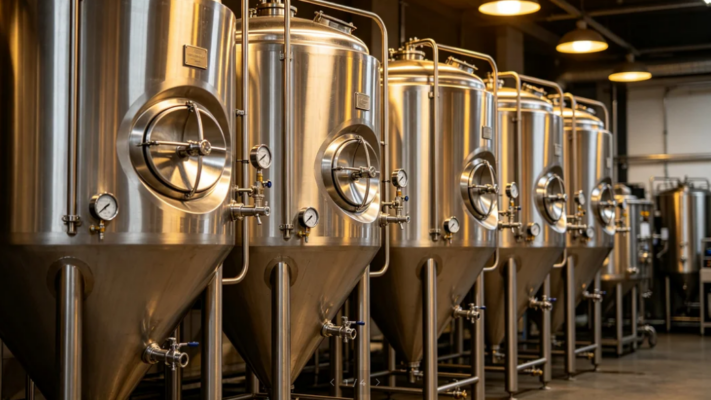
Which Types of Beer Production Tanks Should Buyers Consider?
Buyers should select tank types according to the specific production stage rather than trying to use one tank for every operation.
Should a Brewery Buy Conical Fermentation Tanks?
Conical fermenters are the primary choice for controlled beer fermentation because their cone-shaped bottoms make yeast and trub collection easier.
During fermentation, yeast converts fermentable sugars into alcohol, carbon dioxide, and flavor compounds. Temperature control is critical because fermentation temperature strongly affects yeast performance and beer characteristics.
A professional conical fermenter normally includes:
- Cylindrical tank body
- 60° conical bottom
- Glycol cooling jacket
- Temperature sensor
- Pressure relief valve
- Sampling valve
- Rotating racking arm
- Bottom yeast outlet
- CIP spray ball
- Sanitary tri-clamp fittings
The cone allows yeast and sediment to settle at the bottom of the vessel, making yeast removal easier without transferring the entire beer batch.
For breweries producing multiple beer styles, individual fermentation tanks also provide greater flexibility because different batches can ferment independently.
Should a Brewery Invest in Brite Beer Tanks?
Brite Tanks are the preferred vessels for final conditioning, clarification, carbonation, and short-term storage before packaging or serving.
After primary fermentation is completed, beer can be transferred from the fermenter to the Brite Tank. The beer can then be cooled, clarified, carbonated, sampled, and prepared for packaging.
A typical Brite Tank may include:
- Glycol cooling jacket
- Carbonation stone
- Pressure gauge
- Pressure relief valve
- Sampling valve
- CIP spray ball
- Beer outlet
- CO₂ inlet
- Manway
- Sanitary fittings
A dedicated Brite Tank can also free a fermentation tank earlier, allowing the fermenter to receive another batch.
This can become particularly important for breweries that are increasing production without significantly expanding their brewhouse.
Is a Unitank Better Than Separate Fermenters and Brite Tanks?
A Unitank can be an excellent choice for breweries that want fermentation and carbonation in the same pressure-rated vessel.
A Unitank combines the functions of a conical fermenter and Brite Tank. Beer can ferment, mature, and carbonate in the same tank before packaging.
The main advantages include:
- Reduced equipment footprint
- Fewer beer transfers
- Lower transfer-related contamination risk
- Lower oxygen exposure
- Simplified cellar layout
- Flexible production scheduling
However, Unitanks are not automatically the best solution for every brewery.
A larger production brewery may prefer separate fermenters and Brite Tanks because dedicated vessels provide more flexibility. A brewpub, nano brewery, or small craft brewery may benefit more from Unitanks because floor space and labor are often limited.
How Should Buyers Compare Different Beer Production Tanks?
The most useful comparison is based on function, capacity, pressure, cooling, and cleaning rather than tank appearance or purchase price.
| Tank Type | Main Function | Typical Design | Cooling | Pressure Use | Best For |
|---|---|---|---|---|---|
| Conical Fermenter | Primary fermentation and maturation | Cylindrical + 60° cone | Glycol jacket | Fermentation pressure | Craft breweries and production breweries |
| Brite Tank | Conditioning, carbonation and storage | Cylindrical with dished/conical bottom | Glycol jacket | Carbonation pressure | Packaging and finished beer |
| Unitank | Fermentation + conditioning + carbonation | Cylindrical + cone | Glycol jacket | Fermentation and carbonation | Nano breweries, brewpubs, flexible production |
| Serving Tank | Beer holding and dispensing | Vertical or horizontal | Optional/required depending on process | Serving pressure | Taprooms and brewpubs |
| Storage Tank | Temporary beer or liquid storage | Application-dependent | Application-dependent | Depends on design | Larger brewery operations |
The table demonstrates why tank selection should begin with the production process rather than the tank price.
What Tank Capacity Should a Brewery Buy?
Tank capacity should be determined by brewhouse batch size, fermentation time, annual production targets, and future expansion plans.
A common mistake is choosing tanks only according to the brewhouse volume.
For example, a brewery operating a 10 BBL brewhouse does not necessarily need every tank to be exactly 10 BBL.
Headspace is required for fermentation and process safety. Fermentation creates foam and carbon dioxide, so filling a tank to its total geometric volume is generally not appropriate.
A practical purchasing calculation should consider:
Required tank volume = beer batch volume + required headspace + process allowance
For example, if a brewery produces a 10 BBL batch, the buyer may select a larger nominal tank to provide sufficient working headspace.
What Tank Sizes Are Suitable for Small Breweries?
Small breweries should prioritize flexibility and future expansion rather than purchasing oversized tanks that remain underutilized.
Typical small brewery configurations may include:
| Brewhouse Size | Suggested Fermenter Range | Suggested Brite Tank Range | Typical Application |
|---|---|---|---|
| 3–5 BBL | 5–7 BBL | 5–7 BBL | Nano brewery / brewpub |
| 5–10 BBL | 7–15 BBL | 7–15 BBL | Microbrewery |
| 10–20 BBL | 15–30 BBL | 15–30 BBL | Growing craft brewery |
| 20–40 BBL | 30–60 BBL | 30–60 BBL | Commercial craft production |
| 40+ BBL | Project-specific | Project-specific | Large-scale production |
These figures should be treated as planning ranges rather than fixed engineering requirements. The final specification should be calculated from the brewery’s actual recipe, batch size, fermentation duration, packaging schedule, and expected expansion.
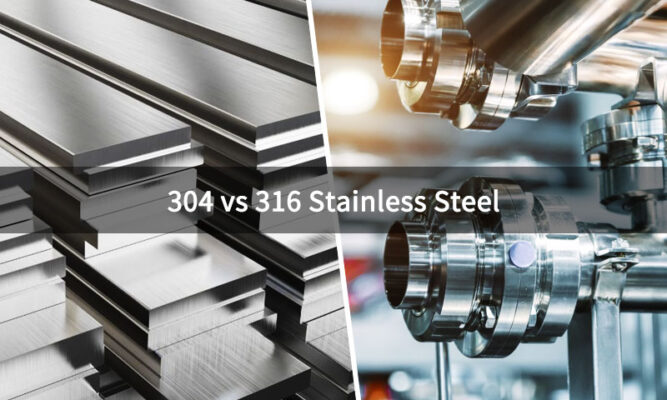
Should Buyers Choose 304 or 316 Stainless Steel?
304 stainless steel is suitable for most standard beer production applications, while 316/316L stainless steel can provide additional corrosion resistance for more demanding environments.
Stainless steel is widely used because it is durable, hygienic, corrosion resistant, and relatively easy to clean.
For many breweries, SUS304 stainless steel provides an excellent balance between cost and performance.
316L may be considered when:
- The brewery has high-chloride water
- The equipment operates in a highly corrosive environment
- Special beverage products are produced
- Additional corrosion resistance is required
- The customer specification requires 316L
The material decision should also consider the internal surface finish and welding quality.
A tank made from good stainless steel but with poor welds or rough internal surfaces can still create cleaning and sanitation problems.
What Internal Finish Should Beer Production Tanks Have?
A smooth, sanitary internal finish is essential because it reduces product retention, contamination risk, and cleaning difficulty.
Professional beer production tanks commonly use sanitary polished stainless steel surfaces.
Buyers should ask suppliers about:
- Internal surface roughness
- Welding method
- Weld polishing
- Pickling and passivation
- Surface treatment
- Internal inspection procedures
High-quality TIG welding with proper argon shielding can produce cleaner and more sanitary welds.
For breweries with demanding sanitation requirements, buyers should request documented specifications rather than relying on phrases such as “food grade” or “sanitary design.”
How Important Is the Glycol Cooling Jacket?
The glycol cooling system is one of the most important components of a fermentation tank because temperature stability directly affects fermentation performance and beer quality.
A typical jacketed tank uses chilled glycol to remove heat generated during fermentation.
The cooling system must be designed together with the brewery’s glycol chiller.
Buyers should evaluate:
- Jacket coverage
- Number of cooling zones
- Glycol temperature
- Glycol flow rate
- Chiller capacity
- Insulation thickness
- Ambient temperature
- Number of tanks operating simultaneously
A brewery may purchase a high-quality fermentation tank and still experience poor temperature control if the glycol system is undersized.
For larger breweries, the supplier should calculate the combined cooling load of all tanks rather than sizing the chiller based on only one tank.
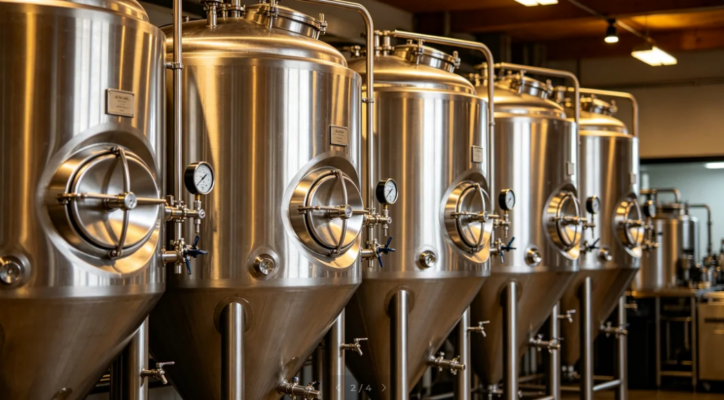
What Pressure Rating Should Beer Production Tanks Have?
Pressure rating must be specified according to the tank’s actual operating purpose, especially when the vessel will be used for carbonation or pressure transfer.
Fermentation, carbonation, and pressure transfer place different demands on the tank.
Brite Tanks normally require pressure-rated construction because finished beer is often carbonated under controlled pressure.
Unitanks also require suitable pressure specifications because they combine fermentation with carbonation and conditioning.
When purchasing a tank, buyers should request clear information about:
- Working pressure
- Design pressure
- Test pressure
- Vacuum rating
- Pressure relief valve
- Pressure gauge
- Safety configuration
- Applicable certification
Vacuum protection is particularly important during CIP and cooling operations. A tank can be designed for positive pressure but still be vulnerable to vacuum damage if the vessel is not properly protected.
What CIP Features Should Buyers Require?
A well-designed CIP system can significantly reduce cleaning labor and improve brewery hygiene.
CIP means Clean-in-Place, allowing the internal tank surfaces to be cleaned without completely dismantling the vessel.
A professional fermentation or Brite Tank should normally be equipped with a suitable spray device or spray ball.
Important CIP considerations include:
- Spray coverage
- Cleaning pressure
- Spray ball position
- Drainability
- Internal surface finish
- Tank geometry
- Sanitary valve design
- Dead-leg reduction
The tank should also be designed so that cleaning liquid can drain effectively.
Poorly designed pipe connections or dead zones can leave beer residue, yeast, or cleaning chemicals behind.
How Should Buyers Choose Tank Quantity?
The number of tanks should be calculated from production frequency and fermentation time rather than simply matching the brewhouse size.
For example, a brewery producing one batch per day with a seven-day fermentation period may require significantly more fermenters than a brewery producing only two batches per week.
A simple planning formula is:
Required fermenters ≈ batches produced during the average fermentation period + operational buffer
The actual calculation should also consider:
- Beer style
- Fermentation duration
- Lagering time
- CIP turnaround
- Packaging schedule
- Seasonal demand
- Planned expansion
Lager production generally requires more tank capacity because fermentation and conditioning periods can be longer than those of many ale styles.
Should Brite Tanks Be the Same Size as Fermenters?
Brite Tank capacity should be matched to packaging volume and production scheduling, not necessarily to the exact size of the fermenter.
A brewery may choose Brite Tanks that can receive one batch, multiple batches, or provide additional packaging buffer.
For example, a brewery with a 10 BBL brewhouse might use larger Brite Tanks when it intends to combine multiple batches before packaging.
This can improve packaging efficiency, but the decision must account for beer style, blending requirements, carbonation time, and tank turnover.
What Tank Configuration Is Best for a Growing Brewery?
A modular tank configuration is usually the safest investment because it allows production capacity to increase without replacing the entire cellar.
A brewery can start with several smaller fermentation tanks and add additional vessels as sales increase.
For example:
- Stage 1: 4–6 fermentation tanks + 1 Brite Tank
- Stage 2: Add 2–4 fermentation tanks
- Stage 3: Add additional Brite Tanks
- Stage 4: Upgrade packaging and glycol capacity
This approach helps prevent excessive initial investment while maintaining room for growth.
A supplier should ideally be able to provide tanks with compatible fittings, dimensions, valves, controls, and pipe connections so that future expansion does not create an incompatible system.
How Can Buyers Avoid Common Beer Production Tank Mistakes?
The biggest purchasing mistakes usually come from focusing on tank price while overlooking process compatibility.
Buying Only According to Nominal Volume
A “1000L tank” does not necessarily mean 1000L of usable beer volume. Buyers need to clarify total volume, working volume, and headspace.
Ignoring the Glycol System
A tank with excellent cooling jackets cannot perform properly if the glycol chiller lacks sufficient capacity.
Choosing the Wrong Tank Geometry
Fermenters and Brite Tanks perform different functions. A flat-bottom or inappropriate vessel may complicate yeast collection and fermentation management.
Underestimating Cleaning Requirements
CIP design should be specified before purchasing the tank rather than added later.
Ignoring Future Expansion
A brewery that expects rapid growth should consider whether the tank dimensions, utilities, fittings, and control system can support future equipment.
Selecting Equipment Without Pressure Documentation
Pressure-rated equipment requires appropriate engineering and safety specifications. Buyers should request documentation before placing the order.
What Should Buyers Include in a Beer Production Tank RFQ?
A detailed RFQ allows buyers to compare suppliers accurately and prevents hidden specification differences between quotations.
A professional Beer Production Tanks RFQ should include:
- Tank type
- Total volume
- Working volume
- Headspace requirement
- Stainless steel grade
- Internal surface finish
- External finish
- Cone angle
- Glycol jacket area
- Insulation thickness
- Working pressure
- Vacuum rating
- CIP system
- Manway configuration
- Sampling valve
- Racking arm
- Pressure relief valve
- Temperature sensor
- Carbonation stone
- Control system
- Electrical requirements
- Tank dimensions
- Shipping dimensions
- Applicable certification
This specification makes it much easier to compare quotations from different brewery equipment manufacturers.
How Can the Right Beer Production Tanks Improve Brewery Efficiency?
The right tank configuration can increase production capacity without requiring an immediate increase in brewhouse size.
For example, if fermentation tanks remain occupied for too long, the brewhouse may be forced to stop even though it has available brewing capacity.
Adding fermentation capacity can allow the brewhouse to operate more frequently.
Likewise, adding Brite Tanks can free fermentation tanks sooner and create a more predictable packaging schedule.
The result can include:
- Higher brewhouse utilization
- Faster tank turnover
- Better packaging scheduling
- Reduced transfer frequency
- More consistent temperature control
- Improved labor efficiency
- Easier production planning
Therefore, the right Beer Production Tanks should be viewed as production assets rather than simple stainless steel containers.
How Should Buyers Choose a Beer Production Tank Manufacturer?
The best supplier is one that can engineer the tank around the brewery’s process rather than simply selling a standard vessel.
Before purchasing, buyers should evaluate:
- Manufacturing experience
- Stainless steel quality
- Welding standards
- Pressure vessel capability
- Tank customization
- CIP design
- Glycol jacket design
- Electrical controls
- Certification
- Factory inspection
- Installation support
- Spare parts
- After-sales service
A manufacturer with turnkey brewery experience can also help coordinate the relationship between tanks, glycol systems, pumps, piping, brewhouse equipment, and packaging equipment.
This integrated approach can reduce compatibility problems during installation.
What Is the Best Beer Production Tank Configuration for Your Brewery?
The best configuration depends on production volume, beer styles, fermentation time, packaging frequency, available space, and future growth plans.
For a small brewpub, Unitanks can provide an efficient solution where space is limited and beer is served directly to customers.
For a growing craft brewery, separate conical fermenters and Brite Tanks often provide better production flexibility.
For a larger commercial brewery, multiple fermentation vessels, multiple Brite Tanks, centralized glycol cooling, automated CIP, and integrated controls may be more appropriate.
The most important principle is simple: buy the tank system around your production process, not around the tank price.
A properly engineered Beer Production Tanks system should provide the right capacity, temperature control, pressure management, sanitation, and flexibility for today’s production while leaving room for tomorrow’s growth.
Frequently Asked Questions About Beer Production Tanks
1. What type of Beer Production Tank is best for a small brewery?
A Unitank or a small conical fermenter combined with a Brite Tank is usually the best choice for a small brewery. Unitanks save floor space and can combine fermentation and carbonation, while separate tanks provide greater flexibility for breweries planning to increase production.
2. What stainless steel is best for Beer Production Tanks?
304 stainless steel is widely suitable for standard beer production, while 316/316L can be selected when greater corrosion resistance is required. Buyers should evaluate stainless steel grade together with internal surface finish, welding quality, passivation, and sanitary design.
3. How do I calculate the right Beer Production Tank size?
Start with batch volume and then calculate working volume, required headspace, fermentation time, and future production growth. The number of tanks should then be determined according to how many batches the brewery plans to brew during the fermentation and conditioning period.
4. Should I buy Beer Production Tanks from a manufacturer or a distributor?
For a complete brewery project, purchasing directly from an experienced manufacturer can provide better customization and system integration. A qualified manufacturer can coordinate tank dimensions, glycol jackets, CIP, pressure specifications, valves, controls, and other brewery equipment according to the brewery’s process.
Final Takeaway: How Should You Buy Beer Production Tanks?
The right Beer Production Tanks should be selected according to production capacity, tank function, working volume, pressure requirements, cooling performance, sanitary design, and future expansion.
Do not choose a tank simply because it has the lowest quotation or the largest volume.
Instead, define your production target first. Then calculate the required fermenter and Brite Tank capacity, determine the required number of vessels, select suitable stainless steel, specify cooling and CIP systems, and confirm pressure and safety requirements.
For breweries planning long-term growth, a modular tank system can provide a better balance between initial investment and future production capacity.
When requesting quotations, provide suppliers with your brewhouse size, target annual production, beer styles, fermentation time, packaging format, available space, and expansion plans. A professional brewery equipment manufacturer can then design a Beer Production Tanks configuration that matches your actual production requirements rather than offering a generic tank package.
