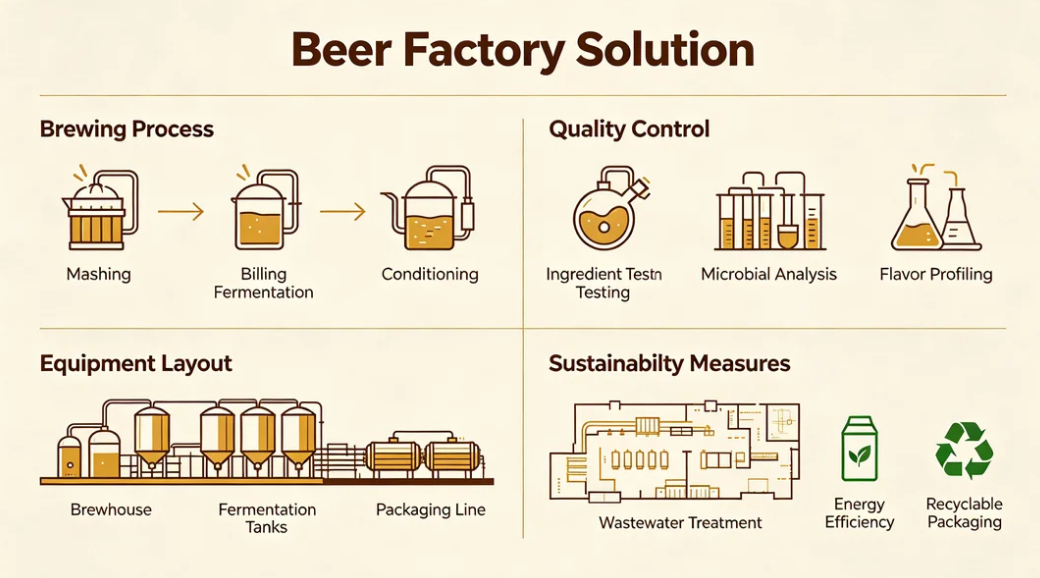
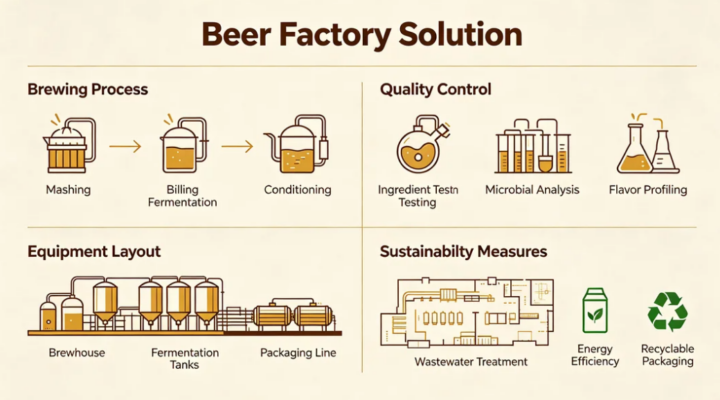
A customized beer factory solution helps breweries match equipment capacity, brewing processes, factory space, automation levels, and packaging requirements with actual production goals. Instead of purchasing individual machines separately, a complete solution connects the brewhouse, fermentation tanks, cooling system, CIP system, automation, and packaging equipment into one coordinated production line.
For brewery investors and purchasing managers, choosing the right beer factory solution can improve production efficiency, reduce equipment compatibility problems, and create a practical foundation for future expansion.
What Is a Complete Beer Factory Solution?
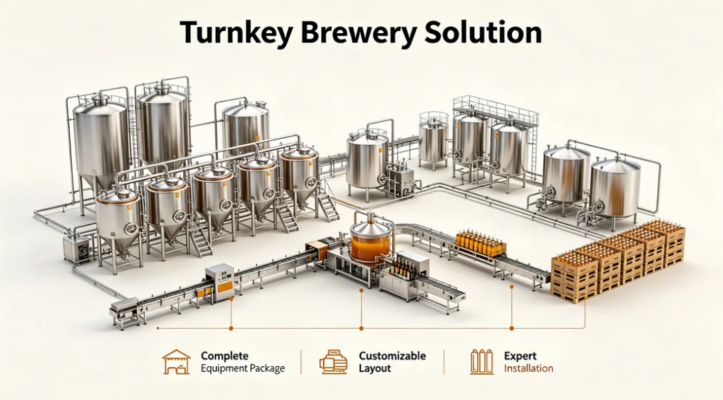
A complete beer factory solution is an integrated brewery production system designed around a specific output target and manufacturing process. It is more than a brewhouse or a collection of stainless steel tanks because every major production stage needs to work together.
A complete solution can include:
- Malt milling and grain handling equipment
- Mash, lauter, kettle, and whirlpool systems
- Hot liquor and cold liquor tanks
- Wort heat exchangers
- Fermentation tanks
- Bright beer tanks
- Glycol cooling systems
- CIP cleaning systems
- Pumps, valves, pipes, and sanitary fittings
- PLC or semi-automatic control systems
- Keg, bottle, or can filling equipment
- Packaging and conveying systems
- Utility and auxiliary equipment
The exact equipment configuration depends on the brewery’s planned capacity, beer styles, production schedule, available factory area, packaging requirements, and future expansion plans.
For example, a small craft brewery may need a compact 500L or 1000L brewhouse, while a larger beer factory may require several 2000L brewing systems, multiple fermentation tanks, automated cellar management, and a high-speed packaging line.
Why Should Buyers Choose a Customized Beer Factory Solution?
Customization allows brewery equipment to match actual production requirements instead of forcing every project into the same standard configuration. According to HGMC, production capacity, brewhouse configuration, factory space, automation, packaging, and future expansion can all influence the final brewery design.
A customized project can help buyers solve several common problems:
- Oversized equipment causing unnecessary capital investment
- Insufficient fermentation capacity
- Limited factory space
- Inadequate cooling capacity
- Packaging bottlenecks
- Excessive manual operation
- Difficult future expansion
- Poor equipment workflow
The objective is not simply to purchase larger equipment. The objective is to create a balanced production system where each process has sufficient capacity.
What Equipment Should Be Included in a Beer Factory Solution?
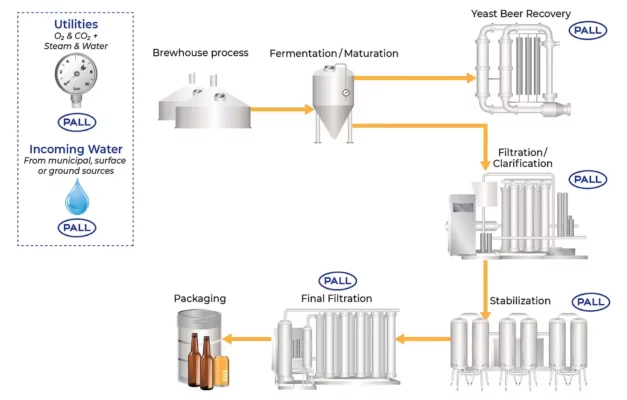
A professional beer factory solution should connect raw material handling, brewing, fermentation, cooling, cleaning, automation, and packaging into one complete production workflow.
How Does the Malt Milling System Support Beer Production?
The malt milling system prepares grain for efficient mashing and helps maintain consistent raw-material processing.
A typical system can include:
- Malt mill
- Grain hopper
- Grain conveyor
- Dust collection equipment
- Grain storage system
The milling capacity should match the brewhouse production schedule. If the mill cannot supply enough grist before brewing starts, it can become an unexpected production bottleneck.
For larger beer factories, automated grain handling can reduce manual labor and improve material transfer efficiency.
Why Is the Brewhouse the Core of a Beer Factory?
The brewhouse is the hot-side center of the brewery because it converts malt, water, and hops into wort ready for fermentation.
Depending on the production process, breweries can choose 2-vessel, 3-vessel, or 4-vessel brewhouse configurations. HGMC provides these different configurations so that buyers can select a layout according to production requirements rather than simply choosing the system with the greatest number of vessels.
A commercial brewhouse may include:
Mash Tun
The mash tun provides controlled mixing and temperature management during mashing, allowing enzymes to convert starch into fermentable sugars.
Lauter Tun
The lauter tun separates wort from spent grain and plays an important role in extraction efficiency.
Brew Kettle
The kettle is used for wort boiling, hop addition, sterilization, and wort concentration.
Whirlpool
The whirlpool separates trub and hop particles from hot wort before cooling.
A well-designed brewhouse should also include sanitary pumps, valves, piping, heat exchangers, temperature sensors, and control systems.

Which Brewhouse Capacity Is Suitable for Different Beer Factories?
Brewhouse size should be selected according to target production rather than equipment volume alone. Buyers should consider batch size, number of brews per day, annual production, fermentation time, packaging demand, and future expansion.
| Beer Factory Type | Typical Brewhouse Range | Configuration | Main Application |
|---|---|---|---|
| Small Craft Brewery | 500–1000L | 2 or 3 Vessel | Taproom and local sales |
| Growing Commercial Brewery | 1000–2000L | 3 or 4 Vessel | Regional distribution |
| Medium Beer Factory | 2000–5000L | 3 or 4 Vessel | Commercial beer production |
| Large Beer Factory | 5000L+ | 4 Vessel / Automated | High-volume production |
These ranges are planning examples rather than fixed industry standards. The final equipment size should be calculated according to the brewery’s expected annual output and production schedule.
How Does Fermentation Capacity Affect a Beer Factory Solution?
Fermentation capacity must be matched with brewhouse output because fermentation can become a major production bottleneck.
Brewhouse capacity determines how much wort can be produced per batch, but fermentation tanks determine how much wort can remain in production at the same time.
A brewery should calculate:
- Brewhouse batch size
- Brews per day
- Fermentation time
- Maturation time
- Number of beer styles
- Packaging frequency
- Seasonal production requirements
For example, if a brewery increases brewhouse capacity without increasing fermentation capacity, the hot-side system may produce wort faster than the cellar can process it.
What Types of Fermentation Tanks Should a Beer Factory Use?
Stainless steel conical fermentation tanks are widely used because they provide controlled fermentation, temperature management, pressure control, and convenient yeast removal.
Key features may include:
- Stainless steel construction
- Cooling jackets
- Temperature sensors
- Pressure gauges
- Safety valves
- CIP spray devices
- Yeast collection ports
- Sanitary fittings
Bright beer tanks can also be integrated into the beer factory solution for clarification, carbonation, maturation, finished beer storage, and packaging preparation.
What Cooling Equipment Is Required for a Complete Beer Factory?
A properly sized cooling system is essential because fermentation temperature directly influences yeast activity and beer quality.
A commercial cooling system commonly includes:
- Glycol chiller
- Glycol storage tank
- Cooling pumps
- Insulated pipelines
- Tank cooling jackets
- Wort cooling heat exchanger
Cooling capacity should be calculated based on:
- Brewhouse output
- Fermentation tank volume
- Number of tanks
- Fermentation temperature
- Local ambient temperature
- Simultaneous cooling requirements
- Future production expansion
A brewery that underestimates cooling capacity may experience slow fermentation, longer production cycles, or difficulty maintaining stable temperatures.
Why Should CIP Be Included in the Beer Factory Solution?
A CIP system improves brewery sanitation while reducing manual cleaning work and helping standardize cleaning procedures.
A commercial CIP system can include:
- Caustic cleaning tank
- Acid cleaning tank
- Hot water tank
- CIP pump
- Spray balls
- Return pipelines
- Temperature controls
CIP can be used for:
- Brewhouse vessels
- Fermentation tanks
- Bright beer tanks
- Wort pipelines
- Beer transfer lines
- Packaging equipment
For a growing beer factory, CIP should be planned at the beginning rather than added after production starts.
How Can Automation Improve a Beer Factory Solution?
Automation improves process consistency by controlling repetitive operations such as temperature adjustment, pump operation, valve sequencing, and cleaning cycles.
HGMC states that brewery control systems can be configured around temperature control, pumps, valves, sensors, and PLC-based controls. Both semi-automatic and fully automatic solutions can be selected according to production requirements.
Semi-Automatic Brewery System
Semi-automatic systems provide a balance between operator control and process automation.
They can be suitable for breweries that want to maintain direct brewer involvement while automating important functions such as:
- Temperature control
- Pump operation
- Heating
- Fermentation cooling
- Basic CIP procedures
Fully Automatic Brewery System
Fully automatic systems are more suitable when production volume, labor efficiency, and process repeatability become major priorities.
A PLC-based system can coordinate:
- Recipe execution
- Temperature management
- Pump and valve operation
- Wort transfer
- Fermentation monitoring
- CIP sequences
- Production alarms
- Process data
The appropriate automation level should be determined by production volume and operational requirements rather than simply selecting the most advanced system available.
How Should Factory Space Influence Beer Factory Equipment Design?
Factory dimensions should be considered before equipment is manufactured because vessel height, floor area, operator access, piping, and material flow directly affect installation and operation.
For example, HGMC lists a 500L 3-vessel brewhouse configuration with a floor area of approximately 5 m², a diameter of 1160 mm, and a height of 2500 mm for the specified configuration.
However, equipment footprint is only one part of factory planning.
Buyers should also consider:
- Ceiling height
- Door dimensions
- Equipment transportation route
- Drainage
- Electrical connections
- Water supply
- Steam or heating requirements
- Glycol pipelines
- Operator working space
- Maintenance access
- Packaging flow
- Future equipment space
A good beer factory layout should create a logical flow from raw materials to finished products.
How Should Buyers Plan Future Expansion?
Future expansion should be considered before the initial equipment layout is finalized because adding capacity later can be more difficult if the original factory design leaves no room for growth.
Expansion planning may involve:
- Reserving space for additional fermenters
- Selecting expandable control systems
- Installing sufficient utility capacity
- Planning larger glycol systems
- Leaving room for additional packaging equipment
- Designing flexible process pipelines
HGMC’s brewery solutions include different capacities such as 1000L and 2000L systems as well as larger configurations for higher production requirements.
For investors who expect production to grow, a modular equipment strategy can make future expansion easier.
What Packaging Equipment Should Be Included in a Beer Factory Solution?
Packaging equipment should be selected according to the brewery’s sales channels because keg, bottle, and can packaging require different equipment configurations.
Keg Filling
Keg systems are suitable for:
- Taprooms
- Restaurants
- Bars
- Draft beer distribution
Can Filling
Canning systems are useful for:
- Retail distribution
- Supermarkets
- Online beer sales
- Export markets
Bottle Filling
Bottle filling systems may be appropriate for breweries targeting traditional retail packaging or specific market requirements.
A complete beer factory solution can integrate filling, sealing, labeling, coding, conveying, and case packing equipment according to production requirements.
What Parameters Should Buyers Compare Before Purchasing?
Buyers should compare equipment capacity, material, automation, dimensions, cooling requirements, and expansion capability rather than comparing purchase price alone.
| Equipment | Key Parameter | Small Commercial Project | Medium Project | Large Project |
|---|---|---|---|---|
| Brewhouse | Batch Capacity | 500–1000L | 1000–3000L | 3000–5000L+ |
| Fermenter | Tank Capacity | 500–2000L | 2000–5000L | 5000L+ |
| Bright Beer Tank | Capacity | 500–1000L | 1000–3000L | 3000L+ |
| CIP System | Configuration | Manual/Semi-Auto | Semi-Auto | Automatic |
| Control System | Automation | Basic | PLC | Advanced PLC |
| Cooling System | Configuration | Compact Glycol | Central Glycol | Industrial Cooling |
| Packaging | Format | Keg/Small Can | Can/Bottle/Keg | High-Speed Packaging |
| Expansion | Design | Limited | Modular | Highly Scalable |
The actual configuration should be calculated according to the production process, beer styles, fermentation cycle, factory conditions, and annual production target.
How Can a Beer Factory Solution Reduce Total Project Risk?
An integrated solution reduces the risk of capacity mismatches because equipment is planned as one production system rather than purchased independently.
For example, a brewery may purchase a large brewhouse but later discover that:
- Fermentation capacity is insufficient
- The glycol chiller is undersized
- The CIP system cannot clean all tanks
- Packaging speed is too low
- Factory doors cannot accommodate the equipment
- Utility capacity is insufficient
These problems can increase project costs and delay production.
A complete engineering approach considers these requirements before equipment manufacturing begins.
What Should Buyers Provide to a Brewery Equipment Manufacturer?
The more detailed the project information, the more accurately a manufacturer can design the beer factory solution.
Buyers should provide:
Production Target
State expected daily, monthly, and annual production.
Beer Styles
Identify whether the factory will produce lager, IPA, stout, wheat beer, sour beer, or multiple styles.
Factory Information
Provide available floor area, building height, drainage, power supply, water supply, and equipment access.
Packaging Requirements
Specify whether finished beer will be sold in kegs, cans, bottles, or multiple formats.
Automation Requirements
Explain whether the brewery prefers manual, semi-automatic, or fully automatic operation.
Expansion Plans
If production is expected to increase, inform the equipment manufacturer before the initial layout is finalized.
According to HGMC, these factors are used to configure brewery equipment around the customer’s actual production requirements.
Why Should Buyers Work With an Experienced Beer Factory Solution Provider?
An experienced brewery equipment manufacturer can coordinate equipment selection, engineering, manufacturing, installation, commissioning, and after-sales support as one project.
HGMC states that it has more than 23 years of experience in the beer brewing equipment industry, a manufacturing facility covering more than 30,000 square meters, and customers in more than 120 countries. The company also describes turnkey brewing, filling, and packaging solutions together with installation and after-sales support.
For buyers, the important consideration is not simply how long a supplier has been operating. It is whether the supplier can provide the engineering capability needed to connect the entire production process.
Before signing a purchase contract, buyers should confirm:
- Equipment specifications
- Material standards
- Production capacity
- Factory layout
- Utility requirements
- Automation scope
- Installation scope
- Commissioning service
- Training
- Warranty
- Spare parts
- After-sales technical support
How Can a Customized Beer Factory Solution Support Long-Term Brewery Growth?
A scalable beer factory solution gives breweries the flexibility to increase production without completely redesigning the original facility.
The initial project should therefore balance current investment with future requirements.
A scalable design may reserve:
- Floor space for additional fermentation tanks
- Utility capacity for future equipment
- Control-system expansion capability
- Packaging-line upgrade space
- Additional cooling capacity
- Flexible process pipelines
This approach allows a brewery to start with a practical production capacity while keeping a clear path for future expansion.
Conclusion: How Should Buyers Choose a Beer Factory Solution?
The right beer factory solution should be designed around production capacity, brewing process, factory space, automation requirements, packaging methods, and future expansion plans. A complete solution connects the brewhouse, fermentation tanks, cooling system, CIP, controls, utilities, and packaging equipment into one coordinated production process.
For brewery investors and purchasing managers, the key is to avoid selecting equipment based only on individual tank prices or nominal capacity. The complete production workflow should be evaluated first, followed by equipment sizing, factory layout, utility planning, automation, and expansion requirements.
A customized solution can help create a more balanced brewery where brewing capacity, fermentation capacity, cooling capacity, cleaning capability, and packaging speed work together. This approach can provide a stronger foundation for consistent beer production and long-term brewery development.
Frequently Asked Questions About Beer Factory Solutions
1. What is a beer factory solution?
A beer factory solution is a complete brewery production system designed around a specific beer production target. It can include malt handling, brewhouse equipment, fermentation tanks, bright beer tanks, cooling, CIP, automation, utilities, and packaging equipment.
2. Can a beer factory solution be customized for different production capacities?
Yes, brewery equipment can be customized according to production volume, beer styles, factory space, automation requirements, and expansion plans. Different brewhouse configurations and fermentation capacities can be combined to meet specific production requirements.
3. What information should I provide before requesting a beer factory quotation?
Buyers should provide their target production volume, beer styles, factory dimensions, packaging requirements, desired automation level, and future expansion plans. This information allows the manufacturer to calculate suitable brewhouse, fermentation, cooling, CIP, and packaging capacity.
4. Is a fully automated beer factory solution necessary?
Not every brewery requires full automation because the appropriate automation level depends on production volume, labor arrangements, budget, and process requirements. Small and growing breweries may choose semi-automatic systems, while larger production facilities may benefit from PLC-based automation and integrated process control.
