

When a brewery plans a new plant or scales up production, the decision of which manufacturer to partner with is rarely about comparing tank prices. The equipment must perform reliably for 15–20 years, and a mismatch in capacity, automation, or material quality can quietly cripple production years later. A professional manufacturer coordinates design, fabrication, and long-term support across the entire brewing system — brewhouse, fermentation, cellar, and utility systems. This integrated approach reduces project risk and ensures the equipment will function as intended from day one, not just after months of rework.
Choosing a manufacturer solely on lower upfront cost often results in integration delays, inconsistent weld quality, and poor after-sales support. In one case, a medium-sized brewery in Southeast Asia selected a low-bid supplier for a 2000L brewhouse expansion. Within 18 months, three fermentation tanks developed hairline cracks at weld seams, glycol piping leaked at joints, and the CIP system could not clean the larger vessels properly. The brewery lost nearly four months of production across two years while chasing repairs. The project saved roughly 15% on initial capital but paid multiples of that in downtime.
Why the Manufacturer Choice Matters for Industrial Breweries
Industrial breweries operate at a fundamentally different scale than microbreweries. A microbrewery might run 500L batches with a single fermentation tank, while an industrial plant can push 2000L batches through a multi-vessel brewhouse network with thirty or more fermentation tanks, bright beer tanks, and CIP stations. The stakes are higher because the entire production line depends on each component working in sync.
A poorly selected brewhouse configuration can cause bottlenecks in wort production. Fermentation tanks that are slightly undersized relative to the brewhouse output force the brewery to run partial batches or delay transfers. Glycol cooling systems that are under-specified for the tank farm cause temperature swings during fermentation, leading to inconsistent beer quality. Utility piping that does not match the CIP routing creates dead legs that are difficult to clean, increasing contamination risk.
The downstream consequences are rarely visible during the purchasing phase. Engineers and brewmasters sign off on equipment lists that look adequate on paper, only to discover during commissioning that a control panel lacks the I/O capacity for future automation upgrades, or that bright beer tank outlet ports do not align with the existing bottling line conveyor height. These mismatches are not hypothetical — they appear in nearly every project that skips a thorough integration review.
Industrial breweries aim for production cycles of 15–20 years, meaning the equipment must tolerate continuous thermal cycling, chemical cleaning, and mechanical stress without degrading. An integrated manufacturer that designs and fabricates the brewhouse, fermentation tanks, CIP station, and glycol system as a coordinated set reduces the probability of these mismatches. They understand how the tank farm layout affects CIP routing, how the glycol chiller capacity relates to fermentation heat load, and how the bright beer tank geometry interacts with carbonation stone placement.

Core Capabilities to Look for in an Industrial Manufacturer
Evaluating a manufacturer requires looking beyond the brochure. The key capability is experience with projects of similar scale. A manufacturer that has completed at least three industrial brewery projects — each with a brewhouse of 1500L or larger and a tank farm of over 20000L — can demonstrate that they have navigated the engineering and coordination challenges that appear only at scale.
In-house engineering depth is more important than manufacturing speed. Manufacturers that outsource process design or structural calculations create a gap between the design intent and the fabricated equipment. This gap shows up during installation when piping does not fit the tank ports, or when the platform structure interferes with valve access. Check that the manufacturer can produce detailed P&IDs and structural calculations internally. Ask who will review the drawings and whether the same engineering team stays with the project from concept through commissioning.
Manufacturing quality comes down to weld standards, surface finish, and material selection. Industrial brewing vessels should use 304 or 316L stainless steel with a surface finish of 0.5µm Ra or better on product contact surfaces. Welds should be full penetration, autogenous or with matching filler, and passivated after fabrication. A manufacturer that cannot provide weld test certificates or pressure test records for each vessel should raise a red flag.
Project management ability is often underestimated. An industrial brewery project involves civil contractors for foundations, utility contractors for power and water, and installation teams for equipment. The manufacturer needs to coordinate delivery timing, provide installation guidance remotely or on-site, and resolve discrepancies between the building layout and the tank farm arrangement. A manufacturer that lacks project management experience leaves the client to resolve these conflicts, which can delay commissioning by weeks.
Flexibility to customise layouts and automation levels is another critical factor. No two brewery buildings have the same column spacing, ceiling height, or floor drain placement. A manufacturer that only offers standard tank diameters and brewhouse footprints forces the client to adapt the building to the equipment, which adds civil engineering cost. Look for a manufacturer that asks about building constraints early and proposes layouts that fit within them.
Automation is a separate tradeoff. Full automation with recipe control, CIP sequencing, and data logging adds capital cost but reduces labour and minimises human error. Manual operation is cheaper upfront but requires more skilled operators. A manufacturer should offer several automation tiers and explain the operational implications of each rather than pushing the most expensive package.
The Equipment Portfolio in a Full-Line Industrial Solution
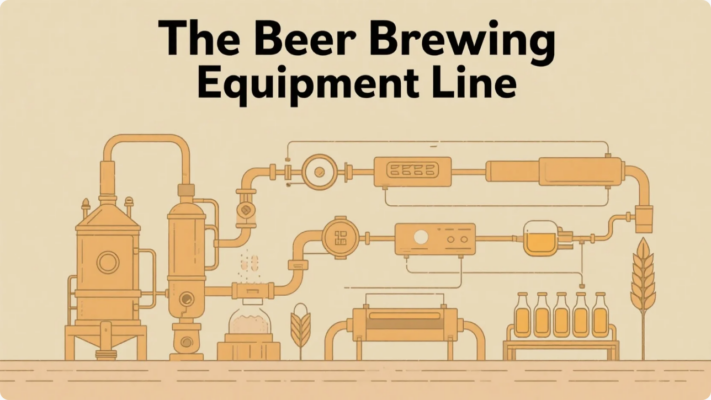
A full-line industrial brewery solution typically includes a multi-vessel brewhouse, fermentation tanks, bright beer tanks, a CIP system, glycol cooling, utility piping, platforms, safety components, and optional items like hop dosing tools and yeast handling equipment. Sourcing everything from one manufacturer simplifies fit and performance because each component is designed with knowledge of the others.
A multi-vessel brewhouse at industrial scale usually consists of a mash tun, lauter tun, wort kettle, and whirlpool. Some configurations combine the mash and lauter functions into a mash-filter, which reduces vessel count but adds complexity in grain handling. The brewhouse capacity sets the production rhythm. A common industrial size is 2000L per batch, which pairs with 30000L fermentation tanks. This ratio allows the brewhouse to fill a fermentation tank in roughly 15 batches, keeping the fermentation schedule predictable.
Fermentation tanks for industrial use range from 10000L to 50000L, with cone angles of 60 to 90 degrees for yeast collection. The tank farm layout must allow access for cleaning, yeast pitching, and sampling without moving other tanks. Bright beer tanks are typically smaller — 5000L to 20000L — and require pressure ratings of 1.5 to 3 bar for carbonation. Glycol cooling must be sized to handle the peak heat load during fermentation, which occurs in the first 48 hours after pitching. An undersized glycol chiller causes slow temperature ramp-down and inconsistent diacetyl rest timing.
CIP systems for industrial breweries need to clean multiple vessels in sequence without cross-contamination. A typical CIP station has hot water, caustic, acid, and sanitizer tanks, with programmable logic control for cycle timing. The piping layout must include return lines with flow meters to verify cleaning effectiveness. Platforms around the tanks need to meet local safety standards for guardrails, stairways, and emergency egress.
Optional equipment like hop dosing tools and inline mixers add functionality but also increase complexity. Hop dosing tools allow dry hopping in fermentation tanks, but the dosing port must be designed to prevent oxygen ingress. Yeast handling equipment — propagation tanks, yeast brink, and pitching pumps — should be sized to match the fermentation schedule. These add-ons are easier to integrate when specified as part of the original order rather than retrofitted later.
The End-to-End Project Process — From Consultation to Commissioning
A structured project process reduces risk more than any single equipment specification. The typical timeline for a mid-size industrial brewery plant — from design to delivery — is 6 to 12 months. Each phase serves a specific purpose in aligning the equipment with the client’s production goals.
The consultation phase begins with capacity targets, beer range, automation level, and building constraints. The manufacturer asks about the number of fermentation tanks needed to support the sales forecast, the types of beer styles planned, and the degree of recipe control desired. This phase should produce a written project brief that both parties agree on before moving to concept design.
Concept design translates the brief into a brewhouse configuration, tank farm arrangement, CIP routing, and utility requirements. The manufacturer produces a conceptual layout drawing and an initial equipment list. This is the right time to request changes — after this phase, modifications become more expensive because they cascade through engineering and fabrication.
Detailed engineering takes the concept and produces P&IDs, structural calculations, electrical schematics, and specification sheets for every component. The manufacturer should submit these for client review before fabrication begins. Local standards — pressure vessel codes, electrical safety regulations, and building codes — must be incorporated at this stage. A manufacturer that claims to handle compliance but does not produce locally certified drawings is a risk.
Fabrication and testing happen at the manufacturer’s facility. Each vessel should undergo pressure tests, weld inspections, and surface finish checks. The client or a third-party inspector should have the right to visit the factory during fabrication to witness key tests. Documentation — material certificates, weld maps, pressure test records — must be prepared for each vessel.
Delivery and installation guidance involve coordinating logistics and providing technical support to local installation teams. The manufacturer should supply a detailed installation manual with lifting points, foundation requirements, and piping connection specifications. Some manufacturers offer on-site supervision for a fee, which can prevent installation errors that damage equipment or delay commissioning.
Commissioning support and aftersales service are the final phase. The manufacturer assists with initial startup, verifies that the brewhouse, fermentation, and CIP systems operate correctly, and trains the brewery’s operators. Aftersales service includes spare parts availability and technical support for the lifetime of the equipment. The quality of commissioning support often determines how quickly the brewery reaches target output. A weak handover can waste months of production.

Practical Steps for Shortlisting and Evaluating Manufacturers
Start by preparing a project brief that defines production goals, layout constraints, and technical requirements. The brief should specify the annual production volume in hectoliters, the number of beer styles, the fermentation schedule, the desired automation level, and the building dimensions including floor drains, column spacing, ceiling height, and doorways.
Shortlist manufacturers that have completed industrial projects of similar scale. Ask for references from clients who built breweries in the last five years. Contact those references and ask about the manufacturer’s responsiveness during design, on-time delivery, installation support, and performance after commissioning.
Request conceptual layouts and equipment lists from each shortlisted manufacturer. Compare the proposed tank sizes, brewhouse configurations, and automation packages. Look for differences in how each manufacturer addresses your specific building constraints. A manufacturer that asks about building dimensions early and proposes a layout that fits them is more likely to deliver a smooth installation.
Conduct site visits or virtual audits of the manufacturer’s fabrication facility. Look at the cleanliness of the workshop, the condition of welding equipment, and the quality of workmanship on vessels in progress. Ask to see weld test certificates and discuss how they handle material traceability.
Check references carefully. A survey of breweries found that 65% regret not vetting the manufacturer’s after-sales support more thoroughly. Ask reference clients how quickly the manufacturer responds to spare parts requests and whether they provide technical support by phone or video within 24 hours. Find out if the manufacturer stocks common spare parts like gaskets, valves, and sensors, or whether each order must be fabricated on demand.
Compare proposals on more than price. Consider the manufacturer’s responsiveness during the proposal phase, their willingness to explain technical tradeoffs, and their track record of finishing projects on schedule. A proposal that is 10% cheaper often compensates by reducing engineering depth, using thinner material, or cutting commissioning support. The cheapest proposal is rarely the cheapest when measured over 15 years of operation.
FAQ
What is the difference between an industrial brewing equipment manufacturer and a microbrewery equipment supplier?
The main difference is scale and integration. Industrial manufacturers design and fabricate multi-vessel brewhouses with capacities of 1000L per batch or higher, large fermentation tanks over 20000L, and fully integrated utility systems like CIP and glycol cooling. Microbrewery suppliers typically focus on 500L or smaller systems with simpler automation. Industrial projects also require engineering depth for structural calculations, piping layouts, and compliance with pressure vessel codes that microbrewery suppliers may not handle in-house.
How long does it usually take from order to installation for a full industrial brewery setup?
For a mid-size plant with a 2000L brewhouse and 30000L fermentation tanks, the typical timeline is 6 to 12 months. Concept design takes 4 to 6 weeks, detailed engineering 4 to 8 weeks, fabrication 12 to 16 weeks, and installation and commissioning another 4 to 8 weeks. Manufacturers that have existing designs for similar configurations may shorten fabrication time, while custom layouts or complex automation add time.
Can a manufacturer customise equipment for a specific building layout or beer style?
Yes, most experienced manufacturers offer customization for building constraints and beer styles. Common customisations include adjusting tank diameter to fit between columns, modifying cone angles for yeast collection, adding hop dosing ports for dry hopping, and integrating manual or automated processes for different beer styles. The key is to discuss these requirements during the consultation phase so they are incorporated into the concept design rather than added as retrofits.
What certifications or quality standards should an industrial manufacturer hold?
At minimum, the manufacturer should comply with international pressure vessel standards such as PED (Pressure Equipment Directive), ASME (American Society of Mechanical Engineers), or local equivalents. Welders should be certified to standards like ISO 9606 or AWS. Material certificates for 304 or 316L stainless steel should be traceable. Surface finish should meet 0.5µm Ra for product contact surfaces. The manufacturer should also have ISO 9001 certification for quality management.
Is it better to buy equipment as a full package or piecemeal from different suppliers?
A full package from one manufacturer is generally better for large industrial projects because it ensures integration across the brewhouse, fermentation, CIP, and utility systems. Piecemeal sourcing can work for small expansions or specific upgrades, but it increases the risk of mismatches in piping connections, automation compatibility, and capacity alignment. Commissioning is also simpler with one responsible party rather than coordinating multiple suppliers.
